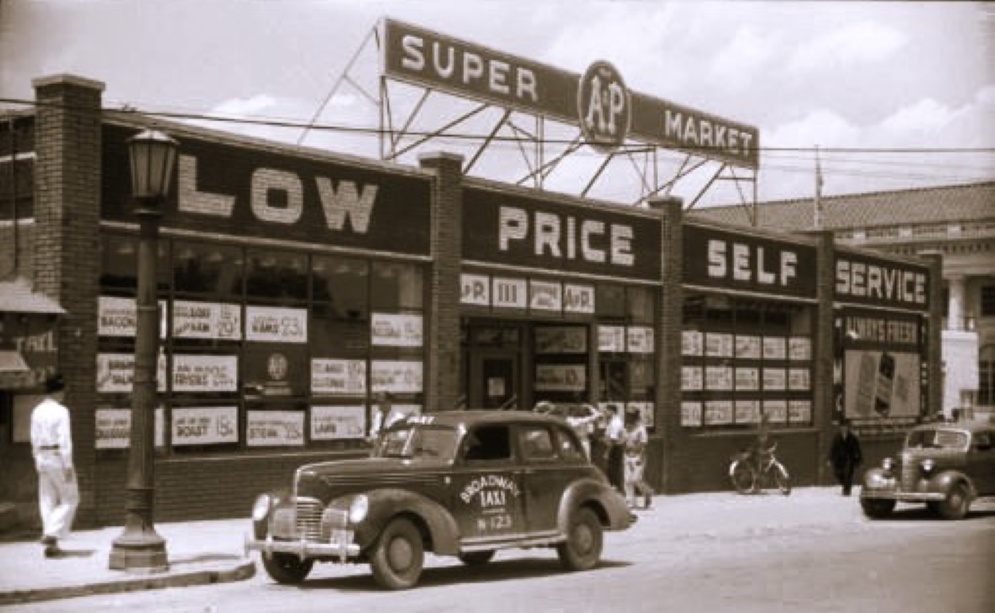
The supplanting of industrial jobs with low-paying service ones is duly noted in this century-old article. The transformation of everyday shops, consumer retail where most household goods were distributed, into monopolized, branded trusts was among the most noticed and remarked upon arrivals of modern capitalism.
‘Chain Stores Arouse Economic Interest’ by Tom Duncan from Industrial Pioneer. Vol. 1 No. 7. November, 1923.
FOR some time distribution, or that branch of it, known as retailing, has been receiving the attention of economists. It is claimed that distribution is developing abnormally. This is quite likely true. The men and women who are no longer able to secure a livelihood in production, or manufacture, must turn to distribution, namely, retailing. (The wholesale phase is covered by immense “jobbing houses,” like Marshall Field & Co., Butler Bros., etc.) Their “upkeep” must, accordingly, be added to capitalist overhead and, consequently, cuts into profits.
Some idea of the size of retailing may be judged by the estimates of A.T. Fisher, an authority on advertising. He declares there are 800,000 store windows in this country. This would indicate that there are almost that number of retailers. This makes allowance for stores owned by chain companies. In his estimates Fisher divides U.S. store windows this way:
172,842 in groceries; 147,980 in general stores; 46,398 in drug stores; 42,217 in candy stores; 37,116 in cigar stores; 29,445 in shoe stores; 28,009 in jewelry stores; 37,563 in furniture stores; 32,472 in department stores; 29,080 in hardware stores; 18,700 in haberdasheries; 40,531 in auto supply stores and garages.
From this we get an idea of the extent of retailing in this country. These 12 classifications cover pretty nearly all its specialties.
Abnormal Growth
Another view of the abnormal growth of distribution is afforded by Sydney Reeves, who is an authority on the subject, and who regards the abnormalities of distribution as a menace to the stability of the present capitalist system. He shows that, in 1850, distribution absorbed 17.3 cents of the consumer’s dollar; in 1860, 22 cents; 1870, 24.9 cents; 1880, 29.6 cents; 1890, 34.7 cents; 1900, 36.6 cents; 1910, 44.2 cents and in 1920, 52.5 cents. This will account, in a measure, for the great attention given to retail prices in the modern discussion of the cost of living. They are a growing factor and a correspondingly great factor in present-day life.
Now enter the chain stores. The growth of the chain store system has recently been called “the greatest romance in American business.” There’s nothing romantic about it. It’s a steady development, superinduced by the immense profits already indicated in Sydney Reeve’s figures.
Leading Chain Stores
The leading chain store system of this country, on the basis of the total sales volume, is given by the Babson statistical service as follows:
Groceries Atlantic and Pacific, $202,000,000; American Stores, $86,000,000; Kroger, $45,000,000.
Drugs–Liggett, $32,000,000; Owl, $11,000000. Tobacco–United Cigar Stores, estimated at $80,000,000. Department stores–May stores, $62,000,000; J.C. Penney, $49,000,000; Associated Dry Goods, estimated at $35,000,000. Shoes–Douglas, $24,000,000; Kinney, $21,000,000. Five and Tens–Woolworth, $167,000,000; Kresge, $65,000,000; Kress, $31,000,000.
The Atlantic and Pacific Tea Co. was established in 1858 and has been growing ever since. It is now reported to have 8,000 stores. The ownership and control of this corporation is said to remain in the hands of one family. Another big firm of the same kind is the Jones Bros. Tea company. It started with one store in Scranton, Pa., in 1872. Through 620 stores in 200 cities, it does an annual business of approximately $40,000,000. The Jewel Tea Company, another member of this group, has 527 branches from which 21,864 wagon and motor trucks operate in 43 states. Scattered throughout the country also are more than 300 Piggly Wiggly stores, with their trade-mark, “all over the world.”
International Chain Stores
Liggett, or The United Drug, operates 250 stores in this country; also factories and laboratories. It started in 1902 with 40 stores, and now also has big interests in British and Canadian chain systems. The United Cigar Stores have approximately 2,450 stores; also foreign ramifications. The Shulte Retail Stores, also tobacconists, had 239 stores in 1922, doing an annual business of $25,000,000. It recently bought out the tobacco department of a big Chicago department store, doing a business of a half-million dollars annually.
The J.C. Penney Co. operates 382 department stores; S.S. Kresge Co., 212; F.W. Woolworth, 1,200. The latter started with one store in Lancaster, Pa., in 1879. It is perhaps the greatest chain store corporation outside the grocery field.
In shoes, the Kinney Co. operates 131 stores; the McCrory Stores, 165; the S.H. Kress Co., 150; the Melville Shoe Corporation, 62.
There are chain stores in other branches of retailing, like candies. But these will suffice to demonstrate the growth of the chain store system.
Large Employers
It stands to reason that these systems are large employers of labor. In fact, in them are concentrated most of the labor forces employed in retailing. These forces are largely unorganized; that is, have no labor unions. It is true, that there are Retail Clerk Unions in existence; but these have to do mainly with employers in small stores. The big stores and chain store systems are not organized; though there are abundant reasons for unionism in them; the principal reason being the low pay.
This lack of organization is due to many causes. Foremost among them is the mental attitude of the workers. They believe themselves superior to factory workers and therefore inclined to frown on labor unions. They are also lacking in self-reliance and assertion. The average store employe, especially among the women, likes to depend upon consumers’ leagues, woman’s clubs and woman’s trade union leagues to improve their pay and conditions by means of white lists (or boycotts) and legislative enactment; that is, when they think at all.
Big Labor Turn-Over
Store employes rarely assert themselves collectively. Strikes among them are of very rare occurrence. Spontaneous revolts, so frequent in other unorganized lines, know them not. Nor do mass movements of any kind. The store employes believe in the individual protest, or strike. That is, they leave their jobs individually rather than submit to unbearable conditions. This leads to a large turn-over, which causes employers much concern and conduces to a slight degree of amelioration. It is not altogether a useless method and should be encouraged until it assumes the proportions of a large walk-out.
In the cigar, shoe, drug and grocery chain stores men clerk predominate; in the Five and Tens women clerks do. But the women are forging into the other lines, especially drugs and groceries. In fact, they contribute largely to the over-supply of labor and consequent conservatism among retail store employes.
Average Wages
The average clerk is said to receive $25 a week. Many get much less than this. Women get $17 and $18. There are five methods in vogue regulating the pay of clerks. There is the straight salary; this is most popular. Then comes the salary plus commission basis. In Chicago, the big stores guarantee their women clerks $15 a week on this basis. About 19 per cent of stores use this method. Then follows the salary plus bonus, in about 14 per cent of stores; salary plus commission for sales above quota, in about 10 per cent of stores; and flat commission in about 2 per cent of stores.
All these systems involve continuous hustling and intensified labor. A retail clerk is more than entitled to all he’s paid; and then some.
The Industrial Pioneer was published monthly in Chicago by the Industrial Workers of the World from 1921 to 1926. The precursor of the Industrial Pioneer was the One Big Union Monthly. Heavily illustrated, the journal included arts, prose, and poetry along with historical articles and analysis. Editors included John A. Gahan, Vern Smith, H. Van Dorn, and Justus Ebert.
PDF of full issue: https://www.marxists.org/history/usa/pubs/industrial-pioneer/Industrial%20Pioneer%20(November%201923).pdf
 Revolution's Newsstand