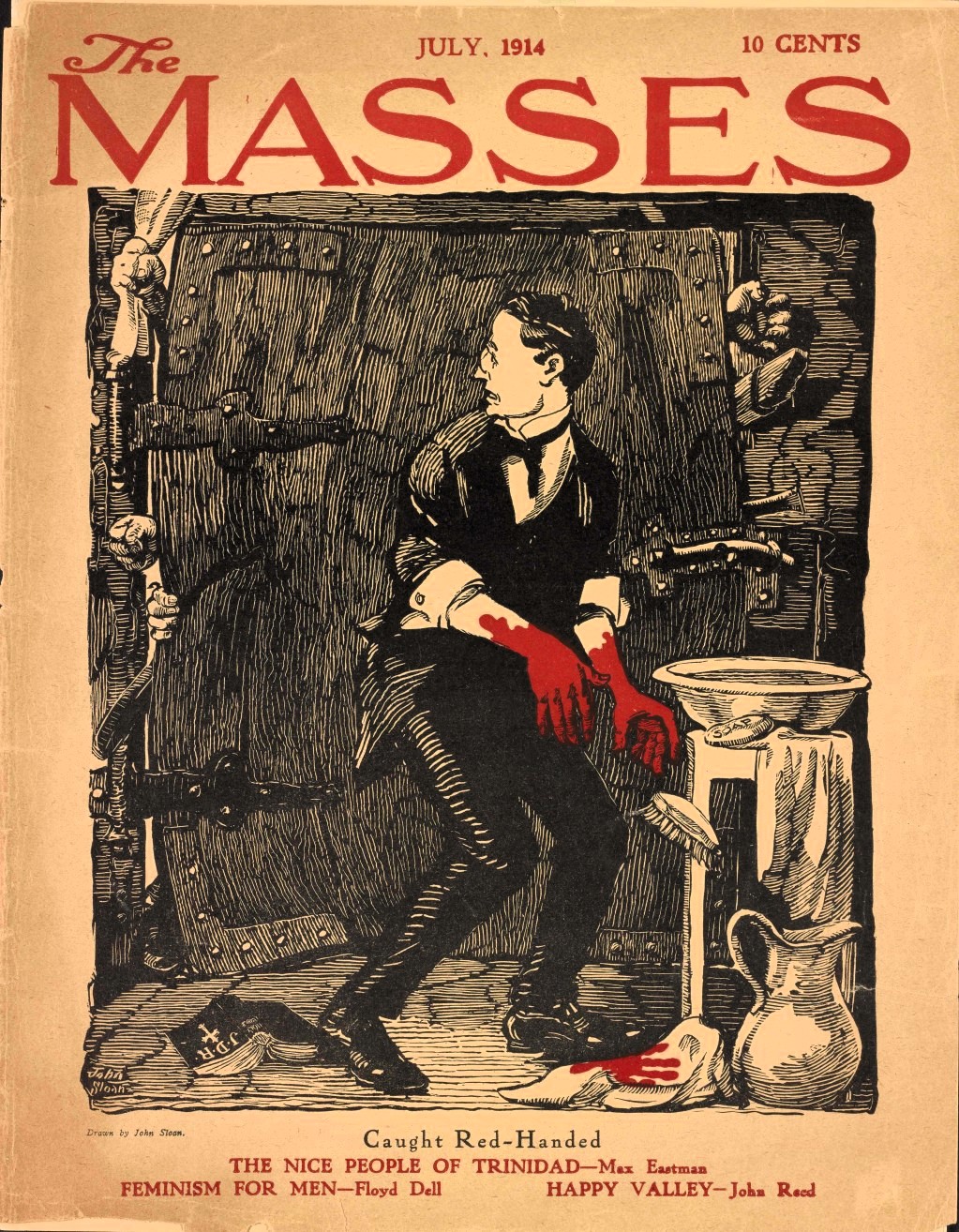
That THE MASSES, when edited by Max Eastman, is the finest radical arts magazine ever published in the United States is an easy argument to make. His future irrelevance was far away when he wrote this essay, which is amongst his most important for the understanding Left history, but worthy of reading for more than that. He illuminates the ethos and politics at the heart of the approach which proved so compelling in 1915, and whose pages remain visually, politically, and emotionally arresting today. In doing so, Eastman raises many issues his generation grappled with still faced by us, but in infinitely greater concentration; the intersection between popular art and popular politics; the need to compete with, while also undermining, the capitalist media; and the deforming impact that the commercialization of art and impulse has had on both.
‘What is the Matter with Magazine Art?’ by Max Eastman from The Masses. Vol. 6 No. 4. January, 1915.
DRAWING is destined to a high place among the arts, for drawings, like music, can be adequately reproduced and widely distributed. And while this has appeared a detriment in the light of aristocratic ideals, in the light of democracy it is a fine virtue. The ideal of democracy has indeed given to many artists of our day a new interest in drawing. Some of the best painters in America would draw for the popular magazines, if popular magazine editors had an interest in true art.
That the editors have not an interest in true art is due, I suppose, not to any natural depravity in them, but to their struggle for existence under the prevailing system of journalism. And the system, briefly, is this:
A publication is a piece of goods manufactured and sold in competition with others for the benefit of a stock company that owns it. The stockholders as a group are interested in dividends. They hire an editor to put out a publication that will sell, and they pay him according to his success. Editors, like human beings, are prone to eat food, and beget families, which is to say that their tastes and ideas are subject to an economic interpretation. And so they seek to mix into their publication a little bit of everything that will sell. The editorial art is the art of ever attracting a new constituency without alienating the old. The result, an insane passion for variety, but a perfectly automatic toning down of every variant that appears. A profitable mediocrity—sometimes called a “golden mean”—is the editorial ideal.
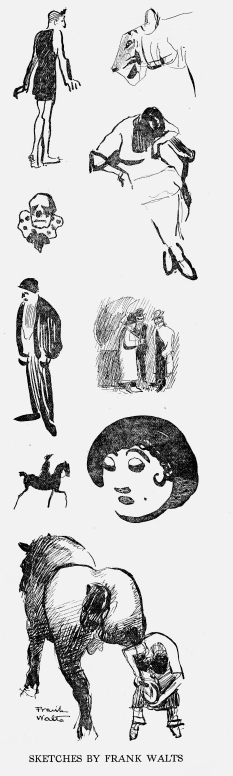
And artists, like editors, are “economically determined.” They learn to draw pictures that will sell, pictures that will attract ever new constituents without alienating the old. Or if their native impulse to be an individual, an object of hate as well as of love, is too strong—then they do not draw for publication at all, which comes to the same thing in its effect upon magazine art.
This, then, is the diagnosis of published art in America. It is business art. It does not aim to achieve the beautiful, the real, the ideal, the characteristic, the perfect, the sublime, the ugly, the grotesque, the harmonious, the symmetrical, or any other of those ends that various schools of art and art criticism have with similar merit set before them. It aims to achieve profits in competition. And any or all of those genuinely artistic aims are subordinated to that.
At this point, certain persons whom I should wish to have disagree with me throughout life and literature, will chime in with, “Yes, you’re right. The trouble is that the people don’t want true art, and the magazines have to give the people what they want.”
The trouble is not so simple. It would not take “the people” long to discover and express their likings for true art, if enough true art, enough kinds of true art, were offered them. Only they would not all discover likings for the same kind. And that is what makes competitive business so incompatible with the artist’s ideal. True art is not one and indivisible, the same today, yesterday, and forever. Indeed, the more highly evolved a group of art works is, the more do individual specimens differ, and the more certain it is that some people will definitely dislike some specimens. And so it falls out that, although plenty of people would like true art, still the effort to please a great many people all the time and never to displease any, results in a drab and mediocre semblance of art.
Might we not almost define good art—braving the learned dogmas of the schools—as art which gives a high degree of satisfaction to those who like it? And does it not almost follow that it will give equal dissatisfaction to those who do not like it? But the aim of a money-making magazine is to give neither intense pleasures nor intense displeasures to a few, but to please everybody a little all the time—namely, about ten or fifteen cents’ worth. Then only can the editors feel steadfast and sure in regard to those dividends.
Let us consider the prevailing features of magazine art in America, and judge if they do not sustain this diagnosis. We shall find that they each arise out of the desire to please everybody a little and displease none.
I
Magazine art tends to be photographic. By which I mean that it tries to reproduce every portion of a figure, as seen from a certain point, with mechanical preciseness—eliminating all those lights and shadows, emergings and recedings, suppressions and distortions of external reality which the individual human factor puts into a perception. The trained magazine artist has carefully destroyed all his own warm and lovable idiosyncrasies, and turned himself into a reproducing machine which can “go over” a canvas from top to bottom, and “put in” with un-erring accuracy everything that “ought to” be there. He is a highly skilled person. He knows how to draw men, horses, buttons, pants, books, hatracks, seltzer bottles, shoes, shoestrings, cats, frowns, kisses, hot-water bottles, anything and everything, scattered or combined; but how to draw a single human perception he has not the slightest idea.
Nor does he need one, for his accurate reproductions in skillful perspective give a certain rudimentary satisfaction to everybody—the satisfaction of saying, “My, ain’t that a good likeness!”
We have the authority of Aristotle that this–“the pleasure of recognition”—is most fundamental and universal of the aesthetic pleasures. But we do not need any authority, for every honest person—even the pastmaster of futurism—will have to confess that still the child in him takes a rudimentary satisfaction in this feat when it is well done.
At the time when I grew beyond a purely childish interest in pictures, I formed the habit of looking through the comic weeklies for drawings by Art Young. If any one then had asked me why I liked these drawings better than others, I should have said: “I don’t know—they’re so funny looking.” But I could say more than that now. I could say that Art Young was almost the first popular draughtsman in America to quit drawing standard types, pictures of pictures of pictures of people, and begin drawing people—the people around him the way they look through his eyes. And that they look “funny,” and look as they never looked before and never will again, was not a discovery peculiar to me.
Consider his “Nice Cool Sewer” picture from The Masses for May, 1913. A critic on the Evening Mail declares that this drawing is “already a classic”—but I find people who do not like it. They think it is not “done.” “Why, his hands look like mittens!” they say. “They’re not hands!”
No—they are not hands, not objective hands, hands in the abstract, hands from a hand factory. They are a certain peculiar individual’s perception of the hands of a certain peculiar man, a tired man, a man sunk onto a chair at the end of a dirty day’s work, a man who feels bad and smells bad to himself, and wishes he were abed.

However, there is no entering a brief for the picture, no judging its artistic merit. The final truth about its merit is that some people will see the picture, and some will not, but those who see it will see it with great joy, for it is not a picture of a picture, nor yet even a picture of a man, but a picture of a perception of a man.
The difference between drawing a man and drawing a perception of a man, is akin to the difference between knowledge and experience. The thing an artist has to do is to transcend his knowledge and win his way back to experience. Take a crude illustration. If you, being as stupid about these things as I am, set out to draw a man going east, you would do it the first time in this fashion:
That would be a poor picture of a man going east, and you would decide that you know very little about physiognomy. On the contrary, however, you know too much. Your knowledge is what got in your way. You know, for instance, what is the shape of a man’s eye, and you drew a picture of your knowledge instead of drawing the looks of an eye. Empty yourself of that knowledge, and you will draw it this way: Somewhat the way it looks.
I here reach the limit of my artist-training, but no more is needed to show the usual progress toward real drawing. It is a progress away from knowledge about things toward experience of things, away from abstraction toward concrete perception.
And when we pass beyond the photographic, or kodak, style of art, we are only taking further steps in the same direction. For, strangely enough, a photograph is a good deal more like knowledge than it is like perception. It has perspective, to be sure, but that is all it has that resembles visual experience. When we look at an object we allow our own character, our memories, predilections, interests, emotions, ideas, to determine what we shall see and how we shall see it. We do something. We go out and seize the salient details of the object, and we over-emphasize, and perfect, and condense, and alter, and mutilate, and idealize—in short, we perform the creative act of perception. And when artists draw creatively, when they draw with individuality, as we say, and with freedom, they are simply coming nearer to that natural act of ours. They are coming nearer to real experience.
Great artists have always drawn in this way. There is nothing modern that departs more boldly from what we know the human proportions to be, than the drawings of Michael Angelo. There is nothing less like a photograph than the sketches of Leonardo.
But most magazine illustrators have never caught the fever of individual being. They have never declared themselves free and independent of customary knowledge; they have never gone beyond catering to the rudimentary pleasure of recognition. And in a commercial way it is well for them, because if they should put their own individual vision strongly into a picture, a great many people to whom their individuality is uncongenial, would dislike the picture, whereas the mere act of easy recognition pleases everybody a little.
II
When magazine art is not photographic, it makes up for that by being neat and “slick.” Perhaps chique is the technical word. I mean that if there is anything omitted or varied by the individual mind of the artist, the variation is so definite, arbitrary, and regular, as to carry us still farther away from a real perception instead of nearer to it. No one could accuse the usual magazine poster prodigy of being photographic. On the contrary, it is nothing but a pattern, a conventionalized symbol, a deft mechanically cut and trimmed diagram remotely suggesting a young lady in the agonies of fashionable attire.
Let us compare with it a drawing which is still less photographic. I choose one that was exhibited at the McDowell Society in New York a while ago. One of the chief virtues of this drawing, in comparison with the usual poster is that it is not a drawing of a girl. But that is not the virtue I mean to point out. I mean to point out that here is a drawing even more abbreviated, more incomplete, less filled up with meat, but which comes right back to reality, instead of going farther away from it. For those who can see it, this is a most true, intimate, and final picture of a certain dog—sketched with unerring loyalty to the eye, and sketched, moreover, with living sympathy and emotion. For those who see it, it is exquisite, but for those who do not, it is only a piece of old newspaper—the last thing in the world to pay money for. And so it is not a magazine drawing, while the chique young lady of the poster decidedly is. For neatness of execution—no matter how inhuman and foolish the subject matter—pleases everybody a little. Sometimes we call it “decorative”—and sometimes it is!
Ill
When magazine drawings express feeling, the feelings they express are only the obvious and conventional ones of average people with coins in their pockets.
Wistfulness in a pretty girl–indicated by arching her eyebrows clear up into her hair.
Adventurous although stylish athleticism in a young man—indicated in the jaw and pants.
Romance in the meeting of the two—indicated by his gazing upon the earth, she upon infinity.
Pathos of old age—indicated with bending knees or a market basket.
Sweet and divine innocence of children—usually indicated in the stockings.
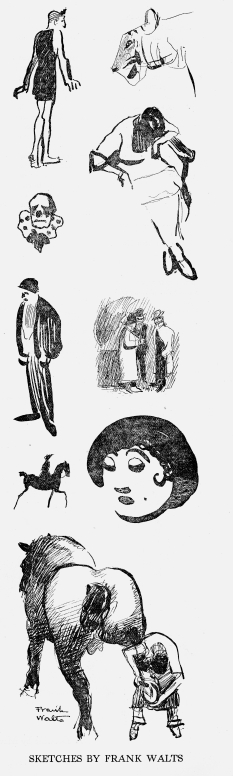
These are the principal sentiments appealed to. And I would not suggest that these sentiments are of any less intrinsic worth than others, only why ding dong upon them perpetually, page after page, and month after month—except because they are the obvious and rudimentary sentiments which everybody feels, and all feel in substantially the same way, and all like to see expressed Whereas, if you delve down into those passions which are deep and elemental, you find thousands who will resent your manner of expressing them; and if you drift out into those veins of feeling which are high-wrought, and subtle, and not to be named with names, you will find that people differ so much in these feelings that one will be attuned to one picture and another to another, and there is danger of losing the old constituency while you are attracting the new. And thus it is more profitable to hammer away upon the tonic chord of ordinary humane feeling, where we are all alike, and will go patiently out and pay down our fifteen cents for the same old song.
IV
When magazine art expresses ideas, these are the ideas most obvious and most current among those who can afford to buy.
Many years back, for example, Life has been profiting upon pictures in ridicule of the idea of woman suffrage, and the feminist movement in general. But after Mrs. Pankhurst woke up the press, and through that the world, to the biological significance and power of the change in women, the profit upon female ridicule dwindled. The idea of the Eternal Feminine as a Perfect Lady grew a little less obvious than it used to be. And so Life one day graciously persuaded itself to bring out a “Pro-Suffrage Number,” advertising among its artists for pictures expressing the values of a real woman. Now this little gamble on opinions is only a kind of frivolous example of the general art policy I have outlined—to attract ever a new constituency and yet not alienate the old. I believe that Life could profit now—just because people are beginning to acquire a degree of mercy toward men almost equal to that they feel toward animals—by dropping anti-vivisection and bringing out a Pro-Jewish number. And doubtless the artists would excel, as they did in the Pro-Suffrage number. For obviously no true works of expressive art can be created when the thing to be expressed is determined, not by the naturally unconventional promptings of native inspiration, but by an editor scared into a mania for the obvious. However, the very trick of cartoon expression, the graphic representation of an idea—any idea that is not radically displeasing in itself—gives a slight pleasure to almost anybody.
V
Magazine art is monotonous. Well, everything there is much of is monotonous. But magazine art makes an ideal of monotony. “The Gibson Girl,” ‘The Christy Girl,” “The Stanlaws Girl,” “The Harrison Fisher Girl”—these are features to be advertised on the front cover. And yet what is the advertisement, but an obituary notice of these men as artists? It certifies that they have given up their profession of realizing in line the varieties of life’s experience, and gone into the manufacturing business. They are now turning out an article that will sell widely in competition, because it is modelled strictly on the lines here indicated; and while they may find it profitable to vary the model a little from year to year, as progressive manufacturers do, the main lines were laid down in the first big sale, and no risks will be taken.
I do not want to lessen the glory that naturally adheres to these men for having created these types. Charles Dana Gibson is the original discoverer of the psycho-physical law that an anatomically impossible amount of space between the eye and the eye-brow of the female produces a romantic reaction in the male. This was a big discovery in every way. It was long known that certain slight physical abnormalities are a sex stimulus. We found that out almost as soon as we came down from the trees, and we used to get the girls to alter themselves a little instead of just altering their pictures. At least so the anthropologists tell us. But, at any rate, the art was forgotten, and the rediscovery of its charm was altogether a new thing and a big thing.
So big, in fact, that it seemed to overwhelm the artist, and he stopped there, and went into the business of manufacturing paper ladies—a business which quite wrecked his art, so far at least as the youthful female is concerned. In the characterizing of the male and the elderly female, Gibson has always been an artist, has always enjoyed within natural limitations of feeling, the varieties of life. He is the best magazine artist who ever learned the trick of pleasing everybody a little. Perhaps, however, his naturally not very wide range of feeling—never transcending a genial and humane interest—has made this possible. So that even in these respects in which he is a true artist, Gibson is still an example of the monotony that is inevitable in pleasing everybody a little. Descend to the imitators—the millions of manufacturers of the girl of the far-away-look—and we find monotony so idealized, entrenched, and confirmed by commercial success, that we cannot characterize their separate styles at all. We can only say that the thought of a magazine cover makes us tired.
VI
One kind of variety, indeed, has been found profitable by all editors—and that is variety in the shape of pictures and their disposition upon the page. And this variety has been cultivated as carefully as monotony in the pictures themselves. The principal function of the art-editor is to fix a magazine so that when it is held loosely in the left hand, and the pages run off rapidly by the right thumb, a sort of kaleidoscopic motion-picture results. Black spots and queer blotches are seen dashing from one part of the page to another, and the effect is quite stimulating to the curiosity. This is no proof that after the purchase is made, any one enjoys reading type which jumps across, over, under and around the misshapen angles of an extraneous insert. It is no proof that any one enjoys looking at pictures which are jumped across, and poked into, by fragments of irrelevant letter-press. No–merely that this “variety of make-up” has the look of a circus as you pass by. And you never remember how you are fooled. You bite again at the next flutter.

This may be an extreme statement, but I doubt if anybody really likes a picture of a horse-race with the rear-end of a horse racing off one page, and the forward quarters racing onto the other, and a half-inch white margin intervening. It is impossible to put much speed into such a picture. It is impossible to put much heart into the creation of a picture that is to be so treated.
VII
Besides being mutilated and vivisected, magazine drawings are belittled. And this is one thing that cannot happen to a story. A story may be lost in the scramble for advertising. It may be given a fairly formidable appearance at the front of the magazine, and then peter out into a long, dreary little tail coiling its way among tomato cans, and tobacco, and beer, at the back. But the story must needs be legible, if it is worth printing at all. And if it is legible, then it exists as a work of art. But not so the pictures. A picture may exist at eight-by-twelve inches, and be absolutely annihilated in the reduction to one-and-a-half-by-two. We might say that the average picture in our popular magazine is about half alive. The vigor is squeezed out of it by the engraver; and even then it is given no margin, no space in which to breathe.
All of which is but a further evidence of the commercial idealism that determines and controls this art. A magazine which is “chuck full of pictures and stuff” seems to be a fat bargain. No matter whether the pictures really exist or not—they look as though they did, and the number is large, and it takes a long time to crowd one’s way through the magazine, and one feels as though he were getting his money’s worth. And while this may be a small satisfaction for so much trouble, it is a satisfaction that everybody enjoys a little.
VIII
Magazine drawings are mainly “illustrative.” Their creation is usually initiated and accomplished somewhat in the following manner:
The editor hands a manuscript to a poor man who is—metaphorically at least—hungry. “We want two illustrations for this,” he says, “and we must have them by the fourteenth—play up the woman.”
The artist goes home and reads the story. He does not enjoy it, and he has no desire to illustrate it. He probably never had a desire to illustrate any story. Neither did the author have a desire to have anybody illustrate his story. Neither does the editor have any desire to see an illustration of the story. Neither does the reader consider the illustration an addition to the story.
All the reader cares about is that the magazine should not look dull when he approaches it; all the editor cares about is that the reader should be led to approach it; all the author cares about is that he should have a popular artist’s name attached to his story; and all the artist cares about is that he should sufficiently conform to the business standard of art so that the editor will give him a full, or at least a half-page, and pay him a full or at least a half-price.
Of course, these statements are sweeping and not strictly true. But they are more true than any other sweeping statements you could make about the popular art of illustrating stories. Except at those times when an artist and an author spontaneously discover in themselves a real harmony of inspiration—and those times are rare—we may say that the illustrator’s business is but an adventitious appendage to a real art. But it is an easy way to promote that variety of physical make-up which furnishes a slight pleasure to everybody and no great displeasure to any.
It would be agreeable to dwell in anticipation upon the nature of magazine art in the distant future, when the ideals of the business office have ceased to reign supreme; but it would be impossible. For one cannot describe a thing whose very excellence shall consist in continual and surprising variation. Magazine art will be true art, and every work of true art is unique. The only way, therefore, in which it can be described in general is to say that it will be free from the tyranny of this demand that everybody be pleased with it—free to make enemies as well as friends.
Such art can never flourish under the commercial editor. To say nothing of the strain put upon his business by publishing something shockingly but surely great, he must also be ready to take chances upon that which is shocking but not surely great. Like the artist himself, or the poet, he must live the experimental life. Fear and a failure of the spirit of adventure are the death of art. Recklessness is its life. And if ever there appears on this earth such a thing as an editorial art, it will be when commercial timidity is removed from the inner office and a spirit of free and genuine sport is enshrined there.
We can perhaps point out, in conclusion, one or two little things that the true magazine art of the future will not be, and this will help people to recognize it when it begins to appear.

It will not be carelessness of technique taking the place of carefulness. No artist is free whose hand is not wholly under the dominion of his feeling or his idea.
It will not be an imitation of foreign monstrosities supplanting the native monstrosities of America. Art need have no national boundaries, but this does not mean that the imitation of Germans or Frenchmen is any more inspiring than the imitation of the folks at home.
It will not be realism supplanting idealism. It will not be love of the poignant supplanting love of the perfect, nor any one artistic ideal supplanting any other. They are all human and they are all divine, those ideals of art. And the important thing is that the appreciator—and here again, the editor—shall know how to judge each work by its own standard, and not by the standard of something else. The function of the critic—if he has any—is to encourage every creator to be himself at his best.
It will not be drawings of the ugly and disgusting, the slops and drippings of a miserable civilization, supplanting the drawings of the festive and beautiful. A little while ago, a paragraph in Collier’s Magazine presumed to denounce from the standpoint of morality some of the young artists of our times, and I quote it:
“Many of the stern young moralists who are winning fame by their pictures in our magazines seem (to paraphrase a homely proverb) to have the same bad smell up their nostrils. Their people are gawky, greasy, febrile, and mean; they are doing contemptible things in a graceless, animal sort of fashion; their backgrounds are dingy, tawdry, and slovenly or unsanitary. Life Is shown in the guise of the thriftless seeker after low pleasures. And yet these artists are Intelligent, educated, alive, with the artists’ deft hand and trained eye. They prove it by drawing a revolting bunch of cats and dogs prowling about some overturned garbage cans! The life of a great and eager city is all about them—you can see courtesy in the subway and devotion to duty in many a dingy shop, but they prefer the manners and labors of the roof garden. One may see men stopping in the street to stare up at the amazing beauty of our tall buildings against the misty blue of the September sky, but these are not artists, only low fellows whose immigration hither should have been prevented by law!”
If this paragraph had been written from the stan point of art, it would be but another proof of the fact that anything strong makes enemies as well as friends. But the paragraph was written from the standpoint of morality. And I have to say that it is a queer morality which can escape the grip of the tragic problems of our time by turning the eyes in another direction. If there is a tendency among free and democratic artists to linger among destitutes and prostitutes and those whom exploitation has driven to vagrancy and crime, this is not because these seem truer subjects of art, but because they are subjects of art which have so long been unrecognized. They are problems of moral reflection, moreover, which have too long been unstudied. It may, indeed, be true that freedom to see and sing these realities has turned the heads–or the hearts—of some poets and artists. They may have fallen a little in love with the sordid for its own sake, but certainly they are upon the heights both of health and virtue, when they are compared with those moralists who solve the profoundest questions of our civilization by the simple device of looking up into the sky where the clouds are floating so sweetly over the tall buildings. They may be “stern”—these young artists—but if the world, like the writer of that paragraph, proves too frivolous to face them, then it will be so much the worse for the world.
It is my part, however, to point out that not the painting of any particular truths will distinguish the art of the future, but the freedom to paint them all—a freedom which carries untold possibilities and untold dangers. If the new love of this freedom has arisen in artists who are big enough to stand it, then we are on the verge of a great era in popular art. But if these artists prove only little bantams, who have their heads turned the first time they find out they can crow—it is vain to hope for anything but a new series of monomanias. The fetters are removed—the wings are free—there is room for untrammelled and universal genius. But self-infatuation, attitudinizing, artificiality of technique, erotic attachment to a queer subject matter, these internal fetters are as quick and sure death to liberty academic custom or ancestor worship.
If intelligence is given its sovereignty, and if men of universality arise, the twentieth century will see an age of art and poetry surpassing that of Elizabeth, because to the splendid paganism and great gusto of the free in those days will be added the ideals and the achievements of science and democracy. But if intelligence is renounced for temperament, if Art and not Life becomes the center of interest, if men prove too little for the adventure—then debauchment and dementia praecox are the harvest, and the hope is postponed.
The Masses is among the most important, and best, radical journals of 20th century America. It was started in 1911 as an illustrated socialist monthly by Dutch immigrant Piet Vlag, who shortly left the magazine. It was then edited by Max Eastman who wrote in his first editorial: “A Free Magazine — This magazine is owned and published cooperatively by its editors. It has no dividends to pay, and nobody is trying to make money out of it. A revolutionary and not a reform magazine; a magazine with a sense of humour and no respect for the respectable; frank; arrogant; impertinent; searching for true causes; a magazine directed against rigidity and dogma wherever it is found; printing what is too naked or true for a money-making press; a magazine whose final policy is to do as it pleases and conciliate nobody, not even its readers — There is a field for this publication in America. Help us to find it.” The Masses successfully combined arts and politics and was the voice of urban, cosmopolitan, liberatory socialism. It became the leading anti-war voice in the run-up to World War One and helped to popularize industrial unions and support of workers strikes. It was sexually and culturally emancipatory, which placed it both politically and socially and odds the leadership of the Socialist Party, which also found support in its pages. The art, art criticism, and literature it featured was all imbued with its, increasing, radicalism. Floyd Dell was it literature editor and saw to the publication of important works and writers. Its radicalism and anti-war stance brought Federal charges against its editors for attempting to disrupt conscription during World War One which closed the paper in 1917. The editors returned in early 1918 with the adopted the name of William Lloyd Garrison’s The Liberator, which continued the interest in culture and the arts as well as the aesthetic of The Masses. Contributors to this essential publication of the US left included: Sherwood Anderson, Cornelia Barns, George Bellows, Louise Bryant, Arthur B. Davies, Dorothy Day, Floyd Dell, Max Eastman, Wanda Gag, Jack London, Amy Lowell, Mabel Dodge Luhan, Inez Milholland, Robert Minor, John Reed, Boardman Robinson, Carl Sandburg, John French Sloan, Upton Sinclair, Louis Untermeyer, Mary Heaton Vorse, and Art Young.
PDF of full issue: https://www.marxists.org/history/usa/pubs/masses/issues/tamiment/t46-v06n04-m44-jan-1915.pdf

