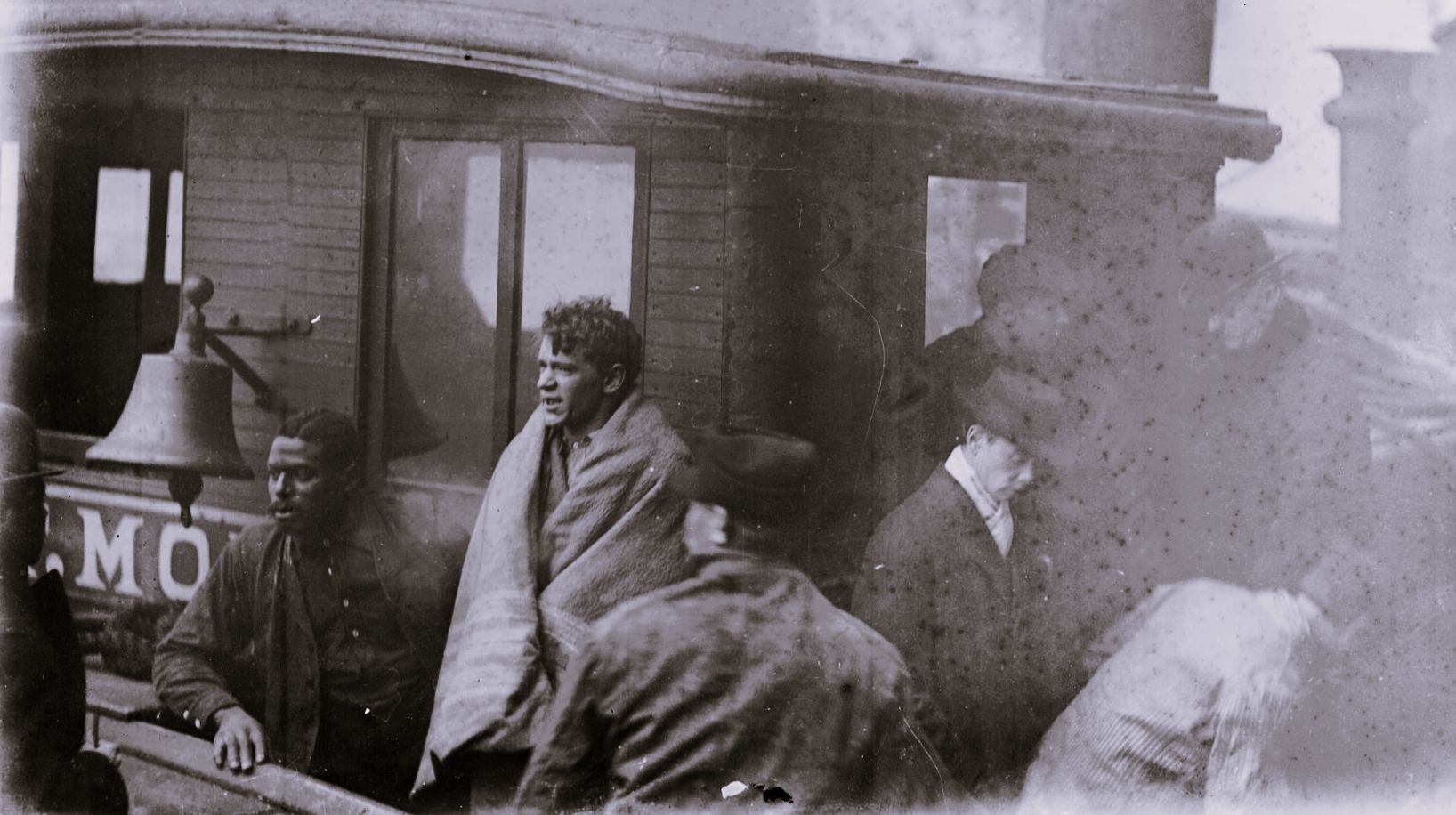
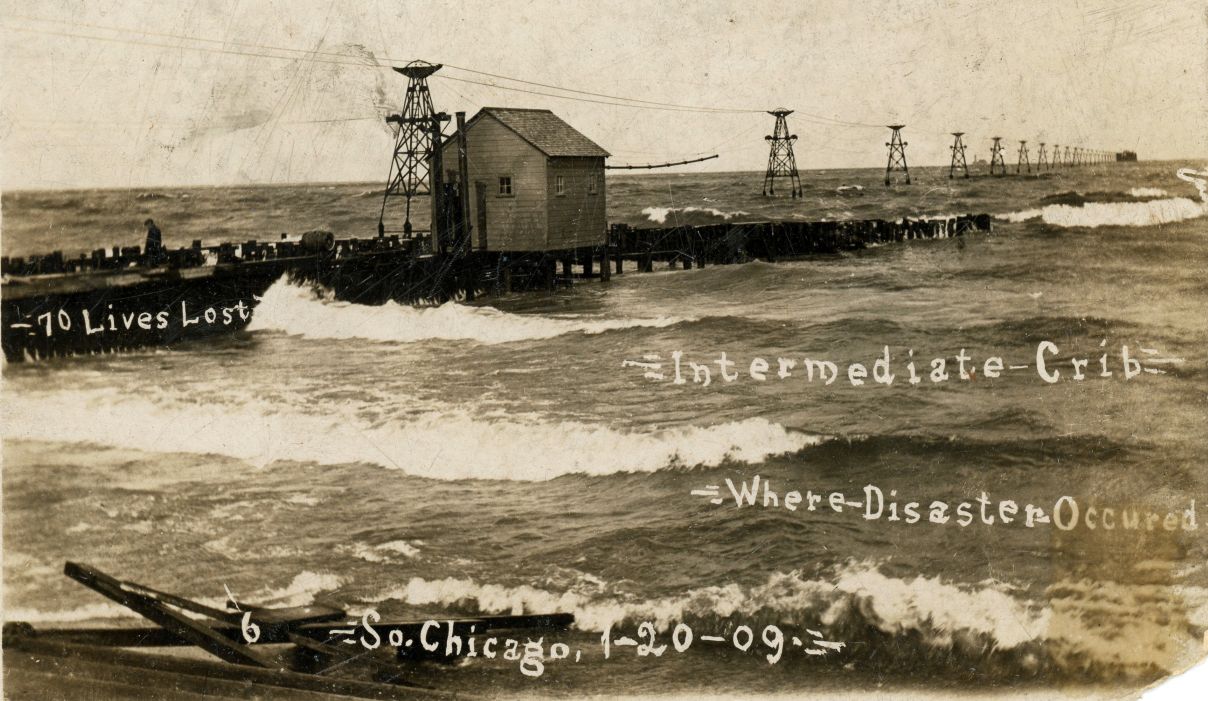
In one of Chicago’s worst industrial disasters, over sixty workers died on January 20, 1909 in nightmarish circumstances a mile and a half off of Seventy-First Street while building a tunnel in Lake Michigan. The crib they were working in caught fire, forcing them to jump into the water to be trapped under the floating ice. The initial reports and a look at the money trail.
‘Forty Men Blown to Pieces on Burning Crib in Lake’ from The Chicago Daily Socialist. Vol. 3 No. 73. January 21, 1909.
Scores of Workmen in Explosion and Fire on the Structure Off 71st Street
27 SAVED FROM DROWNING
Small Tugs Rescue Many–Who Leaped from Flames Into Icy Water
Forty men are thought to have been blown to nieces, and as many injured, when the intermediate crib blew up off Seventy-third Street this morning. Twenty-seven were saved from drowning in the icy waters of Lake Michigan. Several tugs were rushed to the scene and four ambulances and patrols were used to carry the injured to the Illinois hospital, Halsted and Washington streets. The twenty-seven injured men saved from the destruction of the crib were brought to the Wells street bridge in the tug George W. Jackson, and then loaded into ambulances. The fire tug Conway is still working at the crib and will bring the rescued to the Calumet River at the foot of Ninety-second street, where an ambulance from the South Chicago police station is waiting.
Men in Pitiable Condition
The men brought to the Illinois hospital were in a pitiable condition. Half frozen, their clothes in shreds, their flesh seared by flames, their blood chilled by the ley water into which they had leaped to escape being burned to death, they told thrilling tales of the disaster.
The crib in which the men met death is owned by the George W. Jackson company and is part of the system used in building the tunnel which is to give adequate water supply to West Pullman and Rosedale. The fire broke out this morning following an explosion of several hundred pounds of dynamite in the tunnel shaft beneath the intermediate crib. The building was instantly in flames and all of the men employed there, except the forty said to have been in the shaft, made efforts to reach safety. It is thought that the shaft men were killed Instantly.
As soon as the news of the disaster reached the city hall, City Engineer John Ericson and his chief aids left for the scene of the disaster at once. Assistant Fire Chief Seyferlich hurried in his automobile to the crib also. Commissioner of Public Works John J. Hanberg is in Springfield, engaged in the political fight there and Deputy Commissioner Redieske is In Peoria at a convention of the Knights of Columbus so that the officials most directly involved were not in the city.
Many Rescued by Tug
The tug George W. Jackson was within 400 yards of the crib when the explosion occurred. The tug was under steam and at once hurried to the rescue. Lines were thrown to the burning crib and many climbed hand over hand to safety. Others leaped at once into the water and were saved before crushed by floating ice cakes. Almost a score are thought to have perished by floating under the ice and being drowned.
The fire boat Conway, which was lying in dock at the mouth of the Calumet River, was ordered out and its crew rescued about fifteen men, who were taken to the city crib at Sixty-eighth street. The fire boat then returned to the wrecked crib and is engaged in the work of rescue.
What Jackson Says
When Fire Chief Horau called up George W. Jackson, head of the George W. Jackson company, which is building the tunnel, Jackson said:
“Any men who were in that tunnel when the explosion occurred are dead. I have not yet heard how many there were in the shaft.”
The shaft was being worked from the intermediate er b in two directions, shoreward and outward to the outer crib. It was in the shoreward end that the men were working when the explosion occurred. Between the wrecked crib and the shore is a dynamite store house containing thousands of pounds of the powerful explosive. This is said to be submerged, at least partly, and it is not yet known whether or not this blew up. According to the best information on hand there were several hundred pounds of dynamite in the intermediate crib as well the blasts being used on the rock which was being tunneled. This dynamite did blow up.
Who Is Responsible?
The responsibility of the care of the dynamite being used on the work in hard to establish. In the city engineer’s office it was said that the police had charge of the inspection of the dynamite storehouse. The police dented this. Fire Marshal Horan stated that the storehouse had been built under his supervision and that he regarded it as safe.
All this was in strange contrast to the declaration of a miner official of the department of public works who, when told there had been an explosion, said: “That was what I was afraid of.”
No one at the city hall can explain what the conditions were and who was responsible for those conditions under which the forty, men are thought to have met death by names and water. One department is shifting the responsibility to the other. City Engineer Ericson called up his office shortly after his arrival at the scene of the disaster and reported that he did not think there were any men killed.
List of Known Dead
Among those reported dead:
M’DONALD, JOHN, timekeeper.
SCULLY WILLIAM, laborer.
THORPE, JOHN, chef at the crib.
Partial List of the Injured
Among the injured:
SUMMERS, WILLIAM; FLIGHT, DAVID; SHORT, WALTER; CAHILL, GEORGE; WORTHINGTON, ALBERT; POWERS, THOS.; BIRD, ROBERT; SORRELL CHARLES; WALTER, FRANK; MEADS, EDWARD; SWANSON, ALFRED; ANDERSON, PETER; THYOR, FRANK; COLESBY, MOSES; JOHNS, SYLVESTER; SKINNER, EDWARD; PHEIFFER, EDWARD; MASUMA JOSEPH; KING, ERNEST.
The flames broke out in the crib at about 8 a.m. The structure is situated nearly two miles from shore. where are the offices of the George W. Jackson corporation, which has charge of the southwest land tunnel work. When the fire broke out a telephone message was received at the offices on shore.
Workmen Caught Like Rats
The fire, according to stories told by survivors originated in the powder magazine on the first landing shortly before 8 o’clock. Many were asleep in bunks, others were washing and others were just going to work when a sheet of fame shot through the building.
The men were caught like rats in a trap. Many were burned to death be- fore they could reach the doors. Others, their clothes aflame, leaped into the icy waters regardless of the results. A number unable to swim sank beneath the surface. Others swam to cakes of lee to support themselves.
***
Trail of Blood Leads Directly from Scene of Carnage to Wall Street
BIG PROFITS; BIG SURPLUS
Internal Make-Up of Company Whose Men Have Perished Laid Bare
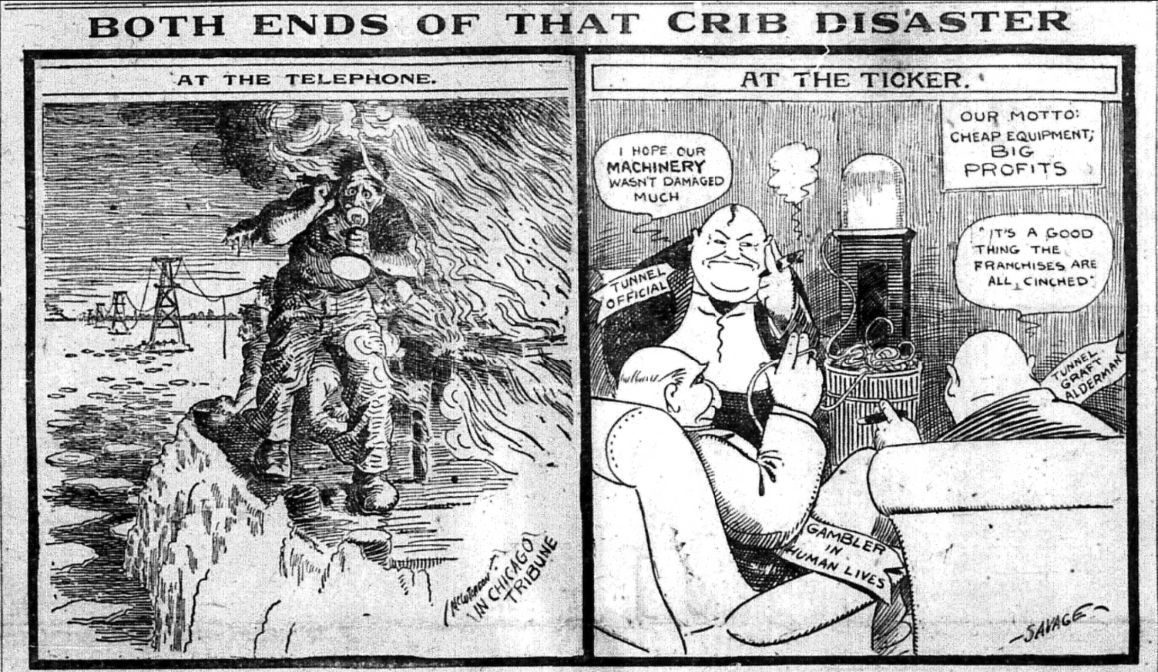
The trail of blood and death from the crib oft Seventy-third street leads directly to Wall Street.
It was discovered this morning that the George W. Jackson company, which has the contract for the work at the intake off Jackson Park, is connected in a most intimate manner with the firm of James B, Russell & Co., 46 Wall Street, New York. In fact, the dividends of the Jackson company are paid through the Russell company, and James B. Russell is one of the directors of the George W. Jackson company.
Graft Angle Presented
George W. Jackson was chief engineer of the Illinois Tunnel company at the time when he became president of the concern with the Wall Street connections. This concern had the backing of the notorious Billy Loeffler and Alderman John Powers, and John J. Brennan of bridewell fame.
The Illinois Tunnel company’s particular graft was made possible by tampering with records by Loeffler, who was afterward tried for the offense before Judge Chetlain.
The company whose dynamite caused the death of at least 40 persons and which caused the tugs coming into the harbor of Chicago this morning to be loaded with men who were near the pout of death from injuries and exposure, was organized in the city of Chicago on December 11, 1906. The present company was the outgrowth of the old George W. Jackson company and the Jackson & Corbett Bridge and Steel Works company.
Wall Street Steps In
When these two companies were amalgamated the assistance of Wall Street in the person of the James B. Russell company was called in and James B. Russell was made treasurer and director of the new company. The dividends of the company have been paid from 46 Wall Street since that time.
The directors of the original Jackson company were James J. Graham, John J. Corbett and George W. Jackson. In the auxiliary company the only addition to the directors was Corsellus Hogan, who was made director and manager of the whole bridge and structural iron business. When Wall Street stepped in and seized the company F.A. Gettleson, T.C. Jackson. G.A. Fehr, A.E. Clark, A.D. Shanks, B.S. Harmon and James B. Russell were made the board of the new company.
Big Profit; Big Surplus
There was something rather queer about the first report of the Wall street company after it had been organized, something which has not yet been explained. The gross earnings of the company are reported at $359,621 for the year 1907. The net income is reported as $260,296 and the dividends as only $30,317. The surplus of the company for this year was $236,510.
The concern, when the Wall street connection was added, was capitalized at an authorized capital of $2,000,000 of common stock and $1,000,000 cumulative 7 per cent preferred stock
All dividends both on the common and preferred stock are paid through James B. Russell & Co.
The total output of the company between March 1, 1907, and December 31 of the same year amounted to $2,362,779, according to the published reports of the company.
The company has had a number of contracts throughout the country for the past year, as well as for the year 1907, but the profits and the “dividends,” as well as the surplus of the last year, have not yet been published.
Long Series of Accidents
The erection of the intake at Seventy-third street, off Jackson park, has been a history of accident and trouble since the beginning of the undertaking by the George W. Jackson company. According to the representatives of the City Press association there have been a number of accidents and a great deal of trouble connected with the completion of the intake and the work on the two cribs, the inner of which was burned this morning.
The Wall street connections of the company were not generally known in this city, although it had been reported once before that the firm of James B. Russell & Co. was an active member of the firm.
The Chicago Socialist, sometimes daily sometimes weekly, was published from 1902 until 1912 as the paper of the Chicago Socialist Party. The roots of the paper lie with Workers Call, published from 1899 as a Socialist Labor Party publication, becoming a voice of the Springfield Social Democratic Party after splitting with De Leon in July, 1901. It became the Chicago Socialist Party paper with the SDP’s adherence and changed its name to the Chicago Socialist in March, 1902. In 1906 it became a daily and published until 1912 by Local Cook County of the Socialist Party and was edited by A.M. Simons if the International Socialist Review. A cornucopia of historical information on the Chicago workers movements lies within its pages.
PDF of full issue: https://www.marxists.org/history/usa/pubs/chicago-daily-socialist/1909/090322-chicagodailysocialist-v03n123.pdf

