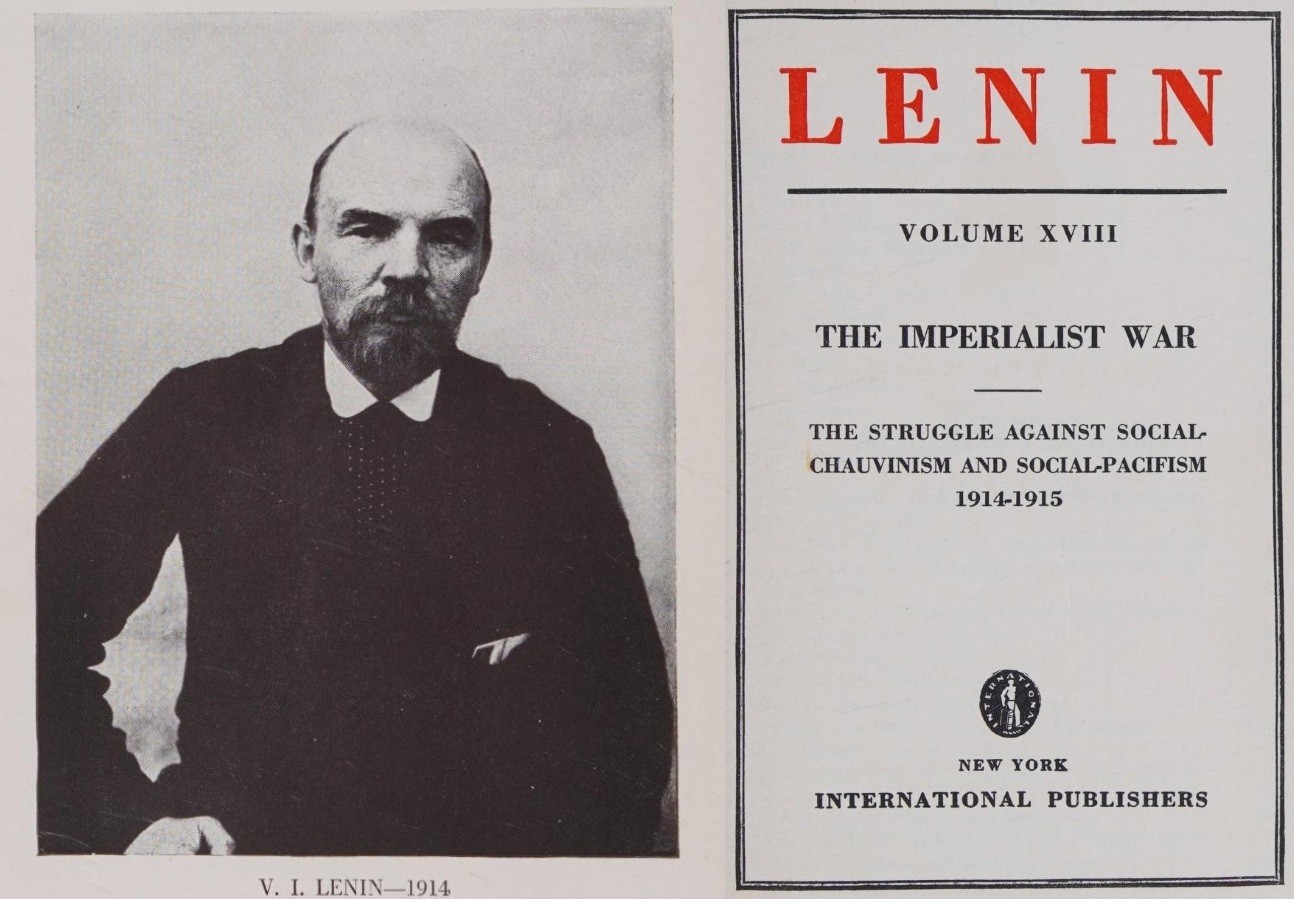
The Russian chauvinism of leading Social Democrats Georgi Plekhanov and Alexrod is the target of this February, 1915 internationalist criticism from Lenin as the start of the First World War made such questions existential for the workers’ movement.
‘Russian Sudekums’ (1915) by V.I. Lenin from Collected Works, Vol. 18. International Publishers, New York, 1930.
THE word Sudekum has acquired an appellative significance: It denotes a self-satisfied, unscrupulous opportunist and social-chauvinist. It is a good indication that everybody speaks of the Sudekums with contempt. There is, however, only one way for us not to sink into chauvinism while doing this: We must help unmask the Russian Sudekums as far as it is in our power.
Plekhanov has definitely placed himself at the head of these by his pamphlet, On the War. His arguments are a substitution of sophistry for dialectics all along the line. It is sophistry to denounce German opportunism in order to shield French and Russian opportunism. The result is not a struggle against international opportunism, but its support. It is a sophism to bemoan the fate of Belgium while keeping silence about Galicia. It is sophistry to treat equally the era of imperialism (i.e., the era when, according to Marxists generally, objective conditions are ripe for the collapse of capitalism and masses of Socialist proletarians are already in existence), and the era of bourgeois-democratic national movements; in other words, to treat alike an era when the destruction of bourgeois fatherlands by an international revolution of the proletariat is looming up, and an era of their birth and consolidation. It is sophistry to accuse the German bourgeoisie of having disturbed the peace of the world while keeping silence about the prolonged and assiduous preparations for a war against Germany by the bourgeoisie of the “Triple Entente.” It is sophistry to evade the Basle resolution. It is sophistry to substitute national-liberalism for Socialism: to say that a victory of tsarism is desirable in the interests of the economic progress of Russia, at the same time failing even to touch upon the question of the oppressed nationalities of Russia, or of the thwarting of Russian economic growth by tsarism, or of the incomparably faster and more successful growth of the productive forces of Germany, and so forth and so on. To analyse all of Plekhanov’s sophisms would require a series of articles, and we doubt whether it is worth while to go into many of his ridiculous absurdities. We shall only touch upon one of his quasi-arguments. In 1870, Engels wrote to Marx that Wilhelm Liebknecht was mistaken in making anti-Bismarckism his one leading principle. Plekhanov was glad when he found that quotation: The same is true, he argues, in relation to anti-tsarism! But let us try to replace sophistry (i.e., the method of clinging to the outward similarity of cases without a connection between the events) by dialectics (i.e., the method of studying all the concrete circumstances of an event, and its development). The unification of Germany was necessary, and Marx recognised it both before 1848 and after. As early as 1859, Engels straightforwardly called the German people to a war for unification. When revolutionary unification failed, Bismarck did it in a counter-revolutionary Junker fashion. Anti-Bismarckism as the sole principle became absurd since the necessary unification was an accomplished fact. But what about Russia? Did our brave Plekhanov formerly have the courage to declare that the development of Russia demanded the conquest of Galicia, Constantinople, Armenia, Persia, etc.? Has he the courage to say so now? Has he considered the fact that in Germany it was necessary to progress from the national disunity of the Germans (who were oppressed both by France and Russia in the first two-thirds of the nineteenth century) to a unified nation; whereas in Russia the Great-Russians have crushed instead of uniting a number of non-Russian nationalities? Having failed to think of these things, Plekhanov covers up his chauvinism by distorting the meaning of Engels’ quotation of 1870 in the same fashion as Sudekum distorts an 1891 quotation from Engels to the effect that the Germans must wage a life and death war against the allied armies of France and Russia.
In another language, and in quite different surroundings, the same chauvinism is defended by the Nasha Zarya [Our Dawn], Nos. 7-8-9, where Cherevanin predicts and desires “German defeat,” asserting that “Europe [!!] has risen” against Germany; Mr. A. Potresov rails against the German Social-Democrats for their “blunder,” which, he says, “is worse than any crime,” etc.; he asserts that German militarism is guilty of “special, extraordinary sins,” that “not the Pan-Slavic dreams of certain Russian circles were a menace to European peace,” etc.
When the legal press thus paints the “extraordinary” guilt of Germany and advocates the necessity of its defeat, does it not sing in unison with Purishkevich and the social-chauvinists? That Russian militarism is guilty of a hundred times more “extraordinary” sins cannot be told under the pressure of the Tsar’s censorship. Is it not obvious that people who do not wish to be chauvinists must in such situations refrain at least from speaking of German defeat and of German extraordinary sins?
The Nasha Zarya is not only pursuing the line of “non-resistance to the war;” it does more, it greases the wheels of Great-Russian chauvinism, of tsarism and Purishkevich, in that it preaches the defeat of Germany and shields the Pan-Slavists by “Social-Democratic” arguments. One must not forget that none other than the writers of the Nasha Zarya conducted a mass propaganda in favour of Liquidationism among the workers in 1912-1914.
Finally, there is Axelrod, whom together with the writers of the Nasha Zarya, Martov angrily but unsuccessfully tries to shield, protect and justify.
Axelrod’s views were, with his consent, expounded in Nos. 86 and 87 of the Golos. Those views are social-chauvinist. Axelrod defends the entrance of the French and Belgian Socialists into the bourgeois cabinets with the following arguments: (1) “Historical necessity, which is often inappropriately referred to nowadays, did not mean to Marx a passive attitude towards concrete evils—in the expectation of a Socialist revolution,” says Axelrod. But what does he mean? What confusion! All that happens in history is subject to the law of necessity. This is elementary. The opponents of social-chauvinism do not refer to historical necessity at all, they refer to the imperialist character of the war. Axelrod would have us believe that he does not understand this salient point nor the attitude towards a “concrete evil” that follows from it, to wit, that the bourgeoisie is the ruling power in every country and that it is timely to start revolutionary actions which lead to a “Socialist revolution.” It is the social-chauvinists who are passive when they deny this. (2) It is impossible to ignore the question as to the real initiator of the war, “who has placed all the attacked countries in a position where they must defend their independence,” says Axelrod. On the same page, however, he admits that “of course the French imperialists intended to provoke a war in two or three years,” but, don’t you see, during this time the proletariat would have become stronger, and with it the chances for peace! The truth is that during this time, opportunism, so dear to Axelrod’s heart, would have become stronger, and with it the chances for an even more dastardly betrayal of Socialism. The truth is that for decades three highway robbers, the bourgeoisie and the governments of England, Russia and France, were arming to sack Germany. Is there anything surprising in the fact that two highway robbers launched an attack before the other three got the new knives they had ordered? Is it not a sophism when the phrases about the “initiators” are used to obliterate the equal guilt of the bourgeoisie of all countries, a fact unanimously and undisputedly recognised by all the Socialists at Basle? (3) “To blame the Belgian Socialists for defending their country,” says Axelrod, is “not Marxism, but cynicism.” This is how Marx labelled Proudhon’s attitude towards the Polish uprising of 1863; Marx, beginning from 1848, continually stressed the historic progressiveness of a Polish uprising against tsarism. No one dared to deny that. There was at that time the circumstance of an unsolved national problem in Eastern Europe, i.e., the question of a bourgeois-democratic, not of an imperialist, war against tsarism. This is elementary.
If we wish our attitude towards the Socialist revolution to be neither negative nor mocking nor negligent (as that of the Axelrods), we cannot help the Belgian “country” in this given war without helping tsarism to throttle the Ukraine. This is a fact. For Russian Socialism to evade it is cynicism. To cry about Belgium while keeping silent about Galicia is cynicism.
What should the Belgian Socialists have done? Since they could not accomplish a social revolution together with the French, etc., they had to submit to the majority of the nation at the present moment and go to war. But in submitting to the will of the slaveholding class, they should have put the responsibility on the latter, they should have refrained from voting for appropriations, they should have sent Vandervelde not on ministerial journeys to the exploiters, but to organise (together with the revolutionary Social Democrats of all countries) illegal revolutionary propaganda in favour of a “Socialist revolution” and civil war; they should have conducted the same work in the army, experience having shown that even in the trenches of the fighting armies “fraternisation” of soldier-workers is possible. To prattle about dialectics and Marxism, at the same time being unable to combine the temporary necessity of submission to the majority with revolutionary work under all conditions, means to mock at the workers, to jeer at Socialism. “Citizens of Belgium! Our country has been visited by a great calamity caused by the bourgeoisie of all the countries including Belgium. Do you not wish to overthrow this bourgeoisie? Do you not believe in an appeal to the Socialists of Germany? We are in the minority; I submit to you and go to war, but even in the war I shall preach; I shall prepare the civil war of the proletariat of all the countries because outside of it there is no salvation for the peasants and workers of Belgium and of other countries!” For a speech of this kind, a Belgian or French Deputy would have been put in jail, not in a ministerial chair, but he would have been a Socialist, not a traitor; he would have been talked of in the trenches both by the French and German soldier-workers; he would have been recognised as their own leader, not as a traitor to the working class. (4) “As long as fatherlands exist, as long as the life and movement of the proletariat are, as at present, pressed into the framework of the fatherlands, and the proletariat does not feel a different, an international, ground under its feet, the question of patriotism and self-defence will exist for the working class,” says Axelrod. The bourgeois fatherlands will exist until destroyed by an international revolution of the proletariat. That there is suitable soil for a revolution was recognised by Kautsky as early as 1909; later on it was unanimously recognised by the Basle Congress and now this is proven by the deep sympathy of the workers of all countries for those who do not vote credits, who are not afraid of prison and other sacrifices connected, by virtue of “historical necessity,” with every revolution. Axelrod’s phrase is nothing but a pretext to avoid revolutionary activity, only a repetition of the arguments of the chauvinist bourgeoisie. (5) The same is true about his assertions that the conduct of the Germans was not a betrayal, that their behaviour was dictated by a “live sentiment, the consciousness of an organic tie with the piece of land, the fatherland, on which the German proletariat lives and works.” In reality, the behaviour of the Germans, as well as that of Guesde, etc., is undoubtedly a betrayal; to cover it up and to shield it is unworthy. In reality, it is the bourgeois fatherlands which destroy, cripple, crush, mutilate the “living tie” between the German workers and the German land, creating as they do a “tie” between the slave and the slaveholder. In reality, only the destruction of the bourgeois fatherlands can “tie” the workers of all countries with the land, can give them the freedom of their own language, a piece of bread and the blessings of civilisation. Axelrod is merely an apologist for the bourgeoisie. (6) To persuade the workers to be “cautious” when such “proven Marxists as Guesde,” etc., are accused of opportunism, means to preach to the workers servility towards their leaders. “Learn from the example of Guesde’s whole life, we would say to the workers, “except his open betrayal of Socialism in 1914. There may be found personal and other circumstances mitigating his guilt, but this is not a question of the guilt of persons; we are interested in the Socialist meaning of events.” (7) To refer to the “formal” admissibility of participating in the cabinets, on the ground that there exists somewhere some minute point of a resolution mentioning “exceptionally important cases,” is equal to the most dishonest pettifogging of lawyers, since this little point was obviously intended to aid an international revolution of the proletariat, and not to counteract it. (8) Axelrod’s assertion that “the defeat of Russia, while unable to hamper the organic development of the country, would help liquidate the old regime,” is true when taken by itself, but when used to justify the German chauvinists it is nothing but an attempt to curry favour with the Sudekums. To recognise the usefulness of Russian defeat without openly accusing the German and Austrian Social-Democrats of betraying Socialism means in reality to help them whitewash themselves, extricate themselves from a difficult situation, betray the workers. Axelrod’s article is a double bow, one before the German social-chauvinists, another before the French. Taken together, these bows constitute the typical “Russo-Bundist” social-chauvinism.
Let the readers now judge the consistency of the Golos editors who, in printing these revolting arguments of Axelrod, express their disagreement only with “some of his ideas” while in the editorial of No. 96 of their paper, they preach a “sharp break with the elements of active social-patriotism.” Are the editors of the Golos so naive, or so inattentive, that they do not see the truth? Do they not see that Axelrod’s reasonings are, from beginning to end, “elements of active” (the activity of a writer being his writings) “social-patriotism”? And what about the writers of the Nasha Zarya, Messrs. Cherevanin, A. Potresov and Co.; are they not elements of active social-patriotism?
Sotsial-Demokrat, No. 37, February 1, 1915.
International Publishers was formed in 1923 for the purpose of translating and disseminating international Marxist texts and headed by Alexander Trachtenberg. It quickly outgrew that mission to be the main book publisher, while Workers Library continued to be the pamphlet publisher of the Communist Party.
PDF of full book: https://archive.org/download/imperialwar0018vile/imperialwar0018vile.pdf

