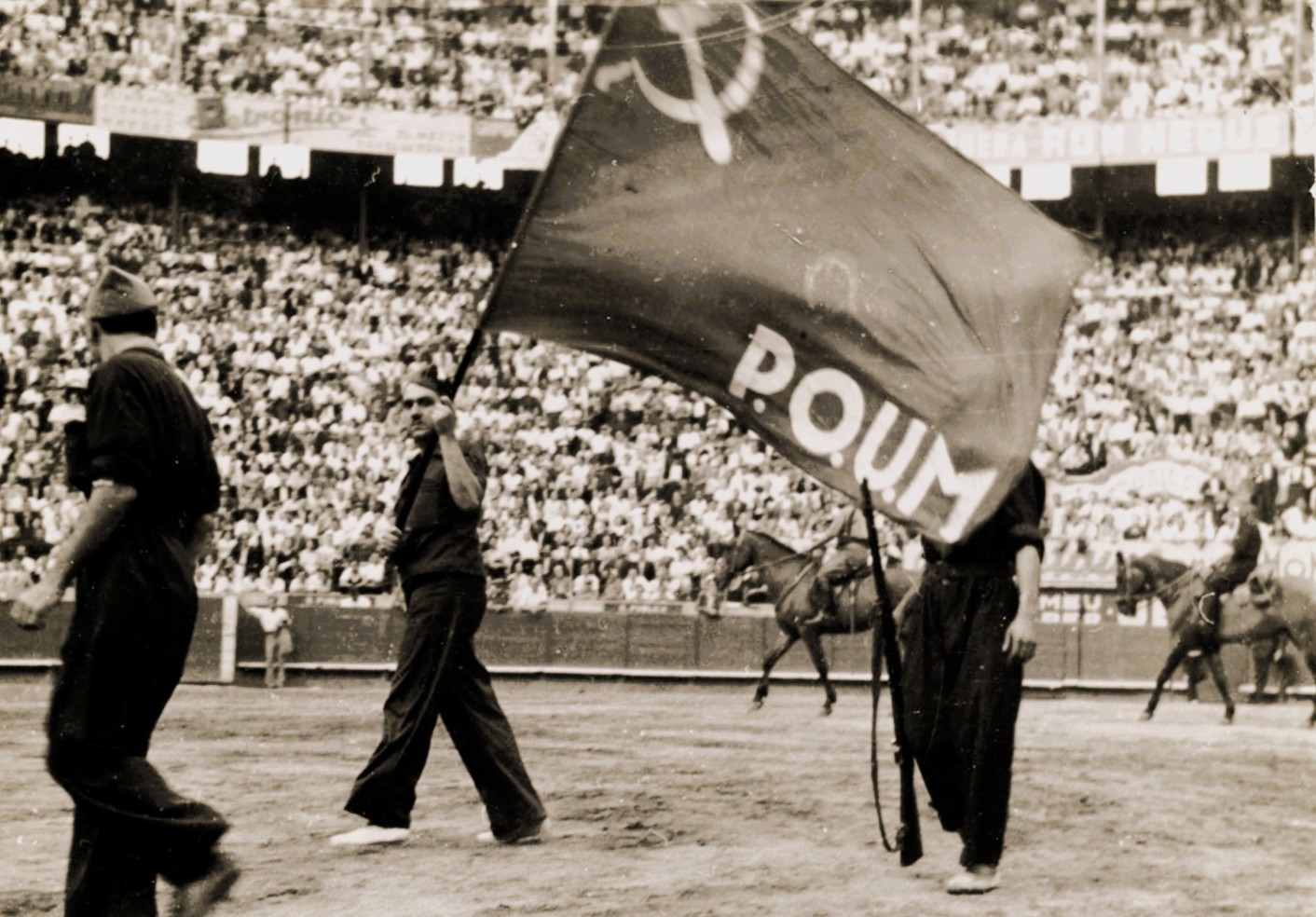
A rarity where, after the revolutionary events in Spain of late 1934 created new circumstances, sections of the ‘Left’ and ‘Right’ Oppositions successfully united. Nin announces the agreement that would create the Partido Obrero de Unificación Marxista, the P.O.U.M. Beginning as the Catalan section of the Spanish Communist Party led by Jaun Maurin, later the Iberian Communist Federation and aligned with the so-called ‘Right Opposition’ internationally forming the Workers and Peasants Bloc in 1931, the B.O.C. (Bloque Obrero y Campesino). That Bloc would unite Andreu Nin’s “Left Opposition”, the Communist Left of Spain (Izquierda Comunista de España, I.C.E.), to establish the P.O.U.M. in 1935.
‘Towards Marxist Unity’ by Andres Nin from International News (R.W.L.). Vol. 1 No. 4. October, 1935.
(Article appearing in La Batalla, organ of the B.O.C., August 23)
The Workers and Peasants Block and the Communist Left have just taken an important step on the road toward unity. The joint commission designated to elaborate the bases of agreement The fusion into a single has satisfactorily finished its work. The party of these two organizations who until a few months ago had engaged in fierce combat, can be considered an accomplished fact for we have not the slightest doubt that the task realized by the commission will be enthusiastically seconded by the membership of both organizations.
No class-conscious worker will fail to see the importance of this first step which is not lessened by the fact that the majority of the parties that participated in the negotiations at the outset withdrew to their tents, bearing the historic responsibility of turning their backs on that which is the ardent will of the entire proletariat.
The step taken is of indisputable importance for two reasons: The first, because with this partial fusion the possibility of a much broader unification is demonstrated; the second, because it points out the road to be followed, which is not that of unification for its own sake, but on the firm basis of absolute agreement in principle and on the fundamental tactics.
It is on this second point that we wish to be particularly insistent, as it is, in our opinion, of the greatest importance.
The working class of our country has need of a powerful centralized party. Without it, the will to struggle that animates the toiling masses, the fountain of energy and heroism which it possesses will be sterilized. Its triumph over the bourgeoisie, without which the Spanish Revolution will inevitably flow into Fascism, will be impossible.
It is evident that at the present moment the Spanish proletariat has no such party. But on the other hand, inside the present parties and among the thousands of workers who stand aloof from them awaiting the appearance of a political force capable of inspiring them with the necessary confidence, there are more than enough elements for the creation of a party that could sweep all before it and turn the course of events towards proletarian victory. To gather together these elements, coordinate their action, this is the most urgent task of the moment.
But to realize this fusion would not represent progress, but rather retrogression if it were carried out at the expense of fundamental principle concessions. In such a case we would achieve the creation of an organization with a large membership, but which would turn out to be ineffective for action; we would be forging a weapon that would break in the first serious combat; we would be raising up an edifice that would topple under the effects of the first wind-storm.
The objection will be raised Must we then create a sectarian party, characterized by the purity of its principles but incapable of leading the masses? By no means. The radicalization of the toiling masses of our country, the irresistible leftward evolution of a great part of the Socialist Party and especially of its Youth, and the need of drawing the Spanish Revolution out of the doldrums in which the parties of the petty bourgeoisie have left it, forcibly imposes upon us the creation of a mass workers party the effectiveness of which will be measured precisely by its greater or lesser identification with the principles of revolutionary Marxism. Not to follow this course which is that laid down by the B.O.C. and the I.C.E. in their fusion is to lead the labor movement to another certain defeat.
We are absolutely certain that this first step will be a powerful stimulus to the revolutionary workers of the whole country, that within their own organizations they will pose sharply the question of unity, and that in a short period of time no one can oppose the fulfillment of the fervent longing of the Spanish proletariat without bringing upon himself the most intense hostility of the working class, which will consider as traitors to its cause those who try to maintain the present division.
International News was the theoretical journal of the Revolutionary Workers League (first calling themselves the Left Wing Group of the Workers Party), publishers of ‘Fighting Worker.’ It began with the split in the Workers Party in 1935. In 1936 it was renamed ‘Fourth International’ (not to be confused wit the SWP’s theoretical journal of the same name from 1940-56) from 1936 to 1939 and was renamed The Marxist in 1939 which lasted on that year. Fighting Worker was the newspaper of the Revolutionary Workers League from 1936 until 1947. The RWL was a 1935 split from the Workers Party of the U.S. led by James Cannon and allied with the Movement for the Fourth Interntional led by Leon Trotsky. Led by Hugo Oehler and Tom Stamm, the RWL opposed the ‘French Turn’ then happening in world Trotskyism whereby national sections were joining left-moving Socialist Parties. Fighting Worker and the RWL at first positioned themselves as oppositional Trotskyists, but by 1938 refuted Trotsky and his international movement as “degenerate.’, The exact date of Trotsky’s degeneration causing an organizational split between the group’s founders and, for a time, two rival Revolutionary Workers Leagues with papers called Fighting Worker. Oehler went to Spain to make contact with the POUM but was arrested during their suppression. Declaring a rival Provisional International Contact Commission for the New Communist (Fourth) International in 1938, they briefly joined with the Leninist League (UK) and the Revolutionary Communist Organization (Austria). Fighting Worker would be published monthly and then every two weeks in Chicago and New York. After suffering a series of splits in the late 1930s, including of Tom Stamm, the RWL went into decline and Fighting Worker ceased publishing entirely in 1947. In addition to Fighting Worker, the RWL published local, labor, and theoretical papers.
PDF of full issue: https://www.marxists.org/history/etol/newspape/international-news/v01n04-oct-1935-RWL-Intnat-News.pdf
 Revolution's Newsstand