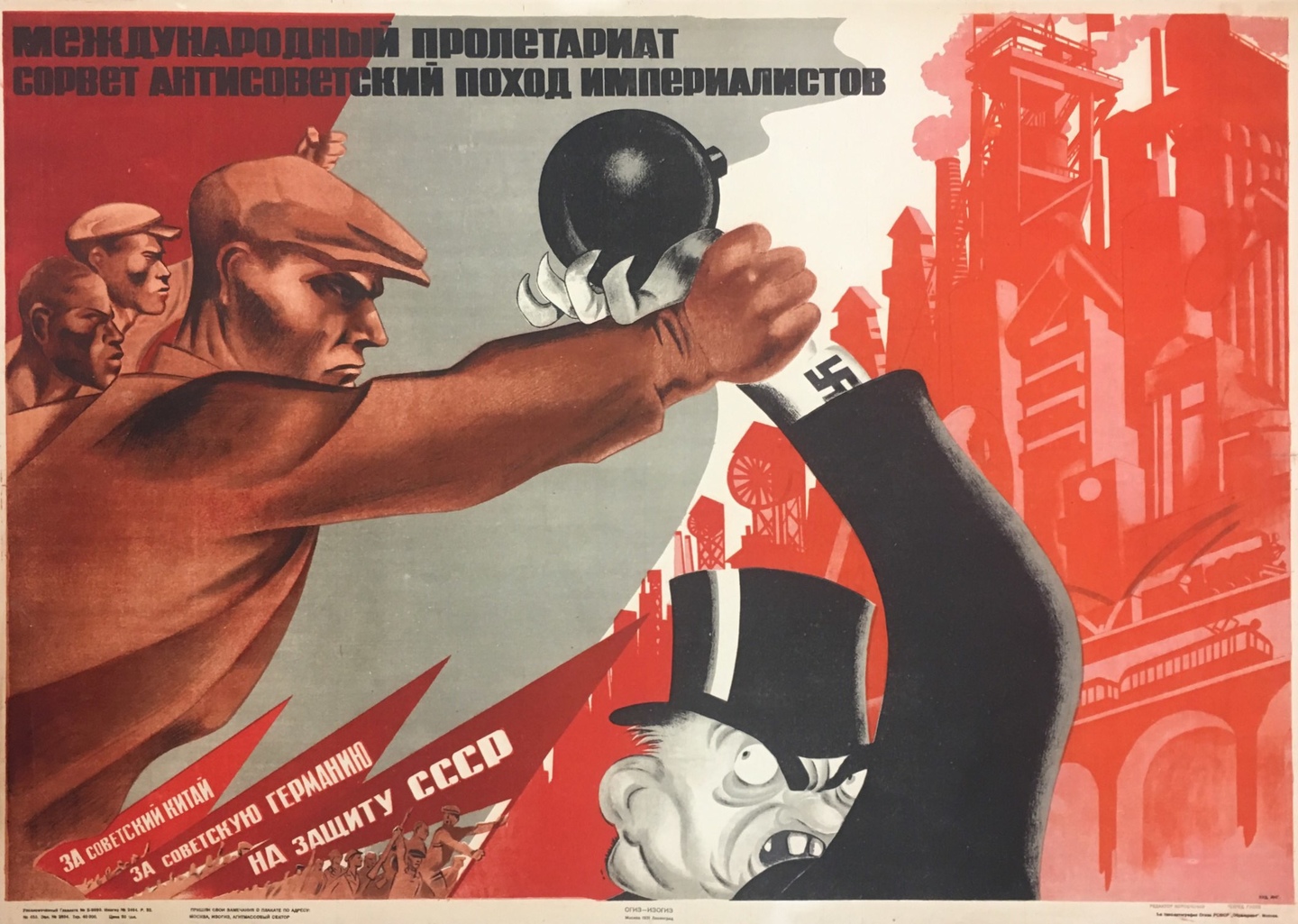
Like all attempts to move beyond capitalism, the Soviets were greeted with the most savage, unhinged violence from their very beginnings by the ruling class and its agents. The anti-Communist terrorism of the 1920s saw the first fascist governments and a ring of right-wing dictatorships brutally installed in nearly every bordering region by the end of that decade, with the Japanese invasion of Manchuria in 1932 and the victory of German fascism in 1933 surrounding the new Socialist state with hyper-militarized reaction. A look at the process as it had developed in 1927 with sections on Finland, Estonia, Latvia, Lithuania, Poland and Romania.
‘The Fascist Ring Round the Soviet Union’ by M.G. Bach from International Press Correspondence. Vol. 7 Nos. 17 & 19. March 3 & 11, 1927.
The seizure of power by Pilsudsky in May 1926, the Fascist coup d’état in Volmar (Latvia), the destruction of the White Russian Hromada, which went hand in hand with an unprecedented terror against all the national minorities which are settled in Poland on the borders of the Soviet Union, all this is in the closest connection with the plans of intervention of British imperialism. The interventionalists aim at the victory of Fascism in the Baltic border States and Poland, so that they may have cover in the rear in case they undertake a campaign against the Soviet Union.
In the following article, it is our intention to give evidence of the existence of Fascist organisations in the Baltics and to expose the socio-political roots of Baltic Fascism and of its foreign political orientation. At the same time we shall endeavour to show to what extent Baltic Fascism is bound up with the administrative and especially the military apparatus of the countries in question, and in what measure Fascism has at its disposal man power from the border States, in the case of a war against the Soviet Union.
I. Finland and Esthonia.
Finland may be described as the birth-place of Fascism. Several years before Mussolini came into power in Italy, the Finnish bourgeoisie formed a war-patriotic class organisation, the so-called defence corps which, in 1918/19 bathed the revolutionary movement in the country in blood. Although the Finnish bourgeoisie has on the whole “stabilised” itself in the course of the last few years by the use of terror and merciless measures of repression, the Fascist troops, the defence corps, have not been dissolved.
The extremely modern corps with up-to-date weapons, over 100,000 strong, are comprised, in the towns, of bourgeois juveniles, sons of industrialists, reserve officers etc., and in the country of landowners and rich peasants. The officers’ corps of the defence militia, trained in Germany in pre-war times, are known to have monarchist leanings.
The object of this defence corps is officially the “support of the organs of administration in the defence of the State against outrages”. Actually, however, the defence corps are, in peace time, an organisation of the Finnish bourgeoisie for class war, with the object of intimidating the revolutionary workers by terror and of defeating the proletariat in its economic fight by organised strike-breaking. In times of war, the defence corps will be used as an excellently trained fighting force, far more reliable than the official army in which there are also “Red elements”.
A peculiarity of Finnish Fascism, which is important, is that the defence corps is part of the general system of defence of the country. They are under the command of the Finnish Ministry for War and receive a subvention from the National Budget (in the draft Budget for 1927, recently passed by the Finnish Parliament, 30 million Finnish marks are granted for the defence corps). The whole country is divided into twenty-one defence corps districts; at the head of each is a district commander with a corresponding staff. The Commander in Chief of the defence corps is appointed by the President. The light weapons are distributed to the individual members, the guns, tanks, air-craft etc. are kept in special arsenals. The defence corps regularly organise manoeuvres, which are sometimes quite extensive and in which all arms take part. The actual leader (although officially only the honorary leader of the Fascist troops in Finland) is the executioner of the Finnish revolutionary movement, the former Czarist general Mannerheim.
A political supplement to the defence corps is the “League for the Protection of Finland”, which has sections throughout the country. The chief objects of this league are to collect material means for the defence corps, chiefly for arming them, and Fascist political organisation. There exists further a women’s auxiliary organisation (the so-called “Lotty Sward”) to which tens of thousands of women belong. Their object is the “moral” and material support of the defence corps and of their ambulance work.
The international connections of Finnish Fascism should also be emphasised. The Finnish defence corps entertain close relations with Germany militarism and Russian monarchist emigrants. The leaders of the Finnish defence corps are also leaders of similar Fascist organisations in Esthonia, Latvia and Lithuania.
Although the Finnish defence corps are a considerable force, there is no absolute unity in their ranks, but conflicts and contradictions may be observed. Above all, there is a certain antagonism between the Republican and monarchist elements. Further, one section of the leaders of Finnish Fascism consider it legitimate to use the defence corps for international, counter-revolutionary adventures, for instance for intervention against the Soviet Union, whilst another section regards the defence corps exclusively as a means for combatting revolutionary movements in the country itself. Thirdly there is national friction within the defence corps, as the majority of the officers is from Sweden, whilst 75% of the privates are Fins. There are also some differences between the defence corps and the General Staff of the army, which sometimes assume a serious character.
In spite of this internal friction and these conflicts, there has so far been no split in Finnish Fascism. The fear of the revolutionary proletariat is still too great and is the cement which holds Finnish Fascism together.
Why has the Finnish bourgeoisie, with such a strong Fascist organisation, not yet openly gone over to a Fascist dictatorship? Because the Finnish bourgeoisie, even without an open dictatorship has always, in cases where it found it desirable, been able to carry through an undisguised Fascist dictatorship under the cover of the Constitution and of Democratic parliamentarism. Was there not, until recently, a bourgeois Coalition Government at the helm in Finland, which considered no means too bad to be used against the revolutionary movement. In order to illustrate with what unconcern the Finnish bourgeoisie trifles with parliamentarism, it is enough to mention the fact that at the end of 1923 the Government had the whole Left Socialist parliamentary fraction, numbering 27, arrested.
Although, however, the Finnish bourgeoisie has not, up to the present, adopted an open Fascist dictatorship, it by no means implies that it is out of the question in the future. Just at the present time, the danger of a Fascist dictatorship in Finland is increasing. For the first time for eight years, a purely Socialist Cabinet came into power in the middle of December last year. Although the Social Democrats of Finland are in no way distinguished from other parties of the 2nd International which inspire the bourgeoisie with no particular fear, and although the Social Democratic Cabinet in Finland today owes its existence exclusively to the mercy of the bourgeois parliamentary majority, the mere fact that a Social Democratic Ministry could be formed, has called forth increased activity of the Fascist organisations, which are following with great attention the work of the new Cabinet.
The possibility of a Fascist coup d’état in Finland is not out of the question, if the Social Democrats at the helm do nothing in the fight against Fascism and at the same time prevent the formation of a proletarian united front. It is hardly thinkable that the Social Democrats will put any hindrances in the way of the further work of the Fascist defence corps. Only recently (December 1926) a section of the Finnish Social Democrats in Parliament, though but a small section, when the Budget of the War Ministry for 1927 was being discussed, openly made a speech of defence for the defence corps and described them as the “guardians of Democratic law and order”. The Right wing of the Finnish Social Democrats voted for the defence corps in Parliament. Thus we see that the danger of a Fascist coup d’état in Finland is by no means out of the question.
In Esthonia, as in Finland, the Fascist organisations are closely intertwined with the administrative and military apparatus. In Esthonia also there is a large Fascist army (20,000 to 25,000) which is organised into defence corps. They arose, with the direct participation of the Government, after the failure of the revolutionary insurrection of the workers and soldiers of Reval (December 1st 1924). There were, however, Fascist organisations in Esthonia even before that, both of a semi-military character, so-called volunteer divisions, and of a political nature, the so-called Esthonian Liberal People’s party. The volunteers are a class organisation of the wealthy peasants, house owners, employers and bankers. They are thoroughly well armed and are regularly trained on military lines. Their chief task is to terrorise the revolutionary movement and to intimidate the proletariat.
These Fascist bands enjoy no great sympathy among the population, both because of their arch-reactionary attitude and also because, among the “volunteers” there are numerous criminals, secret police agents and other scum of society. Even the political organisation of Esthonian Fascism, the National Liberal People’s party which has already been mentioned, with Admiral Pitka at its head, enjoys very little sympathy (this Admiral Pitka is well known from his brutality towards the Esthonian proletariat in 1918/19). At the election of 1923, this party won four seats in Parliament, in 1926 not a single one.
The Reval insurrection of 1921/22 convinced the Esthonian bourgeoisie that, in spite of the bitterest persecution of the Labour movement, in spite of the terror of the “volunteers”, the attitude of mind of the Esthonian proletariat is still revolutionary. The proletariat of Esthonia has never forgotten the “blood-letting” practised on it by the bourgeoisie hand in hand with Social Democracy which joined the Coalition Government the day after the insurrection, and with General Laidoner at its head, in which many of the best proletarian fighters of Esthonia lost their lives.
The bourgeoisie, however, was not satisfied with the bloodthirsty terror which is still practised against the revolutionary movement, but in order to prevent a repetition of a similar revolutionary insurrection, it created a network of Fascist military organisations on the lines of the Finnish defence corps. The defence corps which are organised in all the towns and villages are chiefly recruited from bourgeois strata. In the towns, its members are chiefly students, bourgeois schoolboys from the higher classes, sons of houseowners and employers, in the villages, the rich peasants. Here also, the defence corps not only receive considerable support from private sources, but also subventions from the Treasury of the War Ministry (granted in the National Budget). Here also, the defence corps have two functions; in peace time they are a weapon of the ruling bourgeoisie, in the case of war they would be used as supplementary troops which are superior to the standing army of Esthonia, both numerically and as regards “reliability”.
As in Finland, in spite of a strong Fascist organisation, the Esthonian bourgeoisie refrains from an open Fascist dictatorship. It prefers to govern under the mask of parliamentarism and Democracy, but in doing so, does not shrink from the most brutal measures in the fight against the revolutionary movement.
II. Latvia.
In Latvia the danger of a Fascist coup d’état is most imminent. Among the most influential Fascist organisations of Latvia we have in the first place the so-called “Aizsargi” (or Latvian Defence Detachments), which are organised after the model of the Finnish detachments of this kind. What is most characteristic about these defence detachments in Latvia is the fact that their activity is limited almost exclusively to the open country. In the towns no defence detachments have as yet been formed. The Latvian Aizsargi are armed, receive a regular military training, and are divided into companies, battalions, and so on. In each administrative district there are such regiments, which are under the orders of the district chief and subject to the War Ministry in general matters of administration. Besides their small arms, the defence regiments have at their disposal machine-guns and light artillery. According to official statistics the number of Aizsargi in 1925 was 18,500, though this figure includes only the active members of the force. It is no exaggeration to assume that at present the total of active Aizsargi (receiving a military training in the army) and passive Aizsargi (wealthy peasants’ sons trained in the use of fire- arms) together, ranges from 30,000 to 35,000, thus exceeding the numbers of the standing army of Latvia, which in times of peace figures at between 22,000 and 25,000 men.
According to official statistics, 52 per cent. of this total are made up of well-to-do peasants, 26 per cent. of middle peasants and new settlers, and the rest of “patriotically minded agricultural workers” (?) and farmhands. As we may see, the kulaks play the leading role in the Aizsargi and are thus also in à position to dominate the open country and to terrorise all progressive movements, in particular any trade union or cultural organisations among the agricultural workers, of whom there are some 200,000 in Latvia.
The activity of the Aizsargi, however, is not restricted to combatting revolutionary movements in the open country, as the official organ of the defence detachment (“Aizsarge” Riga 1926, No. 3, p. 84) announces, these formations “must also form the basis in opposing an enemy from without.” In discussing the military expenditure in the budget committee, General Balodis, former Commander-in-Chief of the Latvian army and now one of the leaders of the kulak peasant league which was until recently in power, opposed the Social Democratic motion for the liquidation of the defence corps and remarked: “60 per cent, of the Aizsargi are men who have seen service. They are now better armed than our regular army was in 1919. We must therefore reckon with them as with a military force. The institution of the Aizsargi must not be liquidated, but rather developed.” It may be pointed out that this solicitude for the defence corps synchronises with the general increase in the Latvian armaments. It suffices to remark that in 1926 the total expenditure of 166 million lats (one lat equalling about 91/2d.) comprised 46 millions, on almost 28 per cent. for war expenses. 14.5 million lats and 160,000 cartridges were granted expressly for the defence corps, besides which the latter enjoy a considerable revenue out of local funds.
As in Finland, the defence corps in Latvia are furnished with two auxiliary organisations. One of these is the “Association for the Defence of Latvia”, which carries on a patriotic militarist agnation, collects funds for national defence purposes, publishes a military-Fascist monthly, and sees to the “cultural development” of the Aizsargi. The members of this organisation are all officers of the higher ranks, Fascist intellectuals, employers of labour, house-owners, and the like. In the second place there is the “Women’s Defence Corps” modelled on the Finnish “Lotty Sward”. It was founded early in 1926, but already comprises more than 130 detachments with 3000 members.
Forced by the pressure of the proletarian masses to abstain from forming similar defence corps in the cities, the Latvian bourgeoisie has created a series of open or covert Fascist organisations, such as the Latvian national club known as the “Guardians of the Country”, the “Guardians of Latvia”, the “Latvian National Youth League”, the “Latvian Warriors’ Union”, and the “Sokol”. The most powerful and influential of these is the Latvian National Club, a militarist fighting organisation, which has for the last three or four years openly been preparing for the establishment of a Fascist dictatorship and is supported materially by all the Right, reactionary, and bourgeois parties of Latvia.
The Latvian National Club is in closest touch with the leaders of the General Staff and the political police. Most of the members are armed and receive a military training. The National Club, which comprises 80 sections, has a total membership of 3500. Of late, however, the Fascist movement in Latvia has been seriously compromised by a series of infringements of the penal code, in which active members of the club were involved. The authorities saw themselves obliged to intervene and even to close the club, which is, however, continuing its activity under the style of “Club of Latvian Nationalists”. At the beginning of 1926 it even came to a split, and there arose a new organisation, the “Guardians of Latvia”. This split, as well as the existence of numerous other organisations do not exclude the possibility of united action on the part of the Fascist formations. There is a “Congress of Nationalist Organisations of Latvia”, which meets periodically and elects the “executives” of the Fascist organisations. The next session is to be in April 1927.
After the coup d’état in Lithuania, which synchronised with the formation of a Left-bourgeois-Socialist Cabinet in Latvia, the activity of the Latvian Fascists increased prodigiously. The reactionary Latvian press openly sang the praises of the Lithuanian Fascists and initiated a violent campaign against the Left Government of Latvia. The organs of the Right threatened the Social Democrats quite openly with developments such as took place at Kovno on December 17th, 1926. In the night of January 21st, 1927, the first attempt at a Fascist coup was made by the abortive adventure of Lieutenant Olin at Volmar, an extremely Fascist provincial town. There is now no longer any doubt that the events at Volmar were merely the beginning of a movement long prepared by the Fascist organisations for the deposition of the Government and the setting up of a Fascist dictatorship. Nevertheless, the Social Democratic Prime Minister Skuyenek declared to representatives of the press that the action of Lieutenant Olin was devoid of any political character. A similar opinion was expressed by General Bangerski and by the Minister of War, upon receipt of a report by the three Fascist generals entrusted with the investigation of the events at Volmar.
It is only now, after the occurrences at Volmar, that the Social Democrats are beginning to speak of the danger of “putches” from the Right. True, the Government has resolved on a bold stroke, the arrest of a single Fascist, a prominent leader of the Latvian National Club. At the same time, however, the Socialist Government has released all participants in the Volmar coup from arrest, with the exception of Olin himself. Throughout the country, meanwhile, the systematic persecution of Left trade Unions continues. A number of Left trade union leaders have been arrested, and all publications of the Left trade unions which call for an energetic fight against Fascism, have been confiscated. From the latest reports to hand we see that the Social Democrats and the reformist trade- union centre have declined the proposal of the Left trade unions for the formation of a united front of the anti-Fascist proletariat.
It would thus seem that the occurrences in Lithuania are to be repeated in Latvia. The Fascists are making energetic preparations for a coup. The flabby Government cannot make up its mind to adopt energetic measures against the Fascists, and therefore persecutes the revolutionary movement. The Social Democrats reject the united front and thereby facilitate the victory of Fascism.
III. Lithuania and Poland.
Whereas the Fascist dictatorship is still in course of preparation in Finland, Esthonia and Latvia, it is already at the helm in Lithuania and Poland.
Both in Poland and in Lithuania we see a complete collapse of parliamentarism; parliaments are only tolerated in so far as they are complaisant to those in power, the dictators and the social strata which support them. Woldemaras, Prime Minister of Lithuania, openly declares that he will immediately dissolve the Seym it if passes a vote of non-confidence in the Government. (See “The Riga Review” of January 31st 1927).
Pilsudski still tolerates the Seym, as the latter has eaten humble pie and as the Polish bourgeoisie has accommodated itself to the Pilsudski regime with all its dodges. Both in Poland and in Lithuania the Fascist Government is turning against the working masses with all the power of the apparatus of State; the Warsaw Government is severely sitting in judgment on the White Russian Hromada, an organisation of hundreds of thousands of White Russian peasants, it is terrorising the working population of West Ukraine and is setting in motion the most unprecedented terror against the whole revolutionary movement of the country.
In the domain of foreign policy, we see in the Poland of Pilsudski, the growth of militarism and hear open declarations as to the necessity of extending the Polish frontiers “towards the East, beyond the Bug and the Dnieper”. Systematic preparations for the annexation of Lithuania are being made in Poland in order to create, under England’s instructions, a convenient ground on which to draw up troops, in case of intervention against the Soviet Union.
We see the same in Lithuania. The “Christian” bourgeoisie is not satisfied with slaughtering the best leaders of the Lithuanian, workers, but is having more wholesale death sentences passed by its courts. The trade union movement is shattered and deprived of its leaders. All “democratic freedom” is annihilated; strikes, meetings of workers are prohibited. A state of war has been declared and the censorship introduced. The unrestricted power of the Jesuits and priests has been restored. The national minorities are being terrorised in Lithuania as in Poland.
What is the orientation of Fascist Lithuania in its foreign policy? For “internal use”, for deluding the masses, Woldemaras still demands that Poland return Vilna. In reality, however, semi-official and secret negotiations are being carried on with Foland, about which the Press of Berlin, Riga, Warsaw and Vienna give reports.
According to reports which have not been refuted, “unofficial” negotiations were carried on in Kovno at the end of January between an emissary of Pilsudski, the daughter of the Polish Prince Radziwill, and Woldemaras. At the beginning of January, as the Polish semi-official Press reports, negotiations were started in Vilna between the representatives of Lithuania and Poland and, as the Riga newspapers report, with the participation of Mr. Wohan, the English ambassador in the Baltic States, who came to Vilna especially for the purpose. We are not informed as to the concrete purport of these negotiations, but it is undoubtedly the task of the English ambassador to “reconcile” Fascist Lithuania with Poland as it is impossible to form a broad anti-Soviet bloc of the Baltic countries under the leadership of Poland and the general control of England without this “reconciliation”.
It was no mere coincidence that, as the semi-official organ “Listuva” reports, Mr. Wohan, in his discussion with Smetona, the President of Lithuania displayed great interest in the question of establishing friendly industrial relations between Poland and Lithuania. Neither is the visit of Jurgutis, the Director of the National Bank of Lithuania, to London a coincidence; this visit was for the purpose of taking up a foreign loan, the prospect of which had been held out by England, whereas England had, up to that time, granted no credit to the Slaschewitz Government. There can be no doubt that Fascist Lithuania will, sooner or later, throw itself into the arms of Poland.
IV. Roumania.
In order to give a complete picture of the Fascist ring which surrounds the Soviet Union, we must deal briefly with Fascism in Roumania. In Roumania, the whole policy of the present Roumanian Government is Fascist, as it can only maintain its position by terrorising all those who are of a different opinion and by oppressing the strong national minorities which are trampled underfoot by the Boyar occupants. The oppression of the working population of Bessarabia, which is fighting obstinately against the abhorred “conquerors”, is especially cruel.
The Roumanian bourgeoisie has also, by way of supplementing its arch-reactionary apparatus of administration and justice, created “voluntary Fascist organisations”, which, from time to time, attract general attention by their progroms. These Fascist bands are almost exclusively recruited from students and other strata of bourgeois young people, under the leadership of “Fascist ideologists” of the type of Professor Cuza (a kind of Roumanian Purishkewitch). The Roumanian Fascist students’ organisations occupy themselves chiefly with organising pogroms against the Jews both at the Universities and in the Jewish quarters of the towns. Quite recently, in the middle of December 1926, such wholesale pogroms took place in Kishinev, Jassy and Klausenburg. The Roumanian bourgeoisie needs such progroms against the Jews, no less than did the old Tsarist Russia in its time, in order to distract public attention from the social political reaction.
The Fascist movement, however, does not restrict itself to anti-Semitism alone. The Roumanian Fascists render other valuable services to the bourgeoisie; they smash up Labour organisations, disperse meetings, provide strike-breakers etc.
It is easy to foresee that in case of intervention against the Soviet Union, Roumania will be one of the most faithful servants of English imperialism. It was not for nothing that Bessarabia was recently transformed into a special military territory and that a military Governor General with great authority was appointed there.
A survey of the Fascist movement to the West of the Soviet Union shows that a Fascist ring is being successfully welded against the Soviet Union. The Western neighbours of the Soviet Union, are joining into a Fascist, anti-Soviet bloc, with the direct support of English imperialism, which is arming for intervention against the Soviet Union.
As yet this bloc is not completed, nor is the ring round the Soviet Union closed. Up to the present, Germany has withheld its consent to English intervention. The bargaining continues in the foreign offices of the Great Powers. Germany is setting hopes which are not unfounded, on the support of England and demands that the frontiers laid down by the Treaty of Versailles be changed, above all that the Danzig corridor be removed. Poland, however, still remains inflexible and solemnly declares through the mouth of Zaleski; “not a hand’s breadth of Polish soil; every man to the defence of the fatherland”.
The danger of intervention, however, cannot be doubted, and the progress of Fascism in the border States involves an increase of this danger. It is of course not a mere chance that this coincides with the negotiations which are being carried on between the Soviet Union and the Baltic countries for the purpose of concluding a guarantee treaty for ensuring peace in Western Europe.
Should, however, the danger of intervention become a reality, the working masses of the Soviet Union, in close alliance with the revolutionary proletarian masses of the West, will fight for the defence of the only proletarian republic of the world against the imperialist robbers of the world, in order to prevent possible repetitions of intervention against the Soviet Union.
International Press Correspondence, widely known as”Inprecorr” was published by the Executive Committee of the Communist International (ECCI) regularly in German and English, occasionally in many other languages, beginning in 1921 and lasting in English until 1938. Inprecorr’s role was to supply translated articles to the English-speaking press of the International from the Comintern’s different sections, as well as news and statements from the ECCI. Many ‘Daily Worker’ and ‘Communist’ articles originated in Inprecorr, and it also published articles by American comrades for use in other countries. It was published at least weekly, and often thrice weekly. Inprecorr is an invaluable English-language source on the history of the Communist International and its sections.
PDF of full issue: https://www.marxists.org/history/international/comintern/inprecor/1927/v07n17-mar-03-1927-inprecor-op.pdf

