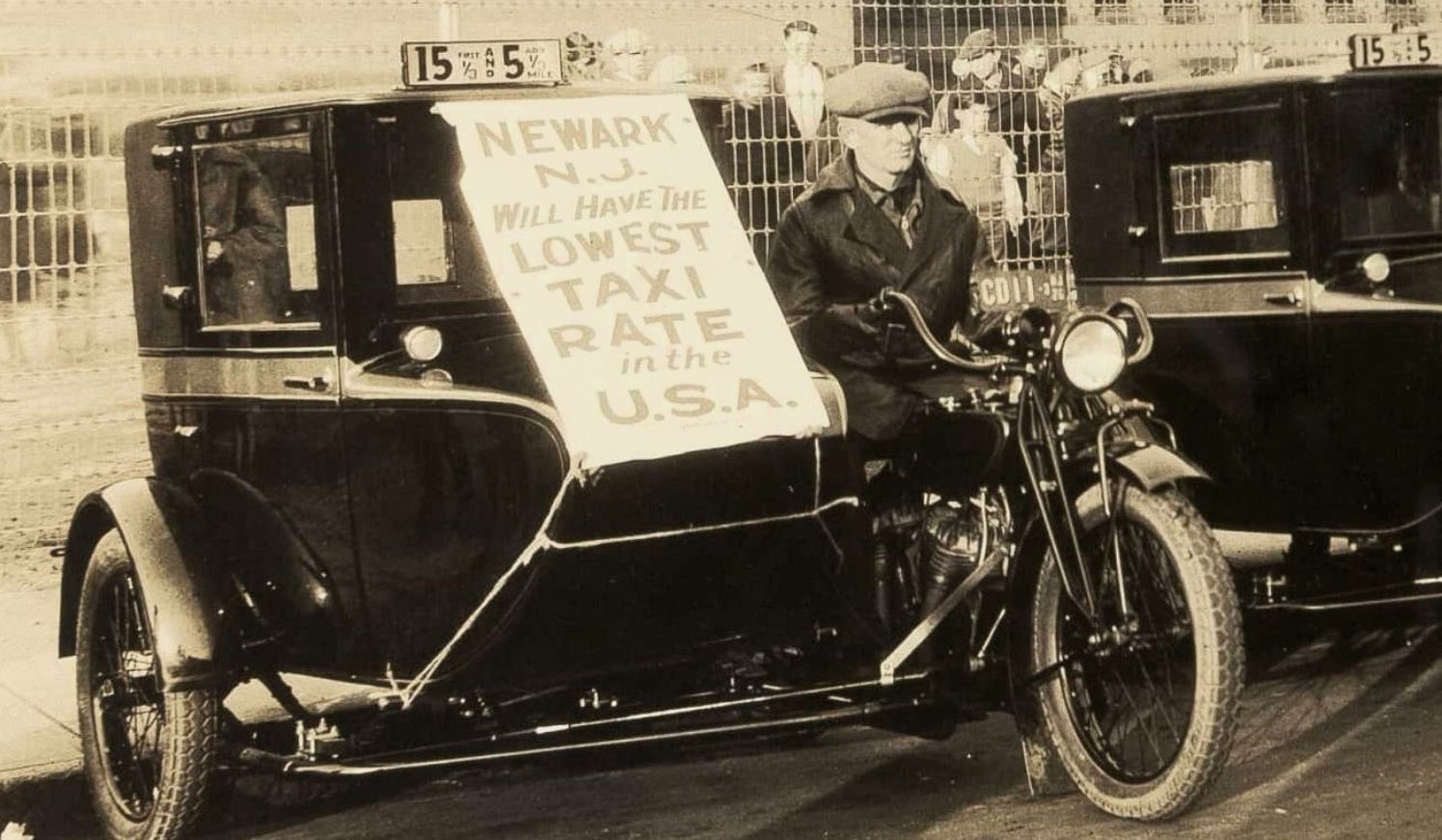
Teamsters bureaucrats sell out an organizing drive among New Jersey cabbies.
‘Taxicab Drivers Betrayed in Newark’ by Irving Freeman from Labor Unity. Vol. 2 No. 5. June, 1928.
TWO months ago the taxicab drivers employed White Co., in Newark, N.J. started a drive amongst themselves to unionize. They rebelled against the tyranny of their superintendent, Mr. Miller. The workers suffered under a speed-up system introduced by the company, a stock selling scheme imposed upon the workers, a method of compelling the men to pay for dead mileage and shortage brought about by petty officers and supervisors who turned on, the clocks when they stopped in a lunch room or cafeteria to get a coffee and sandwich. On top of these schemes the workers were compelled to pay for any damages occurring to their machines under $25 in accidents and for losses incurred during holdups. The men in case of a hold-up would make a collection amongst themselves and thus save the victim from standing all of the losses. The company issued an order prohibiting this practice. This act of the bosses added more fuel to the discontent of the men. The men were compelled to work eighteen hours one day a week so that it would be possible for them to get one day a week off. On a Saturday or a Sunday if a worker failed to show up for work, no matter whether the cause was due to illness or otherwise he was penalised with a three-day layoff. Another practice of “discipline” on the part of the company was the imposing of impossible fines upon the workers for appearing late to work.
The taxicab drivers received a 33 1/3% commissioned on their conference with Mr. Bernhard, the strike for their pay, and some tips. The workers rarely earn over $30 per week under the penalty schemes imposed by the company. The driver also revolted against a 62-clause rule book that imposed a yellow dog contract on them. The employees were compelled to sign in their application when hired a statement that they would not join any union or urge others to join a labor union. For the past six weeks City Limit Taxicabs have appeared in the city. The arrival of these 50-cent cabs reduced their small earnings.
Promise Charter
When the workers started to organize they enlist ed the support of the engineers and Joseph Fay their agent and a local Democratic politician plus a certain Mr. Crowley, who had been a welfare worker, a clerk in the police headquarters, and had worked to secure more salary for police when they were voted their increase. Mr. Fay interested the Brotherhood of Teamsters International officers locally and nationally Teamsters’ officials were Brothers: Slater, Cachel, Carlin, Edward Levy, Jennings and Buckley from Jersey City. At the second organization meeting 27 of the workers were fired by the company. This was the overt act that caused the strike. The local taxi-cab workers had organized themselves and elected officers including an executive board. The executive board acted as the strike committee.
When the men started to organize they were promised a charter from the International Brotherhood of Teamsters and Chauffeur in a short time. Then the strike started and they continued to get the same promise. In a few days the cabs of the Yellow & Brown & White Companies were practically all tied up.
Then began the importation of New York gangsters and no arrival of a charter. The Yellow Cab Co. who have powerful political and economic resources used their influence against the strikers. They practically bought up the local press with advertisements and by other means. They secured an injunction and reached the police so that these made extra efforts to watch the strikers.
A week passed and no charter arrived! The strikers conducted a militant fight against their bosses. They picketed, took strikebreakers off the cabs and tied up the cabs and the earnings of the company.
Men Demand Guarantees
Meanwhile a committee consisting of Mr. Joe Fay, Mr. Breitkoff, their attorney, Brothers Tyman and Murphy were chosen to represent the men at a conference with Mr. John Bernhard, the secretary of the Yellow Cab Co. Inc., who own the Brown & White Co., also. They met him and the company agreed to rehire all the men on strike if they returned to work immediately and all the grievances would be arbitrated with the committee by the following Thursday which was 48 hours after the men voted to call off the strike, and go back to work.
At the meeting when Mr. Fay and Breitkoff reported on their conference with Mr. Bernhard, the strikers revolted and demanded what guarantees the workers would have against being fired in a few days for their activities during the strike. They riddled their committee with all kinds of questions. They harped on the matter of the charter.
Then began a long line of explanations that the workers had started their move to organize along improper lines and that no charter could be secured in time of strike but would come in the near future.
The workers wanted a union as their only means of protection! They confided in Mr. Fay and the Brotherhood of Teamsters’ officials to get them a charter, but in vain. To date the grievance committee have not arbitrated all their differences; the workers have no charter and they are discontented. From other sources they have information that they were double crossed and that the Yellow Cab Company had reached the International Brotherhood of Teamsters’ officials and influenced them not to issue a charter while the strike was on.
The situation amongst the taxicab drivers in the city of Newark can still be saved! The drivers went back to work, not as a defeated army but as one which had won a partial victory. They went back to work with the idea in mind of securing a charter and unionising ever cab driver in Newark and Essex County. They learned in their twelve day strike who their friends and who their enemies were. They learned to rely no more on lawyers and labor politicians or weaklings to defend their cause.
Labor Unity was the monthly journal of the Trade Union Educational League (TUEL), which sought to radically transform existing unions, and from 1929, the Trade Union Unity League which sought to challenge them with new “red unions.” The Leagues were industrial union organizations of the Communist Party of the United States (CPUSA) and the American affiliate to the Red International of Labor Unions. The TUUL was wound up with the Third Period and the beginning of the Popular Front era in 1935.
PDF of full issue: https://www.marxists.org/history/usa/pubs/labor-unity/v2n05-w24-jun-1928-TUUL-labor-unity.pdf
 Revolution's Newsstand