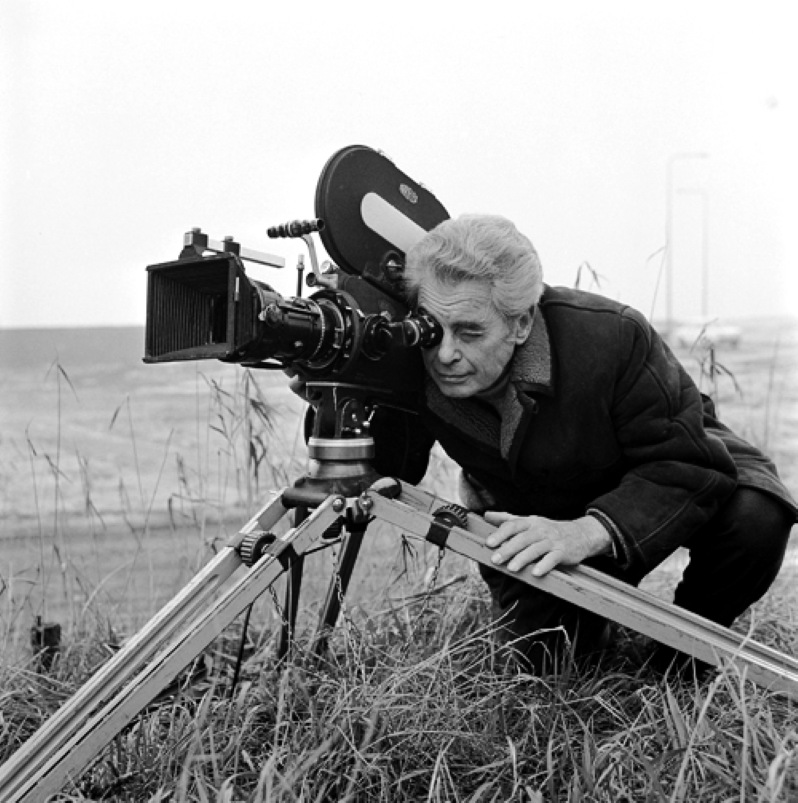
Wolf looks at the early work of prolific radical Dutch documentary filmmaker Joris Ivens, his films The New Land and BBorinage. Spending several years studying and working in the Soviet Union, Ivens moved to the U.S. from 1936 until the end of the war. Here, his most famous production was probably The Spanish Earth on the Civil War and antifascist propaganda work during the War. Ivens worked for sixty years making movies around the, with a focus on the anti-colonial revolutions and Vietnam’s war of liberation, including a13-hour documentary on China’s Cultural Revolution.
‘Too Much Reality’ by Friedrich Wolf from The New Theatre. Vol. 2 No. 3. March, 1935.
WHEN Joris Ivens wanted to produce his great film The New Land (the film is based on the draining of a port of the Zuyder Zee in Holland) in Paris, the presentation was forbidden by the Censor with the sentence: “trop de realite“–“too much reality.” The Paris Censor thus unwittingly paid Ivens the greatest tribute that could ever have been made to a modern cinema director.
Wherein lay the incriminatory nature of this “excess of reality?” The subject of the film, featuring as it does an outstanding engineering feat, is, though very unusual, throughout of a “newsreel” character, never intentionally aggressive. On the contrary, this gigantic work of the “peaceful conquest” of an enormous slice of land, wrested from the sea with the help of Dutch finance capital and the latest technical equipment, might have become a convincing demonstration in favor of the existing social order. And this is the very essence of Ivens’ achievement: What might have been a justification has finally developed into a forceful indictment. As Lenin said, “Things have a way of speaking a language all their own.” All that is necessary is a “mere trifle” to make the facts speak.
How did Ivens accomplish it? As far as the first part of the film is concerned, he managed to get some private citizens interested, who financed it as a sort of “industrial film.” The picture shows how the monster elemental force–the Sea–repeatedly breaks through powerful dams, erected at the price of tremendous efforts, only to be subdued finally by that greatest of all elemental forces–Man, armed with his newest stupendous weapon–modern engineering technique. This struggle of the Titans of our time–Nature–Man–Technique–Ivens portrays in a clear, austere, magnificent montage. Only a past master in the field of film montage could have handled this material with such consummate skill. This conflict of Giants–Man, Sea, Technique–forms the first part of the film. With the help of a dam 34 kilometers long a new land is born. Already wheat is growing in the fields, rows of neat houses are springing up as if by magic, telegraph poles, fertile land, a new world. But simultaneously, growing by leaps and bounds, a third (social) Monster Power is coming into being–the Crisis, the World Economic Crisis. And while Man, by virtue of giant effort, wrested this land from the sea in order to have wheat grown on it, one at the same time sees catastrophic fall of prices on the world wheat exchanges; one beholds the amazing spectacle of a world suffering from a surplus of grain–too much to keep the price level up. We then see thousands of tons of grain thrown into the sea in an effort to stem the precipitate downfall of prices. At the same time we witness a terrible scarcity of bread for millions of destitute workers, starving children in New York, Paris, Berlin, London–all presented in clear, natural, factual montage. That is where the “excessive realism” starts. Here “things begin to speak their own language.” For there is nothing more actual, more demonstrative, than this proof–plainly confronting the eye and possessing the irrefutable logic of a mathematical proposition–this proof of the senselessness and barbarism of this much vaunted system of “peace and order.” “Demontration” (demonstratio quod erat demonstrandum) in its original meaning, as used by philosophers and mathematicians, stood for “what was to be proven.” For the thematics such as this, the film–the montage film–possesses, as no other medium of art does, the power of conclusive proof. It is literally and figuratively–a “Demonstration.”
HIS second great film–“Borinage”–Ivens produced under much more difficult conditions. The film pictures a miners’ strike in the Belgian coal mines and triumphant socialist labor in the Don Bas (coal mining region in the Soviet Union) Only one who has himself gone through a great strike, facing the terror of guards, police and even troops, can realize the skill, knowledge, endurance and courage necessary to film these events correctly and on a mass scale, especially under conditions of illegality. Such scenes as the wholesale eviction of entire miners’ communities from their miserable colonies–permeated with an appalling implacability and yet presented without a trace of sentimentality–cannot be “staged.” There is about them an atmosphere of actuality that no “art” could possibly reproduce. The first part of Borinage unrolls a picture of suffering of the “damned on this earth,” almost inhuman in its cool clarity–something we have never before witnessed in such setting. Yet in the midst of this deep, dull, monotonous oppressiveness, there appears a lightning-like perspective, a bright, keen, flaming ray of light: the miners, slow to move, but unyielding throughout, oppose the eviction of a comrade and are finally driven out of the mine; still unconquered, they demonstrate carrying before them a picture of Karl Marx, painted by one of them. This scene bears the imprint of almost childish primitivity and conveys a sense of unmistakable reality. At the same, time it bears the mark of having been produced by a man who profoundly understands the art of realistic montage. For, it is clear, that sheer “true to Nature” presentation, “naked reality,” does not in itself contain the compelling force of proof: the emotional appeal inherent in facts has to be brought out. We are not mere onlookers, we want to change this world! The manner in which the arrow is poised and let loose will determine whether the spectator is to remain neutral or to be profoundly stirred. In this sense, Ivens reached greater heights in Borinage than in New Land, for in some portions of the latter he still shows traces of being dominated by the material he is handling.
The second part of Borinage takes place in the Soviet Union; it shows the new way, the way out for humanity. As in the case of that other great master of the montage film, Dziga Vertov, the development of Ivens proceeds in a very laborious, in the beginning not very apparent, but, on the whole, entirely consistent manner, leading up to the highest achievements in his latest productions. In his first films The Bridge and Rain, Ivens shows a strong tendency to “formalistic experimentation”; there is an element of “playfulness,” of juggling with his newly-discovered material. After all, how could it be otherwise? Holland had no large film industry of its own, and he was compelled in the beginning to confine himself to smaller “industrial” and “cultural” films. The most interesting in Ivens’ development is the way he came to Marxism. His film work, the material he handled, the “things that spoke their own language” brought him to Socialism.

It is unthinkable that a man with eyes to see and a warm heart beating in his breast could remain indifferent to the eloquent language the “things spoke.” And only through being in the ranks of the workers. could he perceive and comprehend the true proportions, the background, correlation and perspective of the “thing.” And here I think of the inspired words of the young Karl Marx (1844): “The petrified proportions of things must be made to dance, by singing their own melody to them.” These words seem to me to express the very essence of the art of film montage.
The New Theatre continued Workers Theater. Workers Theater began in New York City in 1931 as the publication of The Workers Laboratory Theater collective, an agitprop group associated with Workers International Relief, becoming the League of Workers Theaters, section of the International Union of Revolutionary Theater of the Comintern. The rough production values of the first years were replaced by a color magazine as it became primarily associated with the New Theater. It contains a wealth of left cultural history and ideas. Published roughly monthly were Workers Theater from April 1931-July/Aug 1933, New Theater from Sept/Oct 1933-November 1937, New Theater and Film from April and March of 1937, (only two issues).
PDF of full issue: https://www.marxists.org/history/usa/pubs/workers-theatre/v2n03-mar-1935-New-Theatre-UCD.pdf

