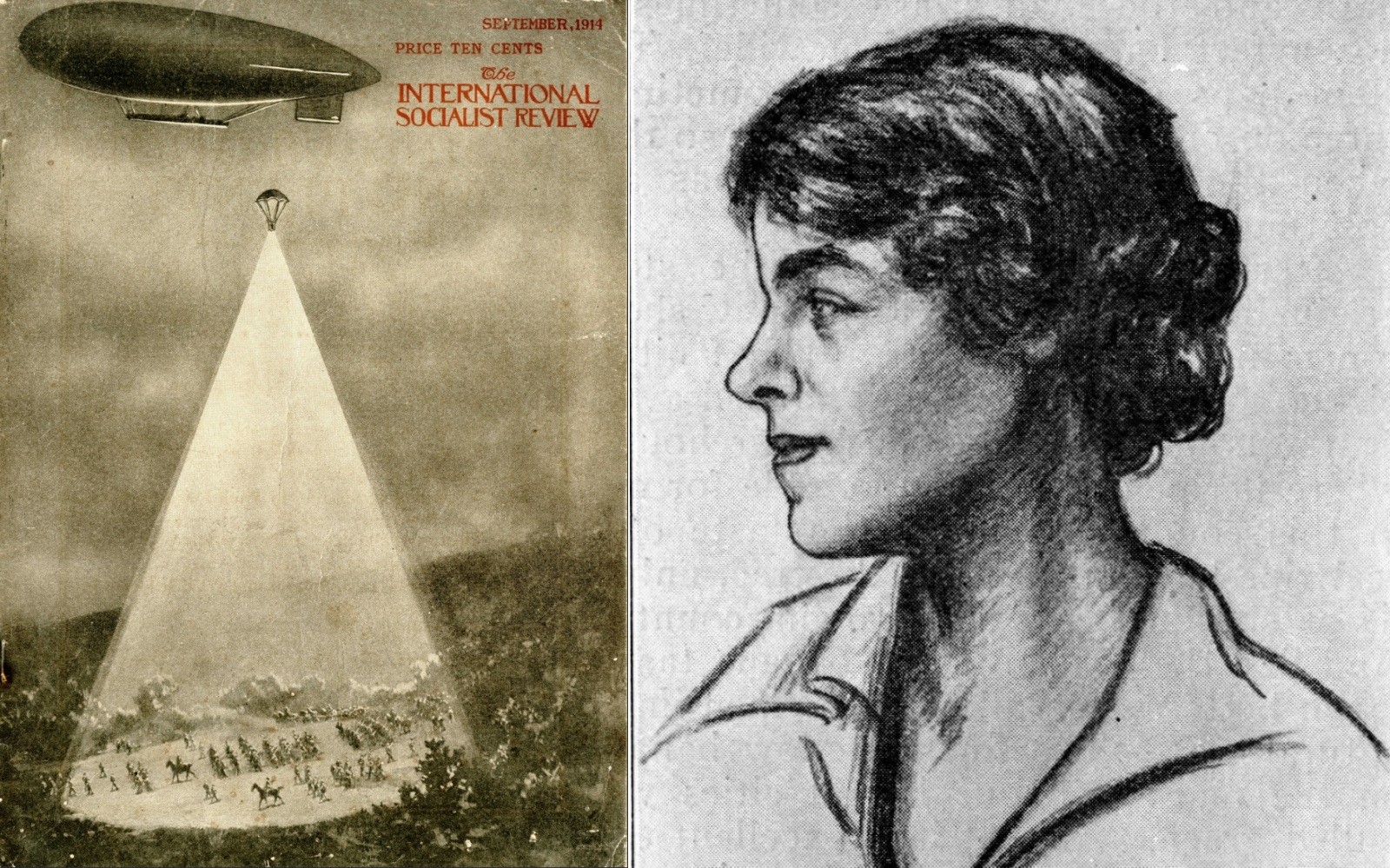
Marcy’s anti-war writings see her at her considerable best. Below, in an unsigned article, being among the first of her responses to the outbreak of World War One.
‘Modern Warfare’ by John Randolph (Mary E. Marcy) from International Socialist Review. Vol. 15 No. 3. September, 1914.
THE glory and romance of war is dead, and they will be buried beyond all hope of resurrection after the coming great world-war is over. War today will be so destructive, so expensive, so terrible and so enlightening to the workers who wage all wars for the benefit of someone else, that we believe they will never again permit themselves to be used as gunners or targets.
Today war has become chiefly a matter of cold calculation, a bloody business of long distance slaughter, with no longer any opportunity for dashing and idiotic personal heroism.
Never again can a Napoleon, looking down from a hilltop, direct the movements of his army of 30,000 men as it maneuvers under his eye on the plains below.
The modern general directing a battle line 150 miles long—such as the Japanese had at Mukden—will never even be within sight of his troops. The Japanese chief of staff was fifteen miles to the rear when the great battle was fought.
Never again will a courier, bearing orders from headquarters to division and corps commanders, have two horses shot under him as he dashes across the battle front. Today orders go out from headquarters over the field telephone wires or by wireless and reach every brigade commander, as he, too, sits in safety far back of the line of fire.
Never again will a battery of field guns gallop madly into action, with the gunners sitting with crossed arms on the caissons and the infantry cheering their rescuers.
Modern field guns are located out of sight over the shoulder of a hill three miles or five miles or more away. The gunners never even GET A SIGHT OF THE ARMY THEY ARE FIRING AT. In the great European war being waged today they do not even KNOW WHAT THEY ARE FIGHTING FOR. It is to their masters’ interest that the working class be sacrificed and the workers go dumbly to their deaths to make it possible for them to grab more lands or mines for exploitation.
And their masters, who exploit them, and their officers who command generally sit in perfect security and amid pomp and splendor while the makers of the world’s commodities die by the hundreds of thousands.
Only the working CLASS fights and pays and only the master class reaps the reward!
Today the fire of gunners is guided by calculations carefully made by an expert mathematician, who sits down in a hole in the ground and figures trajectories and curves and makes allowances for wind and pressure. All are miles away from the scene of the murders they are committing.
“Hold your fire until you see the whites of the enemy’s eyes,” is a command that will never be given in a modern battle.
Modern infantry dig themselves a nice deep ditch in the ground about two miles away from the first of the enemy’s lines. To the present day soldier the spade is almost as important as the gun. He gets down into the ditch so that only his eyes and the top of his head are in sight at all. And he looks across an apparently perfectly empty plain to where in the dim distance he is told the hostile entrenchments lie.
Never in a modern battle picture will a solid column of charging men be shown rallying round their cherished battle flag, which can be seen but dimly through the clouds of black smoke.
There are no battle flags, no smoke and no charging columns on modern battlefields. The presence of a flag on the battle line would instantly reveal its location to the enemy. Smokeless powder has taken the place of the old cloud-belching explosive, and one may look over a modern battlefield with a hundred field guns in action and not be able to locate one of them. As for solid columns of charging men—a modern infantry attack is a far different affair.
It is true the German officers directing the attack on the fortresses of the Belgians were so eager to make a showing that they reverted to the methods of Napoleon in their advance at Liege. Instead of trying to reduce the works with artillery they decided to carry them with a grand assault under cover of a cannonade. The rank and file of the German army fought with great courage and idiocy (for why should they have fought at all?) but their artillery was not heavy enough to make any impression upon the solid defenses of the Belgians. The balls from the siege guns rattled harmlessly off the Belgian works, doing practically no damage.
Despite the futility of the artillery fire, the German infantry and cavalry were commanded to continue their advance, the German generals hurling their men forward time after time under a storm of lead which left long rows of dead and dying. Soon masses of corpses were piled up along the slopes leading to the forts like haystacks. The carnage was appalling. The ground was literally running with blood. The groans and screams of the dying were heard in the fort above the roar of the cannonade. Thousands of torn bodies rolled and pitched in the last torment of death.
But this method of fighting will not become general. Even German army officers, mad with a desire for advancement and for fame, must recognize the fact that file or column formation will not succeed in the face of the modern machine gun. In the old days it was largely the men “in front” who faced and met death. Now the machine gun will annihilate a whole column of soldiers with a single shot.
We suspect that on the modern battlefield the officers of the contending parties will have in their possession maps showing every most minute variation of the ground. On these maps there will be shown 300 yards in advance of the first trench occupied by the infantry, a small brook running through a shallow ditch. The immediate object of the infantry is to move forward and occupy that new cover.
First the field guns—and nowadays a whole regiment of such guns, each of which can fire ten shrapnel shells a minute, is the recognized artillery unit—do their best to smother the enemy’s artillery fire and to drown his trenches in a flood of bullets. Each shrapnel shell bursts into from 100 to 200 projectiles. Then, while this fire is at its height, the infantry gets up—a squad or two at a time—and runs, dodging and bent over, to the ditch through which flows the little stream. They take advantage of every little hillock. A rise of a single foot will afford fairly good protection for a man who lies flat on the ground. So, by fits and starts, running and then dropping behind quickly dug and shallow embankments, they advance toward the enemy’s lines.
All the time field guns are firing a rain of shrapnel over their heads. It is this delicate task of the gunners to so time their shells that they shall burst when they reach the enemy’s line and not before. Else the bullets may kill their own infantry.
By the time the infantry is within close striking distance of the enemy its field guns may have silenced his artillery.
Wireless telegraphy and aeronautics are destined to prove the most destructive implements in the present European crisis and may entirely do away with the modern battleship if not also the massing together of great armed forces on land. The airship is now in use by all the countries engaged in the great European conflict. The science of aviation has undoubtedly developed the most daring body of men ever engaged in any enterprise.
Great battles in the air will soon be recorded and such men as Garros, the French aviator, who is reported to have given his life that he might bring to earth a giant Zeppelin dirigible which threatened the French master class will arise.
And what are these working men fighting for? Will life be any harder for them with a German, or a French, or an English flag flying over the capitol than with the flag that flies there today? Certainly not. The war cannot possibly benefit anybody but the capitalist class and the aristocracy. The Kaiser may become Emperor over the greater part of Europe. England or France may gain supremacy. But what difference can it make to the working class?
Does not the German landlord demand his rent the same as the English or the French or Russian landowner? Does not the French or English capitalist demand his six per cent, the same as the German exploiter? Does it make it any harder on the workers to have a new flag over the factory door?
Herve well says:
“Proletarians have NO COUNTRY. The differences which exist between the present countries are all superficial differences. The capitalist regime is the same in all countries.
“There is only One war which is worthy of intelligent men; it is civil war, social revolution.”
And again:
“Let war break out tomorrow and there will be moaning on BOTH sides of the frontier, there will be damning of the government, there will be shaking of fists, there will be launching of passionate proclamations, but—they will march. They will go reluctantly, but they WILL GO.
“Well, there MUST BE NO GOING.”
“For us socialists there is no question of nationality. We know but two nations: the nation of the capitalists, the bourgeoisie and the possessing class on one side; and on the other the nation of proletarians, the mass of disinherited, the working class. And we are all—Germans, French, English, Russians, Americans—of that second nation. We are one nation only. The workers of all countries form ONE nation.” Liebknecht.
The International Socialist Review (ISR) was published monthly in Chicago from 1900 until 1918 by Charles H. Kerr and critically loyal to the Socialist Party of America. It is one of the essential publications in U.S. left history. During the editorship of A.M. Simons it was largely theoretical and moderate. In 1908, Charles H. Kerr took over as editor with strong influence from Mary E Marcy. The magazine became the foremost proponent of the SP’s left wing growing to tens of thousands of subscribers. It remained revolutionary in outlook and anti-militarist during World War One. It liberally used photographs and images, with news, theory, arts and organizing in its pages. It articles, reports and essays are an invaluable record of the U.S. class struggle and the development of Marxism in the decades before the Soviet experience. It was closed down in government repression in 1918.
PDF of full issue: https://www.marxists.org/history/usa/pubs/isr/v15n03-sep-1914-ISR-riaz-ocr.pdf

