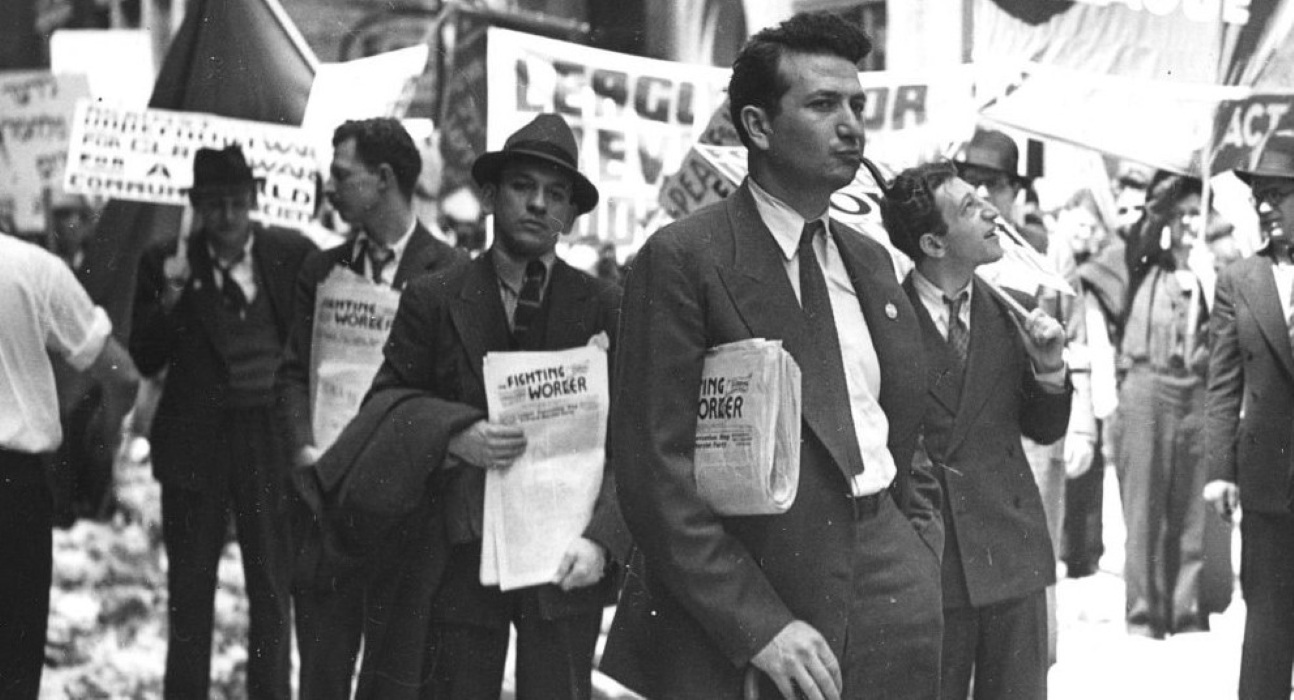
More known as an anthropologist than revolutionary, Paul Kirchhoff, veteran of KAPD who went into the Communist Party of Germany to be expelled as a Left Oppositionist in 1931, writing as ‘Eiffel’ to denounce the policy of the ‘French Turn’ whereby sections of the Trotskyist movement sought to join leftward moving Socialist Parties. In the U.S. this position would be supported, with caveats, by Tom Stamm and Hugo Oehler, leading to a split among U.S. Fourth Internationalists and the creation of the Revolutionary Workers League while the Communist League joined the S.P. Kirchoff would be a leading member of the R.W.L. while living in the U.S. before moving to Mexico in 1938, where he lived until his death in 1974.
‘Against the Liquidators: For an Independent Marxist Party’ by P. Eiffel (Paul Kirchhoff) from International News (R.W.L.). Vol. 1 No. 1. 1935.
One of the most important questions confronting the world labor movement, if not the most important question, is the dispute over the road to the Fourth International. Just as many of the parties of the Second International are torn with factional strife over the question of the road to power, so too the sections of the International Communist League and those close to it are torn with factional strife and splits over the question of the road to the Fourth International.
The new axis of dispute, now that the Committee of Four for the Fourth International had such a short period of life, revolves around the question of the new turn of the I.C.L., commonly known as the “French” turn. In America it first took form in the dispute at the third and last convention of the Communist League of America in the three-cornered factional fight over the question of the “French” turn.
In this fight only a comparatively small number of comrades understood that the entry into the S.F.I.O. (S.P., France) was only the first step of a new international orientation. If they could at that time have been convinced of this undoubtedly the overwhelming majority of the rank and file would have opposed it and probably could have defeated it. Instead they believed all the false arguments about the “exceptional circumstances” which in France necessitated an “exceptional step” and believed assurances given to them that this step would not be extended to any other countries. Even when only a short time later its application to other countries was proposed by the International Secretariat or by the national leadership of other sections, many comrades hesitated to admit that they had been wrong in regarding the step taken in France as merely a national tactics. or three or four “exceptions”, even if they concern the two or three or four leading sections of the international organisation, in their opinion still do not affect the “international line”. We maintain, however, that it is precisely the “orientation” itself which made it from the very outset an international turn.
FROM SECTARIAN ISOLATION TO OPPORTUNISM.
The new orientation, first smuggled in as the “French” turn, was supported precisely by those who, as the result of their inability to make the turn from a mere opposition and propaganda group to an independent political organization, had lost faith in the I.C.L. as an independent Marxian force. This was true in an especially high degree of the leadership of the C.L.A. (Cannon Shachtman, Swabeck). They had lost faith in the future of the League and supported the new orientation in the hope that it would save the League (or rather their leadership).
But in America this orientation took on a special form. An intermediate link–the impending fusion with the American Workers Party–was interjected which helped to obscure the essential facts. It allowed the leadership to lull the doubts of most of the members as to the danger of the “French” turn being extended to other countries and above all to the U.S. and at the same time it served a similar purpose in other countries. “Fusion in the U.S. and Holland. This must be the line and not the
“French” turn” so argued comrades in all countries. They did not see behind the surface; they did not see that to the C.L.A. leadership fusion with the A.W.P. was only a stepping stone on the road to the S.P. Militants. Today ever greater numbers of comrades begin to see through this double bookkeeping of the national and international leadership of the I.C.L. Unfortunately in some countries France, Belgium, perhaps in others, heavy losses have already been suffered. All the more reason, therefore, to put shoulders to the wheel and prevent further disaster. The fate of the sections of the I.C.L., to this day one of the decisive forces for the Fourth International, is of immediate concern to every member of the Workers Party. The new orientation must be defeated if the New International is to live!
FUSION IN THE UNITED STATES.
The historic task of the fusion between the C.L.A. and the A.W.P. was to broaden the organizational basis for the application of Marxism to the American scene. If carried out correctly and sincerely it opened up the possibility of creating in the U.S. an independent Marxist party, standing for the Fourth International, precisely at the moment when in Europe the I.C.L.–up till then the main protagonist of the Fourth International–began to liquidate its sections into the parties of the Second International.
But the fusion was carried out neither correctly nor sincerely by the leadership of the C.L.A. They supported wholeheartedly the new orientation” of the I.C.L. Not without good reason they were stricken with the same panic as the international leadership of the I.C.L. The difficulties accompanying the turn from a more opposition and propaganda group to an independent political and organizational life frightened them. They were unable to make this turn. Thus they lost faith in the C.L.A. Something had to be done to “save” it; that is, to save themselves, its “leaders”! The “new orientation” seemed to open up the perspective of an easier and quicker way “to the masses”. They eagerly seized upon it. They had been ready for it. Now with Trotsky’s authority behind them, they could openly support it. But there was the A.W.P. It had come out for an independent revolutionary party. It had to be eliminated as an independent force if the application of the “now orientation” to the U.S. was to go through successfully. The Cannon group had two perspectives in this respect: either fusion with the A.W.P. might result miraculously in such a growth of the new party that a deal with the Militants of the S.P. would for the time being be unnecessary; or, the A.W.P. had to be taken along on the road to fusion with the Militants or even outright entry into an S.P. dominated by the Militants. Fusion would swell the ranks of the Cannon group leading towards this objective. It was numbers at any cost now that counted, nothing else. Therefore: fusion
FUSION AS A STEPPING-STONE FOR THE “NEW ORIENTATION”.
Consequently the Cannon group, instead of using the pressure of the left wing in the A.W.P. in order to achieve a more advantageous initial position for transforming the merged party into a truly Marxist party, yielded to the numerically more important right elements in the A.W.P. Thus the all-important task of assisting the best elements in the A.W.P. to find the road to Marxism was sacrificed to the ultimate and immediate aims of the Cannon group: to use the fusion with the A.W.P. as a steppingstone. towards fusion with the Militants or entry into a party dominated by them.
Fusion with the A.W.P. served the Cannon group another and very important purpose. They would never have been able to persuade the members of the C.L.A. to support the “new orientation” and its first application in France if the members had not been led to believe that this was a strictly French matter, not to be applied to any other country. If they had understood that it was a new international orientation, to be applied during the following months to one country after the other, they would never have consented to give it their moral backing. They would have been even less willing to do so if there had been any suspicion left in their mind that it would be one day applied to the U.S. as well. The impending fusion with the A.W.P. served to dispel this suspicion.
THE AMERICAN SIDE OF THE NEW ORIENTATION.
The minority in the C.L.A. pointed out that it was impossible for the Cannon group to support the new orientation–which they knew to be of an international character–and at the same time be sincerely for the fusion. But as a smoke-screen the Cannon group used the time-honored trick of accusing their opponents of exactly the crime of which they themselves were guilty. Being themselves insincere in their professed attempt to build, on the basis of the fusion, an independent Marxist party, they accused those who were against the “French” turn of being also against the fusion!
While the minority pointed out that on the contrary they were for the fusion because they were for building independent parties, the slanders and lies of the Cannon group succeeded at the time in misleading the majority of the delegates to the C.L.A. convention.
Since then, seeing that the predictions of the minority had been correct, more and more comrades have left the Cannon group and sided with the former minority in the C.L.A. which since then has widened out into the left wing of the W.P.
For a time the slanders and lies of the Cannon group had another serious result: they induced many comrades from the former A.W.P. to believe that the former C.L.A. minority was against fusion. These comrades too have learned in the meantime that they were victimized by a gross misrepresentation of facts. They have learned that if there are groups in the party which are against the fusion as the basis for building an independent Marxist party, they are to be found not at the left but at the right, among the followers of Budenz on the one hand, and among the supporters of Cannon on the other hand. Both have to be isolated and if necessary eliminated if the Party is to live as an independent Marxist force.
“TWO ROADS”.
The Fourth International can be built only by an independent organization and political force which utilizes fraction work as a tactic for achieving this goal. But there are two diametrically opposite views as to how to proceed in this respect. One group of comrades believe that it is necessary to build a left wing within the parties of the Second International by dissolving into these parties the existing independent organizations standing for the Fourth International. Once inside, these comrades hold, it will be easier to win not only the left socialists but also the left Stalinists to the idea of a new international. A second group of Comrades holds the opposite viewpoint. In their opinion the left socialists as well as the left Stalinists can be attracted to the idea of a new international only if confronted with independent groups which conduct fraction work inside the Centrist parties and which, by their very existence, force the crystallization of left elements. Only a firm and consistent line and organizational steps in harmony with it can attract and hold these leftward moving comrades and groups in the Second and Third Internationals and expose the vacillations and in part the insincerity of the leaders of these left currents before their own followers. If carried out with the correct combination of firmness and flexibility this policy will sooner or later succeed in splitting off groups from the parties of the Second and Third Internationals, thus opening up the possibility of their fusion on a Marxian basis with the independent organizations outside.
On the contrary the policy advocated by the comrades who are for the liquidation of those independent groups will slow down and even stop the leftward development of the oppositional socialists and Stalinists by giving their leaders the best possible argument for not breaking with their own parties. Both the left socialists and the left Stalinists–both indispensable for the building of the Fourth International–will by this policy be lost and pushed to the right.
THE NEW ORIENTATION RETARDS THE LEFT DRIFT IN THE 2ND INTERN’L.
The last six months have given the international working class the opportunity to test which of these two policies helps to build the foundations for the Fourth International and which hinders it. The two most important European sections, the French and Belgian, have already been dissolved into the socialist parties of those countries (SFIO & POB), and in other sections–the Spanish, Polish, Swiss and Italian–the international leadership. of the I.C.L. has been trying to bring about majorities for the Same step. The effect of the entry of the French section into the S.F.I.O. last Fall was immediately felt, nationally and internationally, by the left socialists and left Stalinists. It goes without saying that the latter looked with utter disgust on an organization which, while in words standing for a new communist international, concretely could think of nothing but entry into the parties of the Second International. Nowhere, notwithstanding the repeated assertions of the international leadership of the I.C.L.–(characteristically enough these assertions are never accompanied by concrete facts!)–nowhere has the I.C.L. since the entry of its French section into the S.F.I.O. been able to gain any influence over the oppositional currents which have developed in the Third International against its shameful degeneration into a new species of social-chauvinism.
The left socialists, on the other hand, have reacted even more directly to the “new orientation” of the I.C.L. The main fast which has to be stated clearly and emphatically is this: the movement for a break with the Second International, which just in the summer of 1934 began to assume bigger and bigger proportions, is for the time being dead. It has been killed by the famous “French” turn. The main groups whose leftward evolution has been affected negatively by this orientation are naturally the left socialists in France and Belgium, but they are by no means the only ones. In France, where the political crisis made it especially urgent to push the left socialists still farther to the left, up to the point of breaking with their party and fusing with the independent forces outside on a Marxian basis, the general leftward evolution of the S.P. has been retarded and has even given place to a new evolution to the right. Most of them, led by Pivart, the hope of the I.C.L. leadership, support. the official leader of the Paris district, Zyromsky, wherever it comes to concrete acts or even to votes on resolutions only. Zyromsky, whose leftward evolution, in turn, has been arrested by the entry of the I.C.L. section, has been pushed into a position of leaning towards the Third International. So now: criticize Zyromsky but not ourselves! Push Zgrmomsky toward the Third International and then warn him against Stalinism:
This is one of the most tragic effects of the “French” turn. The workers can see only one alternative: the Second or the Third International. Nobody can blame them for choosing in that case the Third International which traditionally still represents the October Revolution and the first Workers State. And nobody can blame them for not having faith in the movement. for the Fourth International when the leaders of this movement liquidate their sections and become the left opposition of the Second International with the “advantage” of being inside. The workers have seen these leaders push Spaak towards capitalism.
THE I.C.L. ALSO DISINTEGRATES.
Our contention that the “new orientation” would destroy the I.C.L. as an international force (unless corrected in time), and that this event, disastrous for the cause of the Fourth International, would more than offset all the apparent small gains that might be possible here and there on a national scale where the turn was applied, has unfortunately been proved to be only too correct. Of the seven European sections five have experienced a split as a result of the turn: the French, German, Belgian, Polish and Spanish. (The Dutch section has been saved a split for the present at least by fusion with the O.S.P.; the Greek section had just gone through a number of splits so it should be left out in this connection).
In every case the total membership of the pro-entry and anti-entry groups is very much smaller than the total membership before the split. Hundreds of comrades have given in to their feeling of disgust and despair and are, for the time being at least, lost for the movement. The worst case of all, especially. in view of the gigantic tasks confronting that section, is the case of the German section. Here the membership, which during one year of the Hitler regime had soared from less than 200 to about 900, once more dropped to about the same number as before Hitler! All over Europe, threatened by war and fascism, the sections of the I.C.L. have been broken up all this, too, and pathetically enough, in the name of the struggle against fascism and war.
Another aspect of the disastrous effect of the new turn on the I.C.L. is that the lack of collective leadership has even been intensified. In truly bureaucratic fashion international decisions of the first importance are made without any consultation of the sections; in those rare cases where it is regarded as necessary sham plenums are held to give these decisions a post-festum sanction; all information is withheld from all those who oppose the new orientation, including even those who oppose it on tactical grounds only as in the case of comrade Vereecken, a member of the International Secretariat itself. Thus is proved even to the blind that the I.S. functions today exclusively as the center of a narrow faction and caters to its own factional needs and interests at the expense of the broader interests of the movement for the Fourth International and of the working class as a whole.
Summary. The “French” turn was motivated by a partially This concealed and false estimate of the Second International, made the turn international and “justified” entry into the Second International through the liquidation of the I.C.L. sections in many countries a principled and disastrous error as proved by subsequent events. It followed inevitably, too, that those who accepted this turn adopted an S.P. orientation, soften their blows against the second International, and fell into tail-endism and opportunistic errors. Inevitably, too, the independent role of even such parties as the W.P. U.S.A. was gradually liquidated both politically and in the party life and structure, and the membership became demoralized. The road to the Fourth International became blocked with the “gains” of this fatal turn. Leftward moving Socialists and Stalinists were driven back to their bureaucracies and bureaucracy itself took factional possession of sections and parties standing for the Fourth International.
Such is the “French” turn. It must receive theoretical and organizational correction immediately before it is forever too late. The story of this struggle and the gains it has made deserves a separate article.
International News was the theoretical journal of the Revolutionary Workers League (first calling themselves the Left Wing Group of the Workers Party), publishers of ‘Fighting Worker.’ It began with the split in the Workers Party in 1935. In 1936 it was renamed ‘Fourth International’ (not to be confused wit the SWP’s theoretical journal of the same name from 1940-56) from 1936 to 1939 and was renamed The Marxist in 1939 which lasted on that year. Fighting Worker was the newspaper of the Revolutionary Workers League from 1936 until 1947. The RWL was a 1935 split from the Workers Party of the U.S. led by James Cannon and allied with the Movement for the Fourth Interntional led by Leon Trotsky. Led by Hugo Oehler and Tom Stamm, the RWL opposed the ‘French Turn’ then happening in world Trotskyism whereby national sections were joining left-moving Socialist Parties. Fighting Worker and the RWL at first positioned themselves as oppositional Trotskyists, but by 1938 refuted Trotsky and his international movement as “degenerate.’, The exact date of Trotsky’s degeneration causing an organizational split between the group’s founders and, for a time, two rival Revolutionary Workers Leagues with papers called Fighting Worker. Oehler went to Spain to make contact with the POUM but was arrested during their suppression. Declaring a rival Provisional International Contact Commission for the New Communist (Fourth) International in 1938, they briefly joined with the Leninist League (UK) and the Revolutionary Communist Organization (Austria). Fighting Worker would be published monthly and then every two weeks in Chicago and New York. After suffering a series of splits in the late 1930s, including of Tom Stamm, the RWL went into decline and Fighting Worker ceased publishing entirely in 1947. In addition to Fighting Worker, the RWL published local, labor, and theoretical papers.
PDF of full issue: https://www.marxists.org/history/etol/newspape/international-news/v01n01-1935-RWL-Intnat-News.pdf

