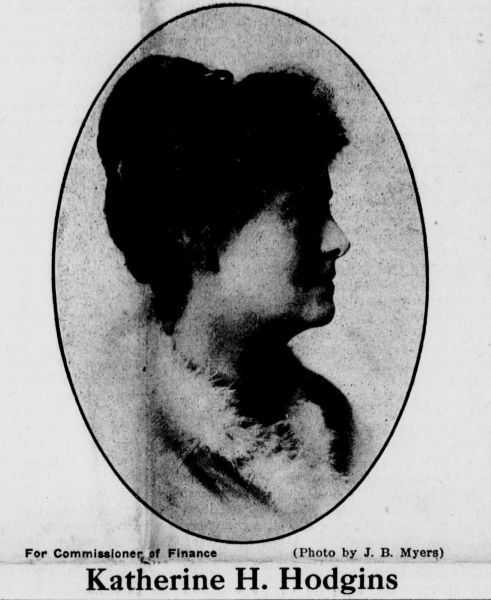
Women won the right to vote on State and Local offices in Washington in 1910, the fifth and most populous state to do so. Everett Socialist Katherine H. Hodges speaks to women in her constituency directly as she runs for office in 1915.
‘A Personal World to Women’ by Katherine H. Hodges from The Northwest Worker (Everett). No. 249. October 14, 1915.
Since the evolution of the machine first began to force the woman out of the home into the factories, the problem of her taking her place by the side of man in all of the various activities of life has been an interesting one. For the reason that the part played by the machine in this important change has not been generally understood, every inch of the way has been stubbornly disputed.
It is but a few years ago since the question of the co-education of the sexes was the cause of bitter disputes and even riots. The first merchant who employed a woman to wait on customers was boycotted, and the first women teachers were ostracized by “self-respecting citizens.”
Whenever economic conditions have forced women into a new line of activity, it has invariably caused a miniature explosion of horror and protest, for a time. After which the situation is regarded as a matter of course. “It always was so, and always will be.”
I knew a woman in the East, who had earlier in her life been a teacher in the public schools in a town of about thirty thousand inhabitants. She told me that when the bicycle craze first struck the human race, she was the first woman in the city to ride one. For her independence she was viciously attacked, and after suffering a period of persecution, she found that she would either be obliged to dispose of her wheel or resign her position. Of course she chose the former. Was it not scandalous that a woman should enjoy the pleasure of bicycle riding! The question of women riding the bicycle was one of the burning issues of the day, all over the country. The funny man took advantage of the situation and the papers were full of his crude (and ineffectual) efforts at humor. For in an incredibly short time, considering this violent storm of protest, every woman who had the inclination and could afford the luxury of a wheel was riding, and making records at it, too.
It is the same with regard to women holding public office. The same unreasoning prejudice exists in the minds of many people, both men and women. Yet it is noticeably disappearing, as evidenced by the number of women that are being elected to fill political positions in various parts of the country, two of them being right here in Everett. And it cannot be denied that wherever women are placed in responsible positions that they have made good. Thousands of women fill clerical positions that carry with them almost the full responsibility of the office, ostensibly conducted by a duly elected official, who is given credit for the woman’s efficiency, which makes his administration a success before the public. This will all be changed, gradually, with the extension of the ballot to women.
At least it has been so here in Washington. I distinctly recall that when women were granted the right of suffrage, a few years ago, that it was regarded by many of the male portion of the population as a huge joke.
I shall not soon forget my first voting experience in a general election in Everett. I went into a filthy, second-hand clothing store on Hewitt avenue where the voting booth was located, and there found a number of men sitting around sundry spittoons. The air was thick with the odor of tobacco and old clothes. Thus do the male rulers of creation prove their superiority. Thus do they prove conclusively that “politics is no place for wimmin.” At least I can say that that polling place was no place for them, nor for self-respecting men, for that matter.
A corpulent, unshaven, unkempt individual leeringly asked me my name. Being provided with this information, another equally uninviting official leaned away from the spittoon long enough to hand me a ballot, grinningly asking me “if I knew what I was votin’ on.” They exchanged significant glances. Surely here was ONE place for me to get information on any subject! When I returned my ballot PROPERLY FOLDED, they seemed to regard that as most marvelous, commenting upon it as a most wonderful exhibition of unexpected intelligence. It produced the same effect, evidently, as when one sees a chimpanzee thread a needle or eat with a knife and fork, in a vaudeville performance.
A friend who had come as far as the door on our way down the street, remarked: “Is that the way they treat a woman when she goes to vote?”
Yes, it was THEN.
But not NOW.
Women vote now, and serve upon election boards as a matter of course. Why not? Which proves that things were not “always this way,” and forever so to be.
The prejudice against women holding public office will take the self-same road as have so many other venerable superstitions. Personally, I have no political ambitions in the ordinary sense of the word. But I should like to see the time come when woman will be permitted, unchallenged, to enter any field of activity, for which she is fitted, mentally and physically. It is safe to say that the war in Europe is doing more to break down the charge of women’s inefficiency and unfitness than could be accomplished in a hundred years of peace. It is an ill wind that blows nobody good. Once women understand the necessity of collective ownership of the greater means of production and distribution, her long term of hopeless servitude will be at an end. She will then for the first time in the history of the race, understand the true meaning of LIFE.
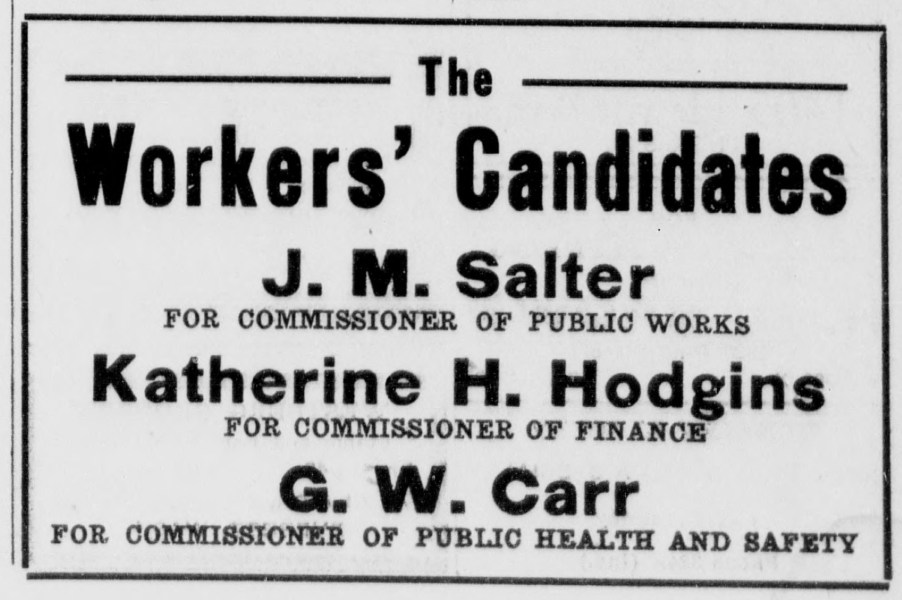
The foregoing explains why I have permitted my name to be used as a candidate in the present election. There must always be pioneers. Why should not I be one of them? I do not want any one to vote for me, however, “just because I am a woman,” but because I am a Socialist. And I do not want a vote from any one who does not understand our principles sufficiently well to vote for the other two Socialist nominees, J.M. Salter and G.W. Carr. We are the only three candidates on the ticket who have a vision of a world free from poverty and all of its attendant suffering WITH A SCIENTIFIC PROGRAM FOR MAKING OUR VISION BECOME A REALITY. We need your understanding of our splendid philosophy and our comprehensive knowledge of economics, more than we need your vote. Women of Everett, if you want to begin to know what life would mean to you under a co-operative commonwealth, I advise you to study the most inspiring of all subjects, Socialism. When you have done that you will want to make a beginning right here in Everett by voting the Socialist ticket, and you will wonder, as I do, what possesses people that they can consciously vote any other way.
The Washington Socialist was a weekly newspaper of the Socialist Party of Snohomish County published in Everett, Washington and edited by Maynard Shipley. Closely aligned with the Industrial Workers of the World, who were strong in the Pacific Northwest’s lumber industry, the paper ran for only 18 months when it was renamed The Northwest Worker with Henry Watts as editor in June, 1915, and again Co-Operative News with Perter Husby as editor in October, 1917. Like virtually all of the left press, the Co-Operative News was suppressed in June 1918 under the Federal Espionage Act.
PDF of full issue: https://washingtondigitalnewspapers.org/?a=d&d=NORWWORK19151014.1.1&e=——-en-20–1–txt-txIN——-#

