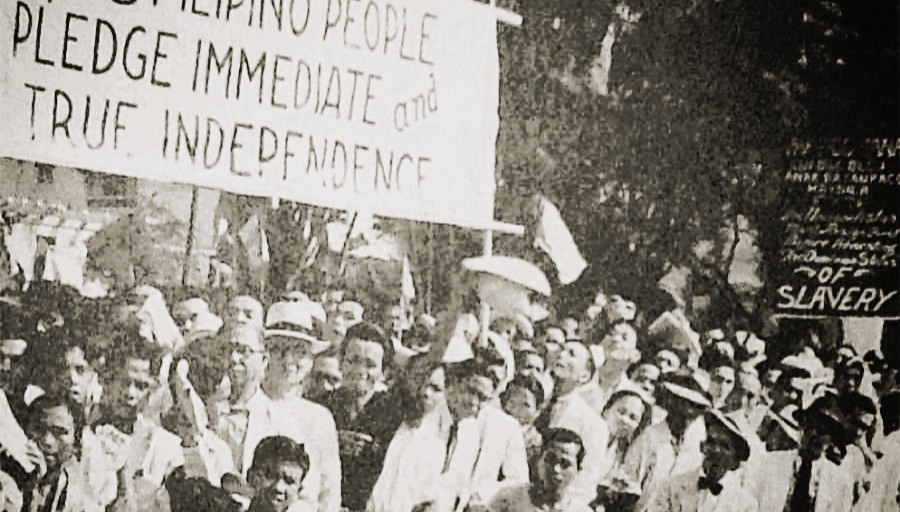
Increasing rural unrest in the U.S. colony is explained by Harry Gannes, with a look at the systems of agricultural labor in this islands.
‘Why the Peasant Revolts in the Philippines?’ by Harry Gannes from The Communist. Vol. 10 No. 3. March, 1931.
KIPLING, in his subtle tales of India, gave the imperialists the cue on how to cast a befuddling net of mystification over the elementary struggles of the colonial masses for land and food. The lesson has not been lost on the present-day imperialists in the colonies, especially in the face of increasing struggles of the masses.
In the Philippines an armed uprising of thousands of peasants took place in the early part of January, 1931, at Tayug, Pangasinan Province, northwest Luzon. It is symptomatic of more widespread discontent among the millions of Filipino peons, tenant farmers, agricultural workers, and actual slaves on the plantations. To hide the real cause of the revolt, it was dubbed a “fanatical religious movement.” In the capitalist press the whole affair is buried under the meaningless and inscrutable name of “Colorums.” We see the same attempt at mystification in Burma, where the peasants and agricultural workers carry on a simple and direct struggle for land, against a crushing head-tax, and against starvation. The capitalist newspapers dangle before the eyes of their readers a strange, unseen leader called King Golden Crow, leading a band of fanatics dressed in blue pajamas, fighting like demons in the jungle vastness, because they do not appreciate the benevolent rule of the British imperialists.
There is nothing strange or mysterious about the tremendous increase in the strike and peasant uprisings which shake the Philippines. The conditions of the masses in the Philippines have been gradually worsened by the encroachment of American imperialism. The world economic crisis, that has so severely affected the agrarian countries, has fallen with a heavy hand on the Philippines.
FILIPINO MASS STRUGGLES
The news of the struggles of the Filipino masses in this leading Yankee colony never reaches the United States. A whole series of strikes in industry and peasant revolts in all parts of the islands have been sweeping the Philippines in the past year. The three leading strikes involved more than 500 workers on the Iloilo Railway, 1,300 lumber workers in the Fabrica mills at Occidental, and 3,000 long-shoremen at Iloilo. The lumber workers carried on a militant strike in December, 1930. Soldiers and constabulary armed with machine guns and hand grenades were sent against the strikers.
The peasant struggles were particularly marked by the uprising of the Moros, Mohammedan peasants in the southern Philippine Islands, in the summer of 1930. Thousands of these expropriated peasants fought the constabulary and United States marines for weeks. They were finally subdued only after wholesale slaughter. In the Buenavista hacienda in Culacan, tenant farmers and peons, who were evicted from their lands after they had raised a rice crop, fought militantly against their eviction. In Dinalupihan, Bataan tenants on the Pampanga sugar estate arose en masse in an effort to keep the lands their forefathers had cultivated for centuries, which the courts had taken away from them. These lands, which were originally taken from them by the archbishop of Manila, under Spanish rule, were handed over to the feudal bourgeoisie by the American invaders. The Filipino-American courts finally decided that the peasants should be evicted.
The uprising of 1,000 peasants at Tayug, who carried on a pitched battle for two days, capturing a town of 15,000 inhabitants, holding it for four days and inflicting serious loss on the Filipino constabulary sent against them, brought the seething mass peasant discontent to light. The immediate cause of this uprising was the decision of the Philippine Supreme Court (with a majority of Americans on it) holding as legal the seizure of the land of 1,000 peasants by the imperialist owned Esperanza estate which already covered 100,000 acres stolen from the peasants. Here we have the action of the Wall Street-controlled supreme court strengthening the hand of the feudal elements in the Philippines against the great mass of impoverished peasants.
INROADS OF IMPERIALISM
It is not only because of the present crisis, particularly affecting the raw-material producing countries, that the peasants are impoverished. The actions of the American imperialists, backing the parasitic landlords and money lenders, are the primary cause of this pauperization.
With the entry of American imperialism into the Philippines there took place the transformation of the economic life of the islands. Colonies are forced to become raw-material producing countries for the industries in the capitalist country. In the Philippines this process has resulted in stimulating the production of sugar, tobacco, coffee, Manila hemp, cocoanut (mainly for the oil) for export instead of the production of food.
Though the soil in the Philippines is unusually fertile, and there is sufficient land to feed the entire population, a large supply of the main food product, rice, is imported at a high price. The Filipino peasants are forced to raise crops for the market, instead of raising food. They are no longer self-sufficing farmers. They are forced to buy food with the money they obtain through selling their raw material crops. Because of the monopoly of the sugar, the cocoanut, and the tobacco industries by native bosses and their imperialist supporters, the prices paid for these crops are forced away below the average market value. To buy sufficient food while producing these crops, the peasants are driven to the money lenders. In this way, imperialism worsens the conditions of the peasants. It ties them to its needs for producing raw material, and in general impoverishes them, making them dependent on the world market, the money lenders, and the feudal landowners.
In these conditions, the eviction of the peasants from their small land holdings is speeded up. With each crisis, whole droves of them lose their lands. They become farm tenants or agricultural workers, where their conditions are even worse than when they were small landowners in the grasp of the money lenders.
The peasant handicraft industries are destroyed by the competition of manufactured products shipped in by the imperialist country. In this way imperialism completes the process of making its colony a source of raw material, on one hand, and a market for its manufactured goods, on the other.
When a crisis of the present magnitude occurs, with world overproduction of such raw materials as are produced in the Philippines, the impoverishment of the peasants is intensified.
NATIVE LANDLORDS BACK IMPERIALISTS
This process is aptly summed up in the Colonial Thesis passed at the Sixth Congress of the Communist International:
“Inasmuch as the overwhelming mass of colonial population is connected with land and lives in the villages, the plundering character of the forms of exploitation of the peasantry made use of by imperialism and its allies (the class of land-owners and trading-usury capital) acquires a specially important significance. Owing to the interference of imperialism (imposition of taxation, import of industrial wares from the metropolis, etc.), the drawing of the village into the sphere of monetary and trading economy is accompanied here by a process of pauperization of the peasantry, destruction of village handicraft industry, etc., and proceeds at a much more rapid rate than was the case when the same process took place in the leading capitalist countries.”1
The whole process of American imperialism has been to bolster up the feudal elements in the Philippines. The leading big landlords and caciques, local bosses and money lenders, are the chief supporters of American imperialism.
The great impoverishment of the mass of peasants and the robbery of their lands by the Spanish imperialists and the Catholic church was the cause of a whole series of revolts leading finally to the overthrow of Spanish rule. In this final struggle American imperialism swooped down on the Philippines and superimposed its more highly organized imperialist structure, uniting with the Filipino landlords, increasing the number of usurers, and hastening the process of expropriating the land of the small peasants.
PLIGHT OF LANDLESS PEASANTS
More than 90 per cent of the Filipino masses depend on agriculture for a livelihood. The vast majority of them are landless peasants, tenant farmers, farm laborers, taos (peons) and actual slaves. Slavery, which was legal under Spanish rule, has actually never been abolished in the Philippines.
Out of 9,000,000 acres of land under cultivation in the Philippines, 6,000,000 acres are recorded as being cultivated by Filipino peasant landholders. The average holding is three acres, but since this includes the large plantations as well as the farms of the richer cacigues, the usual holding is much less, and a good proportion of even the 6,000,000 acres is not owned by the peasants who till the soil.
While the number of farms is reported to have increased from 815,500 in 1903 to 1,955,000 in 1918, there has since been a big drop in the number of Filipino peasants owning their land. The director of agriculture in the Philippines in 1927 reported that there were 1,500,000 small landholders, showing a drop of 455,000 since 1918. This means that in nine years more than 450,000 peasants were robbed of their land. Also, the average holding in 1903 was eight acres; in 1927, it was less than three acres, indicating that nearly all of the Filipino peasants had a big share of their land taken from them and were forced to become tenant farmers or farm) laborers.
From 1903 to 1918, the number of tenant farmers increased from 14,400 to 62,000. Today the number of tenant farmers runs into the millions. In 1918, there were 2,600,000 landless peasants who were forced to become agricultural laborers.
“MANOR LAIRDS”
There are in the Philippines over 325 large plantations ranging from 1,500 to 25,000 acres. More than 2,000,000 tenant farmers and farm laborers are employed on them under feudal conditions. Speaking of conditions on these plantations the American Chamber of Commerce Journal (American-owned), in June, 1930, said:
“It is feudal farming; the manager is the manor laird, and these his tenants his fief lieges.”
The Journal complains, “Too few Americans in Manila go into plantation ventures.” It carries widespread propaganda for more Americans to become “manor lairds.”
Even those of the Filipino peasants who work their miserably small farms find themselves constantly in debt to the money lenders and large landowners who, together with the American imperialists, are the real rulers of the Philippine Islands. An imperialist observer describes this grasp of the money lender on the Filipino peasants in the following terms:
“Ninety per cent of the people of the islands are engaged in agriculture. Many of them are too poor to carry on their farming throughout the year without assistance and they most usually secure this from the cacique of the neighborhood. The cacique is the local boss and sometimes because of his power can control the destinies of his district. His power is based upon his ability to lend money to the farmer to enable him to tide over from crop to crop. He charges usurious rates and sometimes is able to retain the family in economic slavery for a long period of time.”2
MONEY LENDERS SQUEEZE PEASANTS
While the American masters have organized 600 rural credit associations, in actual practice this has resulted in the more efficient organization of the money lenders to squeeze greater interest out of the mass of peasants. According to this same writer, quoted above, the cacique “can determine who shall represent the neighborhood in the legislature.” The fact is, the majority of the Filipino legislators are either large landholders, lawyers who represent them, caciques, or agents of the cacigues. Through this means, and with the full support and approval of American imperialism, a law was passed legalizing the imprisonment and enslavement of the peasants for refusing to pay the usurious interest imposed by the cacigues.
The tenants on the plantations and farms owned by the caciques are held in virtual slavery. They are kept in debt at all times and cannot leave their employment until the debt has been paid. Interest rates average between 10 and 20 per cent a month, and though there is supposed to be a law against “usurious interest payments,” it is winked at by the Filipino politicians and their American collaborators. Dean C. Worcester has declared that peonage “lies at the root of the industrial system, of the Philippines.”3
In 1912 the Philippines Commission, controlled by American members, agreed to a law which legalized peonage and slavery, strengthening the hand of the cacigues and driving the peasants deeper into misery. While this law was “repealed” in December, 1927, the repeal has not changed matters. During the present crisis thousands of peasants were plunged deeper into debt and serfdom.
LARGE PLANTATIONS SWALLOW SMALL
In the Philippines there are 72,000,000 acres of land. Of this 9,000,000 are under cultivation—half by small landowners who are constantly in the grasp of money lenders. The other half is divided between plantations which employ mainly the tenant farm system and the share-cropping system, or the land is leased out to tenant farmers. Over 25,000,000 acres are in forest land, which the imperialists are attempting to develop for their own profit. There remain about 34,500,000 acres of vacant cultivated land, belonging to United States imperialism. This land is dished out mainly to big Filipino landlords and American corporations.
While there is a land law in the Philippines, fostered originally by the American invaders, limiting the acquisition of land to not more than 2,500 acres, in practice this law is not carried out. Preparations are now being made to do away with this law outright, to enable the big American plantations to increase their acreage up to the millions. The Filipino landowners carry on a half-hearted struggle against this attempt to liquidate the law limiting land holdings because they fear that the same process which took place in Cuba, where the American sugar corporations swallowed most of the sugar lands, may take place in the Philippines. But with adequate bribery, they are quite willing to overlook this point. Through a process of “leasing,” the large corporations are able to increase their land holdings to almost unlimited amounts.
“Any second-class lawyer,” said Senator Borah in the United States Senate (January 14, 1930), “can take a leasing system and combine all the cultivable land in the Philippines, so far as the laws in the Philippines are concerned.” This process of extending the large landholdings by the big plantations is going on all the time. Besides, to facilitate this process, the present American governor general, Dwight F. Davis, in December, 1929, signed a land law and sent it to the United States Congress for passage giving “the agricultural secretary authority to allow private interests to survey, subdivide and improve portions of the public domain in any quantity in any part of the island under such terms as he may deem proper, Also, to dispose of such lands he has, or let the surveying outfit do it to such persons, corporations or associations as are entitled to apply for agricultural lands.”3
INCREASING POVERTY
An imperialist observer in the Philippines is particularly struck by the unmistakable signs of increasing impoverishment. He reports his findings in the American Chamber of Commerce Journal, October, 1930, under the title “Lipa’s Classic Poverty”:
“Lipa, at an elevation of about 1,000 feet, is in a rolling country of central Batangas. If you are familiar with provincial life in the Philippines and motor into Lipa, you say at once: Here is agrarian distress, here is monopoly, here is usury, here is ruin—the usurious mortgage and the pacto de retro, sale without right of repurchase. The mean circumstances which have fallen upon Lipa are visible everywhere.”
Against these conditions the Filipino masses are showing a will to struggle. Most of the uprisings that took place during 19301931 were spontaneous, unconnected. They reflect the limit of endurance of the enslaved peasantry. In the cities, the workers are becoming radicalized, following the leadership of the Proletarian Labor Congress, affiliated to the Pan-Pacific Trade Union Secretariat. The strike on the Iloilo railway was carried on in cooperation with the Proletarian Labor Congress.
PEASANTS DEFY TERROR
Despite a ferocious reign of terror carried on by the Filipino petty bourgeois in harmony with the American governor general, the Philippine Peasants Confederation, affiliated to the Proletarian Labor Congress, is endeavoring to unify the struggle of the peasants.5 In January, 1931, on the occasion of the burial of Antonio C. Ora, one of the leaders of the Proletarian Labor Congress, a mass funeral was held in Manila. The workers carried red flags and banners calling for a more determined struggle against American imperialism. The capitalist press openly branded this demonstration, involving nearly 50,000 workers, as a “Communist demonstration.” While the police had expressly forbidden the funeral procession, at the last moment they announced that they would “outwit the Reds” by permitting them to hold the funeral.
There is little doubt that with the growing militancy of the workers and peasants, the Filipino bourgeoisie, already hand in glove with Wall Street, will draw closer to American imperialism. Even now they are begging for a definite determination of the status of the Philippines within the American empire. They realize that their mask of struggle for independence is being rapidly torn away. The masses are beginning to see that their real enemies are both the rich Filipino feudal landowners and their imperialist supporters.
NOTES
1. Thesis on the Revolutionary Movement in the Colonies and Semi-Colonies, adopted by the Sixth World Congress of the Communist International, 1928. Published in pamphlet form by Workers’ Library Publishers, under the title, The Revolutionary Movement in the Colonies.
2. Duggan, Stephen P., “Future of the Philippines,” Foreign Affairs, October, 1926.
3. Worcester, Dean C., The Philippines, Past and Present, p. 714.
4. American Chamber of Commerce Journal, January, 1930.
5. For more details on the labor movement in the Philippines, see H. Gannes, Yankee Colonies, International Pamphlets series.
There were a number of journals with this name in the history of the movement. This ‘The Communist’ was the main theoretical journal of the Communist Party from 1927 until 1944. Its origins lie with the folding of The Liberator, Soviet Russia Pictorial, and Labor Herald together into Workers Monthly as the new unified Communist Party’s official cultural and discussion magazine in November, 1924. Workers Monthly became The Communist in March ,1927 and was also published monthly. The Communist contains the most thorough archive of the Communist Party’s positions and thinking during its run. The New Masses became the main cultural vehicle for the CP and the Communist, though it began with with more vibrancy and discussion, became increasingly an organ of Comintern and CP program. Over its run the tagline went from “A Theoretical Magazine for the Discussion of Revolutionary Problems” to “A Magazine of the Theory and Practice of Marxism-Leninism” to “A Marxist Magazine Devoted to Advancement of Democratic Thought and Action.” The aesthetic of the journal also changed dramatically over its years. Editors included Earl Browder, Alex Bittelman, Max Bedacht, and Bertram D. Wolfe.
PDF of full issue: https://www.marxists.org/history/usa/pubs/communist/v10n03-mar-1931-communist.pdf

