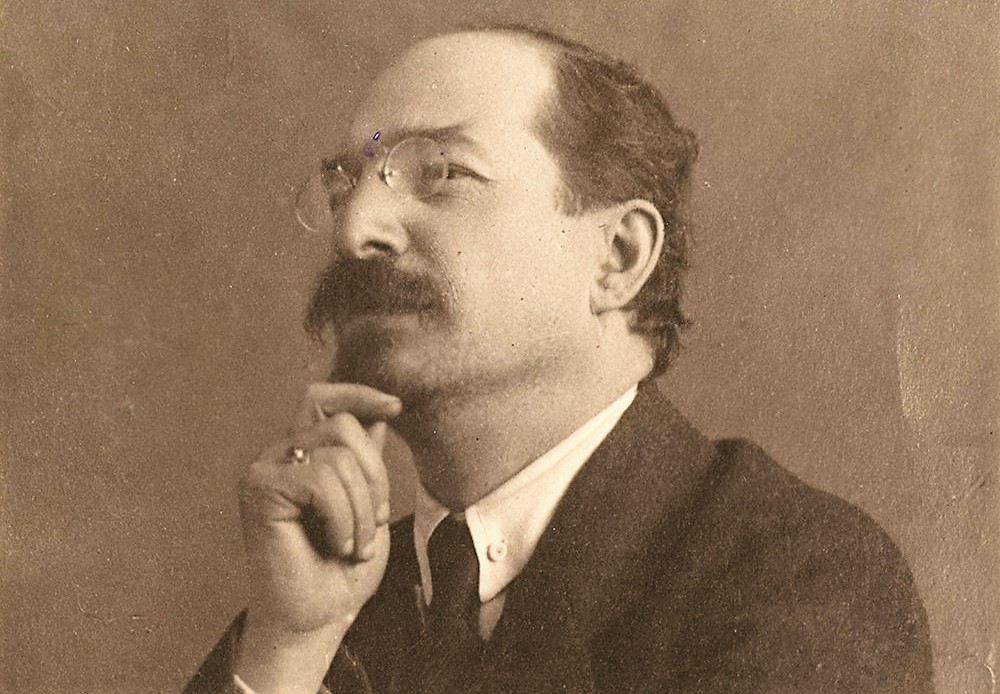
Lunacharsky makes the case for his vision of ‘Socialist Realism’ in the theater with this speech given at the Organization Committee of the All- Russian Union of Soviet Writers.
‘Problems of The Soviet Theatre: On Socialist Realism, Literature and the Theatre’ by Anatoly Lunacharsky from International Literature. No. 3. 1933.
1
Our time is the greatest of all times that humanity has ever known. Our time is a time of heroic struggle for Socialism, for that future of humanity which is really the only form of existence suitable to man.
We are experiencing a tremendous universal overturn. Our country must strain all its powers to accomplish the task historically set before it. On a sustained effort in one direction, or on the reverse, a lapse, hesitation in some other direction may hang important results which will influence the term of final victory or even the continuity of the rise of humanity to its future. There is no one, whatever his field of work may be, that is not, in this sense, a participant in this struggle. The more intensely, the more consciously, he takes part in the building of socialism, the more he is a son of his time. The less he understands our problems, the more indifferent he is to them, the more he resists being drawn into them, the more he sabotages, harms, the more does he represent the strength of the dead undermining the living.
Our art cannot but be a power exercising tremendous influence on the general trend of the struggle and on the building of Socialism.
When the bourgeoisie came upon the historical arena and attempted to obtain its hegemony, it was a realistic class. Bourgeois realism expressed itself most strongly at such times as the higher and upper middle classes felt most satisfied–was it because it was triumphing, because it had triumphed? In any event this was when classical bourgeois realism developed. Its inner music, its fundamental tone was: nature is beautiful, life is a blessing, everything, from the sun rising over this earth on which we live to some pitcher of water with an onion and a piece of bread beside it–it was all good, it was all beautiful. The problem of the artist was to make us love with all our soul these our surroundings, this life, this way of thinking, feeling, experiencing.
Such was the realistic painting of the Netherlands which first Hegel and then Marx acknowledged as the most typical realistic art.
But a self-satisfied bourgeoisie cannot regard its surrounding world as anything but static. It says simply: being is good.
The bourgeoisie is not however an integral class. There exists as you are aware, a middle class, a petty bourgeoisie, which was not satisfied with the triumph of the higher bourgeoisie, a petty bourgeoisie which at the time of the revolution raised its flags high, sometimes came closer to power, at times even held it, but was then thrown off by the turn of events and severely subjugated to the rule of the higher bourgeoisie which swallowed up some of the strata–for capital marches over the bodies of small independent manufacturers and traders. This gave rise to an intense sadness, a great disillusionment in the petty bourgeoisie. Bourgeois realism was attractive to the petty bourgeoisie only insofar as it was a contrast to the old feudal culture with its attempt to shut humanity in within the narrow confines of caste restrictions and rob him of any hope of a better life on this earth by all sorts of fables called “the word of God.” The petty bourgeoisie starting out from bourgeois realism sought other ways–often called those of negative realism.
This negative realism was most effectively expressed in the so-called naturalism of the petty bourgeoisie. The leaders of this tendency disclosed its essence themselves saying we have no program. And how could they have a program?
The petty bourgeoisie said: we are estranged from politics. Our business is to describe the mean system created by the bourgeoisie, perhaps falling into the mood of caricature, but in the main with scientific honesty.
In this way negative realism insofar as it was purely naturalistic, that is to say, objective, honestly described the bourgeois system and amounted to a disclosure of the seamy side of reality for this reality was far from sweet to the petty bourgeoisie.
A more definite departure from reality is represented by romanticism. Bourgeois romanticism has its origin in illusion, the desire for illusions. Artists and theoreticians who are honest enough to understand that it is an illusion create “art for art’s sake.” Such people will tell you they are running away from reality. Even when they portray it, they are interested not in the object but in the portrayal in itself, the technique of portrayal, the purely artistic side of art. It is evident that such running away from the problems of reality is a form of negative realism.
This is the diapason of bourgeois art: static realism, negative realism, an attempt to put up romantic illusions against drab reality.
There are exceptions, rare flashes, recalling tendencies of proletarian art. The few authors of such works, representatives of the young bourgeoisie were squelched by this very bourgeoisie as proponents, according to Lenin’s terminology, of the American way of development.
What is Socialist realism? It is primarily also realism, true to reality.
We do not get away from reality. We recognize reality as the field of our activity, as our basic material, our task. However, this realism gives a picture of humanity with all its dark phases as they were all the horrors of feudal and bourgeois slavery, the cruelty of capitalism on the offensive or battling for its existence. We know that these were inevitable stages which social development had to pass to reach the state now prevailing in the U.S.S.R., on humanity’s road to the realm of freedom. We are far from petty bourgeois negation of reality, making virtual war on it.
We accept reality but we do not accept it statically–for how could we consider it static when we primarily take it as a task, as evolution?
Our realism is exceedingly dynamic.
The proletarian realist examining reality realizes that the fundamental, moving historical force in the past, at present, and in the nearest future is the class struggle. One can of course imagine a Socialist realist to whom this is not yet clear–such a Socialist realist belongs to the preparatory school which, it is to be hoped, he will soon graduate.
A Socialist realist understands reality as evolution, continuous motion, going on by means of a continuous struggle of contradictions. But he not only is not addicted to static, neither is he a fatalist; he orientates himself within this development, in this struggle, he defines his class position, his being as part of a definite class or his relations to this class, he considers himself an active force which is to be applied to make the process take such and such a course and no other. He understands himself to be, on the one hand, an expression of an historical process, and on the other, an active force which influences the process.
The Menshevist fatalism which dares to pass itself off as Marxism, a false Marxism for which Marx cannot be made to answer with a single drop of ink, is as a matter of fact, if not static, fatalistic and hence inclined to remove human volition from reality. A Menshevist type of writer will be one that speaks of evolution but speaks about it “impersonally,” “objectively.”
We can imagine people (they may and may not, as we should be glad to feel, be among us) that are still realists of the bourgeois type. They could not be satisfied with reality, could not sing in unison with it, because our reality is a Socialist one and a bourgeois minded person could not possibly sing in unison with it. Which means they find themselves in the position of dissatisfied elements, of oppressed elements. What kind of art would they create? They would create artistic journals, artistic photographs of the back yards of our revolution and say, like the pig in Krilov’s fable that they “have rooted all the back yards” and found nothing good. (Laughter, applause) This is a fine time for bourgeois realists to do their “realistic” rooting in the backyards of the revolution–when we are in the midst of an intense struggle, when there is much unfinished construction, many lapses, many unfinished buildings, much that is muddled. He takes it all statically–“as is.” Imagine a house in the process of construction and when finished it will be a magnificent palace. But it is not finished and you paint it in that state and say: there’s your Socialism–without even a roof. You will of course be a realist, you will be telling the truth–it is however apparent that this truth is an untruth. The Socialist truth can only be told by one who understands what house is being built, how it is being built, and who understands that a roof will eventually be there. A man who does not understand development will never see the truth because the truth does not resemble itself, it does not stay put, but flies; truth is development, truth is conflict, truth is struggle, truth–it is the morrow and it must be seen that way and whoever does not see it that way is a bourgeois realist and hence a pessimist, a whimperer, and often a swindler and falsifier, at any rate a voluntary or involuntary counter-revolutionist and wrecker. He may not be conscious of this, and sometimes answer the demand of the communist to “tell the truth” by saying “but this is the truth,” he may not be filled with counter-revolutionary hate, he may imagine himself doing a sad duty by telling an unpleasant truth–but it is an untruth in fact, lacking in analysis, lacking reality as development, and such a “truth” has no semblance of Socialist realism.
Can there be such a thing as a Socialist romanticism? Since we are satisfied with reality, accept reality, what room is there for romanticism?
I have already mentioned that we are satisfied with reality inasmuch as it represents development, as its trends are our own, as we go on along with them, as these tendencies live in our bosoms. We accept reality because yesterday and tomorrow are in conflict today, because we are part of the struggle for tomorrow.
For this very reason we are not altogether satisfied with reality. We should like to organize its active forces most rapidly, to muster them more solidly. Art is a tremendous force in our hands for this purpose.
Why then can our art have no grand synthetic images if not in the novel or the drama, at least in the opera or in colossal pageants where tens of thousands of people are gathered? Because it is not realistic? True–there are traces of romanticism in this as the combined elements have not the likeness of truth. But they truthfully represent this truth. It uncovers the inner features of development, becomes its pennant and there is no reason for us to deny the need for us of such an art.
There is no reason for shutting out a means of artistic prognosis. Remember what Lenin said: It is a poor Communist that cannot dream. We should attempt to reach heights from where we can look further into the future. Here the imagination and seeming untruthfulness play a great role, mistakes are possible, but there must be some truthfulness here which, perhaps, consists of this–that the victory of the proletariat, the triumph of the classless society and the great renaissance of personality or the basis of collectivism is the truth.
And so we see that together with the tremendous problem of socialist realism to give a picture full of truth, based on a close description of an object of reality, giving it so, however, that development, motion, struggle are evident, together with this form it is really possible to have a Socialist romanticism, one that is however entirely different from bourgeois romanticism. By virtue of the tremendously dynamic quality of our reality it calls into action such realms where fantasy, stylization, and all kinds of liberties in the treatment of reality can play a big role.
Socialist realism is a broad program which includes many different methods we have already acquired and some that are still to be developed; but it is through and through a live thing, breathing development, devoted to struggle, it is through and through the builder, sure of the communist future of humanity, having a great faith in the powers of the proletariat, its party and its leaders, understands the full significance of the first fundamental battle and this first act in the drama of socialist construction which is going on in our country.
Static realism, idealist tendencies, are having a good time beyond the borders of the Soviet Union, they sustain the evils of the world, are themselves our yesterday, our enemy and we will continue our merciless struggle against them.
Our object, however, should not be to reproach one another that here, say, realism is not rigidly maintained and a certain amount of stylization has crept in–we must respect and support each other. The thing is our writers, critics, like our proletariat, like our entire struggling and constructive world, should present a solid front against our common enemy–it makes no difference whether he lives beyond the border or right here amongst us. For the reason that, if this enemy stirs within our own ranks, whispers his static disillusionment or idealistic escape from life we shall do, as Mayakovsky said about his own untimely songs: we will stamp our foot on this enemy’s neck. (Much applause.)
2
The drama occupies an entirely distinct place in literature. Whenever the class struggle grows tense drama steps up to the front, because, if all literature serves the class struggle, the drama, by means of the theatre is the most active force. We understand this thoroughly and cannot be indifferent to this truly exceptional force. The theatre is graphic in the highest degree and hence highly emotional. Also it affects directly large masses, merges in unified impressions, unified feelings thousands of people. Considering that we wish to by all means increase the influence of socialist art on the masses, we are compelled to turn our particular attention on the theatre.
As Socialist art aims to present events in motion, with their conflicts and consequences or prognoses which follow, no form of art answers more to the spirit of socialist realism than the drama, and the class character of the conflicts is self-evident to us. These conflicts may take place between persons, within the individual, in dialogue or monologue. But whenever you see “two natures struggling in the breast” of a character, it is the conflict of different social ideas, different systems of feeling that correspond to the ideas and feelings of the classes taking part in the struggle. One might examine any of the greatest works of art and always find it so. Such investigation is one of the problems of theatrical and literary research.
In this connection I should like to state one problem that has troubled us a great deal. It was at one time considered quite the thing for an artist, especially a dramatist, to make a thorough study of dialectic materialism, grasp the forms dialectic materialism assumes in artistic work, and only then write accordingly. Such an approach is of course incorrect. It is of course, absurd to think socialist realism attainable only to people having a thorough knowledge of dialectic materialism. This would be equivalent to selecting a small group of writers that have made a special study of Marxian philosophy, if there are such, as the only capable ones and relegate the rest to limbo. The work of writers in the field of socialist realism can of course be based on a thorough study of Marxist-Leninist theory. But one can very well imagine men passionately in earnest in an active struggle for Socialism and yet little versed in dialectic materialism. Artistically presenting the socialist revolution in the practice of which he is immersed, he can instinctively uncover many most important traits of our reality. He clearly understands the struggle going on, has taken a definite side in this struggle but is not sufficiently versed in philosophy to have justified pretensions of the rounded understanding of life which dialectic materialism gives. Such an artist writes with the simplicity of direct observation. But when such writing gets to the proletarian general staff, to our party, it may prove an excellent and artistic creation for dialectic-materialist interpretation.
There may thus be within the literature of socialist realism a large number of gradations.
If the writer has mastered dialectic materialism in the field of sociology and philosophy it is very good. Any one that has the ability and the possibility to master this method should be congratulated. This does not mean, however, that the artist must needs spend a great deal of time first to first find out how to write according to the method of dialectic materialism, how to apply the laws of dialectics to artistic creation, and only then write. In fact, an artist thoroughly versed in sociology and philosophy will do wrong to stop and think of what particular rules of dialectic materialism apply during the process of creation. There was a time of particularly fetishistic worship of the triad which Lenin has ridiculed so aptly in his “Friends of the People.” Mehring has an excellent story of a centipede. A centipede is a very complex creature, you know, that has forty legs and nevertheless, in spite of its complexity, carries out its functions of life very well. Once, however, an evil minded toad asked it: “May I ask you one question?” “Please.” “When you put your first foot forward what other feet go forward too, and when the 14th and 19th knee bend what happens to the 27th leg?” The poor centipede stopped to think and couldn’t move from its place. (Laughter, applause.) One must not narrow down the creative process. You wish to portray artistically with socialist conscientiousness a mean for a noble event in the struggle–must you abandon the effort because you do not know how to do it “by means of dialectic materialism?” Do it, comrades, even if you do not grasp all the fine points of dialectic materialism. What is important is, that you have revolutionary feeling, that you understand the basic problems of the revolution in the given stage, that you are artistically sensitive and that you possess a style that stirs the reader and successfully conveys your thoughts and feelings. Of course one must have knowledge for this purpose–knowledge of the revolutionary practice which served as a basis for Marxist-Leninist philosophy, and which draws so much strength from this philosophy without a knowledge of which it is difficult to give a true picture of reality.
It does not follow that we should not be interested in how dialectic materialism enters or is left out from artistic creation, how it developed, lived and lives. It is very important to work this out. The mastering of dialectic materialism gives the artist a great deal in the sense of a proper education and maturing of his thought and his outlook on the world. If you will, however, approach every line, every image with a demand for “dialectic materialism,” you will only emulate the toad that so disconcerted the centipede.
The problems of the drama are tremendous and so are its possibilities. We do not consider the so-called dramatic genres immovable categories and do not think our dramatists should feel themselves fettered to these genres. Not only can tragedy, comedy, and the drama merge into one another but there can also enter epic and lyric elements. But we can take the older terminology as a starting point and ask, for instance: can there be socialist tragedy?
Not only can, but must. Marx says: the greatest tragedy writers of the past dealt with the sufferings of a dying class, a ruined class, the new tragedy writers will deal with the sufferings of a new world in travail. We have great antecedents, we have excellent tragic subjects in the past. Take such heroes as Thomas Müntzer who went as far as his contemporary reality permitted and who supported himself on the foremost elements of his society. Marx and Engels have pointed out to La Salle that Müntzer, not Sickingen, should have been his hero. Why should not our dramatists pick up the tragedy of Müntzer, show the heroic death of peasant and proletarian heroes of these times, why not show a hero not fallen from the sky, not a genius stranger to this earth, but a class leader, a leader of the class which was then not yet destined to triumph but whose partial defeat was, as Marx said of the Commune, the greatest guarantee of future victory? The closer to ours the era from which the hero is taken the less futile the sacrifice and the nearer the reality to the accomplishment of the class struggle to which we have now approached.
The elements of tragedy, however, are not lacking even in our era, because sacrifice is not only possible but necessary. Sacrifice was necessary during the civil war, sacrifice is necessary in the class struggle between the old and new worlds going on in all countries. There are constant sacrifices in the struggle we are conducting against our internal enemies that put up such bitter opposition now, penetrating even into the socialist forms of the new life, attempting to distort their content. There is a fight on not for one’s belly but for life itself. To sing the praise of our victims of this struggle, portray the heroes of this battle now definitely destined to end victoriously–this is doubtlessly a very important problem and a glorious basis for a modern tragedy.
And modern comedy? One of our theoreticians passed judgement that the proletariat lacks a sense of humor. But what is humor? It is softening laughter, it is a mood for ridicule while feeling sorry for the one ridiculed, or although funny, calling for understanding and forgiveness. So, says this theoretical comrade, the petty bourgeoisie, timid and half hearted found it necessary to laugh, to smile, it needed not satire but humor. The proletariat is relentless, if it laughs–it laughs to death.
The comrade came to a wrong conclusion because he was considering an abstract proletariat and isolated enemies. It is not so in fact. The proletariat is a great educating class. It educates the poor and middle peasantry, educates the hired man that stands so close to it, educates its own backward elements, educates itself, and educates the intelligentsia which, alas, needs the education badly.
With respect to those classes which the proletariat is educating, to those elements within its own ranks that are basically good but have their failings, humor is an excellent corrective. The humorous comedy, the tenderly satirical comedy, showing failings and teaching how to correct them, is therefore a mirror into which one can look, not to be frightened enough to look for a rope and nail, but in which one can see that a wash and shave are needed.
3
The relation between the theatre and the drama is very important.
What is the drama? The drama is part of literature. What does artistic literature mean to us? It is a definite, exceedingly important social act of thinking, feeling, creation. In this act society, by means of certain representatives, certain definite agents that have special aptitudes in this direction performs an act of self-analysis, self-judgement, self-organization. It is a tremendously conscious social act.
This is the drama. And the theatre? The theatre by itself (without the drama) is an institution erected for the purpose of producing the greatest possible impression on a public by means of an organized spectacle. The “ideal theatre” is one, in fact, where everything can be presented and is like a good phonograph: plays any record you put on.
A good machine will play well, a poor one poorly. Only the theatre is not as simple a machine as the phonograph, and can of course by means of its technical and expressive paraphernalia, work over the material given to it by the dramatist. But can it itself define problems? No, it can not. Defining the problems is one of the functions. of the dramatist. If the theatre happens to have a light operator that has written or worked out a play, this was a feat not of the theatre but of the light operator who happened to be a playwright. Only the dramatist can define what the theatre should give, what its social content should be.
Does this mean that the theatre should be indifferent to the work of development of our drama generally and that Stanislavsky, Tairov, the Theatre of the Revolution, can say: “We are form craftsmen, we give drama its final, complete form. Give us plays of a high degree of theatrical literacy that we may play them interestingly!” Pardon this is not so. Soviet consciousness must be part and parcel of our entire art front. The theatre must live a life in common with Soviet revolutionary dramatics and help it grow.
Social class consciousness, acting by means of the dramatist advances what could be called the dramatic literature of a given decade, year, etc.; the theatre tries to heighten the Soviet character of what is to be stressed, bring home the hidden treasure and correct any errors and in this respect the theatre and the dramatist must interact one upon the other.
Engels has said that not only were new instruments created because the composers had invented new music, but also new music was often created because the composer had new instruments. Engels has said that human development followed technical progress. The dramatist that knows the theatre discovers new possibilities for his own art. It is impossible to be a good dramatist without a thorough knowledge of musical instruments. In this sense there is a definite interaction. It must always be remembered, however, that the drama with its social content makes the Soviet theatre, the Soviet theatre as form is what gives this drama its highest expression. When the theatre develops a new form, this is exceedingly important, but there must be a definite interaction, in which social content not form is the leading factor.
What is an innovation? An innovation is the discovery of new ways or methods, not known before, and that follow from new developments that present us with new technical problems.
What is stage trickery? It is an attempt to distract, entertain the public without regard to class thought, creative work, the public as a mob, by means of some novelty, some trick which has nothing to do with the problems of the day. In the first case we have a problem that comes from the content, in the second empty form void of all content.
It is necessary that the dramatist comes very close to the theatre indeed, in order that the theatre will feel the value of his collaboration towards the final results attained and remember that the social content is the prime factor to which the theatre must adjust itself.
The problems of Soviet drama cannot but be concerned with the burning questions of the day. Let us, however, analyse this thesis. Truly great art creations are rarely produced overnight. It is true Grillpartzer wrote his best play, Sapho, in 20 days while those which he took a longer time to write came out worse. This is not the rule, however. Certain peculiarities are required for this which are rarely met with. In general the author must read and reread his work many times, test it, make over parts, so that everything is in its place. And life is on the run. The dramatist is often
tempted to say: where do I come to work out things–I must have a sort of internal “kodak,” snapped–and ready for the theatre. It may not be perfect but it will be fresh.
A frequent failing of our critics is the narrowness of their view point: everything that extends beyond these narrow limits seems wrong to them. Their viewpoint must be sufficiently broad to include the entire wide variety of problems.
One can imagine a theatre of limited forms that shows in the evening what happened in the morning, a live comedy and drama can be conceived in which our every day is reflected. One of the big problems of Soviet art is the ability to work fast. It is hard to get away from this problem. Otherwise:
I loaded well the cannon thinking
Soon we’ll have our friend ablinking-
but our friend in the meantime has gone. (Applause.)
What, then, are writers to do who are working on big serious things? Is it their fate then to lag behind the times? No, comrades, this is not so. When you travel by train the small pebbles at the tracks run together and seem continuous lines. The fill and the ties however do not lose their contours. Further there are mountains that long. remain in the field of vision because they are big and dominate the terrain. There are many problems that dominate beyond our year, our decade, even our century and we must turn our creative attention to them.
From this point of view it is exceedingly important to realize that these general problems of which I spoke are defined, concretely presented, in a way peculiar to the period. I refer not to the concrete problems of the day, but to the problems of the age in which we live, the phase of the struggle in which we find ourselves.
We are, first of all, at a particular phase of our conflict with the enemy. World capitalism is showing signs of extreme nervousness; although in its death throes it is making mad efforts and looking for a way out of its difficulties. One must understand Lenin’s saying: there are no fatally hopeless situations. If the enemy is in a weak position, if he is dying and gasps, do not hope that he will expire anyway but finish him off for otherwise he will stop dying and finish you.
We are in a continuous struggle–which is not a mere statement. Our world is therefore developing in torment while their world is falling in torment–we must present this dramatically. What could be dramatically more effective? Two worlds that find themselves in such different states and preparing for their last grip. Our enemies will not willingly lay down their weapons–they may fall out of their hands when raised against us, and they may not, the conflict must take place in any event. This presents us with the problem of the art of defense in the widest possible sense–not only with respect to serving our Red Army, our most glorious and most important defensive weapon the entire front of socialist construction must be considered.
There can be no Plenum of the Central Committee of the Communist Party or session of any other large Soviet or Party body about which the dramatist can say: well, they are talking politics, you know, and I am putting the finishing touches on my drama–it is not my business, I have other irons in the fire. When the Party speaks of basic points of life it is a signal for every front of the proletarian struggle.
Our life, especially that of the village, the collective farm, has not rid itself yet of the alien kulak elements that have dispersed and now like microbes spread contagion. Participation in the struggle for a victorious collectivized village is one of the central problems of our dramatic art. We know the microbe. It is baneful private property, the desire to grab a better piece of meat for oneself, for one’s family at the expense, even the harm of the collective group. Our big enemy, big in size–the capitalist countries, banks, trusts, say: “Devil take them, for 15 years we can do nothing with those Bolsheviks. But they have an internal disease. That is our small brother. He lives there masked and poisons, disrupts, everything about him. You will see how with time this fortress before which we have lost our courage, will sink of itself.” To expose this enemy, dramatically present in comedy and drama his cunning tricks, his masks, his temporary successes, the inevitability of his defeat which can, however, be had only at the cost of a great effort, psychologic insight, understanding of what he says not to express but to hide his thoughts–all this is the business of the writer, the business of the socialist artist-psychologist.
As against the forces of class antagonism there is the growing socialist consciousness of the masses and that deep shift, which for the moment seems to be the true center of application of our forces–the growth of social ownership and the growing consciousness that by strengthening the socialist economy we shall all be enriched. I am wealthy because the Union of Soviet Republics is rich. I am now building Magnitogorsk, I have gained or lost as construction is successful or not and am happy or suffer accordingly, it is a vital question to me. People that have already reached these heights of socialist consciousness should be raised to mountain peaks that they may serve to help the socialist rebirth of those that have not yet rid themselves of the yoke of old slave feelings, thoughts, habits.
Engels was a good communist. He was also a dreamer. It is true he did not dream of this: it would be good if every dramatist would think out, before writing an act, how dialectic materialism applies to it. But he has said: I have a vision of dramatic works as true and as full of life as Shakespeare’s but which also are imbued with a deep understanding of the historical phases they deal with. He adds: this will probably not happen in Germany.
That is really so it will not happen first in Germany, but in our country. There is already a close approximation to it here.
As every one of you knows, we represent only a portion of the front, a regiment of fighters for socialism. Over this front the banners of victory are waving. On one of these banners the hand of Comrade Stalin has lettered: “The fight for science and skill.”
The dramatist must do battle for science, for, if the dramatist does not know reality he will be superficial, lacking in color. He must fight for skill for he will not otherwise express reality, be actually creative. We struggle for supremacy in science and skill to raise the level of our specific activity and make it of service to socialism.
In the future, when the final victory has been won, our descendants will turn the pages of the history of our life with great respect. Let there rise as monuments of this great transitional era not only the ideas of our thinkers and leaders, not only the triumphs of our masses, not only skill achieved by our socialist labor, but also our great artistic creations, our plays that will then still be presented in order to tell the history of these times with its own voice (Tremendous applause.)
Translated from the Russian by S.D. Kogan
Speech delivered at the Second Plenary Session of the Organization Committee of the All- Russian Union of Soviet Writers.
Literature of the World Revolution/International Literature was the journal of the International Union of Revolutionary Writers, founded in 1927, that began publishing in the aftermath of 1931’s international conference of revolutionary writers held in Kharkov, Ukraine. Produced in Moscow in Russian, German, English, and French, the name changed to International Literature in 1932. In 1935 and the Popular Front, the Writers for the Defense of Culture became the sponsoring organization. It published until 1945 and hosted the most important Communist writers and critics of the time.
PDF of full issue: https://www.marxists.org/subject/art/literature/international-literature/1933-n03-IL.pdf

