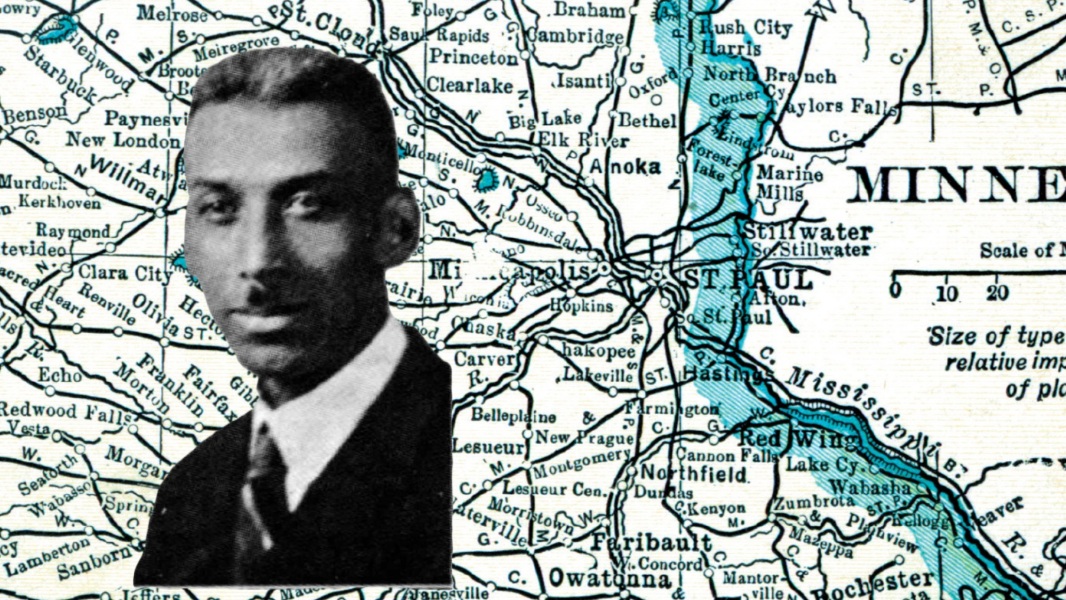
Local leader of the Brotherhood of Sleeping Car Porters on how they organized the union in St. Paul, Minnesota.
‘Our Local Struggle to Organize St. Paul, Minnesota’ by Paul L. Caldwell from The Messenger. Vol. 9 No. 1. January, 1927.
(Local Secretary-Treasurer, B.S.C.P.)
ALTHOUGH there had been spasmodic attempts to organize the Pullman porters as well as other railroad employees as far back as 1909, and at one time around 1919, there seemed chances of success, it was not until about October, 1925, that there seemed a possibility of getting the men in a common frame of mind to act with sufficient enthusiasm and a single ness of purpose to make one feel that the time was ripe to act. This was in part due to the treatment of the men by the local officials, the utter collapse of hope of the “Representative Plan” to function in favor of the employees, and to the agitation of the Brotherhood leaders in the East. When rumors began to come in, through porters from eastern districts and our boys running to Chicago that the chances of success under the leadership of Mr. A. Philip Randolph were better than ever before, the porters in these two districts again lighted the fires of hope, and began to bestir themselves to get more information and to take stock on the previous causes of failure. Once this was done, it was only a matter of waiting for the message to be brought to them to give assurances that the men would “rally to the flag” in sufficient numbers to spread the propaganda of agitation and education into the ranks of the more timid and less informed men as to their condition of servitude.
In the latter part of December, 1925, we were supplied with application blanks, receipt books and other paraphernalia, and at a meeting in the home of one of the porters, a local representative was elected and his name forwarded to headquarters by telegraph. As soon as bonds were arranged, this representative was designated local secretary-treasurer and opened his home as local headquarters, and began a rather spectacular fight for the completion of a local organization.
Before we began taking membership a large number of men from both St. Paul and Minneapolis on runs to Chicago, Kansas City, Omaha and other cities, which had been visited by the General Organizing staff, had taken membership in those districts and we were surprised at the first meeting we held in St. Paul to find such a large number who not only held cards, but expressed their willingness to carry the banner of light to those in darkness.
The first meeting was attended by a large number of men from both cities and among them some representatives of the Pullman Company in the persons of what we term “stool pigeons.” At that time, we had not become familiar with the tactics of the Company, and therefore did not feel the need of separating the sheep from the goats. However, we learned quickly, for we soon found the heavy hand of Pullman penalization by finding the most active men at the meetings removed from their regular runs. Some were relieved completely and others put on the extra list. This opened our eyes to what we had believed to be impossible; the fact that one Negro, no matter how low, would stoop to inform upon another, to prevent him from lawfully combining to better his economical condition. That seemed impossible. While this gave us food for thought, and made us more cautious in our later meetings, it did not dampen our ardor, but made us more determined to succeed. It also made us suspicious of certain men whom we later found out were seeking special personal favors from the Company.
Having heard by this time that certain weeklies were sold to the Company to carry the propaganda against the Brotherhood, we decided to visit our local paper offices to find out what was its attitude toward us. On the day of our visit, we were informed that one of the proprietors was at the time in conference with the local superintendent. We made another call and were informed that the policy of the paper was to give a fair and impartial hearing to each side of any controversy, and has since done so. While the Company was distributing several hundred copies free to the men through the office, every copy carried our advertisement, and whatever articles we wished printed. I am sure that we got news into the hands of the porters in this way, which could not have reached them had they been buying the paper.
I must also here commend the young editor for his fair and impartial stand toward space in his columns, and at one time he printed an editorial in our favor.
On February 7, 1926, at nine-thirty, Sunday morning, we received a message that the General Organizer and Field Organizer would arrive on the morning of February 11th, for a stay of five days. Although we knew they were coming soon, we had no idea of the date. However, by our close contact with the ministry of the two cities and their willingness to cooperate with us, by eleven-thirty of the same morning, the message was received, arrangements had been made for four meetings for the afternoon, two mass meetings for Sunday, February 14th, and a night meeting for each night of their stay with us, and a notice had been read from every pulpit in the twin cities. The attendance at these meetings proved far above expectations due to the magnetic appeal made by Mr. Randolph at the first meeting.
As soon as the local officials learned that the men were in earnest, they began the usual forms of intimidation. Through their petty Negro officials, they put out reports of every kind, such as that the Company knew every man who was a member, and intended firing them as soon as they could hire new ones; that this was only a scheme to rob them of their money; and that the Company was planning to give the boys a large increase in salary, but was only waiting for them to kill the Brotherhood; and numerous other sweet myths of Pullman generosity and love for the men.)
Then again, every time we called a public meeting, they called as many men to the yards as would come presumably for special instructions or any other hoax to keep them from attending with us. While all these things had results with the more timid men, it was not difficult to see that they were only trying to prevent the men from joining and thanks to the intelligence of the majority of the men and the fear of ridicule by some of the less enthusiastic of them, we can feel assured that in a matter of very short while now we will be a hundred per cent. organized.
Now as to outside influences. We have a story to tell. The local press, white, was approached and one of them gave us quite about the increase of pay granted by the a bit of space, including a feature article Company because of Brotherhood agitation.
The other gave promises, but to date has never given us a single line. According to the white labor leaders in the Twin Cities, we are no worse off in that respect than other labor organizations.
The ministry, although they have allowed our notices to be read and sold or gave us the use of the churches (mostly sold), has been nearer neutral than active in our activities. The local secretaries of the Urban League, the chairman of the local branch of the N.A.A.C.P., and the head of the Phyllis Wheatley Community Center, were more than cordial to our cause, and put themselves to much pains to assist us in the movement. Miss Brown, of the Phyllis Wheatley, found it necessary to take a firm stand against Pullman influence to give us free use of a meeting place in Minneapolis.
The secretaries of the local Trades Assemblies were very helpful both in giving advice and furnishing speakers for our meetings. They gave us the free use of the columns of the labor papers, and the secretary of the state labor council, who is president of the St. Paul local assembly, arranged a speaking date for Mr. Randolph while on his second tour. A local of the A. F. of L., a member of the local assembly in Minneapolis, composed of our own people, made the only opposition to Mr. Randolph’s speaking to that body, but when he had completed expressing his contempt for any labor organization who opposed ours, I am sure few had the nerve or inclination to show their faces in public for some time.
After Mr. Randolph’s second visit in July, 1926, our opposition has been whole-hearted and carried on most vigorously by the black faced Pullman officials, which showed the most childish weakness when it met our ranks in contest; such as voting in the representative plan.
The organization of the women’s auxiliary in the separate cities has met with marked success, especially in St. Paul, and women with determination and ability have been chosen to lead in both cities. St. Paul women, like the men, have shown the more united spirit, but that only gives to the leaders the incentive to greater energy.
When the call comes for the National Convention our women will not be among the least to answer the roll. If every district has the support of as loyal a group as has the Twin Cities, we need have no fear that the hands of our indomitable leader will be held high on the day of the final battle.
The Messenger was founded and published in New York City by A. Phillip Randolph and Chandler Owen in 1917 after they both joined the Socialist Party of America. The Messenger opposed World War I, conscription and supported the Bolshevik Revolution, though it remained loyal to the Socialist Party when the left split in 1919. It sought to promote a labor-orientated Black leadership, “New Crowd Negroes,” as explicitly opposed to the positions of both WEB DuBois and Booker T Washington at the time. Both Owen and Randolph were arrested under the Espionage Act in an attempt to disrupt The Messenger. Eventually, The Messenger became less political and more trade union focused. After the departure of and Owen, the focus again shifted to arts and culture. The Messenger ceased publishing in 1928. Its early issues contain invaluable articles on the early Black left.
PDF of full issue: https://www.marxists.org/history/usa/pubs/messenger/v9n01-jan-1927-Messenger-RIAZ.pdf

