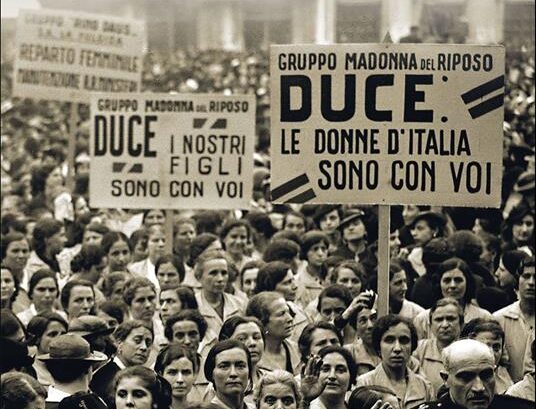
The conditions faced by women at work in Fascist Italy.
‘The Working Woman’s Position in Fascist Italy’ by Ita Mint from International Press Correspondence. Vol. 10 No. 10. February 25, 1930.
The working woman of Italy lives under most difficult conditions. Her wages are considerably lower than those of the man, even for the same work. Woman’s wages have catastrophically fallen since the advent of the fascist regime accompanied by barbarous exploitation and rising cost of living. For instance, whereas in 1921 women in the textile industry worked 8 hours and earned 150 lire per week on an average, now they work 9-10 hours per day and receive much less than that. Their working conditions are particularly bad. We shall cite here a number of statements by working women published in the illegal publication, the “Bulletin of the Women’s Department”.
Here is what a working woman of Turin writes:
“The women working in the spinning department where most strenuous effort is necessary can earn 5 ire a day working normally. By speeding up, for which unusual effort is necessary, they can earn another 3 or 4 lire at most.
“In the winding department work is not so hard but the conditions are extremely bad. The air is saturated with acids and dust, the temperature is very high. Once a doctor who enjoys the confidence of the employers took the side of the women for which he was immediately dismissed. The women in that department earn 9 lire a day.
“Women employed in the sorting department must have a good eye-sight and be able to read and write. Working conditions are very hard, just as in the spinning department, but the wages are lower. After 2 years of work, the eye-sight weakens to half the normal strength. In the weaving department young girls are employed who earn from 6-9 lire a day,
“In the packing department where work is particularly hard, the elder women are employed: they earn from 10-12 lire per day.
“A deduction of 1,65 lire per month is made for social- insurance. The working woman has the right to benefits only after having paid regularly for 4 months. In case of illness she receives from the 5th day. 5 lire per day for a period of 3 months. Usually such women are discharged after a while and thus deprived of the right to receive benefits.
“On becoming a mother, the woman having paid regularly her insurance receives a lump sum of 150 lire and 3.75 lire in the course of one month prior to and after childbirth. In substance she gets back what she has paid and in the period of confinement when she needs special care and food she has to live on 3.75 lire per day.”
From Empoli (the province of Toskan) a woman employed in the Fuchin and Rossel match factory writes:
“Our work is most injurious to one’s health and very hard. But notwithstanding women have to work 11 hours a day for which they receive 7 lire. The match makers whose health is totally ruined after a few years work are working on piece rates and the most they can earn is 7 lire per day. Nothing whatever is done for the protection of the health of the woman and mother. It is impossible to keep on this way any longer.”
From Monte Lupo they write:
“In the Nardi glass factory women earn 5-6 lire per day. Only some of the older women, those of 30-40 years, earn from 7,75 to 8 lire per day. We call them old because most of the workers in the factory are girls of 14-16 years. The temperature in which we have to work is either extremely high or extremely low and one an easily imagine what affect this has on our health. Our factory is a regular nest of tuberculosis, the more so that, as already stated, most of us are under 20. Such are the blessings of our youth.”
From another town they write:
“The new labour agreement concluded by the fascist unions for the hatmakers is advertised as a great victory, but figures show better than fascist praises what this great victory is. Experienced and skilled cutters having learned the trade in the course of years, earn from 6 to 8 lire per day. Finishers earn some 4-6 lire, operators 5.25 to 7.50 lire and pressers from 7.50 to 8.60 lire per day. The hatter has to learn many years before she is considered a skilled worker and can receive the highest pay. However, the bosses enthused over the spirit of class collaboration hastened to dismiss us a soon as we are entitled to receive the highest pay. They hire younger ones instead of us and force them to produce more than they can, for which they pay them ‘learners’ pay”.
The wages of women in Como are very low
“From the collective agreement in the textile industry in the province of Como we take here the most characteristic figures namely, the wages paid to the silk spinners.
“Apprentices receive 4,80 lire in the first and 4,60 lire in the second spinning department, Winders in the first category receive 5,55 lire in the first and 3,35 lire in the second spinning department. Winders of the second category receive 6.35 in the first and 6.10 in the second spinning department. Transmitters of the first category receive 7.15 in the first and 6.85 in the second department. Transmitters of the second category receive 7.95 and 7.65 lires respectively. Spinners receive 8.75 and 8.40 lires respectively. Spinners of the highest category receive 9.55 and 9.15 lire respectively. Sorters receive 6.80 and 6.35 lires. respectively.
“For an apprentice to become an experienced worker she must work 7 years. This means that most of the girls at the age of 20 and even more can earn a maximum of 4.80 lire per day.”
The dying plants of the province of Como write:
“According to the present agreement concluded by the fascist unions dying factories employing less than 100 workers, have the right to reduce the wages fixed in the agreement by 10%. What happens in most of the dying factories in Como? The “good” bosses who stand for ‘class collaboration’ so organise their business that the number of workers they employ is never more than 90. If owing to a lot of work a factory sometimes has an extra worker he is soon dismissed and the others are made to work overtime. Naturally this is done in order to deprive the workers employed of 10% of their earnings allowed by the fascist regime.
“Como dying factories become historically known for their ’99 principle.”
Fascism in its effort to secure a surplus of hands and cannon fodder for its aggressive wars advocates a higher birth rate among the workers.
Fascism severely punishes for abortions and grants 200 hire to those mothers who have borne 10 or more children. Burdening the working class family with many children, fascism only increases the poverty of the workers. Starvation wages, growing cost of living, the absence of any form of protection of the mother and child, lead to an extremely high infant mortality rate, to a high rate of illness of pregnant women and mothers.
Monstrous exploitation, starvation wages and endless deprivation, drives the Italian working women to resistance. Notwithstanding the vicious terror used by the fascist system, working women take part in the general struggle of the Italian proletariat against the capitalist order and against fascism. Many of them have lost their lives at revolutionary posts, many of them are languishing in fascist prisons. On March 8th the revolutionary working women of Italy will remember their advanced fighters in the prisons Jordina Rosetti, a textile worker sentenced to 18 years ior Communist propaganda, Felicita Ferrero of Turin, Anna Povana of Como, Lee Jacala, Viane Isila, Corone Francesco of Padua, Dzaire Czanki of Florence, and many others who have sacrificed all for the struggle of the working class.
International Press Correspondence, widely known as”Inprecorr” was published by the Executive Committee of the Communist International (ECCI) regularly in German and English, occasionally in many other languages, beginning in 1921 and lasting in English until 1938. Inprecorr’s role was to supply translated articles to the English-speaking press of the International from the Comintern’s different sections, as well as news and statements from the ECCI. Many ‘Daily Worker’ and ‘Communist’ articles originated in Inprecorr, and it also published articles by American comrades for use in other countries. It was published at least weekly, and often thrice weekly. Inprecorr is an invaluable English-language source on the history of the Communist International and its sections.
PDF of full issue: https://www.marxists.org/history/international/comintern/inprecor/1930/v10n10-feb-25-1930-Inprecor-op.pdf

