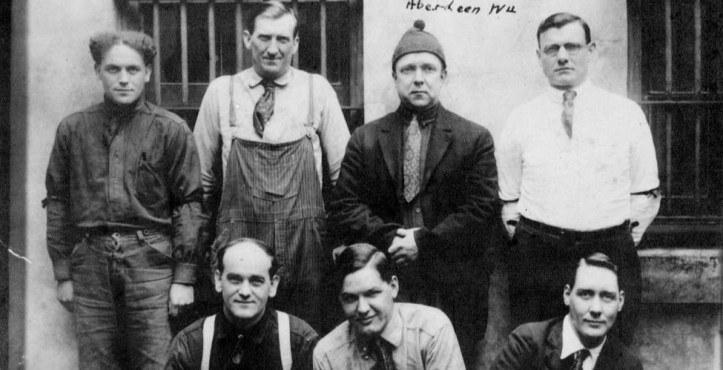
Deserving great respect, these were heroes of our class. 1919’s so-called Centralia Massacre in which I.W.W. members defended their hall against American Legion thugs resulting in the deaths of five reactionaries, the lynching of I.W.W. activist, and fellow veteran, Wesley Everett and long jail terms for both heroic comrades and innocent bystanders. Seven men would serve at least a decade with Irish-born James McInerny dying in prison.
‘The Spirit of Centralia Victims’ from Industrial Pioneer. Vol. 1 No. 7. August, 1921.
MODERN labor history has produced little that has created so profound an impression as did the events of armistice day in Centralia on Nov. 11, 1919.
Attacked in their own hall, members of the Industrial Workers of the World defended their lives and the property of the organization in regular battle with a mob composed largely of members of the American Legion. Three Legionaries were killed in the attack and one ex-soldier, a member of the I.W.W., was murdered by a mob after his capture.
Reflecting the fact of the class struggle in the lumber industry in the state of Washington, the prosecution was directed not against the instigators of the mob who made the attack, but against the members of the I.W.W., who were on the defensive. The lumber trust largely financed the prosecution and were loyally supported by every branch of organized business in the state and country.
Ten men were placed in the dock for their lives. After a sensational trial lasting several weeks a verdict was brought in on March 18th, 1920. Seven men were declared to be guilty of second degree murder by the jury. Two were found not guilty and one judged insane. On the same day the labor jury that had been sent down from representative labor bodies, in no way connected with the I.W.W., returned a verdict of not guilty.
Sentence was later passed by Judge Wilson on the seven convicted men. They were given from twenty-five to forty years in Walla Walla penitentiary.
Their case was appealed to the Supreme Court of Washington and in a decision handed down on April 14, 1921 the appeal was denied and the verdict and sentence upheld. On June 22, 1921 the seven victims of the Lumber Trust were spirited away to Walla Walla to begin serving their long weary years of confinement.
These are the few outstanding facts of the case that acquaint the reader with the actual events. Yet somehow they convey no idea of the tremendous significance and the personal development of individuals concerned with this defeat.
The Industrial Workers of the World as a whole and largely as individual members have come to see that battle with capitalism means a series of defeats so far as the ultimate goal is concerned, until the final fight when victory will mean the taking over of industrial and social power by the working class. Nothing short of such a victory can be construed as anything but defeat by the revolutionary workers.
As the organization and its members have gone from one partial victory or outright defeat to another they know and feel that it is the series of battles that are fought and the constant effort to achieve that will mean success.
It is in this light that the Centralia case must be viewed. The fact that seven convicted men by their brave spoken and written words and the everyday acts of their narrow and restricted lives adopt and express this attitude intensifies the knowledge that defeat is no disaster. It is part of the proletarian battle and the great fight must be carried on.
Never perhaps in any similar case involving as large a number of men has the courage and valor and unflinching attitude of the victims been so unanimous. The seven imprisoned workers have by their every act and deed practised and expressed their solidarity with those who were on the outside, or in other prisons.
It is not so hard perhaps for persons spurred on by great emotions and stimulated by being the center of great attention, to put forth a brave face in the moment of trial. From November 11, 1919 to June 22, 1921 the Centralia boys have lain in confinement. They have passed through terrible nerve racking situations. They have existed in that close promiscuity that wears on friendship and solidarity more harshly than any possible situation that could be imagined.
Yet their time has been spent in creative personal and organization work. Never from the first to the last of this trying period has any evidence of the great strain put upon them made itself manifest in their attitude. Quarrels, bickerings, petty misunderstandings, unavoidable it would seem under the circumstances have failed to materialize.
Education as a class and as individuals has been always a star in the I.W.W. firmament. Self-education has been the main activity of its jailed members. In the case of the Centralia boys the advance that they have made in self-education can judged by an examination of the literary work that they have turned out for the I.W.W. press. Cartoons and pictures, of vision and of artistic value, have from time to time been produced by these prisoners and have been reproduced in the press. In their letters widespread in point of time and written under all sorts of circumstances in regard to personal health and feeling a great contribution to the fighting spirit of the I.W.W. has been made.
Brave, earnest, yet with that touch of human understanding and humorous point of view that sifts out the dogmatist from the person of true breath of mind, the heroes of the Centralia battle have endeared themselves in the hearts of their fellow workers as much by their calm self-control as by their active bravery.
It is these seven men who have been taken to Walla Walla to face the spirit crushing machine of penitentiary discipline. That they will come out unbroken and unafraid is the firm conviction of everyone who has followed their case from beginning to end.
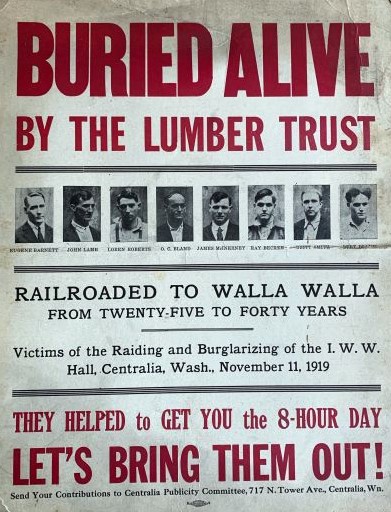
That labor will release them from their servitude is the purpose that is deep in the I.W.W. Earnest is the determination that the battle for our class supremacy will be carried on in the lumber industry and in Centralia.
The organization of the territory around Centralia is now going on full blast. The I.W.W. is well represented on the social map of this once terrorized community.
In the January 1921 active organization work was resumed in Centralia at the request of members of the organization in that place. The statement was made that should the White Terror in all the rest of the country burn and destroy the halls and scatter the members of the I.W.W., yet Centralia would maintain an organization and keep alight the spirit of revolt.
Since January a regular organization campaign has been carried on. The police officials on the instructions of the lumber interests started at once to apply pressure to stop the movement. Newsboys, branch secretaries, organizers and members were arrested. Some were released and others held on charges of criminal syndicalism.
In answer to this move the organization laid out a concerted plan of action. All the spare forces in the district were centered on Centralia. Instead of running for cover in fear of the iniquitous syndicalism law the membership rallied to the fight and dozens of men were soon in town selling literature, making house to house canvases, carrying on an educational campaign that will make forever impossible the recurrence of the armistice day tragedy of 1919.
Halls have been rented and openly advertised speakers have spoken on behalf of the I.W.W. program. Consistent press matter has been gotten out so that the whole district is behind the action of the vanguard on the job.
In organizing this educational campaign it was necessary to look out for the welfare of the educators. Housing accommodations were secured. Committees for looking after the house work, the food and the clothing were appointed and fill their duties thus securing the necessities of life for those engaged in propaganda work. Farmers are co-operating in the activities. Autos collect foodstuffs and the workers engaged in this fight are well supplied.
Four of the first members arrested in this drive were tried in Chehalis, the county seat located a few miles from Centralia. Two were declared guilty of criminal syndicalism and two were turned loose, on June 17th, 1921. Eighteen men have been in jail at one time. On June 25, 1921 nine men were unconditionally released.
They headed a parade up the streets to the place used as headquarters by the self-appointed educators. More workers are coming to town. The campaign’ is gaining attention, and a hearing from the formerly disinterested residents. Centralia will yet be known for acts of civic intelligence. Someday the picture of a noose bound form mangled and bleeding will not be symbolic of the reception given members of the I.W.W. by Centralia’s residents.
The spirit of unselfishness and the habits of patient constructive workmanship have been held up to us by the victims of armistice day in Centralia. This spirit and these habits are bedded deep in the make-up of the working class. Through their militant expression the jail doors will yet swing open on Centralia’s victims and the working class will always claim them as its own.
The Industrial Pioneer was published monthly in Chicago by the Industrial Workers of the World from 1921 to 1926. The precursor of the Industrial Pioneer was the One Big Union Monthly. Heavily illustrated, the journal included arts, prose, and poetry along with historical articles and analysis. Editors included John A. Gahan, Vern Smith, H. Van Dorn, and Justus Ebert.
PDF of full issue: https://www.marxists.org/history/usa/pubs/industrial-pioneer/Industrial%20Pioneer%20(August%201921)_0.pdf

