
Beginning the complete transcription of Anna J. Haines knowing and experienced investigation into the first decade of Soviet health policy under the direction of People’s Commissar of Health, Doctor Nikolai Semashko. Serving as Health Commissar until 1930, the preventative, child-focused, centralized but dispersed, and research driven system devised by him, the ‘Semashko System,’ would later be taken up in the Cuban Revolution where it remains the basis of their health programs today. Below are a biographical note on Haines, the I. Introduction, II. Medicine Under the Old Regime, and III. The Fundamental Principles of Soviet Medicine.
‘Chapters I, II & III’ by Anna J. Haines from Health Work in Soviet Russia; Vanguard Studies of Soviet Russia. Vanguard Press, New York, 1928.
Biography
Haines, ANNA J. Nurse; born in Moorestown, New Jersey, 1886; educated at Friends Academy, Moorestown, Westtown Boarding School, Bryn Mawr College, Nurses’ Training School of the Philadelphia General Hospital, and Pennsylvania School for Social and Health Work; after graduation from college taught for a year and a half in public schools; worked one year with Children’s Bureau, and three years doing settlement work, in Philadelphia; acted as housing inspector in Department of Public Health, Philadelphia, for four years; went to Russia in 1917 as relief worker for American Friends Service Committee, returning to the United States in 1919 and working for a year under American Red Cross in western Virginia; went again to Russia for a year as representative of American Friends Service Committee; returned to America and studied nursing in Philadelphia General Hospital and in Pennsylvania School for Social and Health Work; went once more to Russia for American Friends Service Committee in 1925 for a period of almost two years; now planning to return to Russia as soon as sufficient funds have been raised for the American Friends Service Committee to establish a Nurses’ Training School in Moscow, for which the Soviet Government has already given its permission; author of several articles on experiences in Russia and on subjects related to nursing, published both in America and in Russia.
I. INTRODUCTION
TEN years have now passed since the October Revolution brought the Communist Party into control of Russia. During that time there has probably been more written about different phases of the economic, social and political life there than has ever been written about a similar period in any other country. Truly surprising numbers of books, pamphlets and magazine articles have appeared, most of them, unfortunately; devoted to a spirited defence or denunciation of the present conditions. The unbiased objectivity of a camera lens is probably never possible to achieve in describing social phenomena, but too many recent writers about Russia have shown posters for propaganda rather than real pictures. What is unsensational and little advertised is apt to be overlooked, even though it may be a very fundamental factor in the new structure. Because during these ten years it has gone rather doggedly about its own affairs, not irritating foreign nations in any way and devoting all of its energies to constructive work, we have heard very little about the People’s Commissariat for the Protection of Health.
This silence on the part of journalists and authors is unfortunate for two reasons:—first, because it has given many Russians the impression that we are interested only in their spectacular or destructive activities, and second, because it has prevented us from observing the take-off of a number of very interesting experiments, especially in the field of Public Health.
The more significant of these are certain new methods of approach to the organization and administration of health work. To the present-day Russian physical health seems as important a factor in life as education. Therefore medical service has been put in the same category as the public school system, the state aiming to provide both of them freely for practically all citizens. This widening of the boundaries of public health work, the so-called “nationalization of health service? is the most important experiment that the Russian medical situation offers for observation, since no other country in the world is putting such a system so fully into operation.
Out of this initial project there have developed many other by-products of almost equal interest. The limiting of the working-day required of all doctors to six hours, and the opportunity thus given to them to carry on research work, private practice, or any other avocation they may wish in their ample leisure time, is an original contribution to the solving of the problem of the overworked professional man.
The organization of all workers in medical institutions (including doctors, nurses, orderlies, laundresses, stove men, chauffeurs, etc.) into the “Medical Workers? Union” is a solution of the problem of industrial relations which will seem even more revolutionary to many of us; yet the Union is growing in membership and the idea is growing in popularity even among those Russians who at first repudiated all consideration of it.
Concrete examples of new medical institutions are also provided by Russia. A unique contribution to the treatment of tuberculosis is offered in the “night sanatoria,” where working men and women in the early stages of tuberculosis may spend all their non-working hours in health-building surroundings, and yet live near to their families and to their places of work. Another unusual type of institution is the “forest school,” a public boarding school in the country with outdoor class-rooms and long periods of outdoor rest and play for malnourished city children who need three or more months of especially careful hygiene. The free diet dining rooms to which doctors may send patients requiring scientifically prepared food, just as they might require some scientifically prepared prescription, offer another example of experimental work in public health.
The reduction of the infant mortality from the 27.0 babies per hundred who died in 1913 to the 17.0 per hundred who died in 1923; notwithstanding the fact that the intervening years were filled with war, famine and disease, stirs one to enquire into the kind of infant welfare work which could bring about such an improvement. The report of visitors to Moscow that they have never seen such beautifully arranged and instructive health exhibitions; the attitude of the workers for prohibition, who fight alcohol because they classify it with the spirochete and the Koch bacillus as a social poison; the government’s quite revolutionary attitude toward family limitation: all of these factors contribute to the picture of a new conception of health as a positive national asset.
Because there has been so little written in English about the health work now being carried on by the Soviet Government, and because I have been able to see this work both at long and at close range, it has seemed worth while to write some account of what is being done there.
I went to Russia for the first time in 1917 while Kerensky was still in power, and lived for more than a year in a former Zemstvo hospital in a village of about 5,000 souls on the southeastern steppe. At that time I was a worker with the American Friends Service Committee which was carrying on medical and other relief work for Russian refugees and civilians. In the fall of 1918 we went to Siberia and spent nine months in Omsk, affiliated with the American Red Cross in refugee relief work, at a time when the epidemics of typhus, scurvy and small-pox were at their height. During 1920 I was with the Home Service Section of the American Red Cross in the mountainous western part of Virginia, and had the opportunity of seeing some almost Russian conditions in our own country. The latter part of that year I returned to Russia as the representative of the Friends to help with the distribution of milk, clothing and medicines to the children of Moscow, which in that year endured almost famine conditions. While I was there the great famine began and I accompanied a group of Russian doctors on the first tour of inspection of the famine area, where cholera, the black plague, scurvy and malaria were supplementing the famine’s activities. My third visit to Russia lasted from February, 1925, to November, 1926, at a period when living conditions were much more normal and when I spent my time at first working in a hospital and then teaching nursing in the school for infant welfare workers in Moscow, with week-ends and vacations of travel to other cities, to the Caucasus, and to the former famine area. This total of over five years’ residence in various parts of Russia, during which time I learned to speak the language, not very correctly but rather fluently, has given me an opportunity to see the health work not only in large cities and in well-known industrial centers, but also in the primitive steppe villages and in remote mountain hamlets. In the pursuance of my work I have had several interviews with Dr. Semashko, the Commissar of Health, and with Dr. Lebedeva, Director of the Department for the Protection of Infancy. Letters from these two executives and from Dr. Schaeftel, head of the Bureau of Foreign Information in the Commissariat of Health, have made it possible for me to enter, without previous announcement, hospitals, day-nurseries, sanitoria and other medical institutions in the remotest parts of the country. Whether I was a visitor, a fellow-worker or a teacher, I have found the members of the medical profession (and in Russia this term includes workers other than doctors) most courteous, patient with my poor language equipment and eager to hear what I could tell them of health work in America.
Most of the information in these pages I have gathered at first hand from an almost daily contact with some branch of the health department. The statistics of course are not of my own compiling. Most of them have been taken from the official Statistical Material 1913-1923 issued in 1926 by the Commissariat of Health. Although this book is a mine of information, there are occasional contradictions and more often annoying hiatuses. For example, the Russians have never kept mortality rates with the same inclusiveness as their morbidity rates, so that it is difficult to discover how serious some of their epidemics have been, or to estimate the effectiveness of their therapeutic work. In the pre-revolutionary day it was the duty of the priest to collect the vital statistics of a village, since practically all the births and burials were known to him. After the Church and State were separated this cooperation ceased and for a number of chaotic years no reliable health records are available. It is only since 1925 that there has been legal and financial provision made for the general collection of vital statistics, and when one has sat beside a sleepy country doctor and watched him make up his statistical sheets at the end of a day’s work one sometimes doubts the accuracy of the next issue of Statistical Material. The general trends in health work, however, are shown by these mass figures even if they may not be accurate to the last decimal; in certain instances where we have personal knowledge of the situation we have found it corroborated the more general findings.
In the chapter on the Fundamental Principles of Soviet Medicine I have tried to present the problem of a nation’s health as it appears to the Russian Socialists; when that attitude is understood it is easier to appreciate the development of the organization of their health service.
Throughout I have used the Russian terms for geographic units of government: gubernia, ooyzed, and volost. These correspond roughly to our words state, county, and township, but the areas they represent are all much larger than in the United States; most of the ooyzeds are larger than most of our states, and one volost will often contain several villages of 1,000 to 3,000 population each. The abbreviations R.S.F.S.R. and U.S.S.R. refer to the Russian Socialistic Federation of Soviet Republics, and the Union of Socialist Soviet Republics. The first is made up of the 32 central gubernias which we usually consider European Russia, as well as the states in the north Caucasus region and all of Siberia. The U.S.S.R. is a looser union of the R.S.F.S.R. together with the Ukraine, Georgia, Armenia, Azerbaidzhan, and the various Russian states in central Asia. Always in reading about Russia one must remember the enormous size of the country, comprising one-sixth of the land surface of the earth. Inhabiting this are more than 140,000,000 people of whom all but about 6,000,000 are engaged in agriculture; of the non-agricultural group about 1,600,000 are industrial workers, about 700,000 are transport workers, the remaining being office workers, teachers and civil servants, with a small minority engaged in private trade. It is over such areas and such masses of people that the health problems extend.
II. MEDICINE UNDER THE OLD REGIME
To understand the size of the problem which confronted the Commissariat of Health on its establishment in July, 1918, one must know something of the medical situation in Russia under the old regime. As in many other spheres of Russian life, here also there were the most diverse extremes of backwardness and enlightenment. In general, the standards of medical education were high, and certain experimental laboratories and institutions stood at the very forefront of the scientific world. In 1847 Dr. Piragoff was using in St. Peterburg a method of anaesthesia which is only now being favorably reported on in New York; more recently the physiological research of Professor Pavlov has made all countries debtor to him; Metchnikoff’s name was known even in the non-scientific circles outside of Russia; a thoroughly modern children’s hospital with an almost luxuriant scientific and housekeeping equipment existed in Moscow, and the same description could be applied to one of the maternity hospitals in St. Petersburg. These individuals and institutions however, were separate instances, the result of personal intelligence and of philanthropic generosity. Although clinics and memorial hospitals where poor people were treated freely could be found in all of the larger and many of the smaller cities, there was no organized effort on the part of the government, either local or central, to ensure medical attention to the mass of the people in the cities. The number of philanthropic medical institutions never really met the needs of the sick, and except for one or two experimental child welfare centers prophylactic and educational health work was unknown.
In the country districts the situation was slightly different; there doctors were provided by the Zemstvo or regional authorities who had charge of the distribution of tax money intended for local purposes, such as schools, roads and hospitals. The value of these medical out-posts varied greatly with the type of doctor in charge.
In some cases they were really devoted to their work, receiving large numbers of out-patients daily and driving many miles through deep snows to patients in remote villages. Too often, however, they were men who had failed to make a living for themselves in the city and therefore had been forced to accept the poorly paid country posts, where they consoled themselves for the loneliness and isolation of their lives by heavy drinking and by accepting bribes from the peasants. It is still a very general tradition that “good” medicine must be paid for and that free medicine is only colored water. Very rarely would these country doctors perform any operations, and the expense of a trip to the city for such a purpose was prohibitive to most peasants. They made little or no effort to keep abreast of the modern developments in their profession and sometimes were no real help to the neighborhood in which they lived. During the summer of 1926 one of these old practitioners was found in a remote hill town whose only treatment for diarrhoea in little babies was cognac, and, if that failed, more cognac. A change or restriction in diet was never suggested to the mother, who probably continued her practice of nursing the baby whenever it cried and leaving it with a pickled cucumber or a watermelon rind to suck when she was away from home.
Limited as the service of these doctors was, their number was even more limited. In many districts the proportion of physicians to inhabitants was one to forty thousand. It was no uncommon case for a man with a broken leg to have to drive two days to reach a doctor to set it. In all Russia in 1913 there were only 12,677 doctors, or one to every 6,900 people; of these, 8,900, or 71 percent, lived in cities, leaving an average ratio of one doctor to 20,300 peasants. At that time the peasants comprised about 80 percent of the total Russian population. (These figures are from the Report of the Peoples’ Commissariat for the Protection of Health to the 12th All-Russian Congress, 1925, p. 69.)
So great was the need for medical personnel that a type of semi-qualified individual, not met with in other parts of Europe, was developed in Russia. This was the feldsher. He was given a modified medical course of about two years (at that time the regular course took five or six years); and was prepared to do emergency aid work, to perform minor operations and to prescribe for the more common diseases. The women (feldsheritzas) received in addition a good course in midwifery. Many of the medical outposts were staffed by these feldshers; in the cities they assisted the doctors in the operating room much as trained nurses do in America.
Outside of the larger cities there were few if any nurses before the Revolution, a feldsheritza usually being employed in rural hospitals to take the temperatures of the patients and to carry out the more complicated orders of the physician; all of the personal care of the patient, as well as the cleaning of floors and furniture, was done by illiterate servants or by the patients’ relatives who were allowed to sleep on the floors of the wards or in the corridors of the hospital. These relatives provided all the food for the patient, little or no attention to diet being given by the doctor. Cold boiled meat and over-ripe fruit were frequently the only nourishment offered to typhoid fever patients. Baths were never given to patients in country hospitals; indeed a bed-bath is still unknown in Russia, but bathtubs are gradually being installed in all hospitals for the use of those who can walk to them.
With these conditions it is not surprising that there was a very high death-rate in the Russian hospitals and that the peasants feared to enter them, and postponed doing so until they were beyond hope of recovery. In 1913, the last year of the old regime in which the medical personnel was functioning normally for civilians, the death-rate for all ages throughout Russia was 27.3 persons per thousand; in 1923 it had been lowered to 23.7 per thousand, this marked reduction having been achieved in spite of the fact that eight of the ten intervening years had been filled with international and civil wars, with epidemics of disease and with famine, during which the rate had temporarily risen to 33.4 per thousand. (From “Vital Statistics in the U.S.S.R.” by Professor Michaelovsky in the Report of the Third All- Russian Conference for the Protection of Motherhood and Infancy, p. 141.) If instead of the country as a whole we take the city of Moscow which in recent years has become a center of curative and prophylactic effort, we find that in 1913 the death-rate registered 23.2 per thousand, and in 1923 had fallen to 14.0 per thousand. (From the Report of the People’s Commissariat for the Protection of Health to the 12th All-Russian Congress, 1925, p. 6.)
The infant death-rate under the Czarist regime was admitted to be very high, the highest of any civilized country; 27.0 per hundred in 1911, when Norway showed 6.5, England 13, France 15.6 and Germany 19.2. (From Dr. B.S. Ginsburg’s The Protection of Motherhood and Infancy, p. 15, Moscow, 1926.) But so long as the birth-rate was high enough to assure the normal growth of the population, little attention was paid to the death-rate. This loss of infant life was largely due to the lack of trained midwives in the villages, a lack which resulted in the ministrations of babkas or “old wives,” whose practices were so crude and often so cruel that they are scarcely believable.
One responsibility that was felt by the government was for the prevention of widespread epidemics. Vaccination against small-pox was provided freely, and expeditions, sometimes under the direction of foreign specialists, were sent into territories infested with the black plague and malaria.
There was, however, no central health organization, the prevention of epidemics being directed from a small division of the Department of the Interior. The army and fleet had their own separate medical units, there were certain insurance companies sending doctors to their clients, some cities had their public institutions, but in general the peoples’ health was in the hands of private practitioners and of benevolent individuals. These institutions and individuals had no common standards to comply with, no inspectors to unify their work and no program making for an organized campaign against disease.
III. THE FUNDAMENTAL PRINCIPLES OF SOVIET MEDICINE
With the founding of a socialized state all the needsand activities of individuals were scrutinized with a view to discovering which of them were of the fundamental and group character warranting their assumption by the state. Health was immediately recognized as one of these basic needs.
In a state predicated on the law that every adult should be a worker making some constructive contribution to the general welfare, it is not possible to consider disease as a person’s private business, to be indulged in or not as he sees fit. Disease is seen to be harmful, not only to the person suffering from it, but to the state of which he is an economic and social unit. Illness, moreover, seldom comes in single instances to a community; even a common cold rarely stops with its original owner. Years ago governments which were not at all socialistic felt a responsibility toward protecting their citizens from the so-called “contagious diseases” such as small-pox, diphtheria and yellow fever. In no civilized country are these left entirely to the initiative of the individual patient and the private practitioner. Many more diseases share this “contagious” character, but private physicians and the medical associations have taken alarm, sensing the danger that many of their patients might be deflected to free state clinics.
The difficulty of their position is greatly increased by the shifting of emphasis in recent years from curative to preventive medicine. There is no gainsaying the greater scientific and economic value of preventing disease rather than merely curing it or caring for its chronic forms. But only the Chinese have ever devised a system whereby a man pays his doctor so long as he is well, and collects a fine from the physician if he becomes ill. In Western countries the theory has been evolved that the state should assume the responsibility for sanitary inspection of buildings and food, for vaccination, for the periodic examination of school children etc., etc.; that is, for a gradually widening circle of phophylactic measures, for which the individual healthy citizen is slow in assuming financial responsibility. But the increase in prophylaxis should mean the decrease in individual cases of illness, and therefore, however unintentionally, the decrease in the income of private practitioners. The truth that “an ounce of prevention is worth a pound of cure” ultimately may be translated into dollars and cents. American medicine is now in this impasse. Our medical journals and influential physicians are at the same time eager to adopt the most modern and scientific attitude toward disease and yet are jealously on guard against what they feel to be the encroachments of “state medicine” when it tries to put this attitude into practical effect. We have not gone even as far as most European countries, who have recognized health as a state asset to the extent of creating governmental ministries for its protection. Officially we are still taking very much the same attitude toward the health of our citizens as did Czarist Russia. In some fields our mortality and morbidity statistics do not bear comparison with those of other countries; because we are still rich in numbers we are content to be wasteful of human lives.
Russia broke with this point of view during the October Revolution of 1917 and started on the foundation of a new conception of State Medicine with the creation of the Commissariat of Health in July, 1918. Just as the banks and the railroads and the private trade were nationalized in those days, so medical institutions and the treatment of disease were made a state function and responsibility. In The Foundations of Soviet Medicine, an essay published in 1926, Dr. Semashko, the Commissar of Health, presents the point of view which distinguishes the health service of socialist Russia. “Soviet government,” he says, “is a government by the masses in the cities and the country. This fundamental fact determines the entire character of soviet sanitation and medicine.” The health of the workers is the responsibility of the workers themselves” has become one of the slogans of Russia. “The nationalization of medicine does not mean, as some think, the closing of all private hospitals and the prevention of all private practice, but the actual socialization of medicine; i.e., the taking over by the state of the responsibility of providing for everyone at his earliest need a free and well-qualified medical treatment. Only then will disappear, like a shadow before sunlight, all private hospitals and all commercial private practice. This is the perspective of Communist medicine.”
This goal is to be achieved by the application of five basic principles:
A. The unification of medicine.
B. The accessibility of medical aid to all citizens.
C. Free medical treatment for all citizens.
D. Medical treatment by qualified personnel.
E. The placing of emphasis on prophylactic work.
A. The first step toward the practical realization of national health was seen to be the formation of an intelligent program and the organization of all the available medical resources into a unified system for its enforcement. The Commissariat, or, as we should say, the Department of Health was the organ through which this program was put into effect. The details of its organization will be more fully described later; here it is only necessary to say that all doctors, feldshers, nurses and pharmacists became civil servants, and all hospitals, sanatoria and drug-stores, became state institutions; unified schemes of medical work appropriate to rural conditions as well as others for towns and cities were drawn up and fitted into the general plan of volost, ooyzed and gubernia political organization; a standardization of hours of duty and of salaries based on professional responsibility and local economic conditions was worked out, to be applied throughout the country; programs of child welfare work and campaigns against venereal disease and tuberculosis were prepared on a nation—wide scale; central institutes were established for research and teaching in various branches of medical science, to which provincial doctors could come for post-graduate study; the wholesale preparation of drugs and the purchase of those produced abroad was carried on as a state business, without the cost incident to private production and advertisement.
It is not only the Russians who have seen the economy of effort and of money involved in such a unification and systemization of the forces working for health. In his opening address to the American Health Congress at Atlantic City in May, 1926, Dr. Lee Frankel of the Metropolitan Life Insurance Company said: “To put it as tersely as possible, are we ripe in the United States for an attempt to unite the various national voluntary health organizations in one compact body which shall “not limit itself to campaigns for the eradication of any one particular disease, but whose main purpose shall be reduction in morbidity and mortality through a concerted unified attack on all disease? Is it the psychological moment to think in terms of national health rather than of special disease?…I am convinced that a united organization, manned by representative men and women, with divisions and bureaus to cover every field of activity now covered by existing national health organizations, with a definite purpose to cooperate with existing official health bodies, either local, state or national, could revolutionize health work in the United States. Not the least of its activities would be the education of 110,000,000 people in preventive medicine and personal hygiene. Only when we have united effort, through the work of a unified association can we ever hope to bring about another dream, a united Federal Department of Health.”
One could scarcely find a stronger witness to the inherent intelligence in the idea of the unification of medicine, which the Russian state has been the first to try to put into complete operation.
B. The accessibility of medical help to all citizens is also an essential part of the application of state medicine, but in a country of 140,000,000 people spread over 8 million square miles of territory the immediate accessibility of medical treatment to all becomes no easy matter. It is sure that many more doctors are now being graduated from the universities than before the Revolution, but there is also a greatly increased demand for them within the new institutions created under the socialized health program. A generally applied health insurance policy or a practical child welfare campaign in a city doubles the municipal positions open to doctors there. If these demands are met the villages are meanwhile left with little medical aid, and the steppes of the south-east and of Siberia are still more helpless. Everywhere this lack of personnel is recognized and regretted.
The same conditions are true of institutions as of personnel. It is on the program that medical institutions be open to all citizens needing such care, but it is by no means true that the financial situation of the central or of the local health departments permits this program to be carried out. There are indeed fewer hospitals in the country as a whole now than there were before the destructive years of war. What does exist, however, is a program of expansion which automatically goes into effect as revenue increases, an increase which will come with the improvement in harvests and industries. The growth of the health service may depend on economic conditions, but it is not a matter for political bargaining.
C. The third principle—free medical treatment for all—must at present be discussed in much the same terms as the accessibility of treatment. The original and the ultimate intention is that it should be free to all citizens, but as Dr. Kuchaedze, the Commissar of Health for Georgia, writes in Fundamental Problems in the Structure of Soviet Medicine (page 4), a pamphlet printed in Tiflis in 1926: “This principle unfortunately cannot now be completely carried out owing to the lack of material resources. From the moment of the inauguration of the New Economic Policy we found it necessary to draw back a little, though holding to our original aim…The ranks of those to whom free aid can be given will widen in proportion as the material and economic conditions of the country improve.”
Until 1921 the central funds had helped many neighborhoods which were unable to finance health work of their own, but one article of the New Economic Policy, which went into effect in that year, placed the responsibility for all local institutions on local taxes, and at that time many formerly free medical institutions throughout the country were closed owing to the inability of the local treasuries to support them. At the same time a certain amount of private practice began to be permitted. As a result of the actual shortage of personnel and of the restrictions enforced by lowered budgets, the state clinics were and are very crowded, so that patients often have to wait a long time for their turn for free treatment. If these patients are not very poor they may prefer to spend their money for doctors’ fees rather than sit in the crowded waiting-rooms. A doctor’s regular working day in the state service amounts to only six hours; therefore, after this service is over he is at liberty to receive private patients in his own home and to charge them such fees as he desires.
At present Russia has the compromise system of free or voluntarily paid medical treatment for all holders of health insurance, that is for all salaried workers and their families, for all soldiers and their families, for all wounded ex-soldiers, for all school-children and for the poorest among the peasants. The payment of fees for medical treatment is obligatory on the part of all private traders and employers of labor.
D. Treatment by qualified personnel—the fourth principle of soviet medicine—has a meaning peculiar to Russia, owing to the existence there of the feldshers, or non-qualified medical personnel, who still out-number the doctors and who from necessity are still carrying much responsibility in the rural districts. The policy of the Commissariat of Health is to reduce their number gradually by offering to them each year a certain number of scholarships in the medical schools, and by eliminating the feldsher courses so that no new feldshers will be trained.
At the same time a distinct propaganda for specialization is being carried on among the young doctors. Graduates from the general medical courses are urged to continue their studies along some special branch before accepting any practical position, and attractive courses of post-graduate work are offered with interne service, which is not included in the general program. These courses are very popular and it is possible that in time they may come to be required and that all physicians will be specialists. Excellent as this system may be for the complicated medical service of a city one is somewhat appalled at the dilemma of a rural community unable to afford more than one doctor, and forced to choose among pediatricians, surgeons, psychiatrists and dentists.
A campaign is also being conducted to improve and standardize the work of other medical personnel. Several nurses’ training schools have been opened and classes are held in many institutions for the ward maids and orderlies.
E. The reorganization of Russian health work under the soviet regime came just at the time when “Prevention” was the slogan in medicine everywhere. It was a new point of view for Russia and it fitted admirably into the new Russian sense of values. Preventive medicine deals with groups rather than with individuals, it seeks causes rather than symptoms, it aims to eradicate evils rather than to ameliorate or to cure them. It is easy to understand why “phophylaxis” has become the most popular medical term in Russia.
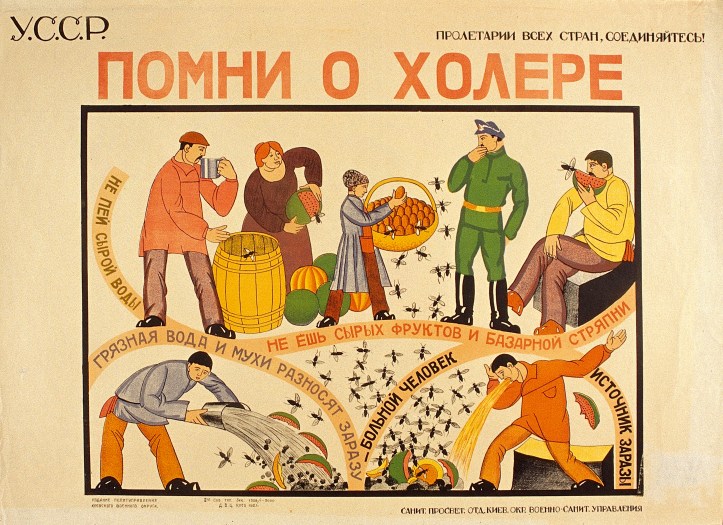
Many of the serious diseases there have been serious only because of the lack of attention to personal and public hygiene. Where the body louse is not tolerantly endured typhus does not spread, where the supplies of drinking water are pure typhoid fever and cholera do not flourish, but these diseases in the past have taken heavy toll from Russia. The methods which have almost rid the country of these dangers are now being applied to the reducing of tuberculosis, venereal disease, infant mortality, etc. The kissing of sacred images, eating from a common bowl of soup, the giving to young children of food partially chewed in an older person’s mouth—to eradicate these sources of infection requires more than a doctor’s prescription. A new word “dispensarization” has been coined to cover all the measures used in combating these diseases of society, as they are called. Dr. Semashko, in The Foundations of Soviet Medicine, says:
“An anti-tuberculosis dispensary differs from a simple out-patient clinic in this, that it aims not only to cure the sick person, but to examine into his living and working conditions; if his apartment is not sanitary it tries to help him to find another more sanitary. If the patient needs some kind of material help the dispensary finds this help.
“The dispensary inspects the factories and warehouses in its neighborhood and if it notices something dangerous to health on the premises (if they are full of dust, if there is poor ventilation, if poisonous gases are emitted) the dispensary tries, by bringing pressure to bear on the administration of the business, to eliminate that danger.
“The dispensary carries on a widespread propaganda for sanitary instruction, by means of lectures and reports, not only within the dispensary, but also within the nearby factories and warehouses.
“Finally the dispensary maintains close relationship with the workers’ organizations in its neighborhood; with the unions, women’s clubs, the Communist Youth movement, and cooperative societies. At the dispensary there is always a Council of Social Aid (it is sometimes called “The Commission for Improving Conditions of Life and Labor”) made up of representatives of these organizations.
“Thus a dispensary not only prescribes for sick people and sends them to sanitoria and hospitals, but also prevents disease, first of all by means of universal teaching of personal and public hygiene, since the great majority of diseases (typhus, small-pox, syphilis, tuberculosis, skin disease, etc.) grow out of the hygienic illiteracy of the population, out of ignorance of the simplest rules for protecting themselves from disease.
“This is what is meant by the ‘dispensary method.’ We wish all our medical work to proceed along these lines…The goal of Soviet medicine—the reason it works not only for the healing but for the prevention of illness—is to create the positive health of the population.
It is this conception of a health service which shall be an active, not a passive, factor in the life of the people that distinguishes the Russian Commissariat of Health from the usual Public Health Department of other countries; its physicians are schooled not as policemen or inspectors, but as social workers and teachers.
PDF of original book: https://archive.org/download/healthworkinsovi0000anna/healthworkinsovi0000anna.pdf

