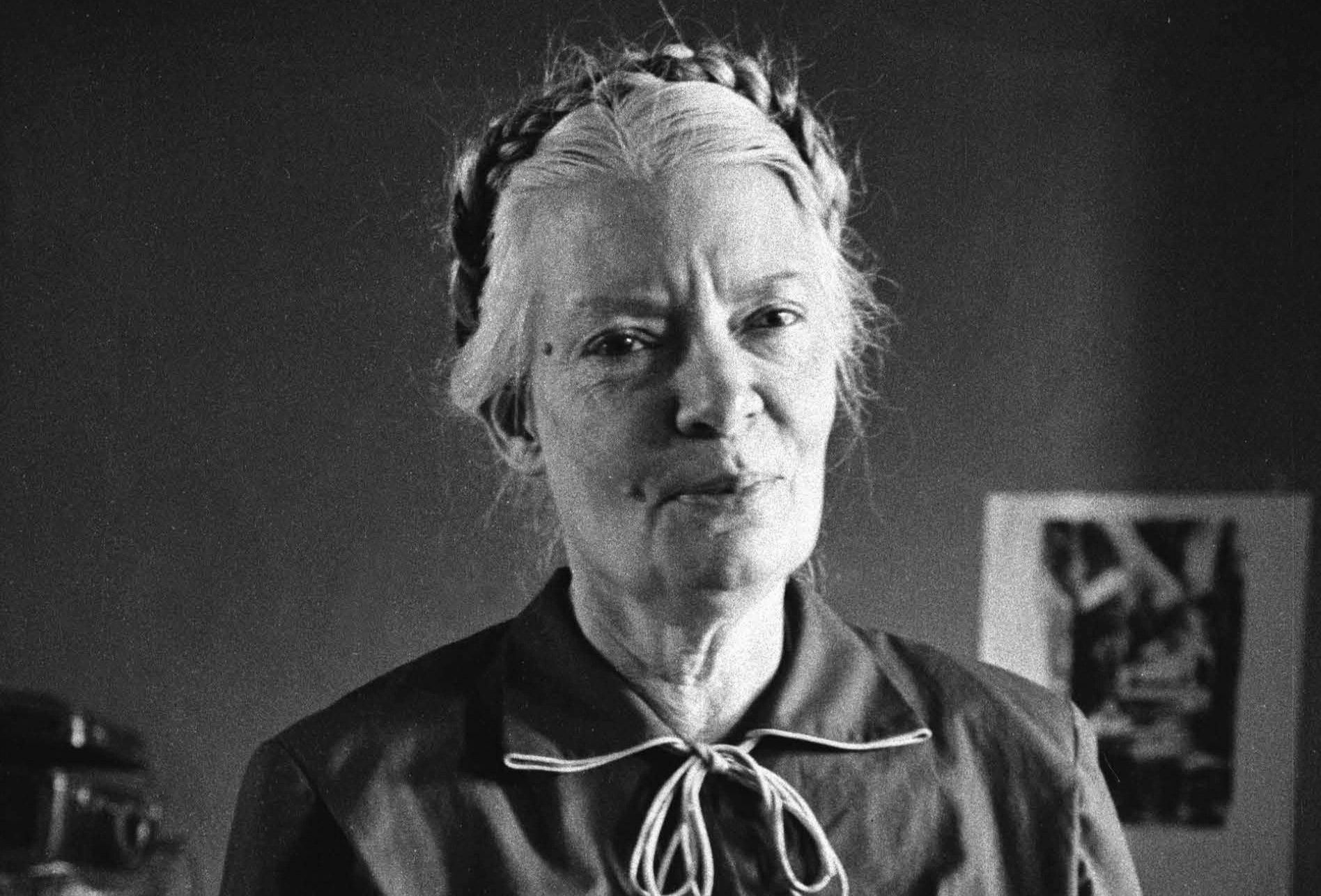
Dorothy Day, who several years after this would found the Catholic Worker, speaks to her experiences with women in Chicago jails, and exhibits that which was so consistent in her character through her political and religious changes.
‘Girls in Jail’ by Dorothy Day from New Masses. Vol. 4 No. 2. July, 1928.
I met a girl in Chicago some years ago by the name of May.
She had been brought up in homes for incorrigible girls and had lived with a pickpocket and dope addict after she got out. But she cured herself of taking dope and left the pickpocket and had lived a calm honest life with a taxi driver for some years. There was a great deal of sweetness about her and for a year we were friends. Often she drank too much and grew raucous in her cups, but she never lost a fine sense of fair play and honor. I was very fond of her.
Then she had a quarrel with her taxi driver, and he went away. Her sense of loss was overwhelming. She lay down one night and took a bottle of veronal tablets and went to sleep. Her landlady notified the Cook County hospital so May was ministered to immediately and saved.
I had not seen her for a week and knew nothing about all this. One morning she called me up.
“I couldn’t stand that damn hospital,” she said. “I’ve lived in enough institutions. And I couldn’t go back to my room. So I’m over at West Madison Street. Come and see me, will you?” The house on West Madison Street was opposite I.W.W. headquarters and was a rooming house for men. We knew several of them, and one, an I.W.W. printer, had always been fond of May. It was to him she had fled. The rooming house was above a store. In addition to the rooms there was a huge common kitchen with a large gas and coal range. It was a general rule of the establishment to keep a large pot of “mulligan” always on hand, so that whoever came in could eat. This supply in the pot was replenished from day to day with vegetables and pieces of meat.
May being a most fastidious housekeeper I knew she would have no appetite for the unending pot of mulligan. So I made up a basket of sandwiches and fruit and took a taxi over to the west side.
We sat in the common kitchen for a time listening to the stories of the men. Then we went to her rooms to go to bed, for she had persuaded* me to stay all night with her. It was eleven o’clock on a very hot July night. I lay down to bed in my chemise and May sat up in a chair dressed only in a pair of bloomers and a brassiere. We munched on sandwiches from the hamper, and talked. Suddenly we were horrified when the door banged open and two strange men pushed their way into the room.
May recognized the type immediately.
“What do you two bulls mean by bustin’ into our room? Can’t you see we’re perfectly all right?” Her tone was half defiant, half pleading.
I could say nothing. I was overwhelmed by a sudden feeling of sickness and fear, and with a mental shrug, tried to harden myself to whatever might come. Stonily May and I dressed—the men standing by—smirking and making playful remarks. With some show of indifference we accompanied them down to the street corner where we waited for the police wagon. Two other detectives there had charge of a young engineer who was rooming at the same place, and the pressman in the I.W.W. printing plant. This pressman had a long scar down the side of his face which drew down one eye and the corner of his mouth in a sinister frown. But we knew that he was gentle and kind and that he would give his week’s salary to anyone who needed it.
We went swiftly through the dark streets, first to the station where the men were left, and then to the West Chicago Avenue station where women are always taken.
The cell into which we were put had windows on two sides through which we could see the stars and a moon. The six cots in the room were without bedding or sheets and the mattresses would not bear looking at. Earlier in the evening a drunken woman had occupied the cell and in her fury had torn a mattress to shreds and turned one of the heavy iron beds upside own.
May and I did not talk. We took off our dresses and regardless of how wrinkled they would get, spread them under us and lay down to seek escape from the horror we felt.
We were awakened next morning by the matron banging on the bars and calling out our names. I didn’t recognize mine at first until May nudged me into remembrance.
“How about coffee and rolls,” May called out.
“One dollar, my dear,” said the matron, grimly.
During the rest of the day our attention was distracted from our own troubles by the arrival of other prisoners. Fifty girls were brought in a chattering, laughing troupe; eight of them put in the cell with us. During the afternoon the other cells were also crammed. The girls laughed and sang and called back and forth to one another, and rushed to the bars every time a new arrest was brought in.
Our six cell mates rid themselves of their outer garments as soon as they were locked in, to keep them neat and for the sake of coolness. Underneath their street dresses the girls wore the sheerest of chemises, trimmed with fresh lace and ribbons. These were of all colors, yellow, green, rose and bright red and blue. When the girls rushed to the bars to shout greetings to others who were brought in, or to call to policemen they knew, they looked like the chorus of a musical comedy.
A group of girls usually worked together, I found. One of them, for legal purposes, constituted herself the head, or as she was booked on the police blotter, the “keeper” of the house. The “madam” in our cell, as one of the girls laughingly styled herself, was a tall, well-made young woman with close clipped black hair, brushed straight back from a broad forehead. The others called her Big Six and she led the rest in singing and story telling through the afternoon and the long night that followed.
I had been lying on one of the couches, with May lying at the foot. I was looking rather mournful, I suppose, when Big Six came over and comforted me. “The first time’s the worst time, kid,” she said kindly. “Come on, have some coffee and rolls and a cigarette and don’t let it prey on your mind. Don’t let them devils see that you care.”
As a matter of fact, aside from an occasional sick feeling at the pit of my stomach, I was more interested than anxious. It was impossible to be melancholy around Big Six. Her vivacity in singing and story telling kept not only our cell, but the others aglow all through that afternoon and the long night.
Every now and then some lost child was brought in. Once it was a little Polish fellow who could not make himself understood and cried and bellowed until one of the girls acted as his interpreter.
Another time it was a boy of six and when the matron was at a loss as to which cell to put him in, all the girls contested as to who should have him. He was assigned to our cell, because the matron too was charmed by Big Six, and before the kid came in, all the girls hastened to put on their skirts or dresses. After they had paid the matron—I don’t know what sort of a woman she was, who would not give bread and milk to a child—they fed him, and he sat on Big Six’s lap while she rocked him up and down on the springs of the bed and crooned to him until he fell asleep. And the girls talked under their breath, and stopped their loud laughter and swearing then.
Late that night, a trembling little girl came in with a policeman who said he found her sleeping in a doorway. She refused to tell him anything about herself, but Big Six persuaded her to confess that she had been sent to the store earlier in the evening by her mother and that she had spent the money she should have used for groceries to buy herself a vanity bag. The girls persuaded her by little gifts of rouge and powder to tell her name and address. Her father was then sent for, and since her grocery money was replaced by some of the girls, he did not scold the child.
Although they showed their tenderness in many little ways, so that my heart swelled, there was cruelty in the girls, too. One of the prisoners brought in was an old washwoman who was accused of soliciting in Lincoln Park and the girls laughed and jeered at her, asking her how much she charged, until she put her face down into her bed and wept. But they had no pity on her.
Thanks to the girls, we had more coffee and sandwiches. In spite of the fact that the matron knew all the girls, she charged them a dollar for coffee and a sandwich, and a dollar for cigarettes, but to show the kindness of her heart she loaned them a pack of cards to while away the night, provided Big Six would sing “Old Pal” for her. All the matrons were not so kind. One of them, they said, kept a house of her own and told the girls to come over there any Saturday night they weren’t busy.
Next morning we were crammed into the policewagon, all of us sitting all over each other and even bulging out of the back of the bus. As we rushed through the streets, clanging, the girls leaned out and waved to passersby. “Too bad we haven’t any cards with us,” they said. One started singing, and the others took up the song, singing at the top of their lungs. On the streets people turned to stare and smile.
I was released after a lot of trouble and explanations by well-placed friends, but I did not regret the two days I spent in jail with those girls. For it is at such times that a strong sense comes upon me of love and sympathy for one’s fellow human beings. One is reassured what a fine world this would be if humanity were given only half a chance.
The New Masses was the continuation of Workers Monthly which began publishing in 1924 as a merger of the ‘Liberator’, the Trade Union Educational League magazine ‘Labor Herald’, and Friends of Soviet Russia’s monthly ‘Soviet Russia Pictorial’ as an explicitly Communist Party publication, but drawing in a wide range of contributors and sympathizers. In 1927 Workers Monthly ceased and The New Masses began. A major left cultural magazine of the late 1920s and early 1940s, the early editors of The New Masses included Hugo Gellert, John F. Sloan, Max Eastman, Mike Gold, and Joseph Freeman. Writers included William Carlos Williams, Theodore Dreiser, John Dos Passos, Upton Sinclair, Richard Wright, Ralph Ellison, Dorothy Parker, Dorothy Day, John Breecher, Langston Hughes, Eugene O’Neill, Rex Stout and Ernest Hemingway. Artists included Hugo Gellert, Stuart Davis, Boardman Robinson, Wanda Gag, William Gropper and Otto Soglow. Over time, the New Masses became narrower politically and the articles more commentary than comment. However, particularly in it first years, New Masses was the epitome of the era’s finest revolutionary cultural and artistic traditions.
PDF of full issue: https://www.marxists.org/history/usa/pubs/new-masses/1928/v04n02-jul-1928-New-Masses.pdf

