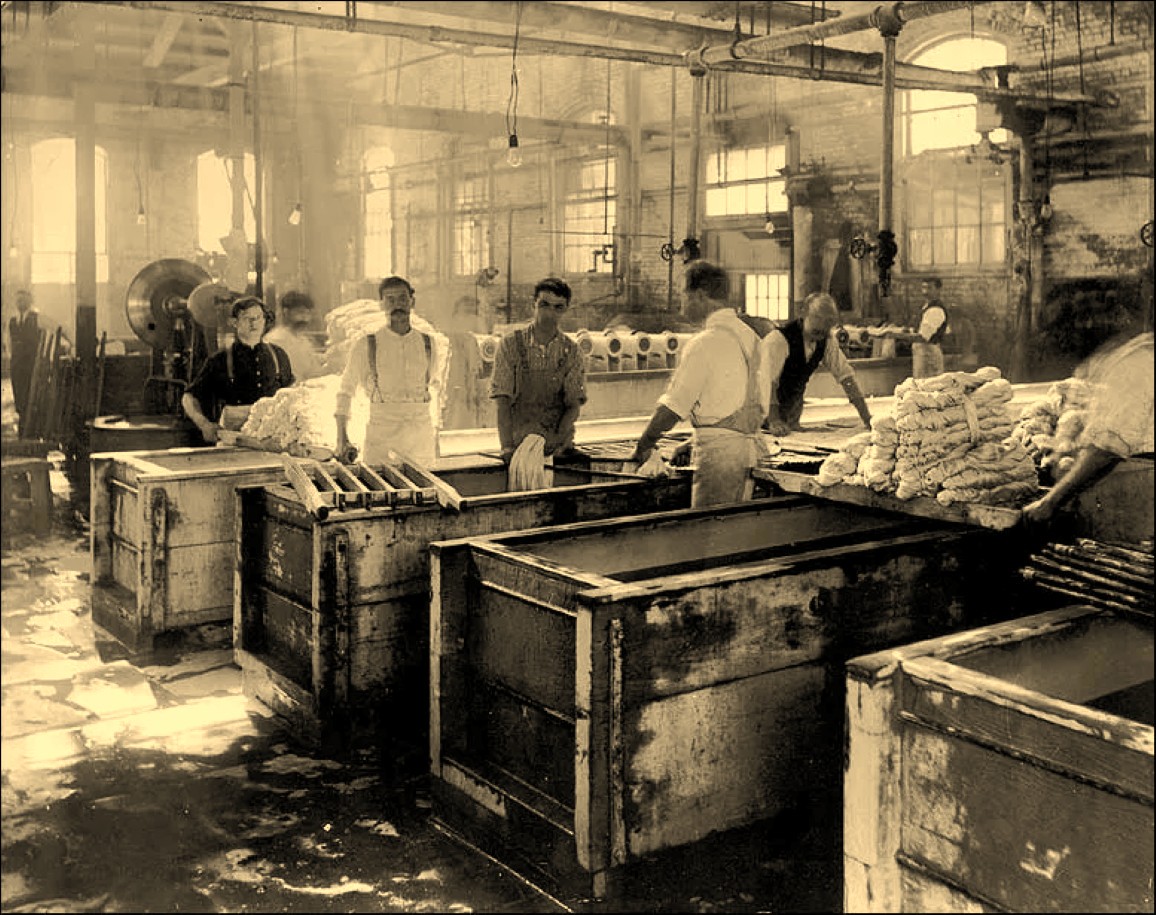
Russak gives names and puts flesh and bones on the storied silk workers of Paterson in the first of what would be many memories of growing up as a child immigrant among the factories of that New Jersey city. A fantastic piece of social history.
‘Memories of a Silk Weaver’ by Martin Russak from New Masses. Vol. 4 No. 4. September, 1928.
THE ARRIVAL
I came to Paterson when I was three months old.
My mother brought me here in her arms. We travelled alone but we were together.
I had been born in New York. My father, a hunted rebel, was in London. When no more money was left, my mother had wrapped me in a blanket and had had herself sent with me to a farm in Pennsylvania, where for several summer weeks she had worked as a servant girl among kind Germans. From that happy place we had fled back to New York after my mother had narrowly escaped an attack by a drunken farmhand. My mother was young and handsome.
She stayed for a while with a cousin. But he was a workingman intent on rising in life, and he told her that he could not keep her any longer. She bethought herself of girlhood friends in Paterson who, like her, had come to America from their little village on the Vistula. She had no addresses, but Paterson was a small town and those friends were comrades from the underground movement in Poland.
We rode on the train, clanging across the industrial landscape of Northern New Jersey. It was evening when my mother got off the train and stood by the red-brick depot. I am sure I behaved well; I don’t remember having been afraid. My mother walked down Market Street, carrying me in a blanket, and had herself directed to Temple Street, which she knew was the Jewish section. For the first time, as she walked through the dusty streets, she heard the whistles of Paterson blow. The day’s work was over in the factories of the town.
And for the first time, at the foot of Temple Hill, my mother’s courage gave way. Under those great elms that, years later, I saw destroyed by lightning and storm, she halted, feeling the end of her strength. She leaned against the old iron railing and broke into tears.
There she stood at nightfall, weeping, homeless, that child on her arm. People were few, and went by discreetly. All at once a man, passing, turned, looked, and came close with a cry.
“Esther! Esther! Is it you? What are you doing here?”
“Bairish! Dear comrade!”
“Esther my old friend and comrade!”
Under the roof of the weaver Bairish I found my first home in this world. There we stayed for months Jiving in two rooms with Bairish and his wife and child, and half of their loaf was ours, until my father came back and we settled on the hill in the home of my early days.
I have no memory of Bairish. I never knew him. He is the first and deepest legend of my life. On mild Spring days I love to go to Haledon Woods and sit under the tree where years ago, in the time of the Great Strike, he hanged himself.
THE HOUSE ON THE HILL
All my early memories center in the house on the hill. Memories of “home” are rare among workingmen. We, also, moved about too often for anything like “home” to become real. But we were always moving back to the house on the hill.
It was a two-storied wooden shack with porches in front and a grocery store in the basement. It was perched on a ledge of the hillside, and we looked through the maple that came into our kitchen window down upon the great cluster of factories and houses that was the town. The street, roughly cobble-stoned, ran obliquely down the hillside. Straight before us, where the hill fell away steeply, was the Golden Stairs. That was the sober name of the wooden staircase that gave access over the difficult slope.
It was good to live so high and free; the sunshine of the porch, the shade of the old trees, were good. One was not so free, though. The town was eternally in one’s eyes, and one lived in eternal consciousness of the town. There it was—you could not deny it, and it made you think about it, with its chimneys sticking up out of its drab masses of grey and brown streaked with intervals of dusty green.
Those chimneys! They were the actual gods that ruled over our lives and destinies, black and lofty above the humble roofs, forever breathing their brown and yellow smoke into the blue air, always roaring into the world their chorus of command, morning, noon, and night, year after year. Very high they towered to childish eyes; they seemed the pillars of the universe; they seemed to prop the falling edges of the sky, lest heaven, perhaps, be spilled upon earth.
Early in the morning the call of the whistles pierced the walls of the house; it might seem to you on your little bed a shepherd summoning his sheep into the fields, while the coils of smoke from the chimneys were the coils of his whip. But above the smoke and the hoarse whistling, was there not a sinister cracking of the shepherd’s whip? And under the cracking of the whip all life passed by.
QUIET YEARS
How quiet those years were! People were always quiet, rarely boisterous or noisy. People worked hard, ten hours a day in the mills. The husband could never earn sufficient, so the wife worked too, and the children too, if they were big enough. People were tired when they came home. After supper they fell asleep. Few had energy left for meetings. Fewer had courage. One didn’t know whom to trust. The next morning after going to a meeting, you would be met at the door of your shop by the foreman with your tools and your apron in his hands and a curse on his lips.
In our house on the hill there were many meetings. Big, sombre men, sometimes a few women, would stumble in after dark and fill the little kitchen with smoke and talk and violent gestures. I lay on my bed in the back room and could not sleep. There was a terrible sound in their voices that stabbed me awake whenever I dozed off.
Very late at night they stumbled out again, leaving a death-like quiet, broken only by the ominous rustling of the maple tree.
WORK DAYS
My father and mother both worked; my mother at intervals, my father always.
The neighbor was paid to take care of me, but the neighbor had four children of her own.
My parents left for work early in the morning before I was up.
I ate breakfast at the neighbor’s, after waiting till the other children were finished, and went to school. Often, on sunny days, I never got there.
When the first evening whistle blew, I put the pot on to boil. My mother, I knew, would be the first to arrive, and the last half-hour of waiting was a flutter of suspense.
Always she burst into the house with a startling suddenness and a tumultuous bubbling over of pent-up excitement, always out of breath, always overwhelming one with a flood of kisses, tears, and laughter. It was good to put one’s arms around her neck and hold her tight.
She was well-built and attractive. Her long brown hair was beautiful. But she was a firebrand! A pure piece of impatience and liveliness, an effervescence, either all tears or all laughter, an absolutely ungovernable quicksilver imagination that ran wild with whatever thinking powers and sense of reality she possessed.
She had run away from a rich home to join the Bund. Her father was a doctor and the right-hand man of the first rabbi in Poland. She met Itsik Russak across the bars of a cell.
Inexhaustible energy was hers. Without a moment’s rest after the long day at the looms, she bustled about the kitchen, singing in her strong sweet soprano, and pausing occasionally for a swooping kiss at me where I stood by the table lost in admiration and love.
My father was pensive, abstract, concentrated, a student, a revolutionary constantly occupied by activity, a bitter hater of everything bourgeois, dismissing with sorn all the opportunities for business and profit he encountered in the course of his life.
He would come in slowly, and always he first sat on the sofa and took off his shoes. I would stand between his knees while he talked to me gently and opened his letters. He had large, very clear blue-green eyes, perfect teeth, and the soft hands of a weaver.
He was an exceptionally good weaver. Years later, when I became his apprentice, I was to discover his superb craftsmanship. But he was forever getting fired. For he talked union and rebellion. He started handbills on their circulation through the shop. On May First he usually lost his job. It was fatal to stay out that day, and he always stayed out.
He was blacklisted. He left town. He went to New York, to Philadelphia, to Easton, to Cleveland. Sometimes we went along. But we all came back, every time.
I like to think of my father as he was on summer week-ends. Saturday afternoon he slept, like all weavers, ancient or modern; and Sunday morning, in the darkness before dawn, he left the house, climbed the Heights above the Falls to watch the sunrise, and lay reading in the grass while breakfast was preparing at home, under the roof below the Heights.
THE OLD MAN
In those days the looms rattled. Today they thunder. Today looms are new, powerful, swift. Then they were old plodders, serenely unperturbed.
The school and the Pelgram-Myers factory stood at the bottom of the hill, on opposite sides of the street. The factory din mingled with all we wrote and read.
In summer-time I brought my grandfather cold lunches at Pelgram-Myers. His looms stood in a favored position, near the windows; and he would grin at me over the rise and fall of his shafts and stroke his big black mustache while I worked my way down the center aisle and across to him. I sat on his box and we laughed to each other, both waiting for the noon whistle, he standing between his looms with one hand on the lade, moving backwards and forwards with it as if he were making it go, and rubbing his belly suggestively with the other hand.
At the first blast he threw his brakes and in the strange silence that filled the shop he said:
“And how is Prince Marty, and has he got some chew-chew for a hungry old man?”
He put his eye-glasses on the breastboard, hung his apron on a bolt, and made himself comfortable on the box that I yielded to him.
“How are your warps today, Grandpa?” I asked.
“Ach, sonny, I have two warps, do you hear, and they are worse than wops. If the ends don’t break, a shaft-cord will give way and smash things generally. Two wops and they won’t give me a minute’s peace. Will you believe me, this is the first time I sit down this morning.”
When he had finished eating and leaned back restfully, his thumbs in his suspenders, I said, “Grandpa, talk Turkish.”
Out came a cascade of delightful sounds accompanied by tickling pokes to the ribs.
“Grandpa, now talk Chinese.”
And, in another pitch, again the stream of magic gibberish.
“Grandpa, let me play with your shuttle-hook and your pickbone?”
“Yes, Mart, but be careful. That pick-bone was my father’s in the Old Country. If you’re good you’ll have it when my own weaving days are over.”
While I played he went over to talk to “those who shoot alongside of me.”
Sometimes I prevailed on him to let me stay for a while after the looms started up again.
“Yes, but your mother won’t like it. She’s terribly afraid oi your getting caught by a belt or hit by a shuttle.”
So I watched him at work, threading his shuttles, passing behind his looms to tie up ends, always guarding the glitter of yellow silk. I sat on the box, fascinated by the ceaseless rise and fall of the rows of shafts, the arrowy darting of the shuttles, the pickwheel gradually revolving, the beam fattening with finished silk, the whirl of belts and pulleys, beaten into a stupor by the pounding din of the factory.
When I came outside I could not hear well in the sudden silence. All afternoon I would have a ringing in my ears.
The New Masses was the continuation of Workers Monthly which began publishing in 1924 as a merger of the ‘Liberator’, the Trade Union Educational League magazine ‘Labor Herald’, and Friends of Soviet Russia’s monthly ‘Soviet Russia Pictorial’ as an explicitly Communist Party publication, but drawing in a wide range of contributors and sympathizers. In 1927 Workers Monthly ceased and The New Masses began. A major left cultural magazine of the late 1920s and early 1940s, the early editors of The New Masses included Hugo Gellert, John F. Sloan, Max Eastman, Mike Gold, and Joseph Freeman. Writers included William Carlos Williams, Theodore Dreiser, John Dos Passos, Upton Sinclair, Richard Wright, Ralph Ellison, Dorothy Parker, Dorothy Day, John Breecher, Langston Hughes, Eugene O’Neill, Rex Stout and Ernest Hemingway. Artists included Hugo Gellert, Stuart Davis, Boardman Robinson, Wanda Gag, William Gropper and Otto Soglow. Over time, the New Masses became narrower politically and the articles more commentary than comment. However, particularly in it first years, New Masses was the epitome of the era’s finest revolutionary cultural and artistic traditions.
PDF of full issue: https://www.marxists.org/history/usa/pubs/new-masses/1928/v04n04-sep-1928-New-Masses.pdf

