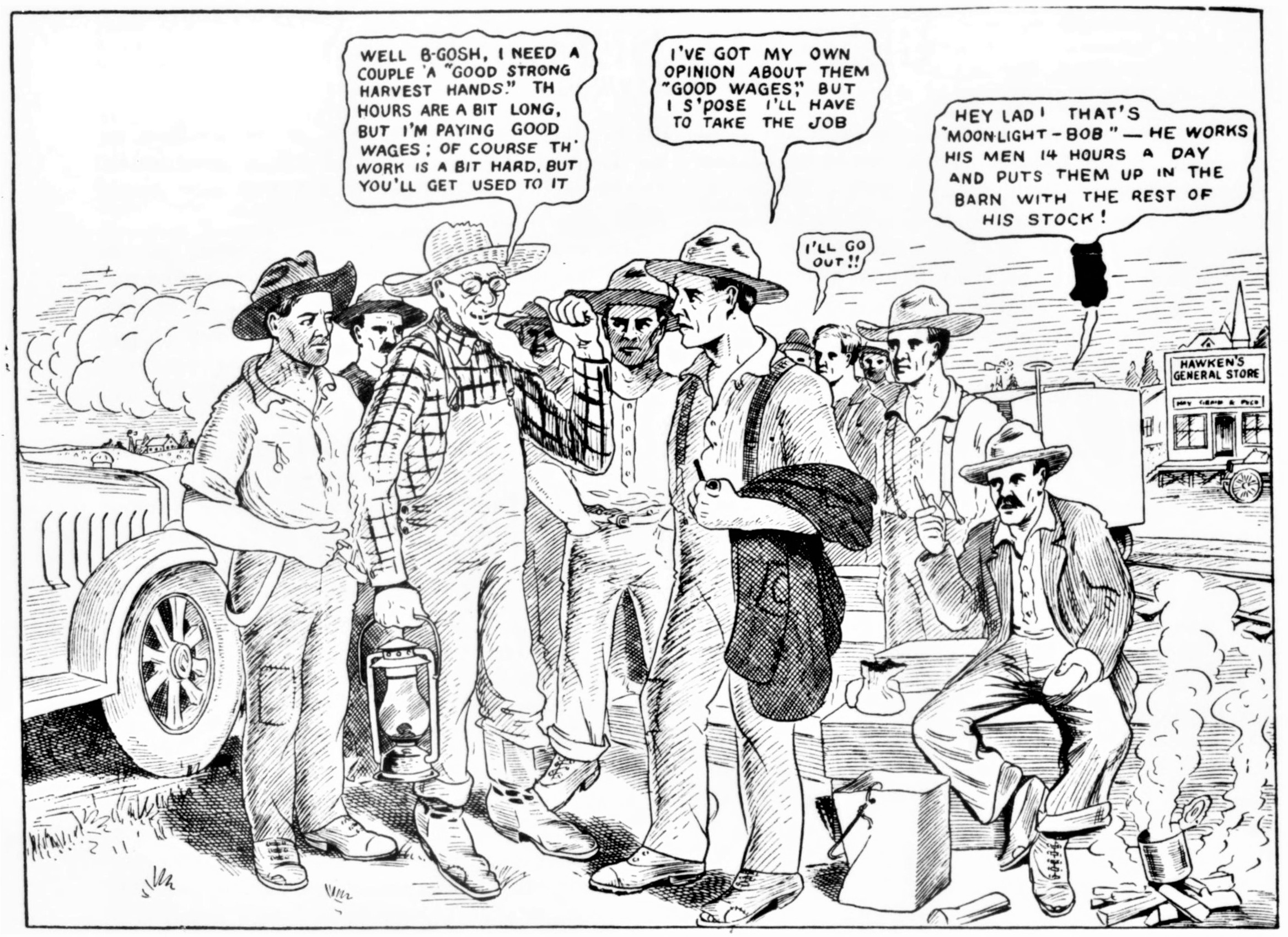
While the U.S. had chattel slavery and share-cropping, it never had anything like a peasant class, with independent landowners still being the image of an American farmer. With few exceptions, before the Russian Revolution the leftwing of the Socialist and labor movements were intensely hostile to farmers, even–especially–to the ‘small’ ones, as petty capitalists incarnate. Indeed, with some exceptions, if you want to know who was on the Right of the Socialist Party historically you can be sure they advocated an agricultural orientation. Below is what the Left Wing sounded like on the question from the Education Director of the Ohio State Socialist Party.
‘The Farmers Delusion’ by W.E. Reynolds from The Ohio Socialist. No. 23. July 2, 1918.
The farmer! That horny handed son of the soil! More bunk has been handed him, especially in war time or on election day than to any other tribe of working people.
He is told, and usually believes it, that he is the salt of the earth. “Why if it were not for the farmer, we would all starve to death.” There is just enough truth in that to make it delusive. It is true, the farmer feeds the world but could he do so without railroads to haul the produce to the consumer? Miners dig coal and iron. Smeltermen change the ore to iron. Molders change the iron to tools; patternmakers, toolmakers, merchants–all are wrapped up in this industry of feeding the world.
Imagine a farmer plowing the ground with a crooked stick and toting his product to market by mule back. If you CAN imagine such a farmer, you can imagine the only independent farmer in existence! All the rest are (1) capitalists, who farm the farmer, or are (2) would-be capitalists who hope someday to be able to retire (and live off the labor of other people), (3) landowners, (and a LANDOWNER is not necessarily a farmer) or (4) some other form of exploiter.
Agriculture is a BUSINESS and all business is by the very nature of our social system, capitalistic. It is true that the tiller of the soil works for a living. So does the man who owns a small town shoe store. Why should one be considered a capitalist and the other not?
In order to determine whether or not one is a capitalist we do not judge by the amount of capital invested. We do not judge by the AMOUNT of PROFIT “made” or “lost,” (95% of all capitalistic ventures are failures). We judge by the method employed. Capital is a social power, a process of social robbery whereby owners or leasers of raw materials, tools, factories and distributing systems are enabled to live off the labor of others.
It is true the farmer is a worker. Fact is, he is the world’s champion worker. He will work more hours for less money than any other body of working men. In addition he will throw in the labor of his wife and children. He is the world’s pack mule, usually content to carry his own whip and spur.
Usually some banker holds a mortgage on the farmer’s (banker’s) farm. The banker has hours from 9 to 3 and the farmer has the same hours–only the farmer has them transposed from 3 a.m. to 9 p.m.
Farming is a necessary occupation. So is mining; so is railroading; so is commerce; so is the communication system and countless other occupations could be named. Each one useless by itself but each one necessary for the well being of the social whole. Each occupation is a cog in the great social machine. Let any cog break and the well being and efficiency of the whole machine is immediately in danger.
Railroaders organize and by collective bargaining improve their condition as workers. So, too, do miners, or moulders, or any one of dozens of other occupations. You see they realize they are of the working class and few have any delusions about getting out of the ranks of the working class into the exploiting class.
The capitalist nature of farming keeps the farmer from recognizing their working class needs and affiliations. Each farmer hopes that this year or next he will have a bumper crop of something to sell and thus he can rise from a working farmer into an employer of “hired hands.” He carries the burden of excessive taxation, a thing of no concern to the working class but of great importance to a PROPERTY OWNER. He carries the burden of excessive interest, again a property problem! He lacks system. Most people imagine that after one has failed in business or lost out while working at a trade, all they have to do is to go “back to the land” and plant and watch things grow.
Can you imagine one man being a metal polisher, a diamond cutter, a painter, a coal miner, a drummer, a cook, a baker, a pattern maker, an electrician, a civil engineer and making a success out of his life?
Ye average farmer tries to fill the position of stock breeder, poultry keeper, butcher, fruit grower, market gardener, packer, shipper, tool sharpener, blacksmith, soil expert, seed expert bee keeper, tile and ditch digger, fertilizer expert, thresherman, laborer and employer of labor, child slaver and wife exploiter, business man and politician.
He is all of these, and none of them, for truly it was said of old that the Jack of All Trades was master of none!
The farmer usually knows nothing of the law of value or the exchange of commodities. He continually tries to compete with outworn tools and methods the modern capitalistic machine. As a result, the local mortgage record grows, public sales become more and more frequent, the farms grow bigger, and smaller, the landowners owning whole sections and the land workers trying to get along on forty acres where they used to consider 160 acres necessary.
The average tiller of the soil adds more labor power to the commodities he has for sale than the average amount necessary for their production and as a result when he goes to market he sells his commodities below their value–or if sold at their value, he does not get out of the transaction enough to repay him for the labor power he has expended.
The average farmer, be he tenant farmer or nominally a farm owner while in reality he is only the banker’s hired man, who winds his own alarm clock, stands no more chance of winning out under the present system than does the small town butcher stand a chance of winning in the competitive game with the modern meat packing company.
What the farmer should do is to REALIZE that his present position is hopeless. It does not offer security for his future, education for his children, nor relief from drudgery for his wife. He should throw in his lot–not with the landlords, the bankers and other capitalistic sharks of the present, but look to the future. Throw in his lot with the Socialists, those who work for Social Betterment, recognize his position, not as a would-be-capitalist, who by reason of the handicaps can never arrive at his goal, but as one of the world’s workers whose lot is interwoven with every other worker in the world. Work for Social Ownership and control of all industry, including agriculture and, thus, while safeguarding the interests of all workers he would do the best thing toward safe-guarding his own.
Fellow toiler and comrade! We greet you! Let the workers of the world unite!
The Ohio Socialist, published by the Left Wing-dominated Socialist Party of Ohio in Cleveland from January, 1917 to November, 1919. It was edited by Alfred Wagenknecht Wagenknecht spent most of 1918 in jail for “violation of the Conscription Act.” The paper grew from a monthly to a semi-monthly and then to a weekly in July, 1918 and eventually a press run of over 20,000. The Ohio Socialist Party’s endorsement of the Left Wing Manifesto led to it suspension at the undemocratic, packed Socialist Party Convention in 1919. As a recognized voice of the Left Wing, the paper carried the odd geographical subheading, “Official Organ of the Socialist Parties of Ohio and Kentucky, Virginia, West Virginia and New Mexico” by 1919’s start. In November of that year the paper changed to the “labor organ” of the Communist Labor Party and its offices moved to New York City and its name changed to The Toiler, a precursor to the Daily Worker. There the paper was edited by James P. Cannon for a time.
PDF of full issue: https://www.marxists.org/history/usa/pubs/ohio-socialist/023-jul-02-1918-ohio-soc.pdf

