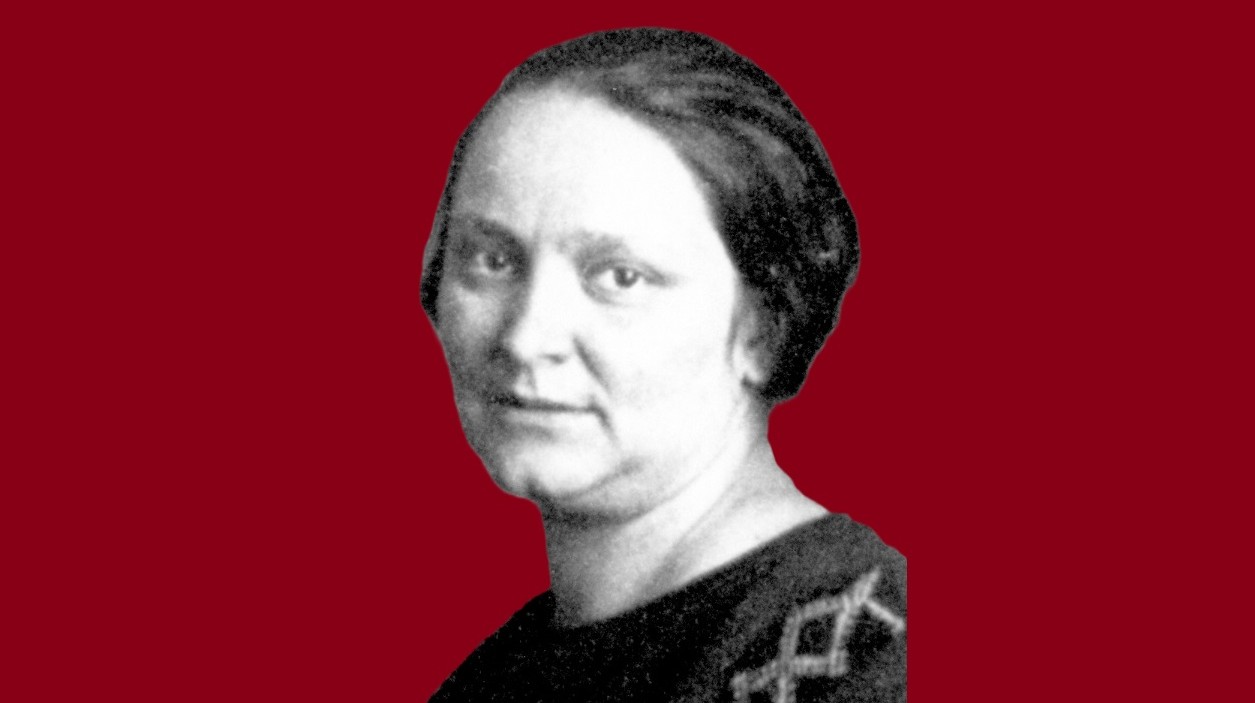
Arguably, no country in Europe between the Wars had a stronger Social Democracy than Austria, or rather, Vienna. How did working class women fare in Red Vienna? A Communist partisan, who would be a central figure in the KPO for decades, with her perspective.
‘The Position of the Working Women in Austria After Ten Years of Suffrage’ by Anna Strömer from International Press Correspondence. Vol. 9 No. 11. March 1, 1929.
Austria is the country possessing the relatively strongest social democracy and the highest percentage of working men and women organised in the trade unions. Out of 6,750,000 inhabitants 683,786 are organised by the social democracy; every tenth Austrian is a member of the Social Democratic Party. The number of members of the free trade unions is over 700,000, of which 23 per cent, are women while 32.9 percent (absolute number 225,200) are organised in the Social Democratic Party.
And how do we find from matters in this country with the “greatest”, “strongest”, and “most influential” social democracy, when it comes to questions of social achievements and the standard of living of the working men and women? What is the state of affairs in regard to the juridical and cultural demands of the working women?
The Austrian worker, apart from the Esthonian worker is the worst paid in the whole of Europe. And if the wages of the working men are shamefully low, those of the working women are truly starvation wages. A few figures will confirm this:
Weekly wages of women workers:
Austrian Schillings (1 Schillings = 7d.)
Brick-workers 14.21
Dressmaking assistants 14.24
Blouse making assistants 21
Ornamental feather making assistants 18.22
Milliners 21.33
Assistant Bookbinders 15.33
Special workers in bookbinding trade 13.32
Assistant workers, paper articles 14.75
Workers in incandescent lamp trade 20.64
Textile workers 18.23
These figures represent the most usual weekly wages paid at the end of 1928, compiled by the chamber of labour at Vienna.
How truly these wages deserve the designation of starvation wages will be realised when it is borne in mind that even the Association of Industrialists has calculated the minimum living wage of an employee to be S200 monthly, or an average of S46 weekly. The actual earnings of the female employees defy all description: salaries of S50 to S100 at most are customary; at the same time the highest qualifications are demanded.
Matters are no better with respect to social achievements. The social democrats, it is true, continue to boast of their “exemplary” social laws, created during the era of the social democratic Secretary of State Hanusch; in actual fact most of these laws exist only on paper, and were provided by their author from the beginning with loopholes by which they can be evaded.
The law, for instance, lays down the 44-hour week for young male and female workers, and for female workers and employees. But an emergency enactment deprives the whole law of its effect, for this enacts that in cases when the shorter working hours of youths and women would cause shorter hours for the men workers, an exception to the law may be made. And what employer cannot demonstrate conclusively that this emergency has arisen in precisely his undertaking? Hence in actual fact there is no 44-hour week for youths and women. The hotel and restaurant trade was directly exempted from the law, and for workers in this trade there is not even the eight-hour day, as the law itself prescribes a 54-hour week.
Since 1921 a woman is supposed to be protected for six weeks before and six weeks after a confinement. During this time she receives sick benefit and maternity relief, to an amount, however, very often beneath the living minimum. Very few working women avail themselves of this leave, owing to fear of dismissal, and continue to work till the last moment before their confinement, returning to stand at their machine again within the shortest possible time. The agricultural labourers health insurance society for Lower Austria reports that in the majority of cases the women agricultural workers return to their arduous work on the third day after a confinement…
Somewhat better provision is made for the women clerks and office workers. True, the 44-hour week here again exists only on paper. But the employees’ law affords a certain protection to expectant and nursing mothers, and prohibits the discharge of expectant mothers. In 1926, however, this law was weakened again by the proviso that only one half of the sick benefit is to be paid as maternity relief.
To judge by the fuss being made by the women social democrats about the ten years of the women’s franchise, it might be imagined that in Austria woman’s legal and political position was the most brilliant possible. Far from it. Austria adheres not only to entirely obsolete enactments on marriage rights and the rights of illegitimate children, but to the most reactionary of marriage laws. In Austria the obligatory civil marriage does not exist, and divorced Catholics cannot re-marry. The Austrian marriage law is more backward than even the Italian after the reintroduction of the Concordat. The General Code of Civil Law enacts that “the man is the head of the family”. “In this capacity he possesses in particular the right to direct the household,” “The wife receives the name of the husband, and enjoys the rights of his status. She is in duty bound to follow her husband to his dwelling place (which can be enforced by the police and gendarmerie. A.S.), and to aid him in the household and in earning (!) to the utmost of her Fower…”
With reference to illegitimate children, it is stated that “these are entirely excluded from the rights of the family or of relationship”.
The enactments of the paragraphs on the procuring of abortions (88 144-48) again appear to originate from the middle ages, and even the truly not very great alleviation proposed by the German criminal law Bill, coming under discussion in Austria in connection with the “adaptation to German law”, found no mercy at the hands of the Christian socialist government.
Social democracy bears the full weight of responsibility for the existence of the reactionary marriage law, and for the frightful penalties under paragraph 144 suffered by the proletarian women of Austria in one small locality in the vicinity of Vienna no fewer than 40 women are awaiting trial on the charge of attempting to procure abortion. Social democracy made a pact with its Christian socialist partner of the coalition government to leave “cultural questions” untouched, for the prelate Seipel declared at a Christian Socialist Party Conference that nothing short of “thunder and lightning” would alter paragraph 144, and this word was strictest law to the social democrats.
This tendency on the part of the social democrats to give way on every question has of course strengthened the bourgeoisie and has permitted Fascism to raise its head in Austria. Today, after ten years of women’s suffrage, and with a quarter of a million women organised in the Social Democratic Party, the hand of the bourgeoisie is heavier than ever on the neck of the worker. Deprivation of economic rights, a’ clerical and reactionary marriage law, intensified persecution under the abortion law these are the “successes” of a “powerful” social democracy, the harvest of ten years of equal rights for the proletarian masses in a bourgeois democracy. These “successes” form the best object lesson, demonstrating that equal political and economic rights for proletarian women cannot be realised in a bourgeois democracy, as the social democrats would like to induce the proletarian women to believe, but solely through the dictatorship of the proletariat.
International Press Correspondence, widely known as”Inprecorr” was published by the Executive Committee of the Communist International (ECCI) regularly in German and English, occasionally in many other languages, beginning in 1921 and lasting in English until 1938. Inprecorr’s role was to supply translated articles to the English-speaking press of the International from the Comintern’s different sections, as well as news and statements from the ECCI. Many ‘Daily Worker’ and ‘Communist’ articles originated in Inprecorr, and it also published articles by American comrades for use in other countries. It was published at least weekly, and often thrice weekly.
PDF of full issue: https://www.marxists.org/history/international/comintern/inprecor/1929/v09n11-mar-01-1929-inprecor.pdf

