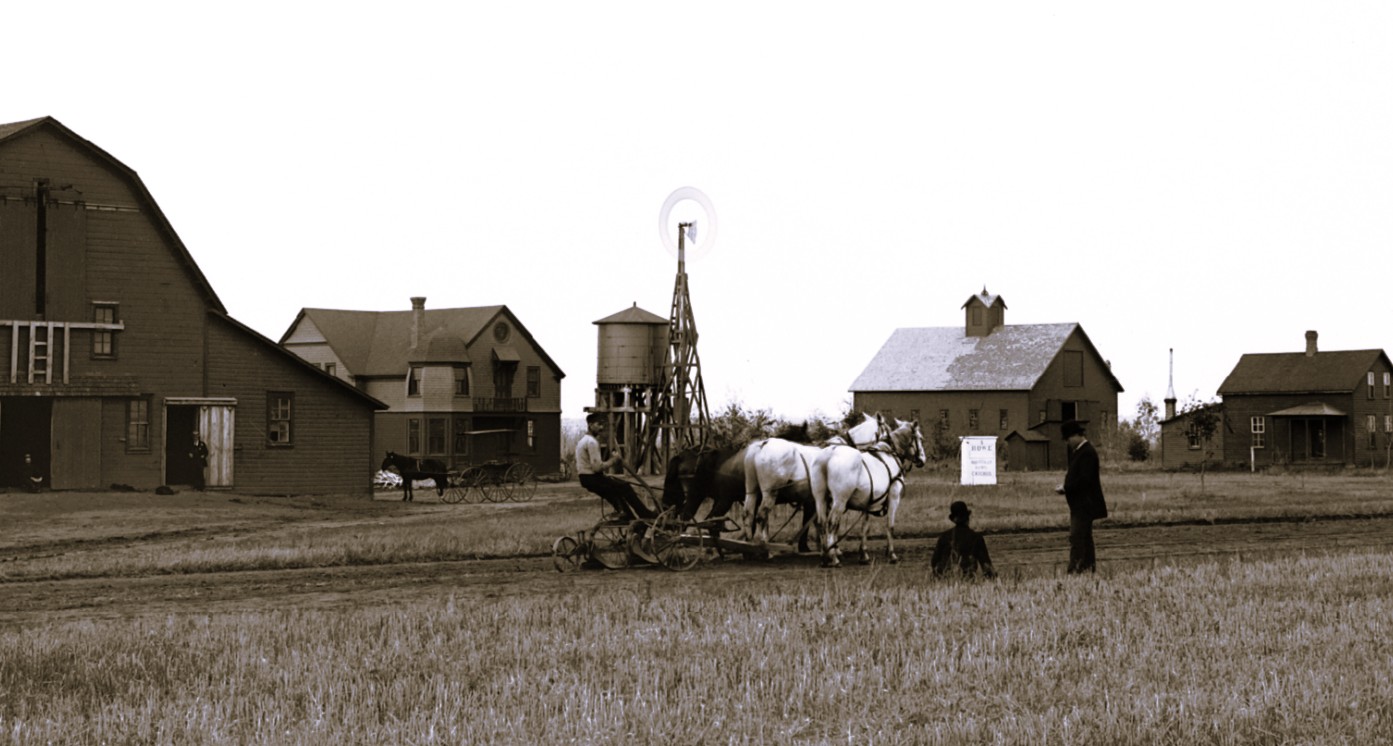
Draft from the South Dakota Committee on Farmers’ Program for the State Socialist Party in 1910.
‘A Political Program for Farmers and Other Workers’ from Chicago Daily Socialist. Vol. 4 No. 302. October 17, 1910.
(The following is the work of the South Dakota Committee on Farmers’ Program, which is here published that criticism may be sent by Nov. 15 to their chairman, E. Francis Atwood, Ellington, S.D., that they may profit thereby before a referendum of the state is taken)
Every worker is entitled to the full value of his labor; to secure this, it is necessary for the workers to own the means of their own employment. This is manifestly impossible where large numbers work together in any industry and that industry is privately owned. Therefore,
The Socialist party is committed to the bringing about of collective ownership of all property that is collectively operated.
By the same reasoning collective ownership stops at the front gate of the home, to which every family is justly entitled.
Collective ownership of productive property is the means to an end, not the end itself. The end sought is the elimination of exploitation.
Private ownership of land used for speculation and rent may lie at the foundation of exploitation, but, as a mason or a carpenter owns the tools of his trade and these are part of his property not used collectively and which, therefore, ought not to be possessed collectively, so, likewise, is land when owned and operated by the actual owner as one of the tools of his trade, for the protection and maintenance of his home.
All land so occupied and used should remain in the undisturbed possession of its occupant and used under laws that will prevent speculation and exploitation.
Use and occupancy should be the basis to the right of possession of land, while basic ownership is today and, ought to be, an attribute of the commonwealth.
As measures tending to secure to every worker the full value of his toil, to enable the farmer to secure the use and occupancy of sufficient land for the maintenance of home and family and to get rid of a master class.
The Socialist party of South Dakota advocates and pledges the support of its elected officials, under penalty of recall, to the following program, subject to changes in detail, as directed by referendums of the membership of the party:
1. Land now in the possession of the state or which may hereafter be acquired, shall not be sold absolutely, but shall be held by the state and leased, at the actual proportionate cost of maintaining, the leasing system, preference being given to co-operative groups and the landless and exceptions being made of mineral land, water-power sites, etc. Such leases are to have all the force of warrantee deeds except as to sale and rent and are to continue as long as the land is occupied and used by the lessee and his heirs.
2. Owners of rented and unused lands shall value their own lands for the purpose of taxation, etc., and the state shall have the right to purchase such lands at the owner’s valuation. This plan of valuation and right of purchase. shall eventually extend to all property used to exploit labor.
3. Graduated taxes shall be levied on unused and rented lands, on incomes and inheritances, on every business nearly or quite monopolizing trade, that exploits labor or that competes with state-owned industries.
4. Farm improvements and homes shall be wholly exempt from taxation. Every property owner shall be allowed to exempt from taxation and execution property to the value of two thousand dollars, except unused or rented property.
5. The state shall insure against diseases of animals and plants, insects, hall, drouth, fire, storm and flood; also against accidents, sickness and old age and against non-employment of its citizens.
6. There shall be created an industrial system, co-extensive with the state (modeled somewhat after the school system in its independence of and interdependence with the general state government) in which all citizens shall be voters, with rights of initiative, referendum and recall of officials. All land and all industries owned by the state shall be under the control of this industrial system, but each industry and each subdivision shall elect its own officials and manage its own internal and local affairs. All employes shall be chose and shall hold their positions by merit only.
7. The state shall have the right to issue bonds, when necessary, based on the property involved in the issues, on industrial property belonging to the state and on its general powers of taxation, for the following purposes:
(a) Purchase of land. (b) Purchase and erection of elevators and warehouses. (c) Establishing factories of dairy products. (d) Establishing packing-house (e) Purchase and erection of flour mills. (f) Establishing factories to make farm machinery. (g) Mining and state lands. (h) Purchase or building of railroads. (i) Purchase or building of telegraph and telephone lines. (j) Conducting or encouraging co-operative buying and selling of farm products, livestock, coal, lumber, machinery, merchandise, etc. (k) Aiding co-operative groups in farming and other industries. (l) Loans on mortgages and on warehouse receipts, with interest at cost. (m) Loans to establish homes, payable in installments that cover maintenance, insurance, etc., but that practically eliminates net profit. (n) Establishing other state-owned industries demanded by the encroachments of monopoly or the needs of the people.
8. Union hours, wages and conditions shall prevail in every elevator, mill, mine, factory, plant and industry belonging to the state; disagreements to be arbitrated.
9. Agriculture, horticulture, animal husbandry, co-operation, domestic economy and kindred and industrial subjects shall be taught by competent teachers in at least one free school in each county, such school to be an agricultural and industrial high school; the elements of such subjects shall also be taught in the common schools.
(As this is a farming state, it is intended to begin with the things that more nearly concern the farmer, increasing the incomes from labor on land and elsewhere; eliminating the superfluous middlemen; taking from none any rights, except the quasi rights of speculation and exploitation, but rather, increasing opportunities and providing better things for all citizens affected by these changes; adding, as fast as practicable, to the holdings of the state, such industries as may be necessary to secure to every worker the full value of his labor, a home of his own, ownership of the means of his employment, an equal voice in industry as well as in politics and safe provision for all the vicissitudes of life.)
The Chicago Socialist, sometimes daily sometimes weekly, was published from 1902 until 1912 as the paper of the Chicago Socialist Party. The roots of the paper lie with Workers Call, published from 1899 as a Socialist Labor Party publication, becoming a voice of the Springfield Social Democratic Party after splitting with De Leon in July, 1901. It became the Chicago Socialist Party paper with the SDP’s adherence and changed its name to the Chicago Socialist in March, 1902. In 1906 it became a daily and published until 1912 by Local Cook County of the Socialist Party and was edited by A.M. Simons if the International Socialist Review. A cornucopia of historical information on the Chicago workers movements lies within its pages.
PDF of full issue: https://www.marxists.org/history/usa/pubs/chicago-daily-socialist/1910/101017-chicagodailysocialist-v04n302.pdf

