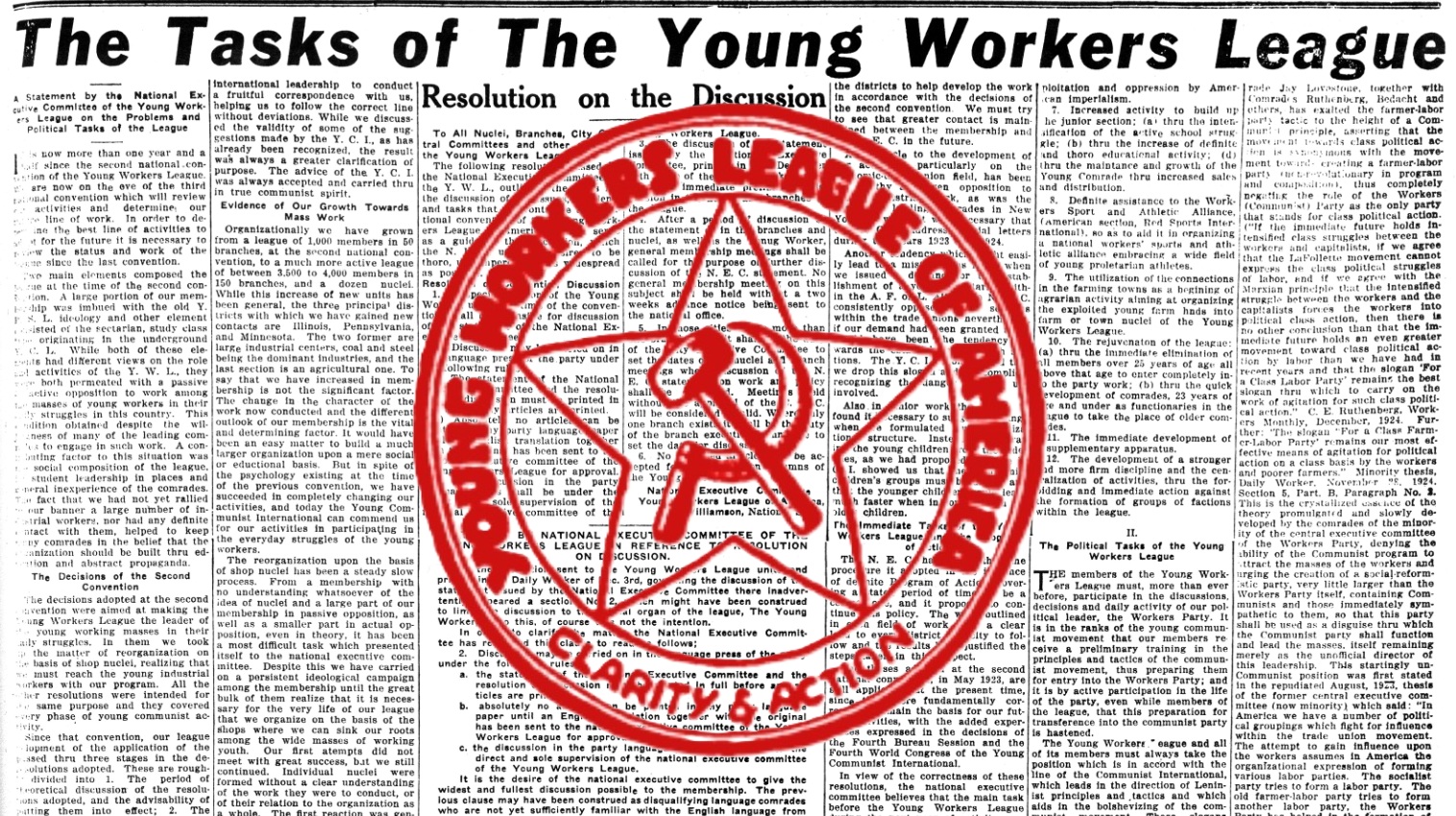
A major document from the then leadership of the Young Workers League reviewing the year and a half since their last convention, the reorganization of the League in tandem with the Communist Party’s turn to shop and street nuclei, and most importantly their position on the faction fight of the Farmer-Labor Party policy that nearly split the Communist movement with the then Y.W.L. leadership firmly with the then Foster-Cannon majority against the Ruthenberg-Lovestone minority. As of this writing the Y.W.L.’s National Secretary was John Williamson and its leading Secretariat consisted of Marty Abern, Oliver Carlson, John Williamson with Max Shachtman editor of Young Worker. The National Executive Committee was Martin Abern (Chicago), Alfred Albright (Chicago), Sydney Borgeson (Minneapolis), John Edwards (Chicago), Harry Gannes (Chicago), Nat Kaplan (New York), Max Salzman (Chicago), John Williamson (Seattle), with Alternates: Nat Carmen (New York), Natalie Gomez (Chicago), Paul Klein (Chicago), Max Lerner (New York), Barney Mass (Kansas City), Rebecca Sacherow (Cleveland), William Schneiderman (Los Angeles), Max Shachtman (New York).
‘Problems and Tasks of the Young Workers League’ from Young Worker. Vol. 3 No. 24. December 15, 1924.
A Statement by the National Executive Committee of the Young Workers League on the Problems and Political Tasks of the League
It is now more than one year and half since the second national convention of the Young Workers League. We are now on the eve of the third anal convention which will review activities and determine our line of work. In order to determine the best line of activities to adopt for the future it is necessary to review the status and work of the League since the last convention. Two main elements composed the League at the time of the second convention. A large portion of our membership was imbued with the old Y.P.S.L. ideology and other element consisted of the sectarian, study class originating in the underground Y.C.L. While both of these elements had different views on the role and activities of the Y.W.L., they both were permeated with a passive and active opposition to work among masses of young workers in their daily struggles in this country. This condition obtained despite the willingness of many of the leading comrades to engage in such work. A contributing factor to this situation was the social composition of the League, of student leadership in places and a general inexperience of the comrades. The fact that we had not yet rallied to our banner a large number of industrial workers, nor had any definite contact with them, helped to keep many comrades in the belief that the organization should be built through education and abstract propaganda.
The Decisions of the Second Convention
The decisions adopted at the second convention were aimed at making the Young Workers League the leader of young working masses in their daily struggles. In them we took up the matter of reorganization on the basis of shop nuclei, realizing that we must reach the young industrial workers with our program. All the other resolutions were intended for the same purpose and they covered every phase of young communist activity.
Since that convention, our league passed thru three stages in the development of the application of the resolutions adopted. These are roughly divided into 1. The period of theoretical discussion of the resolutions adopted, and the advisability of putting them into effect; 2. The period of purely journalistic propaganda for the program and demands adopted; 3. The actual application for all of these resolutions and the direct and active participation thru special demands and slogans arising out of the everyday struggles of the young workers.
These three stages are generally true of the majority of our activities, and especially of our trade union-economic work. It was this phase in our work that has typified the others. The first period of discussion hesitation and doubt was passed through even while we were entering the second. Our press was filled with journalistic activity, in which we formulated our demands without at the same time applying them to concrete situations, without rallying our membership and the young workers to their active support. At the time of the miners’ convention at Indianapolis, for example, we had our resolutions prepared but we did not mobilize the forces necessary to carry our demands the young miners themselves. The me was true of the machinists’ convention. In the strike of the ladies garment workers in Chicago, we bordered on the third stage by actively participating in the walkout; we failed, however, to set up separate demands for the youth. Of course, there were circumstances that explain our failure to carry thru these questions (the Lewis-Howat fight in Indianapolis; the expulsion of our comrades in the ladies garment workers’ union, etc.) We definitely entered the third stage, however, in the carmen’s strike at Hegewisch, where we set up special youth demands, called meetings of the young strikers and organized a league nucleus. Since then we have steadily followed the correct policy in the cases of the factory campaigns against Bunte, the N.B.C., the mail order houses, and in the national coal mining youth drive which has just begun.
Important Factors in the Development
Three main factors were responsible for the gradual development towards this third stage of activity, a development which is in accord with the experiences of the entire international movement as recognized by the Toung Communist International. The first factor was the orientation of the league towards the young industrial workers, after the convention which adopted the resolutions on mass activity, in collaboration which the representative of the Y.C.I. We began to establish organizational contact with the youth of the mines and steel mills in Illinois, Pennsylvania, and Ohio. These two basic industries, where the struggle goes on sharply every day, afforded us the opportunity of assuming a definite position and attempting to organize the young workers into our league.
The second important factor was the persistent popularization by the national executive committee of our decisions, through the press, bulletins, lectures and general correspondence. Despite the opposition of sections of our league, especially of leading comrade on the district executive committee of the New York district, a thorough understanding of these decisions and their application was insisted upon. The third factor in this development was the continuous, comradely aid, advice, and suggestions we received from the executive committee of the Young Communist International. Their knowledge of the experiences of other leagues enabled our International leadership to conduct a fruitful correspondence with us, helping us to follow the correct line without deviations. While we discussed the validity of some of the suggestions made by the Y.C.I., as has already been recognized, the result was always a greater clarification of purpose. The advice of the Y.C.I. was always accepted and carried through in true communist spirit.
Evidence of Our Growth Towards Mass Work
Organizationally we have grown from a league of 1,000 members in 50 branches, at the second national convention, to a much more active league of between 3,500 to 4,000 members in 150 branches, and a dozen nuclei. While this increase of new units has been general, the three principal districts with which we have gained new contacts are Illinois, Pennsylvania, and Minnesota. The two former are large industrial centers, coal and steel being the dominant industries, and the last section is an agricultural one. To say that we have increased in membership is not the significant factor. The change in the character of the work now conducted and the different outlook of our membership is the vital and determining factor. It would have been an easy matter to build a much larger organization upon a mere social or educational basis. But in spite of the psychology existing at the time of the previous convention, we have succeeded in completely changing our activities, and today the Young Communist International can commend us for our activities in participating in the everyday struggles of the young workers.
The reorganization upon the basis of shop nuclei has been a steady slow process. From a membership with no understanding whatsoever of the idea of nuclei and a large part of our membership in passive opposition, as well as a smaller part in actual opposition, even in theory, it has been a most difficult task which presented itself to the national executive committee. Despite this we have carried on a persistent ideological campaign among the membership until the great bulk of them realize that it is necessary for the very life of our league that we organize on the basis of the shops where we can sink our roots among the wide masses of working youth. Our first attempts did not meet with great success, bat we still continued. Individual nuclei were formed without a clear understanding of the work they were to conduct, or of their relation to the organization as a whole. The first reaction was generally to think of their activities as mere shop activities instead of a development into the wider political struggles of the day. This is being gradually overcome through experience. Today we have reorganized two of the largest cities on the basis of working area branches, a temporary basis to the complete reorganization of the league on the basis of nuclei. Our economic activities are closely related to our reorganization. The one is dependent upon the other.
During the past period we have organized many nuclei which have died because of inexperience, strikes, or in some cases, the firing of the active leader. Recently we have again started a steady growth of shop nuclei and we find five nuclei in Chicago, two in Pittsburgh, two in Boston, two prospective nuclei in Detroit. Many others are in the process of formation, with the prospects of culminating in the achievement of the allotted quota called for our program of action. Economic-trade union work has shown a decided improvement in many sections of the country. The three stages already enumerated above cover the actual development of this work in a satisfactory manner. The Chicago organization has been the most active in this work but other sections of the country are gradually developing the true line of activity. New York city has recently made a start in economic activity. Although they also made a mistake in their recent experience in Paterson, nevertheless it is a definite improvement and through the comradely advice of the N.E.C. and of the Y.C.I. they will also develop the correct line and evolve from the purely journalistic stage to the third period, i.e., that of actual struggle on the basis of concrete issues arising out of the everyday struggle.
Linked up closely with the economic work, as a definite part, are the factory campaigns which we have been conducting. It is only necessary to correct these very briefly. This was a new development arising out of our thorough understanding of how to apply our economic work and gain practical results. Several of the nuclei which have been organized in Chicago are as a result of these factory campaigns. No factory campaign can be considered a complete success unless a nucleus results from it.
In the field of press we have probably made one of the greatest advances. At the last convention we realized that our Young Worker was not yet a mass organ and did not have a mass appeal. It was a semi-literary magazine, with nice stories, articles, and poems written principally by the members. From this old monthly magazine, we changed to a semi-monthly newspaper during the month of January 1924. This was a big stride forward. The very change in the make-up from a magazine to a newspaper made itself felt immediately in the contents of the paper. However, with every issue The Young Worker has made marked advances both in makeup and as a paper representing the young workers in their actual economic and political struggles. Its appeal has broadened. Today it takes up the many struggles, strikes, campaigns of the young industrial workers and finds a ready sale wherever it is presented. In its political character it has had a similar advance. It takes up the living issues as presented by American imperialism and reflected in the daily activities of the capitalist state. We can quote with pride the words of comrade Richard Schueller, reporting on behalf of the E.C. of the Y.C.I. at the recent congress where he said: “Nearly all of the papers have changed to mass organs since the time of the third congress. For instance, such as “kaseblatter” the Swiss paper, or such magazines as the American, which represented a real intellectual review, have transformed themselves into real mass organs. It is noteworthy that we have a paper in America, The Young Worker, which lives in the real spirit of the American working class youth. This indicates that they really want to reach the young workers.
But we have not stopped here. We are today in the midst of a campaign to make a weekly organ out of the Young Worker next year, thus enabling us to be the mouthpiece of the American working class youth to a greater extent than ever before.
We have also after long deliberation, been able to start a monthly children’s communist paper, The Young Comrade, during the last period. This is the first working class children’s paper ever printed in America. Already it has lasted for over a year and we are now changing its character to give it a less literary trend and more of the character of a fighting organ of struggle.
Since the last convention, finances have prevented extensive publication of pamphlets. However, small pamphlets have been printed, and recently We published three small pamphlets dealing with the youth in specific industries. The makeup and contents of these small pamphlets make them very popular and we should strive for mass distribution.
The Communist children’s movement (the junior section) has been built during the past period. It today numbers several thousand children organized in more than one hundred junior groups throughout the entire country. Today these are trying to organize into school nuclei so as to be bet ter able to conduct school struggles. The American junior movement is among the best in the English-speaking movement. It has rallied from the ranks of the socialist Sunday schools many hundreds of children who were still being influenced by the old-style pedagogy. Our weakness has undoubtedly been in the educational sphere. While we must educate the children of the workers through the active struggle as far as possible it is also necessary that these young comrades get a primary knowledge, at least, of the elements of communist theory and principle.
The political maturity of the League membership has advanced beyond compare. Whereas in the past our League took no active and direct interest in the struggles and policies of the Workers (Communist) Party during the past period our league has developed its proper sense of responsibility and today the membership realizes that the Communist Party is the leader of the political struggles of the entire American working class and they must take a keen and vital interest in the policies pursued by our party as we are an important section of it. While two years ago our league was considered by the party as a sort of necessary evil, the national committee through persistent efforts has forced the party to a correct realization of the importance of the league. While minor differences occurred during the year of 1923, and previous to the last party convention, these were generally ironed out through thorough discussion, or appeals to the Y.C.I. Since the last party convention and the removal of the party offices to the seat of the league’s N.E.C., the relationship has been steadily improved, and today every major campaign of the party is participated in and arranged jointly with the party and league, from the highest to the lowest unit.
Though we cannot compare our anti-militarist activity to that of any of the European leagues, working in countries whose armies are conscript, we have nevertheless made a start during the past year. Educational activity on anti-militarist work has been conducted throughout the organization. We have conducted a journalistic propaganda against capitalist militarism in its many and varying forms. Conferences with “anti-war” organizations were held immediately after the last convention, two of them being participated in through the N.EC. These meant very little and had only a propaganda or agitational value, if any. A definite campaign was launched at the time of the Teapot Dome scandal and 100,000 leaflets were distributed. Recently, we have had the experiences of comrades attending the bourgeois training camps (C.M.T.C.) A small beginning was made in agrarian work by gaining contact with the farming sections of Minnesota, Wisconsin. This has only opened a field of activity which must be developed and utilized for concrete activity.
Mistakes and Obstacles to the Development of Mass Activity
We must not think that although we have made wonderful progress during this period of activity we were free from mistakes and shortcomings. In the process of this development towards a mass movement we have made many mistakes, and thru these mistakes we have later learned the better and more correct methods to pursue. Our task is constantly to criticize ourselves, in an objective spirit, with the aim in mind of correcting the errors we have made and seeking the right road in order to strengthen ourselves as a result. Upon careful consideration we will find that our American league has passed thru a period of mistakes and errors similar to other communist leagues. But it is a false step to put up a bogey-man, and label it “mistakes.” We are not proud of our mistakes, but we know that an active organization, and especially one which is so young and inexperienced as ours, must of necessity make mistakes in the process of its development. Our aim should always be to eliminate them for the future as much as possible, and to learn through those mistakes we have already made so that we may avoid future ones.
Due to many difficulties, such as scarcity of finances, it has been impossible for the entire membership to have the proper contact with the N.E.C. We have attempted, wherever possible, to send N.E.C. members into the districts to help develop the work in accordance with the decisions of the second convention. We must try to see that greater contact is maintained between the membership and the N.E.C. in the future.
An obstacle to the development of our activities, particularly on the economic-trade union field, has been the apathy and even opposition to active industrial work, as was the case with leading comrades in New York, to whom it was necessary that the Y.C.I. address special letters during the years 1923 and 1924.
Another tendency which might easily lead to a mistake was made when we issued a demand for the establishment of a youth secretariat within the A. F. of L. Although the N.E.C. consistently opposed youth sections within the trade unions nevertheless, if our demand had been granted there would have been the tendency towards the establishment of such sections. The Y.C.I. recommended that we drop this slogan and we complied, recognizing the danger that its use involved.
Also in junior work the Y.C.I. found it necessary to suggest a change when we formulated our organizational structure. Instead of separating the young children from the older ones, as we had proposed, the Y.C.I. showed us that the communist children’s groups must be united and that the younger children would learn much faster when in contact with the older children.
The Immediate Tasks of the Young Workers League and the Program of Action
The N.E.C. has found that the procedure it adopted in the issuance of definite Program of Action, covering a stated period of time, to be a correct one, and it proposes to continue this policy. The work outlined in each field of work gave a clear lead to every district and city to follow and the results have justified the steps taken in this respect.
The theses adopted at the second national convention, in May 1923, are still applicable at the present time, since they wore fundamentally correct and remain the basis for our future activities, with the added experiences expressed in the decisions of the Fourth Bureau Session and the Fourth World Congress of the Young Communist International.
In view of the correctness of these resolutions, the national executive committee believes that the main task before the Young Workers League during the next year of activity consists of the drive to bolshevize the league; to make our organization a Young Leninist League. To this end we must intensify our activities along the following lines.
1.The complete reorganization of the Young Workers League upon the basis of shop nuclei by the next national convention.
2. The intensification of the economic-trade union activity: (a) thru the active and direct participation of the league in the everyday struggles of the working class as the leader of the working youth and the representative of its demands and needs through advancing and fighting for definite economic and political demands that arise out of the daily struggle; (b) thru the increased activity of our members in trades union activity and the definite establishment of youth fractions to advance the demands of the league as embodied in the resolution on trade union-economic work adopted at the second national convention on trade union-economic work adopted at the second national convention of the league and the Fourth World Congress of the Y.C.I.
3. The further development of our press into a living reflection of the lives and struggles of the working class youth. To this end, we must strive to establish and maintain the Weekly Young Worker. Efforts must be made to increase the publication. and distribution of our national and international literature.
4. Greater and more detailed efforts the internal and external education of our league: (a) through the intensive training of the Young Workers League’s membership in the principles of Leninism and Marxism; (b) through the popularization of the Y.C.I. as the world leader of the revolutionary youth; (c) thru the education of the membership towards an understanding of the role of the Workers (Communist) Party as our political leader and the necessity of still closer harmony and participation in the problems and activities of the party.
5. Anti-militarist work in the spirit of Leninism: (a) through constant agitation to show the immediate dangers. of new imperialistic wars; (b) through the consistent struggle against pacifist and social democratic illusions and treachery and the exposition of the communist viewpoint; (c) through the establishment of connections with the revolutionary people’s, youth’s and student’s movements in the colonies of American imperialism; (d) through the establishment of contact with the young workers in the armed forces of imperialism, and persistent propagation of our program therein; (e) thru the popularization of the ideas and principles of the Red Army.
6. Greater attention to be directed towards organizing the young Negro workers of America, particularly among the industrial workers of the North since that is the section with which we have contact. (a) a special literature will be published dealing with this problem, showing the young Negro workers that their interests are identical with those of all other workers, irrespective of race; and the definite enrollment of the young Negro workers in our organization; (b) contact must be established and maintained with the colonial countries and a persistent propaganda and agitation conducted among these young workers, rallying them to our organization on the basis of the slogans and demands propagated by us which will arise out of the opposition to the exploitation and oppression by American imperialism.
7. Increased activity to build up the junior section; (a) through the intensification of the active school struggle; (b) through the increase of definite and thorough educational activity; (d) through the maintenance and growth of the Young Comrade through increased sales and distribution.
8. Definite assistance to the Workers Sport and Athletic Alliance, (American section, Red Sports International), so as to aid it in organizing a national workers’ sports and athletic alliance embracing a wide field of young proletarian athletes.
9. The utilization of the connections in the farming towns as a beginning of agrarian activity aiming at organizing the exploited young farm hands into farm or town nuclei of the Young Workers League.
10. The rejuvenation of the league: (a) through the immediate elimination of all members over 25 years of age all above that age to enter completely into the party work; (b) through the quick development of comrades, 23 years of age and under as functionaries in the league to take the place of older comrades.
11. The immediate development of a supplementary apparatus.
12. The development of a stronger and more firm discipline and the centralization of activities, through the forbidding and immediate action against the formation of groups of factions within the league.
II. The Political Tasks of the Young Workers League
THE members of the Young Workers League must, more than ever before, participate in the discussions, decisions and daily activity of our political leader, the Workers Party. It is in the ranks of the young communist movement that our members receive a preliminary training in the principles and tactics of the communist movement, thus preparing them for entry into the Workers Party; and it is by active participation in the life of the party, even while members of the league, that this preparation for transference into the communist party is hastened.
The Young Workers League and all of its members must always take the position which is in accord with the line of the Communist International, which leads in the direction of Leninist principles and tactics and which aids in the bolshevizing of the communist movement. These slogans must not be regarded as mere phrases but must be realized in the definite struggle against all non-bolshevist elements, against all tendencies towards opportunist deviations of the right and the “ultra-left.” In the words of the executive committee of the young Communist International, “the league has certainly the right to express its opinion in the discussions of the party, without being labeled as a faction…the league not only has the right but the duty to defend the policy of the C.I….Your task cannot be any other than to work by all means for the policy of the C.I. Not only in words, but also in action you should participate in the work so that the policy is put into practice. You should see to it, that the ‘quiet, modest, not noisy, but much the deeper work’ (Lenin) of establishing a real communist mass party gets into full swing.”
The main task of the Workers (Communist) Party today is to gain the leadership of the masses of industrial workers of this country, by establishing itself as a mass communist party, and the securing of an alliance with the poorer section of the farmers in the struggle for a workers and farmers government, i.e., the dictatorship of the proletariat. In the campaign for its development into a mass party the best means towards rallying the working class masses to the revolutionary banner of the communist party is the policy of the united front on the basis of the everyday struggles of the workers and poor farmers for issues and demands which reflect definite needs and vital interests.
In the attempt to realize this fundamental task, many misconceptions have arisen in the minds of groups within the party, concerning the role of the Workers Party, its function as the revolutionary leader of the working class, its united front policy, and more particularly, the tactic of the farmer-labor party. Dangerous interpretations have been put upon our tasks and erroneous policies have been put forward. One of these groups that led by comrade Ludwig Lore, is fortunately small and relatively without influence in the party. The Communist International has already correctly labelled this group as having a second and a half international opportunist tendency, and it is the duty of the comrades in the party and in the league to carry on a relentless struggle for the elimination of this tendency. In some quarters there is an inclination to give prestige to the Lore group because of the stand taken by the Comintern against the tactic of alliance with the third party movement; such a notion should be vigorously counteracted, since, although the Lore group was opposed to participation in the third party movement, it was opposed on the basis of opportunist reasons, and not for the reasons that formed the correct Bolshevik decision of our international leader. Besides the opportunist group of Lore, however, there has already manifested itself a tendency in the party whose opportunist nature is all the more dangerous to the revolutionary integrity of our party because it is cloaked with a revolutionary phraseology which actually hides an objective tendency towards revision of the fundamental principles of the Communist movement, towards loss of faith in the ability of the Communist party, by itself, to lead the masses of workers into struggle against the ruling class. This group, led by Comrade Jay Lovastone, together with Comrades Ruthenberg, Bedacht and others, has exalted the farmer-labor party tactic to the height of a Communist principle, asserting that the movement towards class political action is synonymous with the movement toward creating a farmer-labor party revolutionary in program and composition, thus completely negating the rule of the Workers (Communist) Party as the only party that stands for class political action. (“If the immediate future holds intensified class struggles between the workers and capitalists, if we agree that the La Follette movement cannot express the class political struggles of labor, and if we agree with the Marxian principle that the intensified struggle between the workers and the capitalists forces the workers into political class action, then there is no other conclusion than that the immediate future holds an even greater movement toward class political action by labor than we have had in recent years and that the slogan ‘For a Class Labor Party’ remains the best slogan thru which to carry on the work of agitation for such class political action.” C.E. Ruthenberg. Workers Monthly, December, 1924.)
Further: “The slogan ‘For a Class Farmer-Labor Party’ remains our most effective means of agitation for political action on a class basis by the workers and poorer farmers.” Minority thesis, Daily Worker. November 8, 1924. Section 5, Part. B. Paragraph No. 3. This is the crystallized essence of the theory promulgated and slowly developed by the comrades of the minority of the central executive committee of the Workers Party, denying the ability of the Communist program to attract the masses of the workers and urging the creation of a social reformstic party, very little larger than the Workers Party itself, containing Communists and those immediately sympathetic to them, so that this party shall be used as a disguise through which the Communist party shall function and lead the masses, itself remaining merely as the unofficial director of this leadership. This startingly un-Communist position was first stated in the repudiated August, 1923, thesis of the former central executive committee (now minority) which said: “In America we have a number of political groupings which fight for influence within the trade union movement. The attempt to gain influence upon the workers assumes in America the organizational expression of forming various labor parties. The socialist party tries to form a labor party. The old farmer-labor party tries to form another labor party, the Workers Party has helped in the formation of the federated party.” And again, in more distilled and incorrect form: “We are different than the federated farmer-labor party inasmuch as its program is reformistic and insufficient to achieve the emancipation of the working class of this country, while we are a Communist party, with a revolutionary program. Now programs, as Marx always held, are gauges of maturity, while the vast mass of labor in America is still undeveloped. Therefore, they must be attracted by a moderate program of the type adopted at the Chicago convention, while we must maintain our advanced position and strive to bring this mass under Communist leadership.” (Editorial. Weekly Worker, December 1, 1923.)
It must be remembered that the federated party did not consist of the alleged 600,000 workers and farmers represented at the convention on July 3; instead, its actual condition more nearly approximated the calculation of Comrade Karl Radek who stated in the American commission of the Comintern that the “federated farmer-labor party is itself nine-tenths a fantasy.”
Another dangerous illusion which has become part of the thesis of the comrades of the minority is the new conception of political action which amounts to another abrogation of revolutionary principles and the substitution of reformistic errors. They state: “Thus the slogan of farmer-labor party and campaigns for the building up of farmer labor parties will tend to strengthen the Workers Party organizationally…The slogan of a Farmer-Labor Party supplies the propagandistic basis for the development of political consciousness of the masses.” This is a false and non-Communist conception of political action. The political class consciousness of the masses is not aroused by the building of reformistic farmer-labor parties, which, under the present political situation, can be com posed only of Communists and direct sympathizers, but by the active participation of Communists in the everyday struggles of the workers, becoming the most militant elements in these struggles, directing them into deeper revolutionary channels, bringing greater masses of workers into more open opposition to the forces of the capitalist state, winning their leadership. Such struggles are confined not to the building of farmer-labor parties which cannot lead the workers into revolutionary battles, but on the contrary, consist in strikes, lock-outs, movements and demonstrations of the unemployed workers, movements against the injunction, use of troops and militia, high cost of living, the Dawes, plan, for the organization of the unorganized, shop committees, rank and file labor congresses, Independence of the Philip pines, and other campaigns which are based on the needs of the workers and which draw them into revolutionary struggle. These are campaigns of political nature and they tend towards arousing the political consciousness and action of the masses.
This new opportunism in the Workers Party must be met by a strong hand on the part of all comrades in the party and in the league for the principles of Leninism, that is, the line of the Communist International. In practically every national and international controversy, the young Communist leagues have taken a determined and uncompromising position against all deviations from correct Bolshevist principles and tactics, and the youth leagues have received the commendation of the Communist International for their clear position. In the United States it is incumbent upon our league to take just as firm and clear a position with relation to the controversy at present going on in our party by joining hands with the central executive committee of the party, led by Comrades Foster, Cannon, Bittelman, Browder and others, which is holding to the correct Communist line.
We can combat this objective tendency, which may soon develop into subject intentions, only by harmonious cooperation with the present party leadership, the majority of the central executive committee, whose position is expressed in the statement on the political and economic situation and the tasks of the Workers Party (Daily Worker, November 26, 1924.)
The statement of the central executive committee majority is, in brief, as follows:
The period of capitalist decline is bringing with it a sharpening of class antagonisms, which will cause an aggravation and enlargement of class conflicts in the United States. This fact, together with the election of Coolidge and Dawes, presages an unprecedented campaign of attack upon the workers by the capitalists of America, taking the form of a lengthening of the work day, intensification of the rate of exploitation, wage cuts, open shop drives, increased use of the armed forces of the state against labor, widespread unemployment, and misery, and a more concerted drive to establish American imperialist hegemony over the entire world, bringing in its wake new and more devastating wars. It is the duty of the Communist party to gain the leadership of the masses in their struggle against these renewed capitalist onslaughts, to turn these struggles into political channels, and by the mass confidence gained, to build a mass Communist party. In this task, the policy of the united front offers the best means of solidifying the working class, making an alliance with the poorest sections of the farmers and land workers and mobilizing them under the leadership of the Workers (Communist) Party. The policy of the united front manifests itself in various forms, in accordance with the objective political and economic conditions and the subjective conditions of the masses. Up to one-half year aga, the united front slogan of the farmer-labor party was a potent one for rallying masses of workers and farmers, since there was a widespread movement towards a farmer-labor party, into which the Communists entered, giving it a more definite class character and in many instances assuming the leadership of the movement.
In connection with this farmer-labor party movement, there developed the even stronger movement towards a third capitalist party, personified in the leadership of LaFollette, and composed of small business men, bankers, trade union bureaucracy, labor aristocrats, professional workers, liberals and the more well-to-do farmers. Its two-faced character enabled it to make a class appeal to petty bourgeois elements and to the workers. To the former it presented its bourgeois face and to the latter its “labor” face. This movement swept the young farmer-labor parties along with it, swallowing up the organized sentiment for farmer-labor political action and subjecting it to petty bourgeois leadership. The vote for LaFollette, made up overwhelmingly of workers, shows that a huge mass of toilers are under the impression that the LaFollette movement represents the movement towards political action of the workers and farmers independent of the two old political parties. The workers are unable to realize the distinctions we draw between class political action and third partyism merely if we set up the slogan of a class farmer-labor party. The divorcing of the masses from the LaFollette illusion they are now laboring under cannot be achieved by the propaganda of an abstract slogan of a farmer-labor party, or by the building up of small parties which, while very little larger than the Workers Party, are reformist in program and action. The united front policy of the party must be continued with greater zeal, and must take the form of a unity of the advance guard of the proletariat, the Communist party, and the masses of workers on the basis of slogans, which will not only be understood, but will reflect their needs and interests, appeal to wide masses, and draw them into revolutionary struggle under Communist leadership. Such slogans are exemplified by “Abolish Child Labor,” “Work or Wages for the Unemployed,” “No Troops Against Striking Workers,” “Shop Councils, Committees or Action, Labor Congresses for the Defense of the Workers Against the Attack of the Bosses,” “Free Political Prisoners,” and similar demands. Such slogans will not only be the basis for fruitful united front actions that will give rise to class conscious political drives by the masses, but will expose the LaFollette movement, the treasonable trade union bureaucracy, and the yellow socialists as the opponents of the interests of the workers and small farmers. Such united front campaigns form the basis for the establishment of a mass Communist party which shall have the leadership of the oppressed masses.
The Young Workers League must align itself without hesitation doubt with the position of the present majority of the central executive committee of the Workers Party, whose correct conception of Communist principles and tactics should be supported by all comrades. The duty of the league should be the intensification of Leninist education among the membership, the undivided support of the Leninist element within the party and league, the sharp struggle against the second and a half internationalist tendency of the small Lore group, and an equally firm opposition to the opportunism and revisionism of the Lovestone-Ruthenberg group. As a political part of the Communist movement in this country, the Young Workers League must not remain neutral in so important a question as that which is now agitating the party. It is our right and duty to aid actively in the struggle against every tendency to deviate from the Bolshevik line of the Communist International. Unless we do, we shall have failed in our duty as Communists.
***
To All Nuclei, Branches, City Central Committees and other units of the Young Workers League.
The following resolution passed by the National Executive Committee of the Y.W.L., outlining the basis for the discussion of the issues, problems and tasks that confronts the third national convention of the Young Workers League of America, should serve as a guide in the discussion, which the N.E.C. urgently desires to be thorough, unhampered and as widespread as possible.
Resolution on Convention Discussion
1. A special section of the Young Worker, up to the time of the convention, shall be set aside for discussion of the statement of the National Executive Committee.
2. Discussion may be carried on in the language press of the party under the following rules:
a) The statement of the National Executive Committee and the resolution on discussion must be printed in full before any articles are printed.
b) Absolutely no articles can be printed in any party language paper until an English translation together with the original has been sent to the national executive committee of the Young Workers League for approval.
c) The discussion in the party language press shall be under the direct and sole supervision of the national executive committee of the Young Workers League.
3. The discussion of the statement issued by the National Executive Committee, printed in the December 15th issue of the Young Worker, shall be given immediate preliminary discussion in the nuclei and branches of the league.
4. After a period of discussion of the statement of in the branches and nuclei, as well as the Young Worker, general membership meetings shall be called for the purpose of further discussion of the N.E.C. statement. No general membership meeting on this subject shall be held without a two weeks advance notice being sent to the national office.
5. In those cities where more than one branch exists it shall be the duty of the City Executive Committee to set the dates of the nuclei and branch meetings where discussion of the N.E.C. statement on work and policy shall be discussed. Meetings held without the approval of the C.E.C. will be considered invalid. Where only one branch exists it shall be the duty of the branch executive committee to set the date for discussion.
6. No unsigned articles will be accepted for the discussion columns of the Young Worker.
National Executive Committee Young Workers League of America, John Williamson, National Sec’y.
The Young Worker was produced by the Young Workers League of America beginning in 1922. The name of the Workers Party youth league followed the name of the adult party, changing to the Young Workers (Communist) League when the Workers Party became the Workers (Communist) Party in 1926. The journal was published monthly in Chicago and continued until 1927. Editors included Oliver Carlson, Martin Abern, Max Schachtman, Nat Kaplan, and Harry Gannes.
PDF of full issue: https://www.marxists.org/history/usa/pubs/youngworker/v03n24-dec-15-1924-yw.pdf

