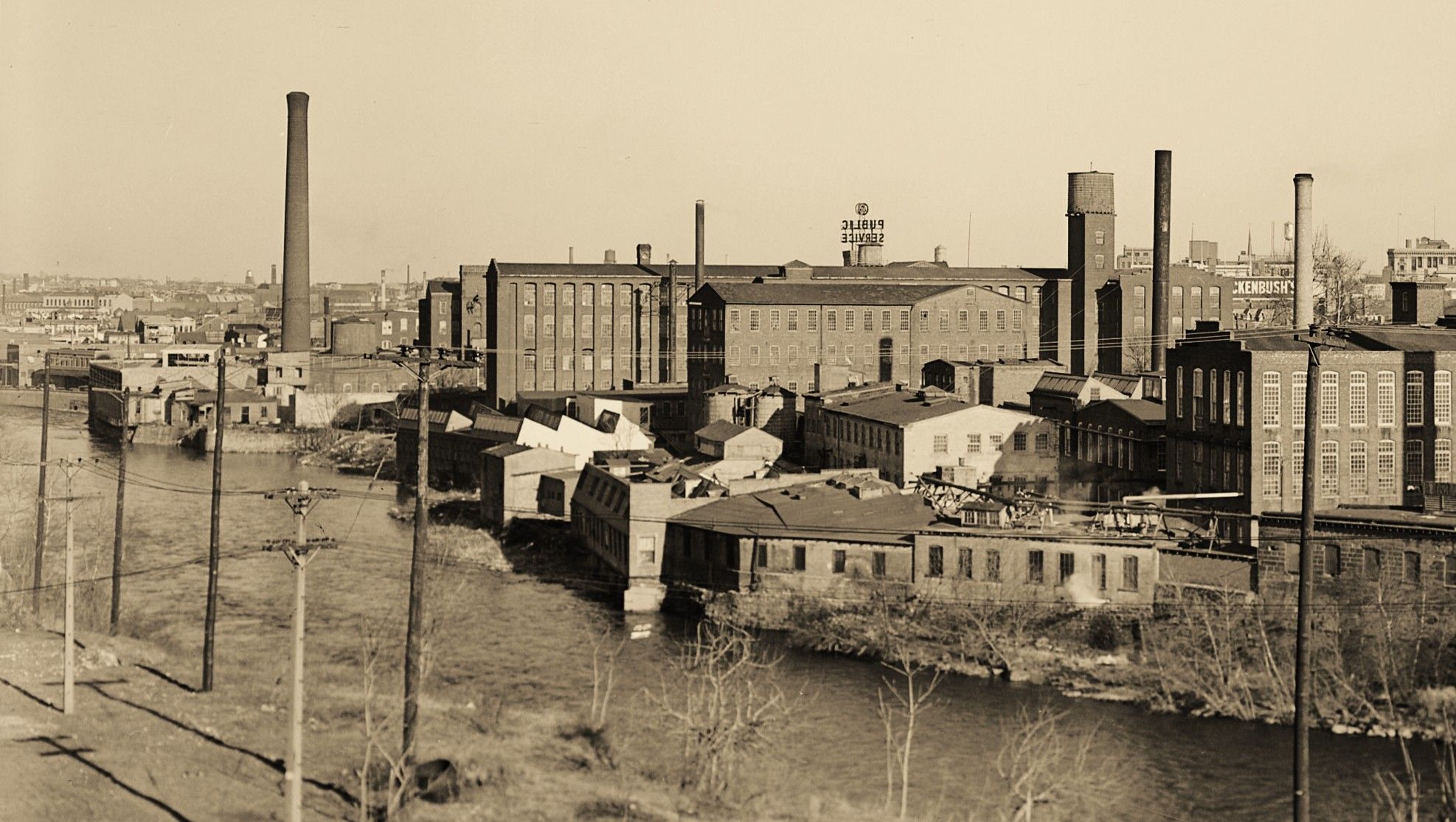
Russak continues his memoirs of growing up in Paterson with recollections of winter, the 1913 strike, and the multi-colored, polluted Passaic River.
‘A Silk Weaver’s Son’ by Martin Russak from New Masses. Vol. 4 No. 7. December, 1928.
(further memoirs of Paterson, N.J.)
Winters were a long torment of wet shoes, frozen extremities, and eternal coughing. The house stood exposed and thin-walled, inhaling currents of frigidity, and assailed by an incessant wind. We slept all in one bed and had hot irons for our feet. Only the school and the mill gave security against the cold. At home the bedroom door was closed until bedtime and life was restricted to the kitchen and the neighborhood of the stove.
All life was severely restricted in winter. Life, revolving relentlessly about the centripetal mills, moved from the first to the last frost in a radius shortened to the length of a weaver’s shuttle or the spoke of a winder’s spindle. Harsh, imperative, overwhelming grew the power of the mills. A man or woman who came late by four or five minutes found an unyielding door shut against him and a new worker in his place when he returned at noon. The whip cracked; the lash bit; and under the redoubled cracking of the whip men were terrified out of manhood.
Outside the wind blew incessantly, sharply and bitterly edged with ice. The frost came; the great frost; the old maple groaned aloud; traffic ceased in the street; below the city lay bleak and frozen. The snow came, descending upon the city, upon everything; and rising out of that white beauty in the first sunshine of early morning, the high chimneys seemed to have attained a frank and absolute purity of blackness.
A scuttle of coal was winter’s symbol of life. My mother made the fire when she came home from the mills. She had to get down on her knees to light it from underneath, and the act was like a gesture of prayer.
My father sometimes took me on expeditions for coal. We got out the sled, coasted down the hill, and dragged back a sackful of the precious stuff. On fine evenings, with a firmly packed snow underfoot and a moon above that made the world a glittering expanse of green silver, we would boisterously resume our coasting. There under the moon one became conscious of young German and Italian workers, neighbors whose existence was a discovery.
A friend or comrade would come to use our bathtub. Ours was the only bathtub among our people in the hill section. A vigorous discussion would invariably commence between my father and his visitor—a stream of language unbroken while the visitor backed, gesturing, into the bathroom, and adding a few last indispensable gestures through a suddenly re-opened door, until the host stood shouting through the glass panels and the other answered in a muffled voice amid splashing water.
In deep darkness, before dawn, the morning whistles blew for work. In darkness, after day, the evening whistles blew for release. In winter time I never saw my parents in the light of day.
REVOLT
Came the time of struggle and revolt, when the workers matched their strength against the strength of the mills, with the winning of a share of their lives in the balance. A strike mood fluttered like a crimson banner in the air. Old men told thrilling tales of struggle, tales garnered from the rich book of every worker’s memory. Young men raised furious heads from their toil. The whip no longer intimidated them. It impassioned them with revolt.
It was late summer of 1912. The mills were going full blast. All day great clouds of smoke blew out of the chimneys and smudged the sky above the town. At night the smoke was visible only under a clear moon. But in the evening, after work, little knots of men stood about on street corners. I could see them under the hill, I passed them across the river by the crowded saloons, where my grandfather took me and stuffed me with pretzels while he drank with big, loud-voiced strangers. When we walked home I clung a little frightened to his large warm palm. His breath was so strong that I was almost intoxicated by it, and he did not answer many important questions I asked him. One night he stopped on the bridge and, shaking his fist over the rail, hurled marvelous imprecations at the silent mills, vast shadowy cliffs walling in the tumult of swift water.
“We’ll show you yet, you monsters, you blood-suckers!” he shouted.
My father was calmer, more calculating. As the time of struggle drew near he became less an individual. He gauged forces and measured the perspectives of victory.
“There couldn’t be a better time for a strike,” he said to my mother across the supper table; “the bosses have big orders and can’t stand a shut-down of the mills.”
“We must strike,” she answered; “we’re starving in the mills and we may as well starve at home.”
Meetings took place almost nightly in the house on the hill. The strike was well organized and fell suddenly. The workers emptied all the mills, emptied the air of smoke, emptied the factory neighborhoods of factory din. But the streets resounded with the tramping of police. The whip had become a club.
After a brief struggle the masters gave in. They could not afford the idleness of workers who had nothing to lose by idleness. The masters lured my father and his fellow-workers back into the mills, yielding all demands, and after filling their needs of production they closed the mills against these upstart toilers who had dared grasp at a ray of sunshine. It was the great lockout. It was the winter of horror. The mills opened again only for those who would go back under the dictation of the mills. How great are hunger and despair! How 1 mighty are the mills that wield such weapons! Men were broken, more terribly than ever before, upon the iron wheels of industry. 1913 was at hand.
1913
1913 is a beautiful name. 1913 is a symbol of pride and love. 1913 is a torch of direction and encouragement. In the late afternoons of work, when the day fails and we turn on the fore and aft lights of our looms, and the weariness of the grinding hours seems impossible to bear, the thought of 1913 often comes to cheer us and to give us determination.
The old weavers who fought the Great Strike of 1913 are our legendary heroes. Big Bill Haywood is our one great epic figure. The irascible, the inaccessible Italian workers are everywhere respected for their leading role in 1913. It is precisely so. The proletariat in the City of Silk was molded into a conscious class in the furnace of 1913. The tradition of 1913 binds all groups of Paterson workers together. In the hush of noon-hour, when the looms are at rest and weavers come out into the aisles, we young fellows had rather listen to an old-timer’s memories of 1913 than talk across a winding-frame to the prettiest girl in the shop.
I remember first of all the wonderful presence and friendship of my father that gave a holiday air to every day. He took me to picket lines and to strike meetings. We escaped unhurt from the great meeting in Prince Street, where an assemblage of thousands was assaulted by mounted police. Never were there such picket lines. People rushed to the patrol wagons, eager to get in first, fearful of being left out. Who could keep track of all the arrests? At first it was glorious if your father was arrested; you were lionized by all the boys. Then the thing became too common, hardly a boy whose father had not been wounded or thrown into jail.
When all the halls were closed and we were not allowed to meet anywhere in town, our meetings took place in Haledon Woods. It was a huge picnic. Great crowds fraternized on the hillside and gathered around the farmhouse where, from a second-story porch, our leaders spoke—Elizabeth Flynn, Carlo Tresca, Gene Debs, and the others.
We boys climbed into the trees for vantage points. Our cheers we reserved for Bill Haywood. Not a man in the crowd was bigger than he. He filled the little porch; behind his white shirt with the rolled-up sleeves the green dress of Elizabeth Flynn disappeared; shaking a terrible fist against the sky, he spoke; and his speech was a clarion call. The crowd roared in answer; a thousand fists were raised against the sky; and a great wave of revolt surged from that hillside down upon the smokeless chimneys in the valley.
A fever of ardor and exaltation swept through the town. They had closed the mills, they had come out of their separate slums, they breathed the blue air of morning and the golden air of afternoon, they tasted freedom, and the taste was sweet though there was no bread to eat it with. Dim-eyed, slow-witted thousands; they had been kept apart, hating each other; now they were one, Italians and Syrians, Jews and Polocks, Germans and Yankees. The proletariat that had not been aware of its own existence, discovered itself. You found yourself the brother of thousands, children of one parentage: sweat and blood.
Ah, the mighty masters of life! Theirs is the kingdom and the power. Hunger and want, the long and hard clubs of the police, were foes too strong for those angry masses of resourceless workers. Hunger and want crushing the revolt of workers! It was merely for the alleviation of hunger and want meekly endured, for the alleviation of intolerable toil, that the struggle was waged. An insuperable wall confronted those brave men and women; against that wall they beat their heads in desperation; their heads were broken; the wall remained.
The summer wore away amid scenes of downfall and desolation. The bread lines grew long and grim. With a thousand other children I was sent to New York to be cared for wherever possible. The Great Strike drew on to its fatal conclusion. We came back to silent parents and to tragic homes. 1913 was at an end.
But 1913 was an arrow of fear driven into the hearts of the masters. The whip trembled. Within the next few years the ten-hour day became an eight-hour day. But I have lived through the time when the eight-hour day became a twelve-hour day.
THE RIVER
The City Hall is a granite building with a beautiful tall tower. In front of the City Hall stands a statue of Alexander Hamilton, historic founder of the city of Paterson.
It was the Falls at this point of the River that lured Hamilton, toward the close of the eighteenth century, to come here in his silken hose and upholstered carriage and to endow factories on the site of old Godwin’s pioneer fording-post. The Passaic River; the Passaic Falls.
The River comes to us out of the mountains of the west, flowing with a gentle motion around beautiful wooded hills and through beautiful fields of corn and rye, hay and oats. Men, women, and children work in those fields, plowing, cultivating, tending crops of delicate vegetables. Cows come down to drink and stand knee-deep in the water. Then the River grows wider; for miles its banks are over-arched by green loveliness of willow, hickory, oak. A region of sunshine and still water, with bungalows on the riverside under the trees, with people canoeing, with laughter echoing in the mild air.
Soon a ribbon of asphalt appears and follows the stream. It is the road; ponderous trucks and swift autos roll on it all day long. Now the River is brown, wide, and deep; it has lost its air of laziness; it has many bridges behind it; it flows with easy but impressive power. Here scattered factories, rectangular masses of sooty brick and an upward chimney, begin to appear.
The River enters the town with a prodigious leap over a precipice of trap-rock. There is a glorious splash, a flinging of spray that falls back to earth like a heavy rain, and enough foam is churned out to last for two miles of tumultuous swiftness…
From the bottom of the Falls to the point where the town is left behind, the River flows through factories. On either bank, rising directly from the stream, is a wall of sooty brick, each section of wall with its sootier upward chimney. Before the River leaves the town it must pass under nine bridges.
The dye shops are all along the River. They empty their refuse, streams of yellow, black, green, red liquid, into the River. Before the River has left the town it is a sewer of powerful odor and varied hue.
The River is black by day and blacker at night. In the daytime its blackness is smitten by golden quiverings of sunlight, in the nighttime by yellow quiverings of street-lamps.
No one notices the River. Trucks and autos rattle over the nine bridges all day long. Crowds of people file over the nine bridges going to work and coming home. No one stops for a moment except to spit into the stream.
But the workers who work in the old factories along the banks love the River. For them the River is a vision of marvelous beauty. At noon-time they eat their sandwiches on the windowsills and gaze down at the River with wonder and love. They never tire of watching this strange flow of water that comes from afar and ceaselessly hurries by them, flecked with foam, and bound for the open sea. They study all its fluctuations, all its changes of color, its floods and hurtling fragments of ice in spring, and grow sad to see it wither away in the heats of summer. In winter they peer through grimy window panes to glimpse the fall of white snow into black water. They love this stream that rushes so hopefully into the invisible distance, they feel a kinship with its abandon, its foaming recklessness, its passage onward, ever onward, by day and by night, time without end.
The River enters the town flowing directly north. Halfway through, it makes a complete turn and quits the town flowing directly south. The town stands on this great bend, embraced by the encircling arm of the River.
The New Masses was the continuation of Workers Monthly which began publishing in 1924 as a merger of the ‘Liberator’, the Trade Union Educational League magazine ‘Labor Herald’, and Friends of Soviet Russia’s monthly ‘Soviet Russia Pictorial’ as an explicitly Communist Party publication, but drawing in a wide range of contributors and sympathizers. In 1927 Workers Monthly ceased and The New Masses began. A major left cultural magazine of the late 1920s and early 1940s, the early editors of The New Masses included Hugo Gellert, John F. Sloan, Max Eastman, Mike Gold, and Joseph Freeman. Writers included William Carlos Williams, Theodore Dreiser, John Dos Passos, Upton Sinclair, Richard Wright, Ralph Ellison, Dorothy Parker, Dorothy Day, John Breecher, Langston Hughes, Eugene O’Neill, Rex Stout and Ernest Hemingway. Artists included Hugo Gellert, Stuart Davis, Boardman Robinson, Wanda Gag, William Gropper and Otto Soglow. Over time, the New Masses became narrower politically and the articles more commentary than comment. However, particularly in it first years, New Masses was the epitome of the era’s finest revolutionary cultural and artistic traditions.
PDF of full issue: https://www.marxists.org/history/usa/pubs/new-masses/1928/v04n07-dec-1928-New-Masses.pdf

