A variety of topics are covered in this famous letter to his comrade from ’48 then living in the U.S. for which Marx’s response to Weydemeyer’s article on Karl Heinzen serves as the impetus.
‘To Weydemeyer’ (1852) by Karl Marx from Selected Correspondence, 1846-1895. International Publishers, New York. 1936.
London, 5 March, 1852.
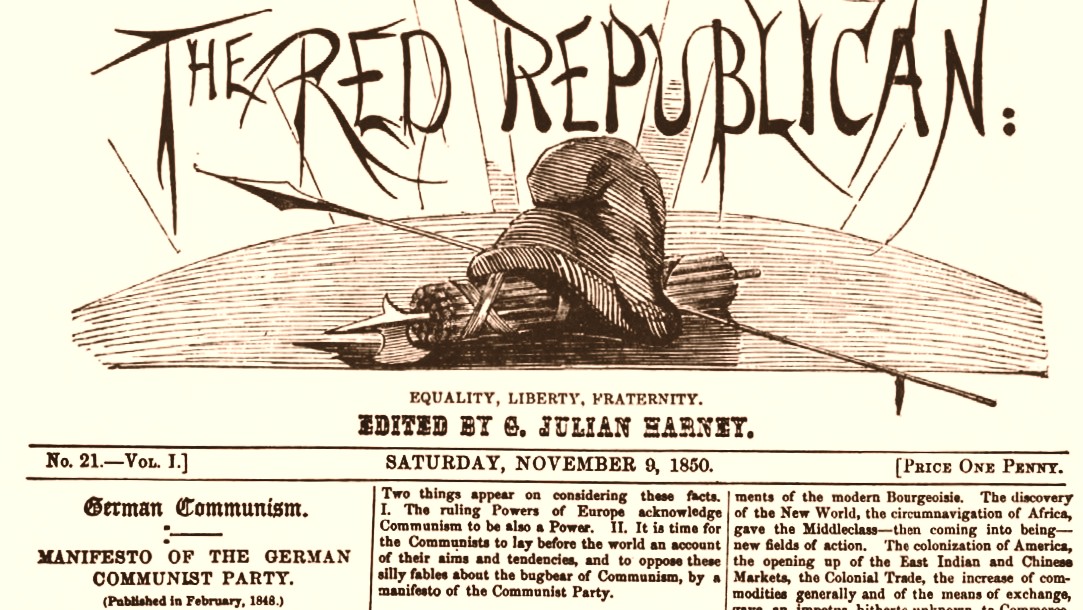
…Your article against Heinzen, which Engels unfortunately sent me too late, is very good, both brutal and subtle–a combination which should be found in any polemic worthy of the name. I gave this article to Ernest Jones, and enclosed you will find a communication for you from him intended for publication. As Jones writes very illegibly, with abbreviations, and as I assume that you are not an out-and-out Englishman as yet, I am sending you together with the original a copy made by my wife, and at the same time the German translation, as you must have them both printed side by side, original and translation. After the letter from Jones you can make the following addition: With regard to George Julian Harney, who is also one of Herr Heinzen’s authorities, Harney published our Communist Manifesto in English in his Red Republican with a note saying that it was “the most revolutionary document ever given to the world,” and in his Democratic Review he translated the articles I wrote in the Neue Rheinische Zeitung on the French revolution, Heinzen’s “discarded” wisdom. In an article on Louis Blanc he refers his readers to these articles as the “true criticism” of the French affair. For the rest, in England there is no need to support oneself only upon the “extremists.” If a member of Parliament in England becomes a Minister he has to be re-elected, so Disraeli, the new Chancellor of the Exchequer, writes to his electors on March 1:
“We shall endeavour to put an end to a class struggle which in recent years has had such a harmful effect on the well-being of this kingdom.”
On which The Times comments on March 2: “If anything could divide the classes in this country up to a point which would make further reconciliation impossible, it would be a tax on foreign corn.”
And in case a chap like Heinzen, with his ignorant faith in “characteristics,” should imagine that the aristocracy are for and the bourgeoisie against corn laws, because the former want “monopoly” and the latter “freedom“–a worthy of this sort only sees contradictions in this abstract form-it is to be noted that in the eighteenth century the English aristocracy were for “freedom” (of trade) and the bourgeoisie for “monopoly”–the same relative position that we find at this very moment between these two classes in Prussia with regard to “corn laws.” The Neue Preussische Zeitung is the most violent free-trader.
Finally, in your place I should in general remark to the democratic gentlemen that they would do better first to acquaint themselves with bourgeois literature before they presume to yap out their contradictions of it. For instance, these gentlemen should study the historical works of Thierry, Guizot, John Wade, etc., in order to enlighten themselves as to the past “history of classes.” Before they try to criticise the criticism of political economy they should acquaint themselves with the first foundations of political economy. One has only to open Ricardo’s great work, for example, to find these words on the first page: “The produce of the earth–all that is derived from its surface by the united application of labour, machinery and capital–is divided among three classes of the community, namely, the proprietor of the land, the owner of the stock or capital necessary for its cultivation, and the labourers by whose industry it is cultivated.”
That bourgeois society in the United States has not yet developed far enough to make the class struggle obvious and comprehensible is most strikingly proved by C.H. Carey (of Philadelphia), the only American economist of importance. He attacks Ricardo, the most classic representative (interpreter) of the bourgeoisie and the most stoical adversary of the proletariat, as a man whose works are an arsenal for anarchists, socialists, and all the enemies of bourgeois society. He reproaches not only him but Malthus, Mill, Say, Torrens, Wakefield, McCulloch, Senior, Wakley, R. Jones, etc., the master-minds among the economists of Europe, with rending society and preparing civil war because they show that the economic bases of the different classes are bound to give rise to a necessary and ever-growing antagonism. He tries to refute them, not indeed like the fatuous Heinzen by deriving the existence of classes from the existence of political privileges and monopolies, but by attempting to make out that economic conditions–rent (landed property), profit (capital), and wages (wage labour) instead of being conditions of struggle and antagonism are rather conditions of co-operation and harmony. All he proves, of course, is that he is taking the “undeveloped” conditions of the United States for “normal conditions.”
And now as to myself, no credit is due to me for discovering the existence of classes in modern society nor yet the struggle between them. Long before me bourgeois historians had described the historical development of this class struggle and bourgeois economists the economic anatomy of the classes. What I did that was new was to prove: (1) that the existence of classes is only bound up with particular, historic phases in the development of production; (2) that the class struggle necessarily leads to the dictatorship of the proletariat; (3) that this dictatorship itself only constitutes the transition to the abolition of all classes and to a classless society.
Ignorant louts like Heinzen who deny not merely the class struggle, but even the existence of classes, only prove that, despite all their blood-curdling yelps and the humanitarian airs they give themselves, they regard the social conditions under which the bourgeoisie rules as the final product, the non plus ultra [final limit] of history, and that they are only the slaves of the bourgeoisie. And the less these clowns themselves understand even of the greatness and temporary necessity of the bourgeois regime the more disgusting is their servitude.
From the above notes take anything you think suitable. For the rest, Heinzen has adopted “centralisation” from us in place of his “federative republic.” When the views which we are now spreading about the classes have become platitudes and a part of the furniture of the “ordinary human mind,” then the lout will announce them with a lot of noise as the latest product of “his own penetration” and start barking against our further development. So by “his own penetration” he yelped against the Hegelian philosophy as long as it was progressive. Now he is feeding himself on the stale fragments of it which have been spewed out undigested by Ruge.
International Publishers was formed in 1923 for the purpose of translating and disseminating international Marxist texts and headed by Alexander Trachtenberg. It quickly outgrew that mission to be the main book publisher, while Workers Library continued to be the pamphlet publisher of the Communist Party.
PDF of later edition of book: https://archive.org/download/in.ernet.dli.2015.227457/2015.227457.Selected-Correspondence.pdf

