Even if you think you are not interested in dance…A marvelous essay on how the era’s great artists– Duncan, Graham, St. Denis, and Nijinsky–reacted to the First World War.
‘Dance of Death’ by Paul Love from New Theatre. Vol. 2 No. 5. April, 1935.
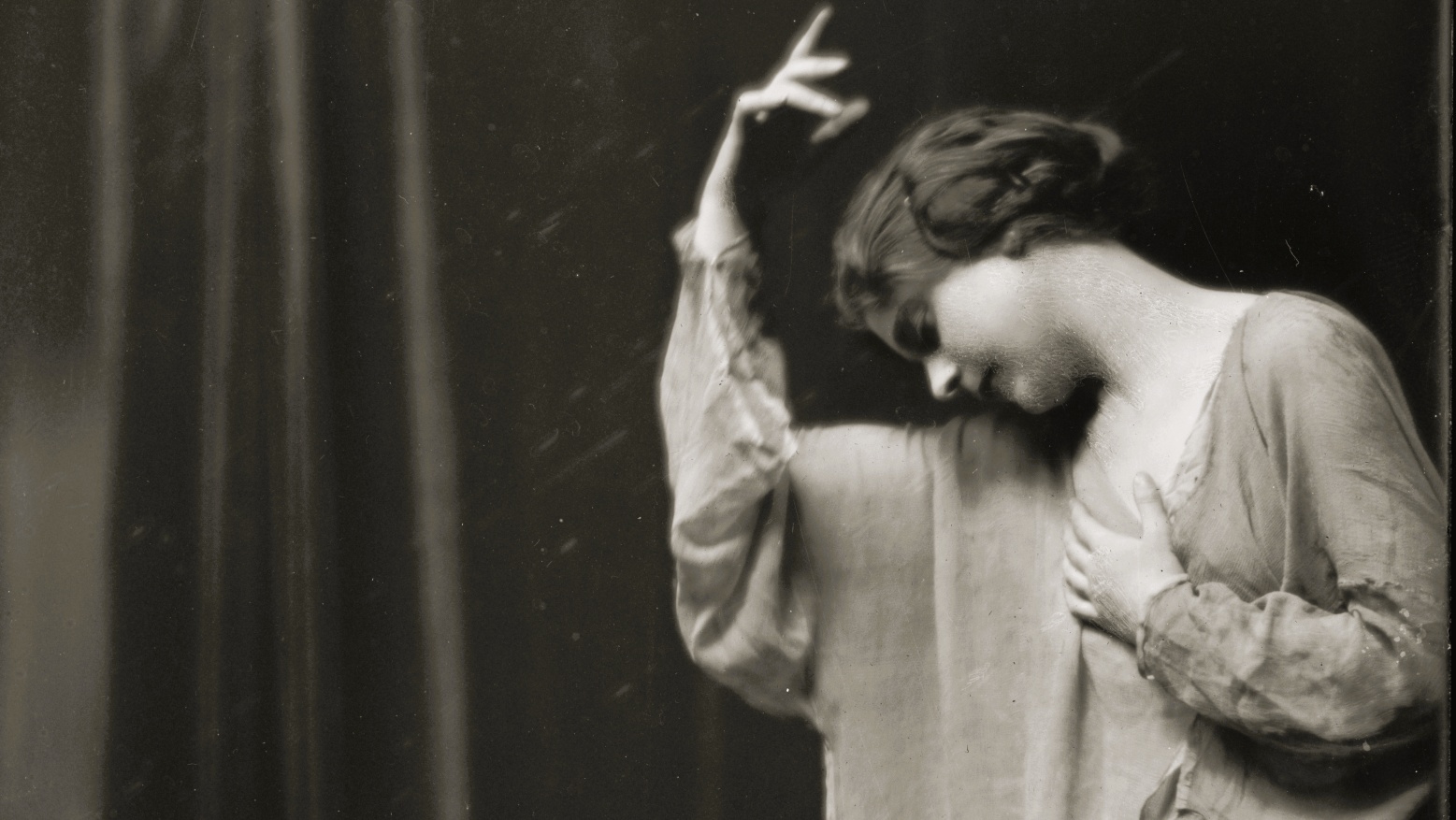
NIGHTINGALES OF AMERICA READY FOR WAR’S STERN DUTIES. This headline in the Journal on August 12, 1914 was illustrated with an ironical photograph of Isadora Duncan in a pose similar to the neo-classic David’s portrait of Recamier. Isadora was one of those “heading the colony of brave American women who are going to the front as war nurses. The women had made their plans even before the men were called to their colors, and were ready and waiting when the summons came.”
Isadora was never a war nurse, but it was interesting publicity. As she was gnashing her teeth over the blindness and stupidity of America for not giving her enough money to carry on the Greek Dionysion which had been briefly presented, the Russian Ballet under the direction of Diaghilev was touching the heights and simultaneously suffering from internal wars due to jealousies and intrigues. Nijinsky, through his marriage, had aroused the wrath of Diaghilev and had temporarily left the company. Pavlova was touring on her own. Mary Wigman, beginning her career, was working in Switzerland and recuperating from a serious illness. Ruth St. Denis in California was at the height of her oriental period.
As nearly as could be discovered in a rapid survey of books and clippings, there were only three of these dancers who were aware that a war existed–aware, that is, to the extent of making an immediate response in their dancing. Those three were Ruth St. Denis, Isadora and Nijinsky.
Pavlova continued uninterrupted in her classical ballet divertissements. The Russian Ballet was too busy with internal dissensions and too occupied with its program of beauty and grace. It continued on its way, expatriated, with romanticism, remoteness and exoticism as the key-note, apparently unaware that the Ivory Tower had crumbled into something worse than dust. It was beautiful in the sense that filigree or a cameo are beautiful and for this reason it offered nothing but an escape in two directions: in time, backward into past and calmer days; in space, upward into the realm of faëry where the Law of Gravity is unknown.
There were several things that prevented the creation of any dances based on war experiences. Possibly the main one is that the modern dance was hardly out of swaddling clothes and the ballet technique which was current was impossible for such a theme. Another is that there were personal incidents which deterred and determined the reactions of several of the dancers. Still another is the fact that expression follows an experience and does not occur simultaneously with it. Nearness, for almost any creative person, is a blinder; he must wait until the experience becomes disentangled from his own personal and immediate life before he can realize it in three dimensions.
It is because of this that Jooss’s The Green Table was not composed until some twelve or thirteen years had elapsed. Several dances and cycles by Mary Wigman, two or three solos by Martha Graham and most of the finest (that is, truest) books on the war appeared within the past five years. There were some dances, however, that were created in the 1914-1919 period and they are worth some small attention since they represent a reaction as typical as the mob reaction to drums.
ISADORA was in France when war was declared, staying at the Hotel in Bellevue which had been converted into a Temple of the Arts for her. It was in the month of August, almost to a day when the mobilization began, that she gave birth to her third child. She had lost the first two under tragic circumstances, and she was to lose the last one only a few hours after it was born.
This has little to do with war, but it has much to do with the state of mind and condition of body with which, from that moment of death onward, she viewed the world and watched it collapse. This final frustration, nurtured by her exhibitionist ego and her emotional response to the writings of the mad Nietzsche, caused her to fall unreluctantly into the chaotic tide that was sweeping over Europe.
She gave her Bellevue villa as a hospital for wounded soldiers; she conducted one of her many frenzied romances with one of the doctors; and she blamed the war to the fact that people ate meat. “Who loves this horrible thing called War? Probably the meat eaters, having killed, feel the need to kill…The butcher with his bloody apron incites bloodshed, murder. Why not? From cutting the throat of a young calf to cutting the throat of our brothers and sisters is but a step.” Yet, somewhat later, covered by the tri-color of France and with arm uplifted in exalted defiance, she danced the Marseillaise–a cry to war.
She saw the insurgence of jazz and was unable to realize that the vogue which she called “the barbarous yaps and cries of a Negro orchestra” was an easily understandable response to the tension that was about to snap. Because America seemed to like this better than it liked giving money for Greek dramas or for her bleeding France, Isadora shortened her American tour and returned to Europe. She and her group of dancers, like a bunch of school children, lustily sang the Marseillaise as the boat left the deck–all this as a way of thumbing her nose at the managers who refused to assist her.
Isadora’s whole life was a series of contradictions. She talked peace but she danced war. Inwards, in talk, she suffered for humanity, but in life she was extravagant and crass. The more one thinks of Isadora as a person, the more one wonders whether she was not really one of the supreme self-publicity agents.
Two of her other dances were Tchaikowsky’s Symphonie Pathétique and the Marche Slav. Of the first she has said, “It represents the soul of a nation in travail, in war. I was calling to them never to surrender, never yield. Why do our ships stay home?” And in direct contradiction to this capitalistic cry, she has said of the second that she was “picturing the down-trodden serf under the lash of the whip.” Possibly she did but we doubt it–doubt it, that is, as a sincere protest.
Similar to her in many ways is Ruth St. Denis. She too has the Vision of God; she too has heard the anguished Cry of Humanity. But the words are all capitalized as were Isadora’s, and capitalized in a much more literal sense. Her only dance on a war theme that I could discover was The Spirit of Democracy which was about as banal as the Statue of Liberty has become.
Miss St. Denis had been planning a year’s vacation, when suddenly America entered the war. Her words were for peace but she did the usual thing and gave the usual justification. It was one of those explanations we have heard so many times and which is both true and false: “I don’t believe in the horrible war, but we are in it, so well, we must do our part.” For her and, in a slightly different light, for Isadora and for thousands of Americans, it was an unexpected opportunity to put into practice a great many abstract nouns such as Love, Tenderness, Valor, Renunciation, Sacrifice–nouns which had been sitting so long in the dictionary that their meaning had been forgotten.
Miss St. Denis became the godmother of the 158th Ambulance Company at Camp Kearny in California in which Ted Shawn had enlisted. She abandoned her vacation and started on a vaudeville tour, turning over her income to war work. In 1918 she spent her time selling Liberty Bonds and giving speeches. During the influenza epidemic, “braving the quarantine, Ruth St. Denis came to Camp Kearny, lived for eight days in a tent on the outskirts, and nightly gave open-air performances to a ghostly-looking host of soldiers whose faces were covered with white ‘flu-masks’.”
It was shortly before the Armistice that she composed The Spirit of Democracy, in which she was the Spirit, clad in a flaming robe. All of the movements were based on war gestures such as bayonetting, throwing hand grenades, etc. The climax came when a girl in black tatters came onto the stage, pleaded totteringly for aid and finally fell down dead. From all accounts, this group dance was little more than a miming of War Posters, full of War, Death, Starvation and that peculiar thing called Democracy which in some vague way America was supposed to be attempting to save.
NIJINSKY and his wife and the child Kyra were in Budapest on the twenty-third of July, 1914. On the following day an ultimatum was sent to Serbia. July twenty-fifth they went to the circus which was overfilled with excitement. Strangers kissed each other; it was like a national fête. War had been declared. “Ceaselessly regiments of soldiers marched by, covered with flowers, singing, accompanied on the roadside by their laughing and, frantically waving women relatives.”
Nijinsky stood sighing before the window. “All these young men marching to their deaths, and for what?” It was shortly after this that they were made prisoners of war and lived for more than a year and a half in complete isolation. Nijinsky was well aware of the war but regarded it with a fatalistic mind and continued his work as well as he could under the restrictions that were imposed upon him. He created the choreography for the long ballet, Tyl Eulenspiegel, and began to work on his system of dance notation.
Finally, through Diaghilev and some of Romola Nijinsky’s friends (“The relatives of people in high positions all stay at home, they do not go to the front”), they were moved to Vienna in January, 1916. At this time Nijinsky composed the Mephisto Valse and began another ballet on a Japanese theme, which was never finished. After a short interval, he was “loaned” to America and made his American debut at the Metropolitan Opera House. There was an American tour and a visit to Spain and South America before he finally returned to “home in St. Moritz.” There was no creative work in this period which reflected the war psychoses. Possibly it would never have entered his work at all if it had not been for several outside factors.
One must remember that Nijinsky came from a family with a decided insanity taint. Because of this his mind was peculiarly open to the sudden reversion Tolstoi had made in his writings. Through one or two fanatical friends he was subjected daily to this new so-called humanitarian philosophy which Tolstoi projected in his volume on æsthetics. This and the sex triangle, involving him and Diaghilev and his wife this and the inherited tendency toward insanity–this and his excessively sensitive nature–this and the rigid training of the ballet–and the constant touring, which made him cry out, “I am not a machine. I will dance when I feel like it.” With these things in mind, it is not surprising that the war should eventually touch him like a bristle drawn over flayed flesh.
It was in Switzerland that he improvised and presented his last ballet. He was already mad. His intention was to show “how we live, how we suffer, how we artists create.” After a tense half hour or more of silence and motionlessness, sitting before his audience of two hundred, “he took a few rolls of black and white velvet and made a big cross the length of the room. He stood at the head of it with open arms, a living cross himself. ‘Now I will dance you the war, with its suffering, with its destruction, with its death. The war which you did not prevent and so you are also responsible for…He seemed to fill the room with horror-stricken suffering humanity…Whirling through space, taking his audience away with him to war, to destruction, facing suffering and horror, struggling with all his steel-like muscles, his agility, his lightning quickness, his ethereal being, to escape the inevitable end. It was a dance for life against death.”
It was the sudden snap of his mind that impelled him to this gesture. Finally, it was not the World War that Nijinsky was dancing; it was himself, his own war with life, his last powerful effort to escape the darkness that was enfolding his mind. Nevertheless, it should remain, whether legend or fact, as the one dance of death that grew out of the world struggle. “Marriage avec Dieu,” the title of the chapter in which his wife describes it, may well remain as the name of this ballet.
The Russian Ballet did little more than cool its heels until The Thing was over; it did not affect their work at all. Isadora’s was the romantic version, colored with the thrill of excitement and danger but blind to the fact. Ruth St. Denis’s was the humanitarian version, weakened by her distance from the field of battle and smothered by high-sounding generalizations. It remained for Nijinsky out of madness to say, “This is my marriage with God.” He alone seems to have experienced the war in the way that it is being re-experienced by many people today–not as a valorous struggle but a mass murder for profit.
***
This article pretends to be neither compact nor conclusive. It is more a brief record than an interpretation; that, the reader will be forced to make for himself. The quotations on Isadora Duncan are mainly from her autobiography, My Life. Those on St. Denis are chiefly drawn from Ted Shawn’s biography of her. Those on Nijinsky come from the recent biography by his wife. P.L.
The New Theatre continued Workers Theater. Workers Theater began in New York City in 1931 as the publication of The Workers Laboratory Theater collective, an agitprop group associated with Workers International Relief, becoming the League of Workers Theaters, section of the International Union of Revolutionary Theater of the Comintern. The rough production values of the first years were replaced by a color magazine as it became primarily associated with the New Theater. It contains a wealth of left cultural history and ideas. Published roughly monthly were Workers Theater from April 1931-July/Aug 1933, New Theater from Sept/Oct 1933-November 1937, New Theater and Film from April and March of 1937, (only two issues).
PDF of full issue: https://www.marxists.org/history/usa/pubs/workers-theatre/v2n04-apr-1935-New-Theatre-UCB.pdf

