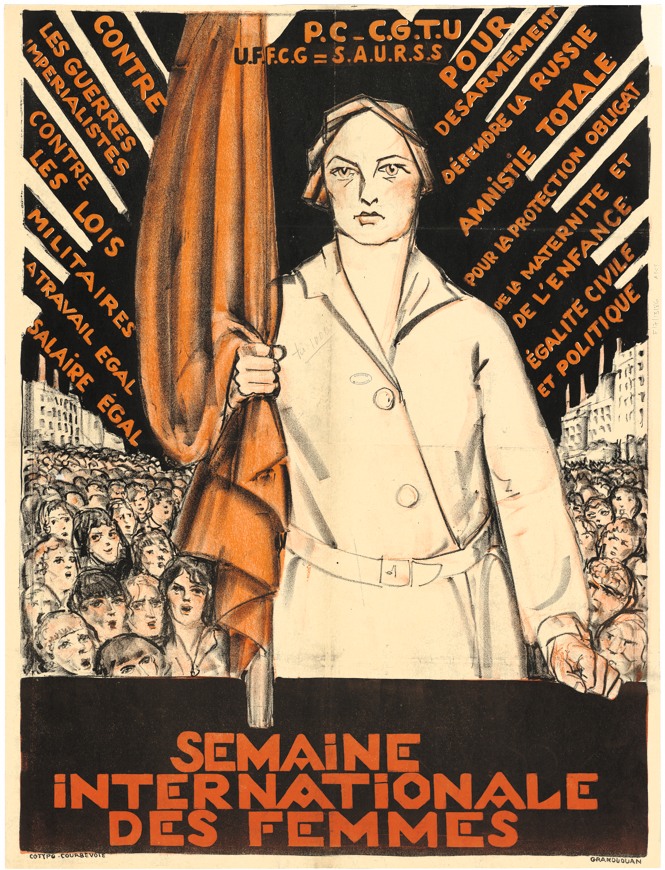
Declining significantly throughout the decade, by 1929 women made up less than 1% of the French Communist Party, one of the lowest percentages of any in the Comintern. The 200 or so women who were in the Party around the turn of that decade had a daunting task before them.
‘The Significance of International Women’s Day in France’ by Jeanne from International Press Correspondence. Vol. 9 No. 11. March 1, 1929.
In the next few days, when the proletarian women of the whole world will demonstrate for their demands, the Communist Party of France will again, as in previous years, call upon the working women to take part in the International Women’s Week.
During the present intensification of the class struggle in France, and at a moment when the struggle between capital and labour assumes peculiarly acute forms, the International Women’s Week is of special importance.
It cannot represent an isolated demonstration, separated from the whole of the labour movement. This year it is being held in the atmosphere of the tenth anniversary of the Communist International, which has been leading since the Red October the exploited and oppressed of the capitalist world to liberating world revolution. It must be one of the upward stages, one of the links in the chain of our work of mobilising broad masses of the workers for the mass celebration of 1st May, and for the preparation of an International Red Day of the whole working class against imperialist war.
When we remember that in consequence of capitalist concentration 40 per cent of the workers of France are women, distributed over all branches of industry, then it becomes obvious that the problem of female labour cannot be considered apart from the system of capitalist production and its resultant phenomena: It is an inseparable constituent part of the problem di rationalisation.
The employers, in their struggle to reduce the costs of production, fall back upon female labour, and upon juvenile workers and foreigners.
By means of special additions to wages of the workers, the employers bring about great differences in the amounts of wages; they create competition in wages. Women is becoming competitor of men. And women, in allowing to be paid less wage than men, promote the general deterioration of wages.
Both for the whole working class and for the women workers in particular, the main problem is the fight for “equal pay for equal work”, combined with a general rise in wages.
The slogan of “equal pay for equal work” must be imparted definite class character; it must not be regarded as a purely women’s demand.
The modernisation of production transforms the working woman into an automatic machine, to whom no thought of her own is allowed, merely observance of the labour laws. The working woman, not having time to think, frequently does not even know the causes of the wretched situation in which he finds herself. Capitalist rationalisation, demanding from her an output of work beyond her powers, and that at a starvation wage, reduces her to a work beast.
Her children fade and die in the over-crowded dwellings, without light or air, for the building speculators demand ever higher rents, and are of the opinion that workers have no claim on either hygiene or pure air.
The workers’ families are crushed beneath the burden of taxation, and two thirds of the sums thus wrung out of them are applied to meet the enormous expenditure of military purposes. The costs of living rise steadily, rushing rapidly ahead of the buying powers of the working class.
The working woman is only too well aware of all these things, crushing her to the ground from all sides. She recognises them instinctively, for indeed their heaviest burdens fall upon her shoulders, but she does not fully realise their ultimate cause. Often she protests, but it is not a consciously revolutionary protest. She does not know that the whole situation is the inevitable result of capitalist rule, which aids solely at exploitation and profit.
While woman is exploited daily, and deprived of all rights politically and as “citizen”, still a special role is being allotted to her for the coming war. The law drawn up by the socialist Paul Boncour, reorganising the capitalist army on a fresh basis, provides for the mobilisation of the women in the factories and workshops. She is to be forced into the service of the fatherland of the capitalists, in company with the working men, to help the criminal war against the Soviet Union; she is to manufacture war material during unlimited working hours.
Already the women working in hundreds of factories are making munitions intended for the Baltic states.
At the same time, however, the women in various important industrial centres have commenced energetic opposition to the employers.
The first victims of capitalist rationalisation have been the women workers in the textile undertakings of the North, in Rouen, in the valley of the Marne, in Troyes, and the women workers in the bleaching works of Arcueil Cachari, who like the wives of the miners in the Loire district and Gard took up the struggle for better wages, and against the consequences of capitalist rationalisation; a struggle, however, unorganised for the most part. In the growing strike movement the women lead the struggle. In the course of these struggles, in which they take part on an entirely equal footing with the workers, the women have the opportunity of recognising the Communist Party as the sole Party true to the interests of the working class. The working woman, too, realises the treacherous role which the social democratic leaders and the bureaucrats of the reformist trade union federation are playing in the class struggles of the working class against the capitalist class. Their daily struggles bring them more and more to the realisation that the socialist leaders are the zealous servants of the capitalist system.
The working women, in the course of their attacks on the strongholds of capitalism, learn to join the front against the bourgeoisie.
We do not doubt that in the era of struggle now before us, the women workers will throng to the meetings now being convened by the Communist Party in connection with International Women’s Day, and will demonstrate for the slogans of the Communist Party, against the imperialist war which we are approaching with rapid strides, and which is designed to overthrow the first workers’ and peasants’ State of the world. the first State in which woman lives in freedom, and from which her exploiters have been driven away.
Forward to 8th March! Fight:
Against the preparations for imperialist war! Against the pacifist lies of the bourgeoisie!
Against the persecutions!
Against the Irrationalisation!
Against the rent usurers!
For the defence of the Soviet Union!
For higher wages!
For protection of mothers!
For the political rights of women!
Equal pay for equal work!
by joining the ranks of the Communist Party.
International Press Correspondence, widely known as”Inprecorr” was published by the Executive Committee of the Communist International (ECCI) regularly in German and English, occasionally in many other languages, beginning in 1921 and lasting in English until 1938. Inprecorr’s role was to supply translated articles to the English-speaking press of the International from the Comintern’s different sections, as well as news and statements from the ECCI. Many ‘Daily Worker’ and ‘Communist’ articles originated in Inprecorr, and it also published articles by American comrades for use in other countries. It was published at least weekly, and often thrice weekly.
PDF of full issue: https://www.marxists.org/history/international/comintern/inprecor/1929/v09n11-mar-01-1929-inprecor.pdf

