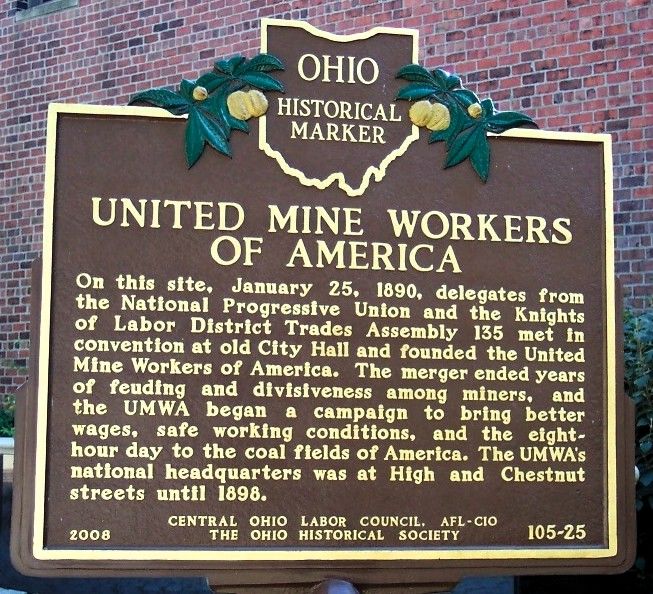
The United Mine Workers of America, for decades the largest and most important working class organization in the United States, was an outlier in the U.S. union movement in that it was built on industrial, ‘all in,’ principles. Unlike the craft unions of the time the U.M.W. included everyone working in the mine from the blacksmiths to the breakers. Yet, the U.M.W.A.’s leadership largely retained a craft union politics and outlook as Ettor explains below.
‘Industrial Unionism and Coal Mining’ by Joseph J. Ettor from Industrial Worker. Vol. 1. Nos. 9 & 10. May 13 & 20, 1909.
The United Mine Workers of America has made certain demands upon the operators of this region and in the little while since they made them they seem to be a thing of the past.
At the Tri-District Conference of the U.M.W. of A., held in Scranton, October 12, 1908, the following demands were made upon the operators:
1st. That an agreement shall exist between the miners and the operators of the region and all disputes arising shall be adjusted as provided in the said contract.
2nd. The complete recognition of the United Mine Workers of America as a party to negotiate a wage contract, and that the United Mine Workers of America shall be recognized in our right to provide any method for the collection of revenues for the organization.
3rd. A general eight-hour day without reduction in pay.
4th. All coal shall be paid at basis of 2.000 pounds a ton.
5th. Demand of a uniform wage scale for all company men and that all employes paid $1.00 or less shall receive a ten per cent advance, and all employes receiving more than $1.50 and less than $2.00 per day shall receive a five per cent advance.
6th. That no miner be allowed to hire more than two laborers and shall have no more than one contract at a given time.
7th. That the employers be required to issue monthly pay statements with name of workers and company, etc., the wages received for different workers and occupations.
8th. That a contract be entered into for the period of one year. Suffice it to say at this point, that the recent convention of the National Organization held in Indianapolis, after going through all the form, endorsed the above demands and instructed its officers to secure the above demands and the convention ends the endorsement by saying “We hold sacred and binding each section and all the terms of any contract entered into, and recommend that such methods, procedures and means for the settlement of all disputes between the anthracite miners and operators, be agreed upon as will prevent any stoppage of work pending the adjudication of any controversy as may be provided for in the agreement and maintain inviolate any and all parties, each and all, of the provisions of the contract.”
Since about the best method to expose false ideas and proposals is to offer something better the Coal Miners Industrial District Council of the I.W.W., at its regular session held in Scranton, Sunday, February 28th, 1909, acting upon instruction from the membership of the different local branches, decided on the following demands to be made to the operators:
1. Uncompromisingly opposed to the program advocated by the officers of the United Mine Workers of America in the matter of recognizing the said union as the bona fide miners union, opposed to the recognition on the part of the operators of any specific union of coal miners whereby the condition of employment shall be governed and secured by virtue of membership or non-membership in any union whatsoever.
2. Opposed to any program designating the establishing of a system where the operators are asked to collect the revenues of the union.
3. Opposed to signing any contract with the operators governing the conditions of employment and wages for any specified period of time.
4. A demand for a general eight (8) hour day to constitute a day’s work for all employes of mines, breakers, collieries and washeries.
5. The minimum wage for all underground workers shall be $3.00 for eight hours of labor.
6. Sufficient supplies such as timber, etc., and ventilation for the safety and protection of life and limb, and to put the above demand in operation there shall be in every mine, etc., a commission composed and elected by the employes themselves.
7. The wages of all employes of breakers, collieries and washeries including all other outside workers of the industry shall be two dollars ($2.00) minimum for a day’s work.
8. Prohibition of employment to boys below the age of sixteen (16) years.
To some this program may seem quite revolutionary, but be that as it may, we are willing to fight for something worth while fighting for, and not get it rather than battle for some demands that at best mean only mere palliatives and not even get them. When it is recognized that the masters will present as great an opposition to mere demands for crusts as they would for the loaf of bread itself, we choose to be men and make such demands as may be worthy of men.
More Pay and Less Work.
The demand for the general eight-hour day by the I.W.W. men is not made on n the basis as the U.M.W. of A. would have it! “It increases the efficiency and intensity of labor” but is made on the general principles that the workers are entitled to whatever they demand in so far as their material interests are concerned, irrespective of what the boss may have to say or think on the subject. We hold that if it be true that we are able to do as much work in eight as in ten hours, then we are wasting our efforts and energy to ask for any reduction in hours at all; if the same amount of energy is to be spent, we hold that the worker has not gained but has lost all that it took to gain the so-called victory. We are asking for an eight-hour day now, not because we believe we will be more efficient, but we lack the power to enforce a still shorter work day that may be necessary for labor’s advancement.
The demand for a minimum wage scale for all underground workers, for $3.00 as a day’s wage is made on the basis that the workers are the only ones who have any right to say what the price of their labor shall be. It can be readily seen that such a demand has for its object the abolition of the present iniquitous system of digging coal by the ton or car, and as some do by the yard, etc. The present method of payment is the best method that could be devised in the brain of the masters as a means of first confusing and then dividing the workers in the mines, against themselves, so as to be able to exploit and rule. To understand the full import of this demand it must be explained that at present, the miner hires his laborer: in fact he can hire as many as necessary; he establishes the wages for him, he has the right to hire and discharge him; one works by the day, the other works by contract. It requires very little understanding to see that by a plan of that nature, the miner becomes an actual employer and his laborer a slave, thus one-half of the men–wage slaves of the same master–are divided against each other to the great elation of the masters. The present method of paying for coal by the car or as it may be arranged, works all to the good of the operators by many devious tricks. To cite a few of these tricks: the miner is not paid for the ton of 2,000 pounds as provided by the law, but the operators sell the same coal at the basis of 2,000 pounds in a ton. Another way of skinning the miner is this: the coal is not weighed at the place where it is mined, but in most cases it is carried a good distance off, the cars are shattered, broken up and generally arranged so that in the shake-up necessary while being transported from one place to another, all the small coal falls by the wayside, the companies acting upon the principle that “every little bit added to what you got makes just a little bit more,” have what is known as company men to pick the coal and appropriate the same for the operators without having to go through the formality of paying the workers that did the digging. Then, “lest we forget,” when the car finally gets to the scales, the short weight comes into play. It is true that the law of the state provides that there shall only be dockage for the amount of dirt contained in a car and that in all cases the maximum dockage shall be no more than 500 pounds on each 2,000 pounds, but such little trifles as constitutional provisions and legal enactments don’t bother the operators very much in docking the miners as much as they see fit. You say, “why don’t the workers have a weighman of their own?” O, well, they have that ornament too, but in most cases he is a good member of the United Mine Workers of America and is thoroughly imbued with the notion that the employer is entitled to a fair profit and he winks his eye at the robbery, and if the miner insists on changing the checkweighman, then the former one generally gets a good job as reward for faithful service done. Those who are militants in advocating organization and better conditions are victimized by the refusal on the part of the employers’ agents to earn as much as the ones who are meek and faithful to the interests of the masters; they are made to suffer by shortage of cars, bad levels, placed at openings that are dangerous: any way to make then quit the job and make way for some one less aggressive.
A whole book could be written about this nefarious game, but we have neither space nor time to proceed any further on this point.
***
The demand for protection of life and limbs and that a commission elected by the workers of the mine to determine when it is safe to go to work should need no argument, especially when it is considered that almost daily the nation is shocked at news of explosions and all round accidents that cost hundreds of human lives. We hold that only those who are risking their lives to produce fuel for the nation have any right in determining when they shall risk their all and when not. At the present time there is a heated discussion in this region over a bill that would provide the mine inspectors in the different districts to be appointed by the governor of the state, the present method is by election. It should be clear to any discerning person that either way the plan cannot work to the satisfaction of the miners and workers of this dangerous industry in general. Appointment by the governor would only place the lives of the workers in the hands of politicians appointed by another politician which as a general rule know nothing about mines or anything else that spells work. The system whereby they are elected by a general vote of all classes in a district will not benefit the miners for many reasons, chief amongst them are the fact that the bosses and all the petty exploiters of labor have a voice and determining power to govern elections, the ones that are workers and whose lives are daily in danger but happen to be in this country, less than the required length of time, have no vote in the matter. The political machines of political parties are controlled by politicians, and they in turn are controlled by the masters who have the industrial power upon which their political influence and power rests. We can look neither to politicians nor government to protect our lives, we must do that ourselves, and we will be able to do so only when we have the power that is generated by the industrially organized coal miners. Such a demand as this is based on the recognition of principle that the coal miners must and shall run and own the coal mines themselves.
The demand for a minimum wage of $2.00 a day for all outside workers is based on substantially the same reasons as the 5th demand, with the greater aim in view beside, and that is to aim a heavy blow to the nation’s disgrace, child labor–a disease that threatens the very life of the working class. Preachers, orators, philanthropists and political saviours may pray, grow great in their eloquence, give alms and charity and make laws as they please, the evil cannot be eradicated by their efforts. Having in mind the great fact that neither wage slavery nor child labor is based on any other fact but that they are a method of capitalist exploitation, the child has less power to resist. Therefore he is employed at a lower wage than it would require for the man, so that it is a matter of price that determines the condition. The children can only be taken to school and out of mines, factory and workshop when the men, their fathers insist that they shall receive as much as anybody else. With that fact before them, the delegates of the District Council voted for the demand. The present game offers no end to the evil of the mistaken idea that because one worker happens to get more wages he is therefore justified in looking down on the others who do not fall in the same low level of paying homage to the bosses.
In reply to the argumentation of those who may think that it is improper or that the boys working in the industry are not entitled to as much pay as the men, we would call attention to the fact that the boys perform certain work and that if a man was hired he could do no more, in fact in the case of the slate pickers the men could not do as much as the boys. It should be sufficient to state, however, that that should be no concern of the wage workers since the fact stands that the boss has to pay the wages and in case he pays less he will have that much less left over to be able to amass and get in line for the much-sought honors of buying a European duke or something of that nature for his daughters to play with.
Relative to the demands for the check-off system and recognition of the union there should be very little explanation required as to why sane and conscious workers should be opposed to it. Suffice it to say that at some other date we may treat the matter more fully.
Bosses Prepared for Trouble.
In spite of all the claims to the contrary, the workers of this region are facing a serious situation and however it may be against our hopes and wishes they will be defeated in the oncoming conflict. Cold figures prove that the bosses have some 13 million tons of coal stocked up and that is about six million tons more than they have in time of prosperity. When it is considered that millions of workers all over the land are out of work and hungry, and the further shameful fact that the coal miners of other fields will remain at work digging coal and living up to the sacred contract, what other conclusion can we come to? But should there be a strike a lesson will be learned, a painful lesson indeed, but a necessary lesson for the final end; that lesson is that the coal miners of this region and this country in fact, can never hope to be victorious in their conflicts as long as the employes of the entire mining industry of the nation and of the world for that matter are not united under one banner, having one aim in view, standing together shoulder to shoulder as men worthy of the great history of the working-class on the revolutionary basis that “An injury to one is an injury to all.”
Over the shattered ruins of decayed pure and simple unionism that has led the workers of this land from one defeat to another, one compromise to another, there will rise new hopes that find their true expression in the Industrial Workers of the World.
Speed the day, men!
The Industrial Union Bulletin, and the Industrial Worker were newspapers published by the Industrial Workers of the World (IWW) from 1907 until 1913. First printed in Joliet, Illinois, IUB incorporated The Voice of Labor, the newspaper of the American Labor Union which had joined the IWW, and another IWW affiliate, International Metal Worker.The Trautmann-DeLeon faction issued its weekly from March 1907. Soon after, De Leon would be expelled and Trautmann would continue IUB until March 1909. It was edited by A. S. Edwards. 1909, production moved to Spokane, Washington and became The Industrial Worker, “the voice of revolutionary industrial unionism.”
PDF of full issue: https://www.marxists.org/history/usa/pubs/industrialworker/iw/v1n09-may-13-1909-IW.pdf
PDF of issue 2: https://www.marxists.org/history/usa/pubs/industrialworker/iw/v1n10-may-20-1909-IW.pdf

