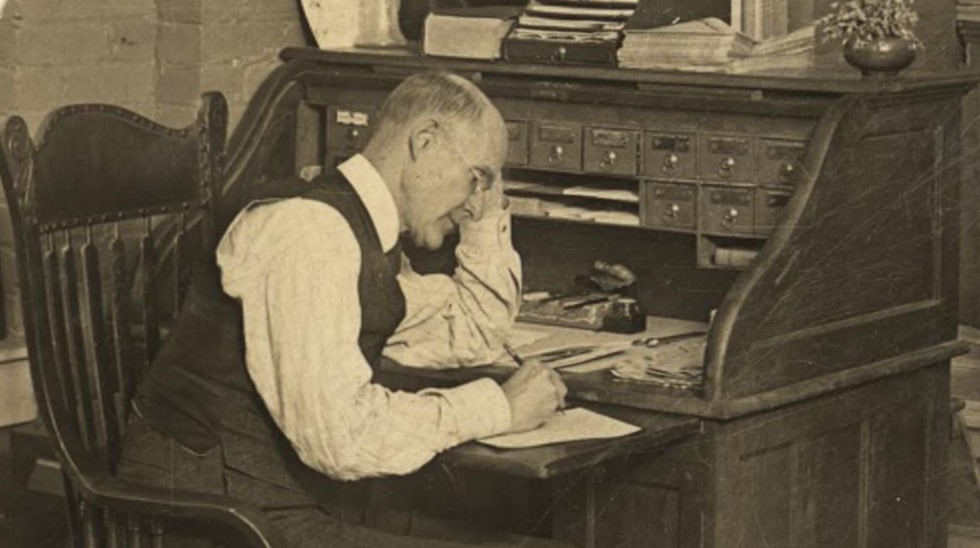
Says Debs, for a mass of diverse people to work towards a common goal requires real and competent organization.
‘The Need of Organization’ by Eugene V. Debs from Party Builder. No. 35. July 5, 1913.
THE subject here discussed is a trite one, but it is nevertheless of perennial interest to the workers.
The substantial progress of the Socialist movement and the successful outcome of the social revolution are wholly dependent upon the thorough and efficient organization of the working class. The impending social transformation involving the change from capitalism to Socialism is, therefore, in a word, a matter of organization.
But the fact should not be lost sight of that organization itself is subject to continuous change, especially in this evolutionary epoch, and that the forms and methods of a decade ago, or even less, are now outgrown, or at least out of date, and that unless organization adapts itself to the changing conditions under which the class struggle is being waged, its efficiency for good will be impaired, and in time it will be discredited and fall into disuse, if it does not become actually reactionary and a hindrance instead of a help to the workers.
The class struggle is the fact to be kept uppermost in mind when the matter of organization is considered. It is this fact that is the bedrock of militant Socialism. Built upon this rock, industrial and political organization of the workers cannot fail. The storms and tempests may assail it, but it will stand impregnable and defiant against them all. But the very hour it slips from that foundation it is in the shifting and treacherous quicksands and its doom is sealed.
The economic and political organization of the working class upon scientific principles is the most stupendous undertaking in all the annals of the human race. It is nothing less than an impeachment of all the past and a challenge to all the future in the name of all humanity.
To overthrow the ruling class of the world is as nothing compared to the organization of the working class.
It is precisely because the workers are not organized efficiently and are unable therefore to develop and assert their invincible power that they grovel at the feet of their petty masters and cry out impotently against their unhappy fate.
The ruling masters of capitalism of themselves are not strong but pitifully weak and contemptibly vulnerable. The despotic power they have and exercise, as such power is always exercised, is not inherent in themselves or in their class at all, but is to be found in the ignorance, weakness and impotency of their unorganized and helpless workers who are dependent upon them for employment.
The task before us, therefore, is the economic and political organization, with all the education, enlightenment, discipline, and self-restraint this implies, of the working class.
The recruiting, awakening and co-ordinating of the workers in their own Industrial Grand Army, where they stand elbow to elbow in class-conscious array, feeling themselves multiplied many times by the magic touch of solidarity, and their spirits rising within them and finding expression in boundless enthusiasm in anticipation of the fulfillment of their age-long dream of emancipation, is the grandest work in which any human being ever engaged since the world was born.
To give one’s self wholly and unreservedly to this cause is to be born again and to feel the new life bounding in one’s veins and swelling into hope, courage, and self-reliance such as forever defy disappointment and defeat and stand unafraid before all the world.
To the extent that the workers are rightly organized and fitted to take their places in the new order as free and self-governing citizens of the collective commonwealth, the revolution will come in peace instead of the deluge of blood which has accompanied all the upheavals of the past.
We need not worry as to how to get rid of our exploiters once we know how to get along with ourselves.
With the workers organized as an industrial and political army, they could walk peacefully into their own, and all the power that now rules and curses the world would dissolve and fade away at their conquering approach.
The unity of the workers and how to accomplish it is the open sesame to the promised land.
Let us study the art of how to unite for our common good, and stop fighting among ourselves for our common destruction!
Let us bend all our energies to organize the workers industrially and politically and let minor differences take care of themselves!
The industrial evolution is compelling the industrial organization of the workers, and we have but to watch its progress and adapt our methods to the changing conditions.
Today craft unionism is outgrown and class unity along industrial lines is the demand!
And the industrial union and the political party of the workers, being of the same class and the same aim and aspiration, must inevitably be mutually conscious of each other, and like the two separate engines of a locomotive, work together reciprocally toward the common end.
For a variety of reasons, the national Socialist Party of America did not have an official publication until May 1904 when the national convention mandated the monthly Socialist Party Official Bulletin as a way for the Party to communicate to its members. The name was changed to Socialist Party Monthly Bulletin in October 1911. The Party Builder became the name in 1913 and also became a subscription paper and a weekly. In 1914 the Socialist Party replaced The Party Builder with a regular propaganda newspaper, The American Socialist. These Party paper contain National Committee and National Executive Committee minutes, National Secretary reports, membership figures, financial statements, letters from party members, articles by prominent party leaders, and the figures for election of party officers and internal questions.
PDF of full issue: https://www.marxists.org/history/usa/pubs/spa-bulletins/130705-partybuilder-w35-debs.pdf

