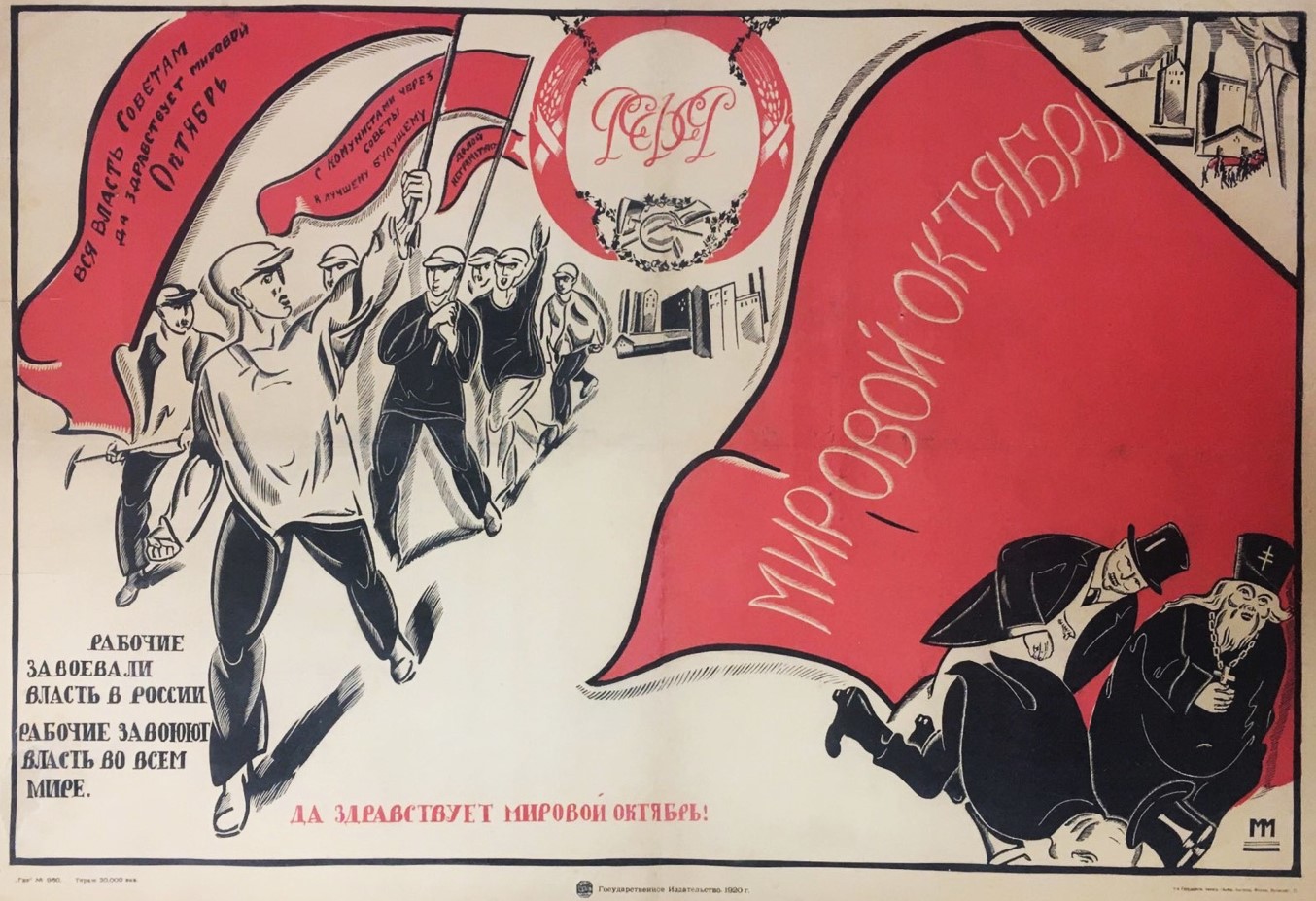
Essential primary source information of Comintern history, prepared for the Fifth World Congress in 1924, a report on the work of the Eastern, Propaganda, Information and Statistics, Press, International Communications, and Organisational Departments; Comintern Section Reporters; “lnprecor;” Commission on Lenin, the Study of Fascism, and the Budget; Proletkino (Cinema); the Comintern Library; as well as information on Manifestoes published; the names of Section Representatives to the Executive; and questions before the Executive.
‘Apparatus of the Communist International’ from From the Fourth to the Fifth World Congress of the Communist International, 1924.
Apparatus of the Executive Committee of the Communist International
EASTERN DEPARTMENT
During the past year the Eastern Department was in continual touch with the Communist organisations of Japan, China, Korea, the Dutch Indies, Persia, Turkey, Egypt, and Palestine. In Japan the Communist Party, under the guidance of the Comintern, perfected its tactics in connection with the work among the masses, the Trade Unions, and the formation of the Workers’ and Peasants’ Party, which is destined to play a significant role in the life of the country. The persecutions of the Communists commenced in the summer, and which reached a climax after the earthquake, hampered the activity of the Communist Party to a great degree; even at this date it has not fully recovered.
In China the Communist Party has made great progress. Its membership increased, its contact with the workers has become closer, and it took active part in all the more important Labour movements (Peking-Hankow strike, etc.). The Communist Party adopted a definite stand with regard to the national movement–the Kuomintang Party–and actively took part in the reorganisation of the latter.
In Korea the attempts of the Eastern Department to unite all the groups have thus far been fruitless. At present fresh attempts are being made to build a unified Communist Party.
In the Dutch Indies the Communist Party has developed into a definite force. It embraces several thousand workers, and is at the head of a number of Trade Unions and the strong national-revolutionary organisation, “Sarekat Rajat.’ The contact between the Eastern Department and the Party has greatly improved.
In India the Communist movement is in the early stage of development. The attempt to unite the individual groups miscarried as a result of repression. In a number of Trade Unions our comrades hold influential positions.
In Persia there are Communist parties in only two or three cities (Teheran, Thauris, etc.). The Party is just beginning to establish contact with the South-Persian oilfields. It is also taking an active part in the national-democratic movement of the country.
In Turkey the Party was twice dissolved during the past year. Toward the end of 1923 the results of this disruption were overcome, and the Party began to renew its activities. The influence of the Party on the radical intelligentzia has considerably increased, but its work in the Trade Unions is not yet sufficiently intensive, and measures are being taken to develop it.
In Egypt the Party has revived during the past year. Its membership increased, it took a definite stand on the national movement, and it succeeded in capturing the leadership of the General Confederation of Labour. The Party took a leading part in the strikes which occurred toward the end of 1923 and the beginning of 1924. The Party was violently broken up by the authorities. Seventeen comrades, members of the Central Committee and leaders of the General Confederation were arrested, and are now in prison. The provisional illegal committee has been able to restore some of the wrecked organisations.
Reference must be made to the feebleness of the activity in the French colonies in North Africa (Algiers, Tunis, Morocco). The Eastern Department had no direct contact with these countries, and the French Communist Party has not conducted sufficient activity there. The colonies are of great importance to France, and in France there are 700,000 workers who are natives of these colonies.
In the course of the past year the Eastern Department invited a number of representatives of the Communist parties in the countries mentioned above (China, Japan, India, Egypt, Palestine, etc.) to Moscow, with whom the principal questions of activity in the Party were discussed. The most important questions were turned over to the Presidium (attitude of the Japanese Communist Party to the organisations of workers’ and peasants’ party; tactics of the Chinese Communist Party towards the Kuomintang; the Korean question; the Indian movement, etc.), which arrived at decisions on these questions.
There will be avowed Communist organisations in the most important Oriental and Colonial countries when the Fifth Congress meets, which will be active under the leadership of the E.C.C.I.
PROPAGANDA DEPARTMENT
The functions of the Propaganda Department is to furnish the Labour Press with suitable articles dealing with the activity of the Communist International, on the class struggle in the various countries, on the Russian Revolution, and on important concrete questions, for the purposes of propaganda. It has to prepare books and brochures and make necessary proposals. A still more important function was the improvement of the agitation, propaganda, and educational activity of the Communist parties.
The activity of the Propaganda Department was very defective during the period under report, and it was able to fulfil only a fraction of its program, mostly owing to the fact that the comrades who were at the head of it were overburdened with work. The reorganisation of the Propaganda Department for the purpose of attaining more effective activity is under way.
ORGANISATIONAL DEPARTMENT
The Organisational Department of the Executive Committee of the Communist International was formed in December, 1923, in accordance with a decision of the Presidium. The Organisational Department assumed the task of introducing changes into the organisational structure of the sections of the Communist International, which had retained the organisational forms suited to the peaceful development of the Second International. It also did its utmost to facilitate the transition from peaceful election–agitation and propaganda forms of organisation to a more militant form of organisation capable of assuming the leadership in the struggle for proletarian dictatorship and of taking over power at the opportune moment.
In order to accomplish its task successfully the Organisational Department of the Executive Committee of the Communist International has:
(1) Studied the work of organisational development and the experiences of the various sections of the Communist International, and especially the experiences of the Russian Communist Party.
(2) Encouraged the systematic organisational work of the sections, from the fundamental factory party nucleus to the largest party organisation.
(3) Paid special attention to the illegal and semi-legal parties, to work among soldiers, etc.
The question which mainly concerned the Organisation Department during the past period was the organisation of factory nuclei. Party organisations must be based on factory nuclei and not on groups, circles, or sections organised on a territorial basis. All Party members must do active party work. These thoughts were expressed in the resolution framed by the Organisational Department, which was adopted by the Presidium of the Executive Committee of the Communist International on January 1, as well as in the instructions given to the representatives of the various sections who had come to Moscow, and in the letters addressed to the various sections.
A very animated exchange of opinions took place in the German Communist Party, which had considerable effect.
Although even in Germany the reorganisation of the Party on a factory nucleus basis is far from complete, considerable results in this direction were achieved.
This cannot be said of the other countries. Nevertheless, a move in that direction has been made in the largest European parties (as for instance, in France, Czecho-Slovakia, Poland, Bulgaria, Norway, not to mention other small countries). In all these countries this question is discussed in the sessions of the Central Committees, in the party Press, and at party conferences.
In connection with this reorganisation of the party on a factory nucleus basis, many mistakes are still committed in the majority of countries. For instance, nuclei on a territorial basis are maintained side by side with factory nuclei, the former retaining the leadership of the party. But the ball has been set rolling, and it is obvious that the reorganisation on the factory nuclei basis will proceed. Many sections of the Communist International have recently shown much interest in this question. At present the Organisational section receives a considerable amount of material on this question from the various sections, while at the beginning of its activities it received hardly anything except from the German Communist Party.
In many sections of the Communist International a keener interest is here shown on the question of the attitude of Comrade Lenin to the structure of the party. The Organisational Department has, therefore, made arrangements for popularising Comrade Lenin’s ideas on this question in all the sections.
Special attention was paid to the task of familiarising the various sections of the Communist International with the structure of the Russian Communist Party, and especially with the work of its fundamental factory nuclei.
The department has also drawn up instructions for organising Communist factions in non-party workers’ organisations, which were endorsed by the presidium of the Executive Committee of the Communist International. These instructions do not demand a fundamental break with the organisational practices developed in the course of several decades, and the various sections of the Communist International thus find it easy to follow these instructions. But in some sections the fraction and the nucleus are considered to be identical.
In general, the activities of the Organisational Department are not developing as rapidly as they should. During the last five months only eight committee meetings were held.
DEPARTMENT FOR INFORMATION AND STATISTICS.
The Department for Information and Statistics was formed after the Fourth World Congress. The object of this department is “to provide the Executive with information on the activity and social structure of the parties adhering to the Communist International, such information to be based as far as this is possible on coordinated facts.”
At first the department had to overcome considerable difficulties within the Comintern apparatus itself. The problem arose of establishing an organisational connection between the departments which hitherto provided information independently of each other (the library, the newspaper section, and the archives), and the department for information. This connection is not quite established as yet, but the department for information is doing its utmost in that direction, in order to establish a centralised information service.
The second and far greater difficulty comes from the parties themselves. All attempt to establish a regular service with the various party secretariats for the supply of material and information have utterly failed. Most of the parties have not even answered the letters and questionnaires of the Department for Information. It became evident that most parties are still unable to appreciate the importance of statistical party and trade union material even for their own political and propagandist needs. How much more difficult is it for such parties to understand the necessity of supplying the Executive of the Communist International promptly and regularly with reliable material.
During the last few months the Department for Information was busy with compiling a central catalogue necessary for the political work of the Executive. This catalogue is divided into two parts: (1) catalogue of books and pamphlets (library); (2) catalogue of newspapers and periodicals (party reports, minutes, party statistics, etc.). Whereas the library catalogue has already been in existence over two years, and is considered to be one of the best library catalogues in Russia, the cataloguing of the most important articles contained in newspapers and periodicals was taken in hand only a few months ago. The cataloguing of archive material could not be undertaken because of absence of a properly-trained staff. But this work is to be begun immediately after the Fifth Congress.
As far as the future of the Department for Information is concerned, we can say that it, depends largely on the following conditions:
(1) Centralisation of all sections supplying political information to the Executive under a uniform organisational control.
(2) IN THE VARIOUS PARTIES: Appointment of a thoroughly conscientious comrade capable of carrying on such work, whose duty it will be to keep in close contact with the Department of Information of the Executive, who will be responsible for supplying the material required by the Department for Information and for compiling statistics.

(3) The possibility of organising the Department for Information, and especially the archive and the central catalogue, on an up-to-date technical basis.
REPORTERS
In accordance with the decision of the Fourth Congress, the Presidium appointed responsible reporters, one from each of the most important countries, whose duty it is to compile the work of the various sections for the Executive Committee of the Communist International and its Presidium. As a rule these reporters were members of the Executive. In order to facilitate the work of the reporters assistants were appointed who were at the same time collaborators of the Department for Information and Statistics, and were under the control of the reporters. It was also the duty of the reporters and their assistants to provide information to the various departments of the Executive Committee of the Communist International, as, for instance, the Department for Agitation and Propaganda, the Budget Commission, the Publication Commission, etc.
The number of reports placed before the Executive Committee of the Communist International by the reporters and their assistants is as follows:
The German reporter 123 Reports
The French reporter 11
The Italian reporter 25
The Balkan reporter 29
The reporter for Great Britain and British Colonies 42
The reporter for South America (also for Spain and Portugal) 33
The reporter for North America 8
The Scandinavian reporter 17
The reporter for Austria, Czecho-Slovakia, and Hungary 10
The reporter of the Eastern Section 7
In the period intervening between the Fourth and Fifth Congresses, the following comrades acted as reporters:
1. Germany, Holland, and Switzerland. Radek, Hörnle and subsequently Com. Zetkin (as substitutes, Mörler and subsequently Eisenberger).
2. Austria, Czecho-Slovakia and Hungary. Neurath, subsequently Com.Zetkin. (Substitutes: Eisenberger, Cicinksy, and Peluso.
3. Poland, Lithuania, Latvia, Esthonia, and Finland. Pruchniak, and Kostcheva; specially for Finland, Kuusinen; for Latvia and Lithuania: Mitzkevitch-Kapsukas.
4. Scandinavia and Iceland. Kobestky, subsequently Kuusinen.
5. English speaking countries. MacManus, subsequently Stewart and Amter. (Substitute, in the beginning, Wallenius.
6. South America (with Spain and Portugal). Stirner. (For Spain and Portugal Genari and Gramsci in the beginning.)
7. Italy. Gennari and Gramsci, subsequently Terracini (substitute: Chiarini).
8. France, Belgium, Luxemburg. Souvarine, Levy, and Dunois.
9. Balkan countries. Kolarov. (Substitutes: Vuyovitz. Badulescu, and Sapunov.)
10. Eastern Department. Katayama and Safarov.
INTERNATIONAL PRESS CORRESPONDENCE
During the period under review the International Press Correspondence became the best organ of information for the Communist movement. It has a world circulation, and has become an indispensable auxiliary of the technical staffs of all our sections. For the illegal Communist Parties or for Parties which have no daily organ, it is the only source of information on the development of the International movement.
“Inprecorr ” has a German edition which appears three times a week and also a German weekly edition. In the French and English languages it is published twice a week.
When last autumn the German bourgeoisie drove the German Communist Party underground, ” Inprecorr was also prohibited. But barely three weeks later the publication appeared again in Vienna.
Although Inprecorr’s services are invaluable, many sections have as yet failed to give it the moral and material support which it well deserves. The decision of the Executive
calling upon all sections to appoint responsible correspondents for “Inprecorr” has not been carried out to any great extent.
THE PRESS BUREAU.
The work of the Press Bureau consists in preparing for publication everything issued by the Executive Committee of the Communist International through the publishing department of the various parties.
The Bureau has a staff of translators, editors, correctors, and typists, and fulfils work of translating, copying, etc., for its Departments and other international organisations adhering to the Comintern.
We give below a table showing the character of the work accomplished by the Press Bureau in the period between December 9, 1922, and May 1, 1924.
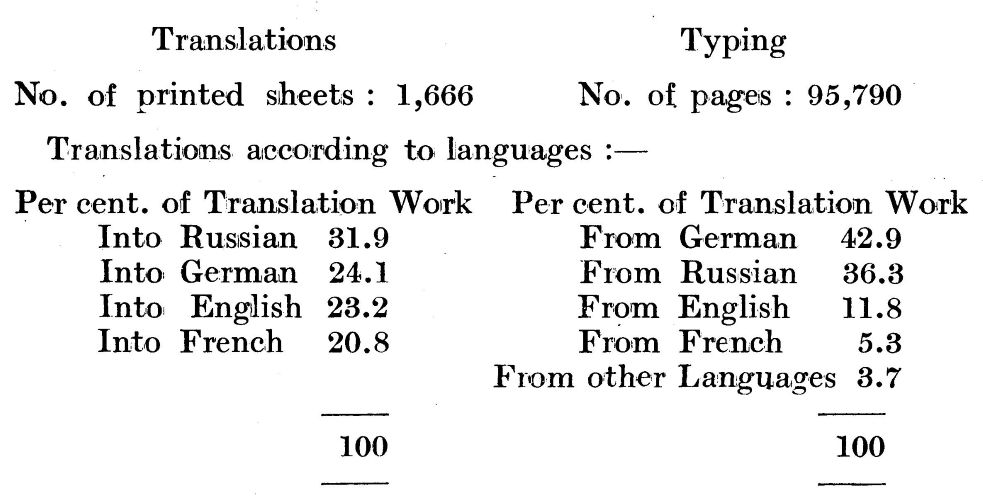
The main difficulty in the work of the Press Bureau is securing highly qualified, experienced translators having a Marxian training.
THE COMMUNIST INTERNATIONAL
The organ of the Executive Committee of the Comintern is published in four languages-Russian, German, English, and French. Since the Fourth Congress to April 10, 1924, six volumes of the magazine have been published, 82 printed sheets (in the size of the Russian publication) representing Nos. 24, 25, 26, 27, 28, 29, 1 (30-31), 2 (32). Nos. 3 and 4 (33-34) are being prepared for the Press.
During this period the magazine contained eleven articles on general questions of the theory and practice of the international workers’ movement. The number of articles concerning the various countries were as follows:
On German questions 13 articles
U.S.S.R. 9
British 9
American 5
French 4
Italian 3
Polish 3
Bulgarian 3
Norwegian 2
Eastern 7
Finnish, Latvian, Lithuanian, and Esthonian 5
Australian 1
Eleven articles and notices were dedicated to Lenin.
Sixteen articles and notices to the anniversary of the Communist International. In addition, there appeared a number of book reviews, articles, etc.
COMINTERN PUBLICATIONS
The publications of the Executive Committee in the Russian language are issued through the Publication Department of the Russian Party (“Krasnaya Nov”). This Publication Department publish literature on all questions on the international Labour movement, which is very popular.
The German publishing department continues to do fruitful work on a large scale, and is concentrating attention on extending its sale. In this it has the full support of the German Communist Party. The publishing department continued its work after the October events, in spite of the prohibition and confiscation of Communist publications.
During the period of its existence (four and a-half years) the Publishing Department issued about 230 books and pamphlets, in addition to periodicals. It should be stated that the parties of the German-speaking countries do not devote sufficient attention to disseminating literature.
Between November 1, 1922, and April 15, 1924, the Publishing Department issued 61 books and pamphlets (total amount of pages, 11,360; number of copies, 546,550. Twenty-five works are in the press or in the course of preparation for the press (total number of pages, 7,200; approximate number of copies, 283,000).
The British publishing department, in addition to the “Communist International,” which has a circulation of 2,500, and is read in all English-speaking countries, has issued a number of pamphlets and leaflets, as well as the minutes and resolutions of the Congress and of the Plenum. At present there are in the press:
“Material on the Comintern Programme.”
“Lessons of the German Events.”
“Rise or Fall of Capitalism,” by E. Varga, and a number of other publications.
The French publishing department, which is not yet fully organised, in addition to “The Communist International and official reports of the Congress and the Plenum, published a number of works on the theory and practice of the international movement.
ACTIVITY OF THE LENIN COMMISSION
Immediately after Lenin’s death, the Communist International set up an editorial commission, in order to publish Lenin’s works in the German, French, and English languages, and later into the other Western and Eastern languages. The Commission is composed of Comrades Kamenev, Kolarov, Krupskaya, Bela Kun, Kuusinen, Radek, and Varski.
At present the Commission is preparing three editions of selected works of Lenin.
First of all, a large bound edition (about forty printed sheets) of selected works of Lenin will be prepared. This volume is intended particularly for such advanced Party members as have attained a certain grasp of the Marxist teachings and of the experience of the Labour and Revolutionary Movement. The volume will be divided as follows:
(1) Tasks of Social Democracy; this contains the most characteristic writings of Lenin during the period prior to the formation of the Russian Social Democratic Labour Party.
(2) Organisation of the Party and the fight against Opportunism; the preparation and development of Bolshevism at the Second Congress of the Russian Social Democratic Labour Party; this contains selected excerpts from two fundamental works of Lenin which have appeared hitherto only in the Russian language: “What is to be Done?” and “One Step Forwards and Two Steps Back.”
(3) Two tactics in the Revolution of 1905: Lenin’s article dealing with all the principal problems of the revolution of 1905, and particularly the questions on tactics and organisation of the Revolution.
(4) Parliamentarism and the Tactics of the Bolsheviki: directed against Right liquidators and the Left Bolshevists, written at the time of the retreat and the reaction.
(5) The Imperialist War 1914-1917; articles selected from the volume of Lenin’s and Zinoviev’s joint work “Against the Stream.”
(6) The Conquest of Power (February-October, 1917): this contains the articles which determined the bolshevist tactics during this period.
(7) Dictatorship of the proletariat and the Communist International; articles and speeches on the policy of the Soviet State and the Communist International.
The first volume is now being printed.
The other editions are being prepared for publication by the Commission. The first is a smaller Lenin volume which is intended for the masses outside the Communist International, or for those Party members who have not yet attained the proper grasp of the subject. It will consist of 16-17 printed sheets and include not only separate articles or excerpts from Lenin’s work, like the one described above, but will be a sort of textbook of Lenin’s writings which will include everything necessary for preparing Communist Party members for active party work and for the general task of educating the great working- class masses with reference to the general and particular questions of the Communist Revolution and Bolshevism.
A five-volume edition, also of Lenin’s selected works, is also under preparation. The first three volumes contain his writings on the strategical, tactical, and organisational problems of the Russian Revolution and the International Labour Movement (Second and Third Internationals). The fourth volume contains his writings on Marxist theory, particularly that pertaining to theoretical economics and philosophy. The fifth volume includes writings and speeches on the national and political-colonial questions and those treating particularly of the theory of the agrarian question. At present it is planned to issue these volumes only in the German, French, and English languages. The purpose of this volume is to furnish the basis for a deeper study of the Leninist teachings and to supply the leading officials of the Communist Parties with a permanent handbook.
Finally, a 400 page symposium on Lenin will be issued, which will contain the best articles written about Lenin, and which throw light on Lenin’s activity from all points of view–in a word, a Handbook for Lenin Propaganda.
COMMISSION FOR THE STUDY OF FASCISM
In July, 1923, the Executive set up a Commission for the Study of Fascism, which was charged with the duty of gathering material on Fascism (especially on German Fascism), and to furnish the Executive and the Sections information on Fascism. The Commission will publish brochures on Fascism, which will be prepared with the aid of the Sections. The Commission has been issuing the “Chronicle of Fascism ” (since August, 1923), which appeared twice a week in Berlin. It was transferred to Vienna during the state of siege.
The Commission has gathered copious material on Fascism; the “Chronicle” appears in 15,000 copies.
PROLETKINO
In February, 1923, the Russian Trade Unions and Labour organisations, with the assistance of the Communist International and the Red International of Labour Unions, started an organisation for the development of proletarian moving pictures. The task of Proletkino is to offer the workers proletarian films in competition with the bourgeois films.
The Proletkino began its work on May 1, 1923. Since this time it has made and distributed over thirty of its own films of a total length 15,000 metres. The films treat with themes and settings in the Red Army, in the factories, among the proletarian youth, etc. In Soviet Russia they were quickly distributed and became very popular. Besides its own films, Proletkino distributed various films of an educational and propaganda nature. Up to March 1, 1924, Proletkino distributed 749 programmes with a total length of 985,000 metres. These programmes find their way into the factories and workers’ clubs. We furnished the various organisations with programmes follows Textile workers, 136 programmes; railwaymen, 118; metal workers, 86; the Red Army, 66; Russian Communist Party, 41; Russian youth, 30, etc.
Proletkino has set up branches in several of the large cities of Soviet Russia, and travelling theatres in the provinces. In spring, 1924, the “Society for the Development of Proletarian Cinematography” was formed for the support of Proletkino. It has assumed the task of encouraging workers’ cinematography, and already has over 50,000 workers as members.
Proletkino is now preparing several large proletarian films. Connections abroad were not made until toward the end of 1924. Regular contact has been established only with America, the Scandinavian countries, and China at present, and only seven films have been sent abroad. Correspondence has been opened with other countries. We have received a great many orders, which can be only incompletely filled on account of scarcity of raw material and financial difficulties.
Proletkino has furnished the Communist press of the various sections with approximately 2,000 photographs of Soviet Russia.
Our section will surely appreciate the value of Proletkino and give it their support, for it offers them the opportunity of competing with the bourgeoisie on a field where the latter has always been sole master.
THE BUDGET COMMISSION
The Budget Commission of the Executive Committee of the Communist International was elected by the Presidium, and is under the direct control of the latter.
The main function of the Budget Commission consists in dealing with the financial questions connected with the activities of the various Communist Parties.
The Budget Commission decides what portion of the membership contributions the Communist Parties have to assign to the Comintern, and distributes the amounts received among the various parties for their most urgent needs (election campaigns, publishing activities, central apparatus, etc.).
The Budget Commission controls the finances for the activities of the various parties in order to ascertain whether the sums allotted by the Budget Commission from the amounts contributed by the various Communist parties were expended for the purpose for which they were intended.
The work of the Budget Commission is under the control of a special Commission elected at the Congress.
During the period under review, November 5, 1922, to May 9, 1924, the Budget Commission held thirty-four sessions. At these sessions 172 questions were discussed, 129 of which (75 per cent.) are concerned with the Comintern sections, and 43 (25 per cent.) with Comintern institutions.
DEPARTMENT OF INTERNATIONAL COMMUNICATIONS
The activities of this department comprise the organisation and upkeep of relations with all the sections of the Communist International, and to provide them with literature.
The Department of International Communications has a Sub-Section for Literature. The work of the latter consists in selecting and procuring publications appearing in the Union of Socialist Soviet Republics, which are of interest to the sections of the Communist International which avail themselves of the services of the department. On this field preference was given to fundamental literature dealing with the internal and economic policy of the Soviet Republic. The Department for International Communications procures the works of Lenin, Plekhanov, Zinoviev, Trotsky, &c., from the Sub-Section for Literature, and sends them to the subscribers. It also supplies the sections of the Communist International with light literature reflecting the revolutionary movement.
The Sub-Section for Literature receives foreign publications from abroad and distributes them on the exchange system among the respective party and State publication departments. It also sends them to the library and the respective departments of the Executive Committee of the Communist International.
The same applies to the publications of the Communist International appearing in the Soviet Union.
On an average, twenty-five to thirty Russian publications and eight to ten foreign publications are distributed monthly. The sub-section for literature procured nearly all the publications bearing on Comrade Lenin’s death and sent them to the various sections of the Communist International.
THE LIBRARY
The reference library of the Executive Committee of the Communist International, which is at the disposal of Comintern employees and delegates for their work, comprises about 14,000 volumes of which 11,750 are classified and catalogued (from January 1, 1923, to May 1, 1924, 6,100 volumes). The books are arranged on the Dewey decimal system, and visitors to the library have the use of an alphabetical title and contents catalogue.
A reading room is attached to the Ebrary and is open daily from 10 a.m. to 6 p.m. In addition to books, there is a supply of bound volumes of newspapers and sets of periodicals, in various languages. From January 1, 1923, to May 1, 1924, 6,720 persons availed themselves of the library and reading room.
A newspaper archive is attached to the library, which supplies the reporters and departments of the Executive Committee of the Communist International with foreign papers and periodicals from all countries. The newspaper archive receives about seventy foreign and ten Russian newspapers, and fifty-three foreign and twenty-three Russian periodicals, which are also at the disposal of visitors to the library.
Books are mainly read in the library. They are lent only in exceptional cases.
The library regularly obtains the most up-to-date publications (useful for Comintern work) appearing on the Russian and the foreign book markets.
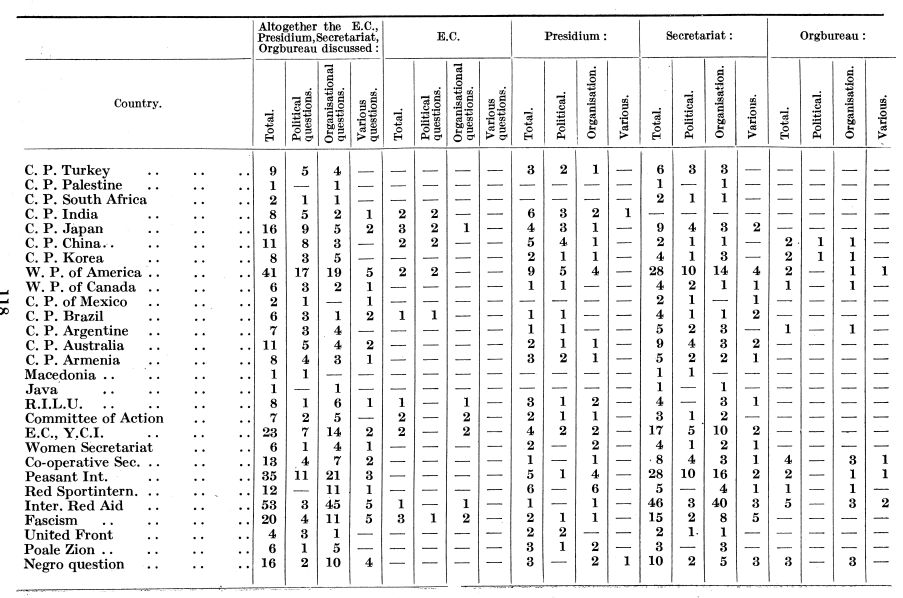
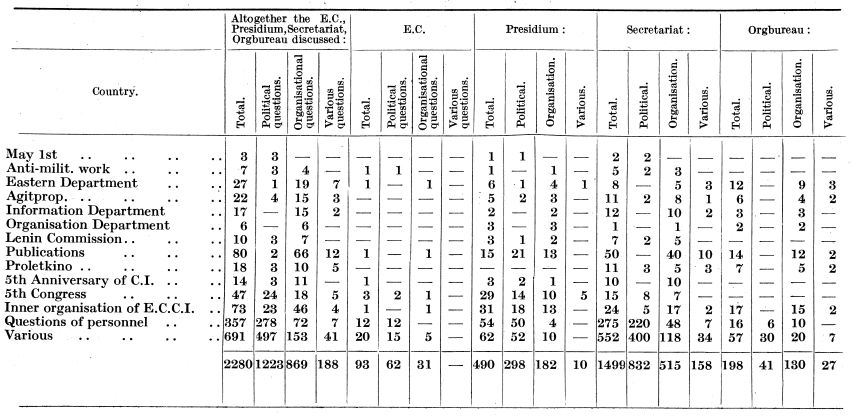
REPRESENTATIVES OF THE EXECUTIVE ABROAD
During the period under review, the Executive sent 31 representatives or delegations to the sections, congresses, conferences, etc. A total number of 65 comrades were delegated to the following 22 sections: Germany, Russia, France, Italy, Czecho-Slovakia, England, Norway, Bulgaria, Rumania, Jugo-Slavia, Greece, Holland, Sweden, Denmark, Finland, Switzerland, Austria, Hungary, Poland, Spain, Portugal, and Korea. In addition, representatives were sent to the conferences of the Balkan Federation and to the Frankfurt Conferences.
MANIFESTOES
The Executive issued the following manifestoes during the period under review:
December, 1922. The Amsterdam will again deliver you defenceless to the beasts of war.
January, 1923. To all the workers. To the agricultural workers.
January, 1923. For the united front. To all workers, peasants, and soldiers against the war.
January, 1923. Open letter to the Londoners. The Vienna International and the Amsterdam Trade Union International. Against the war. Against Fascism. To all sections.
January, 1923. Fight against Italian Fascism.
January, 1923. Manifesto to the Party Congress of the Communist Party of Austria, March 23, 1923.
January, 1923. To the workers and peasants of South America.
February, 1923. Executive Committee of the Communist International to the Communist Party of Australia.
February, 1923. Protest against the persecutions of the revolutionary workers and peasants in Europe.
February, 1923. The Fifth Anniversary of the Red Army.
March, 1923. To the fighting proletariat of Hungary.
March, 1923. International Women’s Day.
March, 1923. Twenty-fifth Anniversary of the Russian Communist Party.
March, 1923. Protest against sanguinary justice in India.
March, 1923. To the International Conference of Frankfurt-on-the-Main.
March, 1923. To the I.W.W. in Chicago.
March, 1923. To the Communist Party of Belgium.
March, 1923. Protests against the shameful law in Czecho-Slovakia.
March, 1923. To the Chinese railwaymen.
April, 1923. The bloody events in Essen.
April, 1923. Protest against the White Terror in Esthonia. (The murder of Comrade Kreuks).
April, 1923. The First of May manifesto of the Communist International.
June, 1923. To the Bulgarian workers and peasants. Against the Government of the White Coup d’Etat, for the Workers’ and Peasants’ Government.
August, 1923. On the amalgamation of the II and II 1/2 Internationals.
August, 1923. Against the White Guard Regime in Finland.
August, 1923. The White Terror in Bulgaria. To the workers of all countries.
August, 1923. To the Communist Parties of all countries. The Ninth International Youth Day.
August, 1923. Come to the support of the German proletariat.
September, 1923. To the workers and peasants of the Balkans, to the peoples of the Balkans. For the Workers’ and Peasants’ Government.
September, 1923. The treacherous attack of the Tzankov Government on the Bulgarian Communists.
October, 1923. To the workers of Japan and the workers of all countries.
October, 1923. To the workers and peasants of Bulgaria. For the Workers’ and Peasants’ Government in Bulgaria.
October, 1923. Protest against the conviction of Nikolau and Mateau.
October, 1923. To the anti-militarists of all countries.
October, 1923. To the workers’ and peasants’ revolutionary organisations of the whole world, for solidarity with the Bulgarian workers and peasants.
November, 1923. To the workers of all countries, on the events in Cracow, barbarity in Ireland, and murder of political opponents.
January, 1924. Remember Mateau and Nikolau.
January, 1924. Message from the Executive Committee of the Communist International to the C.P.F.
January, 1924. To the proletarians of all countries on the death of Lenin.
February, 1924. To the British and International proletariat. The Labour Government of England.
February, 1924. To the Central Committee of all sections. International Women’s Day.
February, 1924. To all Communist Parties. To all proletarians. To all Colonial slaves. The Fifth Anniversary of the Communist International.
March, 1924. To the toiling masses in the Greek Republic.
March, 1924. March 18, International Red Aid Day.
March, 1924. To the defence of the Bulgarian workers and peasants.
March, 1924. To the Red Army soldiers and the Red Commanders. The Sixth Anniversary of the Red Army.
April, 1924. The First of May, 1924. Proletarians of all countries.
April, 1924. To the toilers of the whole world. Protests against the White Terror in Poland.
May, 1924. To the workers and peasants of Japan. Protests against the Japanese militarists and landowners. For the Workers’ and Peasants’ Government of Japan.
May, 1924. To the workers of Scandinavia. On the labour struggles in Norway.

