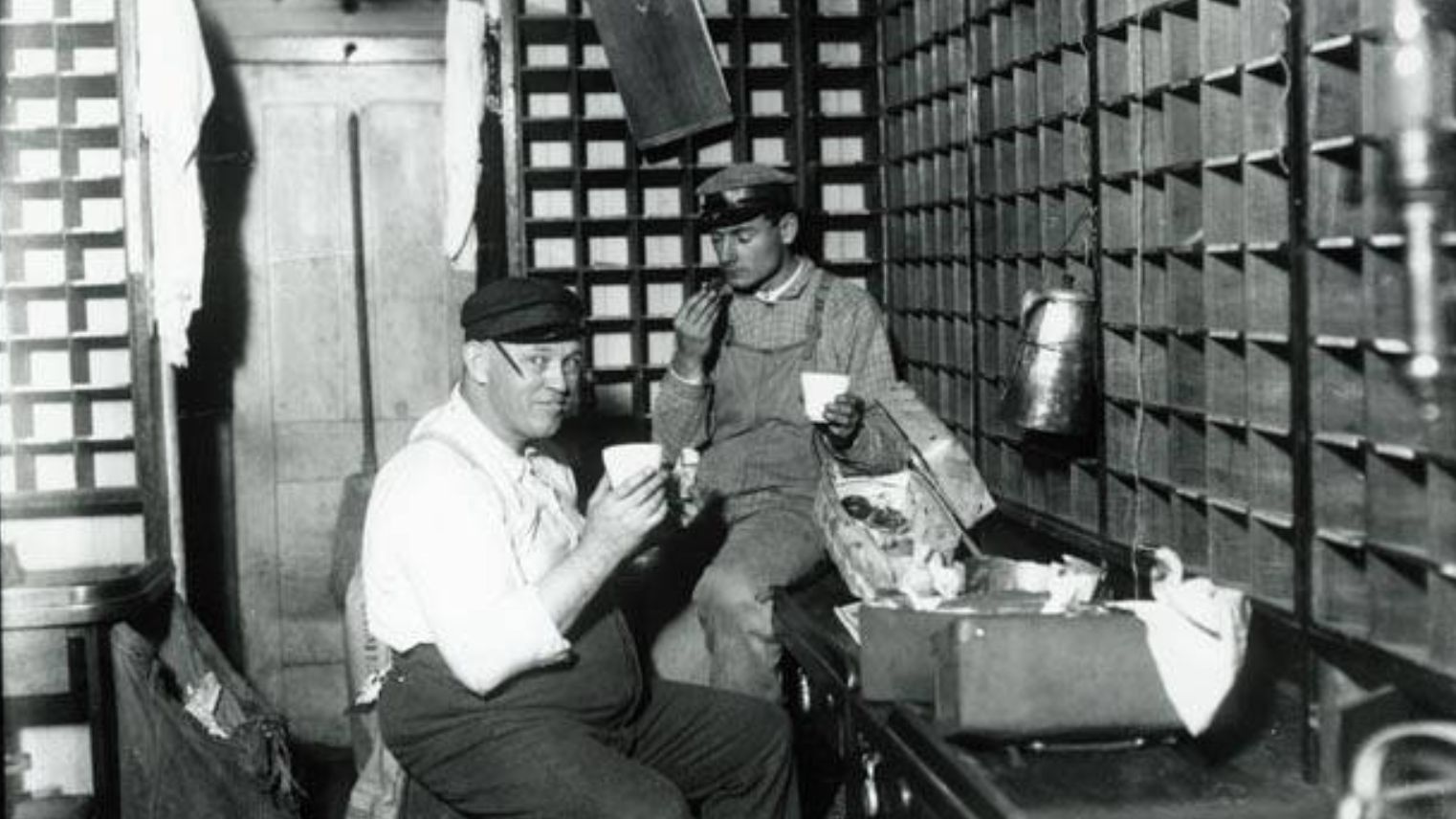
The Post Office is held up by some on the left as an example of Socialism. This Socialist postal workers begs to disagree.
‘Uncle Sam’s Open Shop’ by John Marshall from International Socialist Review. Vol. 16 No. 9. March, 1916.
SOON after Hitchcock was appointed Postmaster General by President Taft, he inaugurated, as the Post Office employees termed it, “The Hitchcock economy policy.” He went into office determined to eliminate the deficit which amounted to millions of dollars yearly. At the expiration of his term the surplus amounted to several hundred thousand dollars. Mr. Burleson, the present Postmaster General, has followed very closely “The Hitchcock economy policy.” At the end of the fiscal year 1914 the surplus amounted to almost four and one-half million dollars.
Classes of Mail Used by Big Business and Workers
To understand who paid the deficit it is necessary to know what percentage of the different classes of mail is sent by big business and what percentage is sent by the working class.
About ninety per cent of the first and second class mail, such as sealed letters, newspapers and magazines, belongs to big business.
Third class mail, such as circulars or advertising, practically all belongs to big business. The workers have nothing to sell, except labor power, consequently they have no need of advertising. About the only time the workers ever use the third class mail privilege is when they send mimeograph copies announcing union or lodge meetings or the proceedings of such meetings.
Fourth class mail, which is known as domestic parcel post mail, including merchandise, books and catalogues, is almost exclusively big business mail. During Christmas is about the only time the workers ever use the parcel post privilege.
Until a few years ago catalogues were rated as third class mail. Under this rating it cost the big mail order houses thirty-two cents to send a catalogue weighing five pounds. Since the parcel post, when the rates on fourth class were lowered, the post office department has very kindly transferred catalogues from third class to fourth class mail. Now it only costs seven cents to send a catalogue weighing five pounds anywhere in the first zone. By this change the big mail order houses are saving millions of dollars.
About ninety per cent of the registered letters and money orders are sent by the working class. When big business sends money they write a check on the bank. The working class, having no bank account, puts the money into a letter or buys a money order. The only time that big business ever registers any mail is when it sends valuable papers.
Increasing the registered mail from eight to ten cents and raising the rates on money orders was one of the first orders issued by Mr. Hitchcock after being appointed Postmaster General. Then he sent out an order to all superintendents in the Railway Mail Service “to take up the slack.” The superintendents began squeezing the clerks until conditions became unbearable.
The Railway Mail Clerks’ Association, which is controlled by the Post Office Department, would not do anything for them. The clerks began organizing a union barring all officials of the department. Locals were organized in St. Paul, Minn., Chicago, Ill., Syracuse, N.Y., and another in Massachusetts.
Hitchcock Breaking Up the New Organization.
To destroy the new organization the Post Office Department issued the following order:
“Sir: You are requested to notify all clerks in your office who are members of secret organizations within the service that the department regards membership in such organizations as inimical to the interest of the government. All clerks when they enter the service take an oath to well and faithfully discharge the duties of the office to which they are appointed and to perform all the duties required of them and to abstain from everything forbidden by the laws in relation to post offices and post roads. It is incompatible with their obligation to the department that they should assume another oath with a secret organization in the service which may at any time interfere with the obligation which they have assumed upon entering the service.
“This is not to be construed as interfering with any right which a clerk may have of acting personally and individually with reference to organizations outside the postal service. Yours very truly,
“C.P. Granfield,
“First Assistant Postmaster General.”
Then Mr. Hitchcock dismissed from the service all the officials of the new organization. After the organization was destroyed some of the dismissed officials were reinstated.
Speeding Up System
After Congress passed a law automatically promoting clerks and carriers of one hundred dollars per year from $800 to $1,100 in first class offices and from $800 to $1,000 in second class offices, the Post termed a merit system. In reality it was Office Department inaugurated what it only a demerit system. There are demerits for failing to ring the time recording clock, for being late, for being absent without permission, for making an error in assorting mail, for talking disrespectfully to your superiors, etc., etc. A certain number of these demerits is sufficient to cause a reduction of salary or even dismissal from the service. The only way to receive merits is by speed tests. If an employee handles more pieces of mail per minute than the standard set by the department, he receives merits. If he handles less than the standard he receives demerits. All the employees are compelled to work at the highest speed to hold their salary and job.
Blacklist
When a clerk comes into the postal service he is given one of the state schemes. He must memorize every office in the state given to him. The number of post offices vary in the different states from two thousand to five thousand. He must be able to pass an examination in speed and accuracy, in which county every post office is located. Then he must pass another examination, in speed and accuracy, known as the “stand point.” That is, he must know which road and train running through the state will take a piece of mail to its destination in the least time. Some post offices have as many as twelve to fifteen dispatches in twenty-four hours. It requires from two to three years of hard and continual study to become a proficient mail distributer. This study must be done on the clerk’s own time. Whenever an employee is dismissed from the service for talking disrespectfully to his superiors or any other cause, he is blacklisted in every post office in the United States. He becomes an outcast. He might as well be thrown in the midst of a desert. All the years of hard study amounts to nothing.
Reduction in Salary and Dismissal of Old Employees.
During the summer of 1914, eighteen employees were dismissed from the service and thirty were reduced in salary, in the post office at Washington, D.C. The age of the dismissed employees ranged from forty-six to eighty-one. Some of them had served the government for fifty-one years. A little later in the year the same thing occurred in the Chicago post office. Not being able to stand the high speed tests set by the department, they were given a reduction in salary or thrown on the scrap heap to shift for themselves.
Until about one year ago the collectors, the men who collect mail from the street corner mail boxes, were old men in the service. They had worn themselves out carrying the sack up and down the street. Rather than join the unemployed army they took the collection cart. The Post Office Department issued an order that all collectors must report for carrier duty. Those who were unable to carry the districts allotted to them by the department were given a two hundred dollar reduction in salary and sent back on the cart. And yet the Post Office Department opposes every measure introduced in Congress to pension the superannuated employees.
Arresting and Jailing Clerks and Carriers for Quitting the Job.
Only a few months ago twenty-eight clerks and carriers of Fairmont, W. Va., tendered their resignation in a body under the pressure of treatment by the postmaster. The Postmaster General, Mr. Burleson, had them immediately arrested and thrown into jail on the charge of conspiracy to delay the mail. These clerks and carriers belonged to organizations that were controlled by the Post Office Department. The organizations would not do anything for them and, rather than submit to the tyranny of the postmaster, they quit the job.
Increasing the rates on working class mail, squeezing, speeding and tyrannizing ever the employees is the method by which the deficit has been paid in the United States Post Office Department, government owned and controlled.
The International Socialist Review (ISR) was published monthly in Chicago from 1900 until 1918 by Charles H. Kerr and critically loyal to the Socialist Party of America. It is one of the essential publications in U.S. left history. During the editorship of A.M. Simons it was largely theoretical and moderate. In 1908, Charles H. Kerr took over as editor with strong influence from Mary E Marcy. The magazine became the foremost proponent of the SP’s left wing growing to tens of thousands of subscribers. It remained revolutionary in outlook and anti-militarist during World War One. It liberally used photographs and images, with news, theory, arts and organizing in its pages. It articles, reports and essays are an invaluable record of the U.S. class struggle and the development of Marxism in the decades before the Soviet experience. It was closed down in government repression in 1918.
PDF of full issue: https://www.marxists.org/history/usa/pubs/isr/v16n09-mar-1916-ISR-riaz-Holt-ocr.pdf

