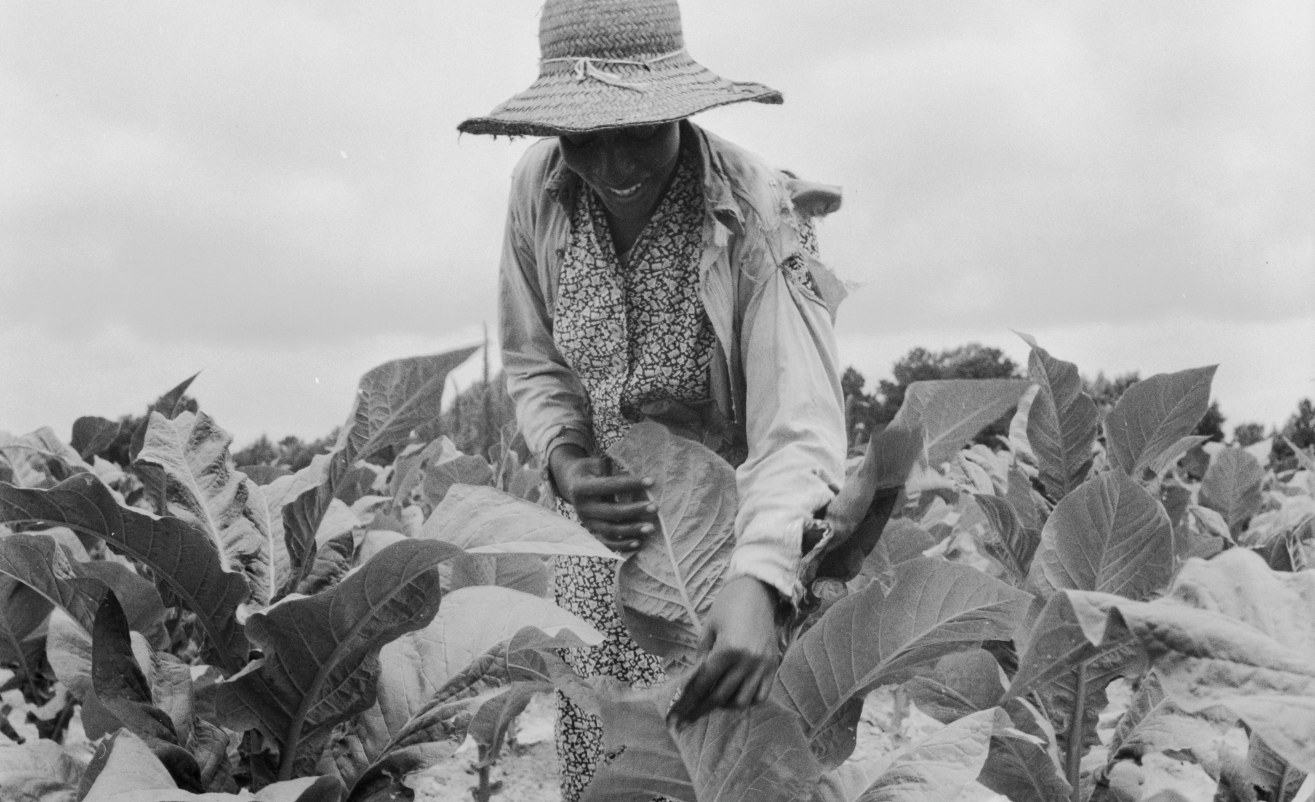
A brief look at the lot of that historically most exploited section of our class in the United States, Black women at work in the fields.
‘American Negro Women in Agriculture’ by A.S. from International Press Correspondence. Vol. 9 No. 11. March 1, 1929.
When we consider women in agriculture in the United States we must divide our attention among various groups. There is the woman that works and lives on the grain or vegetable farm, the woman that works in the fruit orchards and the women in the various plantations, cotton, rice, sugar, tobacco, etc.
In the first group, the woman on the grain farm, not a very large percentage of Negro women can be found. This is. due to the fact that usually women working on a grain farm are either wives or daughters of the farm owner and the percentage of Negro farm owners is comparatively small. However, this does not lessen the fact that the life of the farm woman on the grain farm, and of the Negro woman particularly, is an exceedingly difficult one, when one takes into consideration the high degree of development of America. Added to the burden of the heavy tasks every farm woman is confronted with, such as more or less dilapidated farmhouses minus electricity, minus a heating plant, minus any of the improvements which may lessen her labour of feeding the farm hands, keeping the house and barn in good condition, feeding the animals, milking the cow and lending her back to any other work that she may find time for, working from sun up to sun down the year round, eighteen to twenty hours daily, the Negro farm women, along with her husband, has to cope with race discrimination. This makes her position the more difficult, the banks do not give them the same assistance they will give a white farmer, the rates of interest are not as elastic as they might be in the case of a white farmer, mortgages are foreclosed more promptly and the Negro farmer, already the poorest of the poor farmers and the poorest of the owning farmers, is more rapidly than the white farmer disappearing from the field. The extreme poverty with which the Negro farmer and his family must put up with, the miserable conditions under which they must live, makes the life of the Negro farm woman many times more difficult than that of the white farmer woman.
Industrialisation of the farm is eliminating the small farmer and making it harder each year to eke a living out of the soil. As the industrialisation of the farm grows, more and more of the farmers, Negro and white, men and women, will become labourers on the industrialised farms where, under capitalism, instead of bettering the conditions of the workers as the Soviet farm does, the conditions become worse. Wages are low, the working day is long, and the speed up system applied to farming is as deadly as when applied to industry.
The Negro women employed in the fruit orchard and its sister industry, fruit canning are many. The conditions here are the same as on the cotton, sugar and tobacco plantations of the south. On the plantations their life is the life of a slave. Their living quarters are shacks built especially for the Negro help. These shacks are often of a poorer construction than the barns and chicken coops of the farm. Merely four walls, a mud floor and a leaking roof. The extremely low wages force their standard of living down to worse than a mere existence. This forces parents to use the labour of their children to help make a living at all. A Negro mother going to the field takes with her her children as young as five and six years old to help her pick cotton, work in the sugar fields, or pick fruit. She is paid by the basket and the help of immature fingers and a child’s back, insignificant as it may seem adds a few much needed pennies to the small income.
Infant mortality is extremely high, as the pregnant woman has no social protection whatsoever. She often gives birth while working in the fields, working to the last moment in a frantic endeavour to hoard together enough to offset the two or three days she will have to remain in bed and away from work and may be even lose her job for being away.
A large percentage of the children do not attend school regularly. In Alabama 10% of the white and 30% of the Negro children of school age do not attend school at all.
On the field the worker is treated like the slave of old. Slowness, tardiness, disobedience is punished by severe reprimands, often physical violence on the part of the managers.
And this in advanced America that boasts of its lack of illiteracy, its tall cities and giant industrial plants, of its “equality of man”, its human treatment of workers and dogs! Of all the proofs of the hypocrisy of Imperialist America in setting out the above advertising slogans about the country, the example of the Negro plantation worker speaks loudest.
International Press Correspondence, widely known as”Inprecorr” was published by the Executive Committee of the Communist International (ECCI) regularly in German and English, occasionally in many other languages, beginning in 1921 and lasting in English until 1938. Inprecorr’s role was to supply translated articles to the English-speaking press of the International from the Comintern’s different sections, as well as news and statements from the ECCI. Many ‘Daily Worker’ and ‘Communist’ articles originated in Inprecorr, and it also published articles by American comrades for use in other countries. It was published at least weekly, and often thrice weekly.
PDF of full issue: https://www.marxists.org/history/international/comintern/inprecor/1929/v09n11-mar-01-1929-inprecor.pdf

