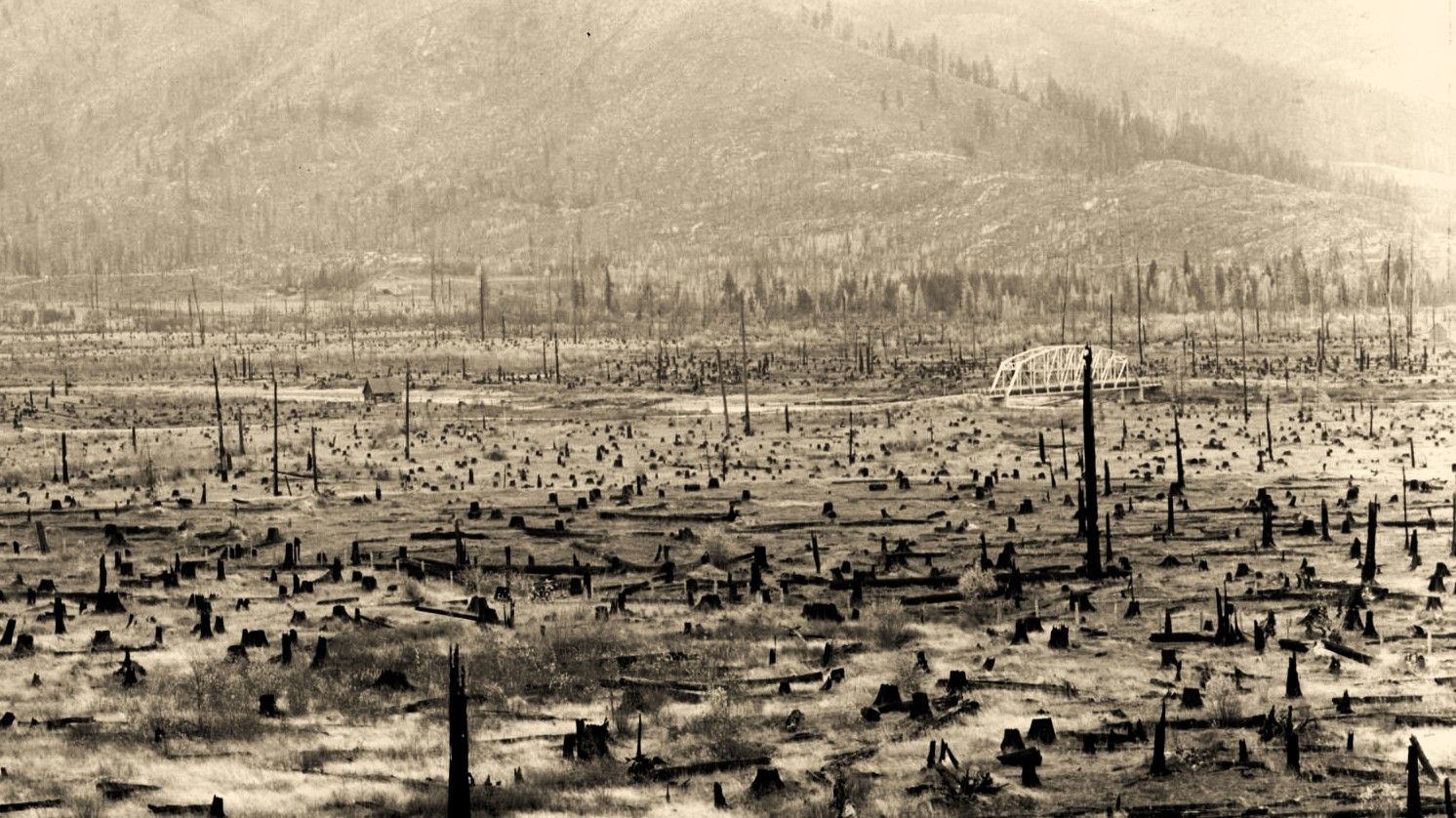
The lumber industry externalizes nearly every cost, raking in enormous profits and leaving an infertile wasteland in its wake.
‘Stumping the Stump Ranches’ by C.E. Payne from Industrial Pioneer. Vol. 1 No. 6. November 1921.
THE stump industry in the heavily timbered sections of the northwest is a very lucrative one, but the stump ranchers who make it successful have never yet been organized. Whether the Industrial Workers of the World can take it up with any degree of success will depend largely on future developments.
The stump industry flourishes when properly conducted. The first requisite is natural preparation of the soil for several thousand years, then a heavy growth of marketable timber on that soil. These, of course, must be attended to before ownership is attempted. For owners to prepare the soil, then plant the timber and protect it until marketable, would make serious inroads on the profits of the industry—a crime not to be contemplated.
The second step is to obtain ownership of the land and timber in large bodies. The methods of doing this are not subjects for public discussion. Scores of men have been, and are now in penitentiaries in many states for even making reference to some of the methods. An even larger number have been incarcerated (that means penned up, or jailed) for suggesting that corrections should be made after ownership had been obtained.
In many parts of the Northwest ownership of the land is not attempted, as that would also have made inroads on the profits. Where large bodies of timber are located, forest reserves have been established. In those places the land itself is not owned, in the sense that ownership is commonly understood. The timber, however, goes to owners by various devious methods.
But it should not be thought for a moment that ownership of the timber is the object of the stump industry. That is merely preparatory for the great philanthropic purpose of the owners. The ownership is only for the purpose of removing the timber and getting it out of the way of the stumps. Nature has not been sufficiently considerate of the wishes of owners in this respect. There was never yet a stump that had not had a tree growing atop of it. The purpose of ownership is to remove the tree so the stump will be accessible.
Of course there is, even in the charitable act of owning, some small returns for such arduous toil. Ten years ago the cost of cutting the trees and taking them to a mill was less than six dollars per thousand board feet. The cost of running the logs through the sawmill, the yard, the dry shed and the planer was less than another six dollars per thousand. As the lumber was selling for only a paltry twenty dollars on an average, F.O.B. the mill, it can easily be seen that ownership of the timber was not the ultimate purpose of the owners. Not so!
Promotion of the stump industry was the purpose. But no one should run away with the idea that the profits on the capital stock was two-thirds. That rate of profit was kept down to five per cent or less. Profits on expenditures is never talked of except in the most select circles.
Having removed the trees from the stumps, the next thing is to promote the basic industry—the stump industry. There are numerous promoters and each promoter has his own particular method, but all lead to the one end: Get some stump ranchers. The qualifications for stump ranchers are very high. They are much higher than for being a Mason, a Baptist or a United States Senator. There are innumerable neophytes—but few ever attain the superlative degree of entering the simon pure and unalloyed, stump owning class.
The first requirement for a stump rancher is great strength, excellent health and a firm belief in the divinity of ownership. He should have a little money—not much—to trade in on an agreement for some stumps. The less money he has the more firmly will he be convinced that the owners will provide him with a job in mill or woods till he has made ultimate payment for the stumps.
The second requirement is that the stump rancher shall have a wife who is tougher than a brindle steer. She must be able to live alone all week and comfort her worn-out husband on Saturday night when he comes home for a twenty hour stay. She must be able to do her house work, clear some land, raise a garden each year and a baby each two years, yet never be sick or require more than $17 worth of clothes in any one year. Keeping a flock of chickens and a cow are merely side lines to keep her from flirting with other lumber jacks than her husband. Of course she does not pull the stumps. She does the clearing and gardening between them. The stump rancher himself will pull the stumps—”sometime, when I get around to it.” The owners are furnishing him with work and he must tend to his job.
The price the stump rancher agrees to pay for the stumps he lets his wife live among, varies greatly, according to the number of stumps per acre and the location. Like food, cotton and other things which have been destroyed by wholesale to keep the price up, so with stump land. The fewer stumps per acre the higher the price the stump rancher agrees to pay.
The owners of the stump industry (often mis-called lumber companies) frequently let the stump ranchers remain at home for several weeks during a year. Some stump ranchers devote the time to pulling stumps and have been known to have vast tracts of five or six acres cleared of them at the end of ten years. This, however, is done only in exceptional cases. When the stump rancher comes home he is generally so tired that he can do nothing but hunt, fish, rest and tell his wife how to run a farm. But in ninety per cent of the cases both courses lead to the same result—a different stump ranch in less than ten years.
It is necessary that the stump ranchers eliminate some stumps. Firewood cannot be obtained otherwise than from timber, and this necessitates some clearing. Also, the stumps will rot in time—tamarack and cedar in about one hundred years’ time—if the brush is kept cut down between them. Add to this the fact that most stump ranchers or their wives have some ambition when they start in and are buoyed up by hope (Hope, not Dope) and you arrive at the fact that some clearing and plowing will be done between the stumps.
If some stumps are pulled before a rancher leaves a place, he may be sure he has been of some value in the world. The place will then be bargained to the next stump rancher for a higher price than to the one who first tackled it, making the possibility of final payment on the stumps just that much more remote. The bargaining and first payments are thus made endless, with ownership still in the hands of the masters of the Stump Industry.
Some eight or ten years ago the announcement was made by the Forest Reserve officials of the government that as fast as the timber matured from the Kaniksu Forest in Northern Idaho and Northeast Washington the land would be offered for homesteading. But someone with more authority than any government official at once put a quietus to that notion. It would never do to have it suggested that the homesteader should have the timber to get a start in the stump ranching industry so that he could have some assurance of winning title to the land.
It should be noted in passing that the stump ranching industry is not the same as the stump industry. The stump industry presupposes ownership. The stump ranching industry means hard work, with ownership at the foot of a rainbow.
When soldiers were started on the return journey from France early in 1919 there were some suggestions that the soldiers of Washington and Idaho should be given each a cut-over tract of land in the Kaniksu Forest. But even the soldiers who fought to make the world safe for democracy knew an impossible proposition when they saw it and the proposition died a-bornin’.
There have been a few stump ranchers lined up while they worked in the woods and mills. But men who work in the woods and mills are not much inclined to line up while chained to a bunch of stumps. Like horses in a blizzard, they are too badly bewildered by conditions to seek a way out. They drift with the storm and unless they can be turned from their course they will go over a cliff to destruction. The blizzard of conditions is growing worse; can the stump ranchers be turned toward safety?
The Industrial Pioneer was published monthly in Chicago by the Industrial Workers of the World from 1921 to 1926. The precursor of the Industrial Pioneer was the One Big Union Monthly. Heavily illustrated, the journal included arts, prose, and poetry along with historical articles and analysis. Editors included John A. Gahan, Vern Smith, H. Van Dorn, and Justus Ebert.
PDF of full issue: https://www.marxists.org/history/usa/pubs/industrial-pioneer/Industrial%20Pioneer%20(July%201921)_0.pdf

