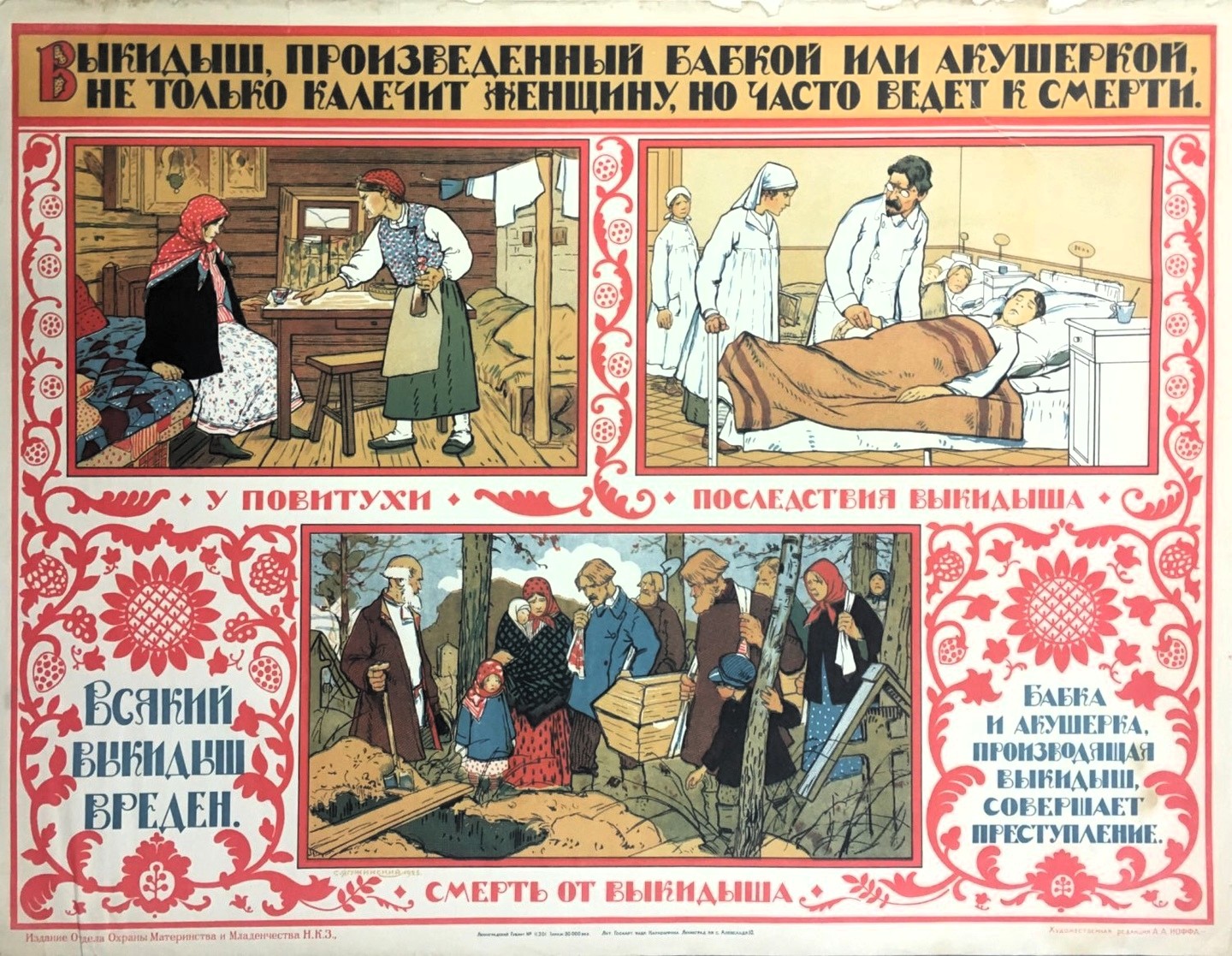
Into the heart of Haines’ investigation with chapters on VII. The Organization of the Commissariat of Health, VIII. The Department for the Protection of Motherhood and Infancy, and IX. The Department for the Protection of Children’s Health.
‘Chapters VII, VIII & IX’ by Anna J. Haines from Health Work in Soviet Russia; Vanguard Studies of Soviet Russia. Vanguard Press, New York, 1928.
VII. THE ORGANIZATION OF THE COMMISSARIAT OF HEALTH
We can better understand the internal organization of the Commissariat of Health if we first orient it in the general scheme of Soviet Government. The following extract from the Guide to the Soviet Union, published in English by the U.S.S.R. Society for Cultural Relations with Foreign Countries will make this plan clear:
“The fundamental nucleus of the Soviet power is the Soviets [Soviet is the Russian word for council] of the productive unit; i.e., the village in the country, and the factory or office in the city. The soviets are elected annually by all the working people…The Soviet Congresses of the various provinces and of the Autonomous Republics elect delegates to the Union Congress…The Union Congress of Soviets [The Union Congress of Soviets corresponds to our Congress ] is the supreme organ of authority, having both legislative and administrative functions…The actual work of legislation, on the basis of the principles laid down by the Union Congress, is carried out by the Central Executive Committee of the Union Congress…[which] is vested with the authority of the State during the intervals between the [annual] meetings of the Union Congress. Similarly the local authority is vested in the local Executive Committees that are elected by the local Congresses and are responsible to them…The work of the Council of People’s Commissars [The Council of People’s Commissar corresponds to our Cabinet] of the U.S.S.R. is carried on within the limits prescribed by the Central Executive Committee which elects it. Unlike the ministerial cabinets of parliamentary countries the Council of People’s Commissars, within the sphere of its activities, possesses not only administrative but also legislative authority. The Council of People’s Commissars is composed of the Chairman and his deputy and ten People’s Commissars responsible to the Central Executive Committee for the different branches of the affairs of the State.”
In other words, one may say that in Russia the Cabinet officers are chosen by the permanently sitting executive committee of the Congress and that the Cabinet has legislative as well as executive authority, although ultimately it is responsible to the Congress for all its activities. The Commissar of Health corresponds to one of the Secretaries in our Cabinet and the Commissariat of Health to one of the departments of our Federal Government.
It was actually founded by a decree of the Council of People’s Commissars in July, 1918, but its present status dates from a statute promulgated by the same body in 1921. Its aim is put forward in Article I of this statute as follows: “The People’s Commissariat of Health is responsible for all matters involving the people’s health, and for the establishment of all regulations promoting it, with the aim of improving the health standards of the nation and of abolishing all conditions prejudicial to health.” Here one sees the intention, more fully emphasized by Dr. Semashko’s words quoted in the previous chapter, to make positive health and not just the curing of disease, the foundation of the government policy. Prophylaxis is not to be a fad of a moment, but a part of the law of the country.
Article II of the statute gives the duties of the Commissariat of Health, indicating the practical paths leading to the goal:
(a). The protection of motherhood and infancy; the protection of the physical development of growing youth.
(b). The drawing up of sanitary regulations for cities and villages and the organization of sanitary inspection.
(c). Campaigns against social and infectious disease.
(d). The maintenance of hospitals and other curative institutions.
(e). The protection of the health of the Red Army and Navy.
(f). The provision of expert legal and medical advice as well as treatment for wounded ex-soldiers and those incapacitated for labor.
(g). The preparation and publication of statistical data relating to national health conditions.
(h). The establishment and maintenance of research institutes dealing with all scientific and practical questions in the sphere of health.
(i). The organization of medical instruction in cooperation with the Commissariat of Education.
(j). The drawing up of regulations for education in hygiene.
(k). The supervision of all curative institutions as well as those dealing with public sanitation; the responsibility for the equipment, instruments and other property of these institutions.
(l). The widespread publication, to institutions and to private citizens, of new and valuable discoveries in the sphere of health conservation.
(m). The responsibility for the carrying out of all laws and ordinances pertaining to health.
(n). The responsibility for the activity of all medical departments.
These functions are given in such detail in the statute itself that very little supplementary comment is needed to explain them. It can be seen that much of what we call social service is here definitely included in the health program.
The Commissariat is situated in a large office building in the center of Moscow; the three advisory committees and the nine departments into which the administrative work is divided have their main offices in the same building, effecting thereby an economy of time, space and personnel. The diagram on the following pages shows the internal organization of the Commissariat and the relationship of its various departments.
At the head is the People’s Commissar for Health, chosen by the Central Executive Committee, and sitting as a member of the Soviet of Commissars. This position has been held by Dr. Semashko ever since the creation of the Commissariat in 1918. As his immediate assistants, advising him in all important decisions, are the members of the Collegium. This body is made up of the Commissar, the Assistant Commissar (who is also the President of the Russian Red Cross and the Chief of the Health Department of the Army and Navy), the President of the Medical Workers’ Union, the head of the Finance Bureau of the Commissariat, and a representative of the peasants. At all meetings of the Collegium, moreover, there are present various other people whose interests are involved in the discussions of that day, or whose advice is sought on some proposed legislation. These people may be department heads, executives of institutions, scientific specialists, or even representatives of other commissariats or non-medical trade unions. A subsidiary organ of the Collegium is the Planning Commission, which has the duty of working out in practical detail the suggestions of the Collegium, of fitting them into the active work of the department and of submitting them to the Collegium for its final approval before they become actual administrative orders.
Parallel with the Collegium, but without its administrative responsibility, is the Scientific Medical Council, a group of about thirty specialists in various branches of medical science, who must give their expert advice regarding the scientific foundation for all the health regulations drafted by the Commissariat. Almost all of the members of this Council are directors of the various State Scientific Institutes and have back of their decisions the results of research in the best laboratories of the country. They may invite to the Council meetings any person whose services they may consider necessary for the better understanding of the matter in hand. Beside its advisory function the Council is authorized to call congresses of medical workers, to institute debates and discussions, and to appoint commissions to study any phase of health. It is a self-perpetuating body, but new members must be approved by the Commissar.
The State Scientific Institutes whose research supplies the basis for the activities and decisions of the Scientific Medical Council are a very interesting and important part of the work of the central Commissariat of Health.
In America we are accustomed to think of government funds being expended only for proved types of work, leaving to private resources or foundations the encouragement of all experimental research. Quite the reverse is true in Russia, where the resources of the state are applied to the investigation and discovery of new scientific material and methods. These Institutes include in their function not only research, but also the training of specialists in various branches of medicine such as tuberculosis and X-ray work, and the maintenance of model institutions whose equipment and administration can be copied in the provinces as soon as local funds will permit. The titles of the State Scientific Institutes located in Moscow show the wide range of medicine covered by their activities:
1. The Microbiological Institute. 2. The Institute of Hygiene and Sanitation. 3. The Institute of Experimental Biology. 4. The Institute of Tropical Diseases. 5. The Institute for the Control of Sera and Vaccines. 6. The Institute for the Study of the Physiology of Nutrition. 7. The Biochemical Institute. 8. The Tuberculosis Institute. 9. The Institute of Physical Therapy and Orthopzdics. 10. The Institute of Therapeutic Apparatus. 11. The Institute of Biologic Physics. 12. The Venereal Institute. 13. The Dental Institute. 14. The Institute of Social Hygiene. 15. The Institute of Physical Culture. 16. The Institute for the Protection of Motherhood and Infancy. 17. The Institute for the Protection of Children’s Health. 18. The Balneological Institute.
Besides these there are several other Institutes, mostly for bacteriological research, maintained by state funds in other cities. The work of some of these institutes will be described in more detail in connection with the administrative departments whose practical work they supplement.
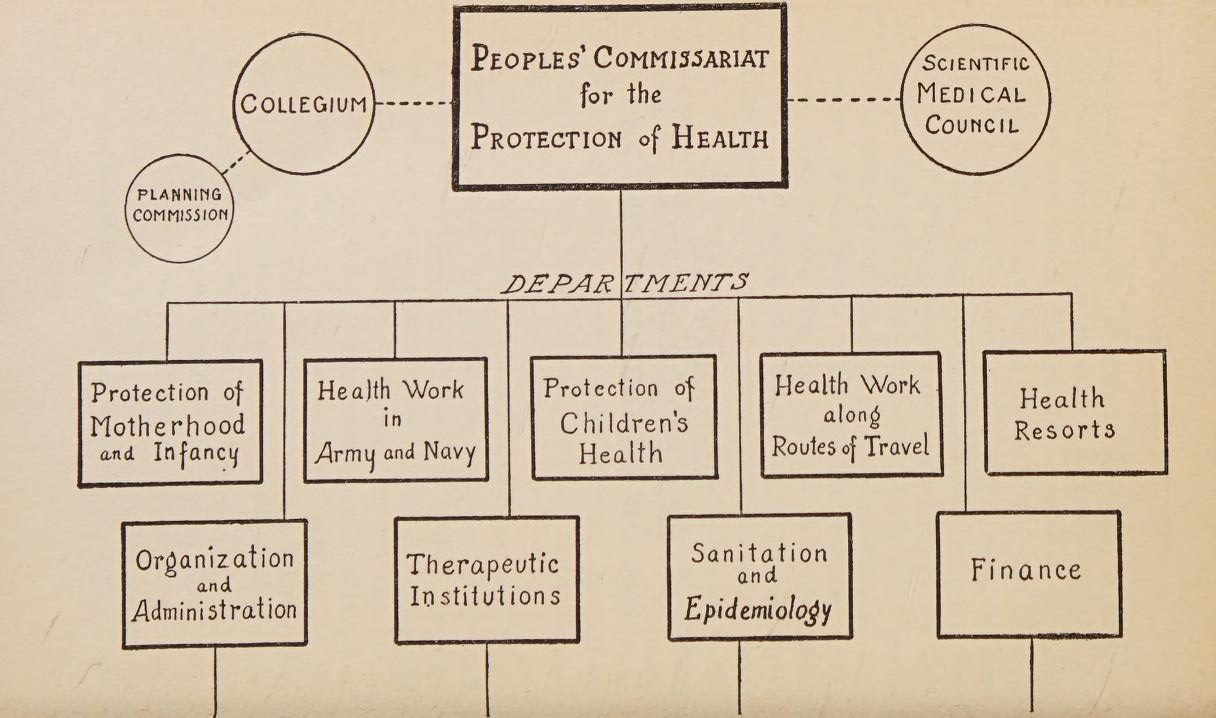
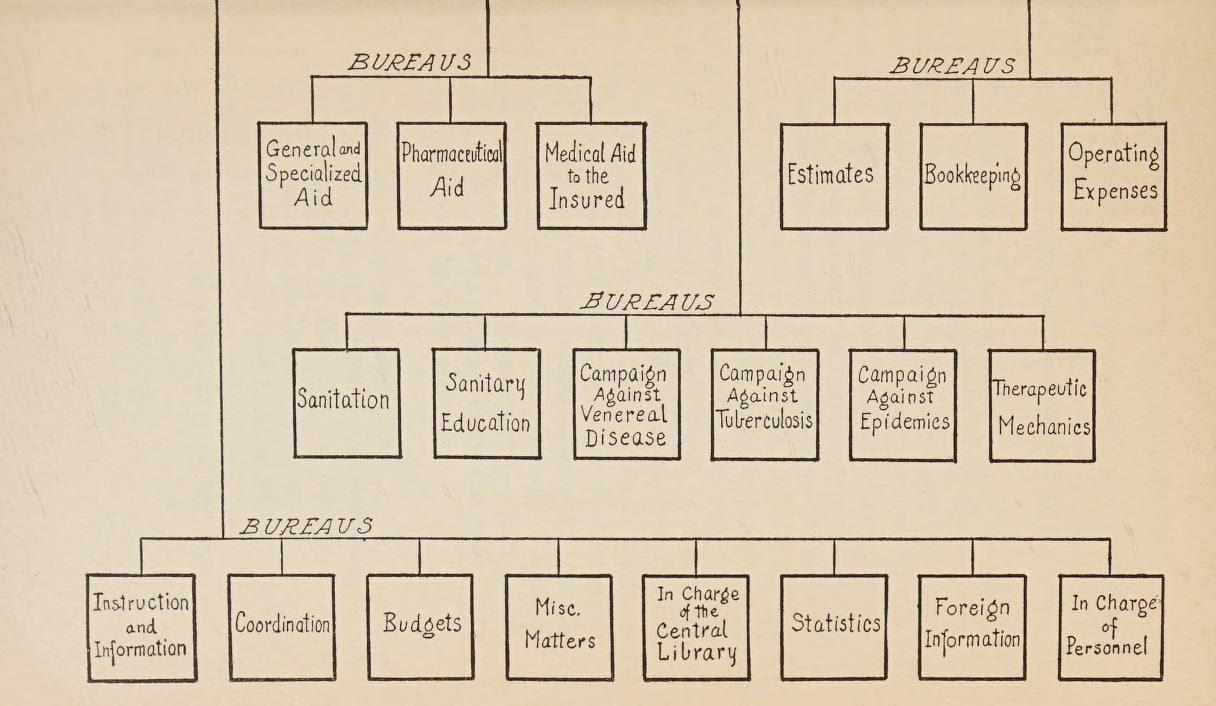
As the diagram following page 46 shows, the Commissariat of Health is divided into nine administrative departments, as follows:
A. The Department of Organization and Administration, which has the most complicated duties. Its sub-divisions are:
a. The Bureau of Instruction and Information. b. The Bureau of Coordination. c. The Bureau of Budgets. d. The Bureau of Miscellaneous Matters. e. The Bureau in Charge of the Central Library. f. The Bureau of Statistics. g. The Bureau of Foreign Information. h. The Bureau in Charge of Personnel.
Every foreigner interested in learning at first hand something of the health work in Russia soon becomes acquainted with one of these Bureaus, that of Foreign Information. Its courteous director, Dr. Schaeftel, takes great pains to help all visitors to understand the organization of Soviet state medicine and to see as many of the Russian health institutions as they wish. But his first duties are really in the reverse direction, for his bureau is the link between the Commissariat of Health and the medical work of the Western world. All the foreign medical journals of importance pass through this bureau; connections are made with representatives of Russian health work in England, America, Germany, Italy, France and other countries; foreign specialists and delegations are invited and welcomed to Russian medical congresses; a Russian-German Medical Journal is published in cooperation with a group of German scientists; and membership is maintained in the Section of Hygiene of the League of Nations and in other international organizations.
B. The Department of Therapeutic Institutions is the most important of all the departments from the point of view of the financial outlay involved. It supervises all regular hospitals and out-patient departments in the cities and rural communities and constitutes the solid background of the practical medical work of the country. Seventy-seven percent of the local health department budgets, as distinct from the budget of the central Commissariat, is devoted to this branch of health work, evidence of how much better it is understood throughout the country than the newer branches of prophylaxis and sanitation which must depend for their promotion largely on the central budget. A considerable proportion of the funds for the maintenance of hospitals, sanitoria and out-patient departments is received from the Health Insurance Department of the Commissariat of Labor. All industrial workers and office workers in state, cooperative or private business are automatically insured at the time of accepting employment. The large surplus of money from this source is used for opening and maintaining institutions which give special medical attention to insured persons and their: families. The work of the Department of Therapeutic Institutions is divided into:
a. The Bureau of General and Specialized Medical Aid. b. The Bureau of Pharmaceutical Aid. c. The Bureau of Medical Aid to the Insured.
C. The Department of Sanitation and Epidemiology is closely allied to the Department of Therapeutic Institutions, but places the emphasis of its work on preventive measures. It is subdivided as follows:
a. The Bureau for the Campaign Against Epidemics. b. The Bureau for the Campaign Against Tuberculosis. c. The Bureau for the Campaign Against Venereal Disease. d. The Bureau of Sanitation. e. The Bureau of Sanitary and Hygienic Education. f. The Bureau of Therapeutic Mechanics.
The activities of the first three of these bureaus will be described in detail in other chapters as they offer good examples of the application of the new attitude and principles of Soviet Medicine.
D. The Department for the Protection of Motherhood and Infancy occupies a middle place between the departments devoted to prophylaxis and to healing, as it has under its direction institutions of both types. Its maternity hospitals are places of actual care for ill people, while its infant welfare stations are intended only for well babies. Much of the work of the department is along the lines of health propaganda and will also be described in greater detail later.
E. The Department for the Protection of Children’s Health supplements the work of the preceding department by protecting the health of children from the ages of three to eighteen years.
F. The Department of Health Work in the Army and Navy has entire charge of health and sanitation among the soldiers and in the army camps and in the navy; it has its own regional administrative centers, independent of any local health department, and its own separate budget. The Assistant Commissar of Health is the Chief of this Department.
G. The Department of Health Work along Routes of Travel is also responsible directly to the central Commissariat, without control by local departments. It also has its own regional administrative centers, which supervise the sanitation of all railroad lines and docks, and the hospitals and clinics maintained throughout the country for railway and merchant fleet employees and their families. In the provinces the representatives of this department become members of the local boards of health so that the friction and overlapping of their work and of that of the regular local civilian medical institutions may be minimized.
H. The Department of Health Resorts was created to meet the necessity of organizing and correlating the service of sanitoria and vacation homes throughout the widespread area of their distribution.
I. Finally there is the important Department of Finances, with its three divisions:
a. The Bureau of Estimates. b. The Bureau of Bookkeeping. c. The Bureau of Operating Expenses.
As we have seen, the original plan for the Commissariat of Health placed its maintenance entirely on the central government, but since May, 1922, when the New Economic Policy became effective, most of the local institutions have been supported by local taxes and by the insurance funds. The central Commissariat is still responsible for:
a. The upkeep of the “flying squadrons” ready to combat sudden outbreaks of epidemics anywhere in the country.
b. The support of laboratories making vaccines and sera.
c. The support of several research laboratories.
d. The maintenance of model institutions, showing how best to campaign against the social diseases, to protect children’s health, etc., and of certain model rest and vacation homes for workers and peasants.
e. The maintenance of certain hospitals in outlying regions which care for more than a local population; e.g., a psychiatric hospital in Siberia, several leprasoria.
f. The maintenance of hospitals for crippled ex-soldiers.
g. The maintenance of a staff of medical experts required as witnesses in the law courts.
h. The purchase of medicine from abroad.
The total amount of money spent on health work in 1925 (the last year for which the figures are available) was 180,462,900 roubles, or about ninety million dollars.
The sources of income for health work in the R.S.F.S.R. in 1925 were:
a. The central Commissariat budget 10.5 %
b. The state budgets of Autonomous Republics 1.4%
c. Income from investments .2%
d. Income from vacation homes .6%
e. Local budgets from taxes 48.8%
f. Amount set aside for repairs 1.1%
g. Insurance and other special funds 27.7%
h. Budget of Army and Navy Departments 9.7%
Total 100.0
(From the Report of the People’s Commissariat for the Protection of Health to the 12th All-Russian Congress, p- 87.) It is also interesting to see the way in which this money was spent. According to the same source (page 84), this was as follows:
DISTRIBUTION OF FUNDS FOR HEALTH WORK IN R.S.F.S.R. IN 1925
a. For hospitals and out-patient departments 77.0%
b. For protection of motherhood and infancy 14.0%
c. For sanitary and hygienic education 2.0%
d. For sanitoria 1.0%
e. For campaigns against contagious diseases .6%
f. For psychiatric treatment .4%
g. For unclassified purposes 5.0%
Total 100.0%
The figures given above were compiled from the expenditures of the local health departments, as these are much more representative of the health work in the country as a whole than the figures of the central Commissariat which would be more heavily weighted by administrative and experimental activities.
The work of most of these departments will be described in more interesting detail in later chapters, but a clearer appreciation of the organization and administration is gained from the rather dry information afforded in the working diagrams of the Commissariat, just as the blue prints of a house may give a better idea of the architect’s intention than the complete model of one room.
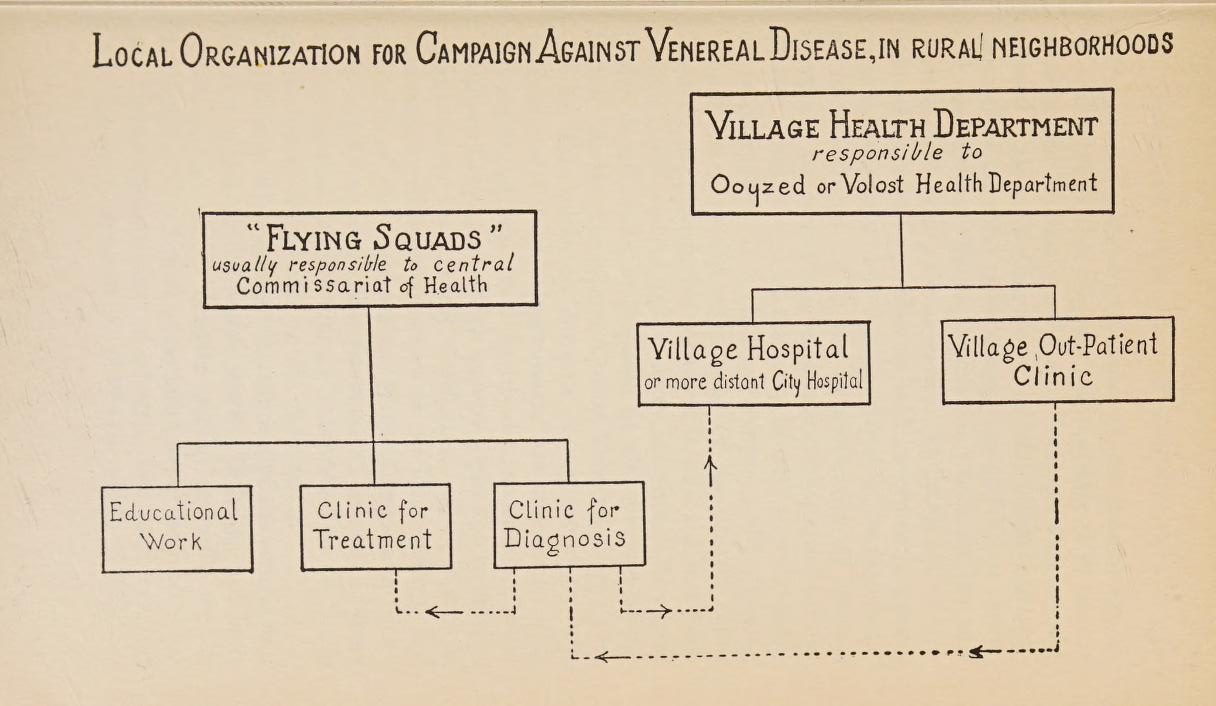
For those who are interested in this administration and organization it may be worth while to describe the plan of one of the Bureaus to the point where it is possible to see exactly how the individual worker or peasant is reached. Following page 56 is shown diagrammatically the administrative units of the Bureau for the Campaign Against Venereal Disease, which is one section of the Department of Sanitation and Epidemiology.
In a given city, for example, the Venereal Dispensary belongs definitely to the local health department, but this department is subdivided into bureaus corresponding to those of the central Commissariat, so that while the dispensary is expected to depend on local funds for its support, it works under the scientific direction of the specialists of the central organization. The same principle applies to the city hospital, maintained by the Department of Therapeutic Institutions of the gubernia or ooyzed health organizations.
The functions of the City Venereal Dispensary (and in large cities there may be several) are:
a. The education of the population in social hygiene. b. The carrying on of a campaign against prostitution. c. The treatment of cases of venereal disease. d. The examination of contact cases.
The first two of these functions are achieved by means of social service methods: lectures, moving-pictures and poster exhibits are used to instruct factory workers, students, women’s organizations, etc. in the problems of social hygiene; prostitution is attacked by police methods and by means of finding other work for the prostitutes who are willing to accept it. The last two functions are of a more medical character. The doctors who are on duty in the dispensary are specialists trained by post-graduate work usually in the State Venereal Institute.
If, therefore, any case of venereal disease presents itself to the out-patient department of the city hospital or to the city clinics, it is immediately directed to the venereal dispensary. This is the explanation of the dotted line with the arrow pointing toward the venereal dispensary. On the other hand the city hospitals are expected to maintain a certain numbers of beds for venereal cases, to which the doctors of the dispensary (which has no facilities for permanent bed-patients) may send those too ill to be ambulatory patients. This latter connection is represented by the dotted line leading toward the city hospitals.
In the villages the general plan of work is the same. The permanent venereal stations here are very small; they have the same relation to the village hospitals that the city dispensaries have to the city hospitals.
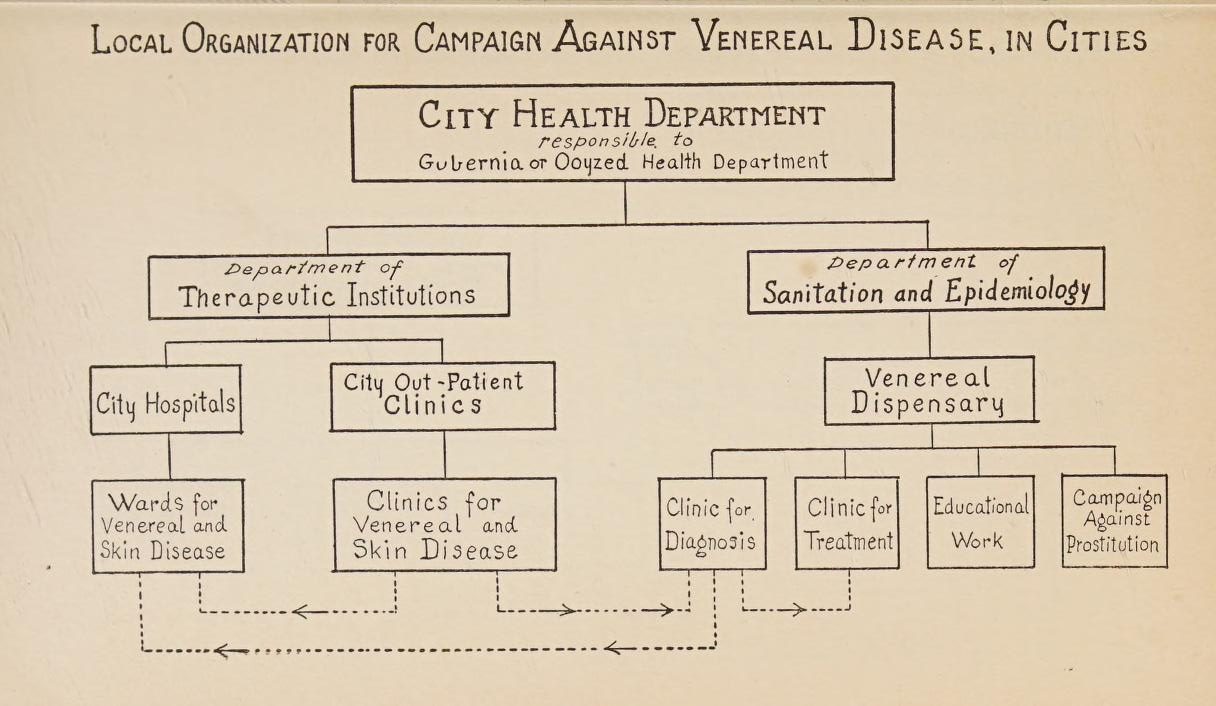
What is more frequently found in the country is a “flying squad;” i.e., temporary clinics with special doctors, laboratory equipment and medicines sent for a limited time into a rural neighborhood to make a survey and to examine the population. Treatment is carried on for a time and an intensive educational campaign adapted to the peasants’ understanding and living conditions. Then the active cases are turned over to the regular local medical facilities for a continuation of the treatment and the “flying squad” moves on to another neighborhood. The permanent stations for such specialized service, as well as the “squads,” are usually supported by non-local funds.
The Bureau for the Campaign Against Tuberculosis has an almost identical outline of work, with corresponding institutions and connections. Other bureaus have equally detailed plans, appropriate to the type of work they are doing.
In addition to showing the plan of one definite branch of health work this diagram also indicates the general organization in the provinces. Corresponding to the Central Executive Committee of the central government there are local gubernia, ooyzed and volost executive committees. These committees, which are the permanent local units of government, are made up of representatives of all branches of local government, among them being one or more representatives of the health department. In so far as the administration of medical matters is concerned the local executive is the final authority, even though its make-up be only slightly medical in character. It is charged, however, with carrying out all the laws and regulations of the central Commissariat of Health, by which it is directed and controlled in its medical and sanitary activities. The local health departments, as is shown by the diagram of the Bureau for the Campaign Against Venereal Disease, are divided into different bureaus corresponding to the scheme of the central Commissariat. In connection with the provincial and rural health departments are local “Sanitary Councils,” which occupy a position somewhat analogous to the central Collegium. These Councils are made up of representatives of the local workers and peasants, of the trade unions, of the Communist Party, etc. and have the double function of general advisers to the medical officials and of interpreters of the work of the health department to the community.
This somewhat detailed description of the central and local organization of health work which has just been given, applies in its definite particulars only to the R.S.F.S.R. The Union of Socialist Soviet Republics has no Union Department of Health, but each republic has its own Commissariat of Health whose general organization and promulgations are very similar to those in Moscow. In the 1923 Constitution of the U.S.S.R., is a clause giving to the legislative body of the Union the right “to draw up common regulations in the sphere of health.” Of more practical importance than formal laws, however, in coordinating the health activities of the different parts of the country, are the frequent congresses on many phases of health work. These congresses are usually held in university towns irrespective of their political or geographic situations and are attended by doctors and other medical workers from all parts of Russia.
VIII. THE DEPARTMENT FOR THE PROTECTION OF MOTHERHOOD AND INFANCY
Without doubt the most energetic department in the Commissariat of Health is that presided over by Dr. Vera Lebedeva and devoted to the protection of motherhood and infancy. It had a challenging field of activity open before it on its organization in 1918—the highest infant death rate in any civilized country. When in pre-war days the mortality of infants under one year of age registered in England 13 per hundred and in Germany 19.2 per hundred, the Russian rate was 27.0 (according to The Protection of Motherhood and Infancy, Moscow, 1926, p. 15, by Dr. B.S. Ginsburg). These figures were already troubling pediatricians and philanthropically minded citizens before the Revolution and certain tentative efforts to improve conditions were being made along the lines of private charity. Occasional infant welfare centers and milk stations were to be found in Odessa, St. Petersburg, Moscow and other cities, but they were of a frankly experimental character and had no unified program.
With the outbreak of the Revolution and during the first terrible years of bloodshed and uncertain victory there was a great need, admitted even by those steeled to ruthless deeds, for some practical expression of the idealism which was hidden in the heart of the movement. Much of this need was met by an emotional tenderness for children and an intellectual appreciation of their role in a socialized world, an attitude embodied in the early slogan “Our Children—the Hope of the Future.” Personal sacrifices were made and state funds freely appropriated to shield children from some of the hardships of those years. During this wave of enthusiasm the Department for the Protection of Motherhood and Infancy gathered a momentum which it has never lost.
The first institutions opened under its control were “consultations” or, as we should say, Infant Welfare Stations, and day nurseries for the children of working mothers, but the perspective soon widened. As one of the provincial directors says: “We went into this work with one idea—to make a campaign against the infant death rate. Now we find that we are involved in the whole social and economic life of women.” The scope of this report excludes all except those aspects of the work affecting health, but they are many and fundamental.
The following figures (taken from the Report of the Third All-Russian Conference for the Protection of Motherhood and Infancy, page 12, published in Moscow in 1926) present an accurate picture of the growth of the department throughout the R.S.F.S.R. from 1917 until 1925:
INSTITUTIONS FOR THE PROTECTION OF MOTHERHOOD AND INFANCY
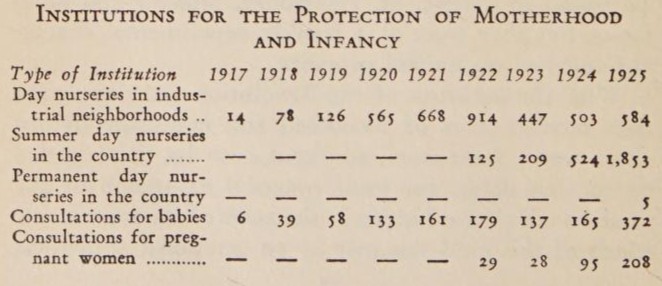
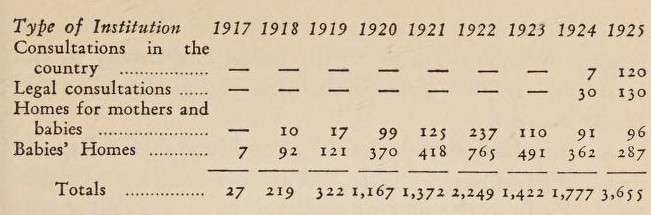
In this table one sees the rapid growth of institutions during the first years when most of the funds came from the central Commissariat, then the sharp decline in 1922 when the New Economic Policy required local institutions to be supported in the main by local funds. After that date there is again a growth, this time more slowly and only along the lines of those institutions which met proven needs. One can also trace here some of the developments in the point of view of the authorities themselves. In the early days much emphasis was put on children’s homes. Parents were encouraged to place their babies in these homes, where nurses were provided to give the expert care which was expected to show better results than the clumsy efforts of the untrained mother. Although schools for older children gave many proofs of the value of collective living, it was found that infants did not respond well to this regime, and so we find that after the famine years (when there was a real need for the extra food supplied in these homes) this type of institution permanently decreased, although recently all other forms of institution have been increasing in number. The department has now definitely adopted the policy of encouraging all mothers to keep their infant children at home, even orphans being placed out with private families under visiting nurse supervision. The recent direction of attention to the country districts is also reflected in the growth, first, of summer day nurseries to care for the babies of peasant women working in the fields, and finally in the establishment of a few all-the-year-round day nurseries in the villages.
A Consultation, whether in a muddy steppe village or in a busy industrial center, always presents a lively picture. Early in the morning women in shawls and sheepskins or in silks and astrakhan coats (for all classes come to these health stations, even ex-princesses), each with a closely wrapped baby, gather at the door of the building. One doctor is supposed to examine only twenty-five babies a day, so that full time and unexhausted interest may be given to each case; therefore the punctuality, as latecomers are turned away unseen. At nine o’clock the nurses arrive and the doors are opened into the waiting rooms. The head-nurse, dressed as are all the personnel in flowing white overall and white kerchief, stands guard at the entrance and past her slowly file the mothers and babies. If any of the latter have colds or a temperature or an upset stomach their mothers are directed into a side-room divided by glass partitions into separate little cubicles each with its chair for the mother and examining table for the baby. Here the doctor comes first, to prescribe for the minor ailments and to direct the mother to a hospital if the child is really very ill. The other babies are taken by their mothers to long wooden shelves which line the general waiting room and which are divided by wooden partitions into separate stalls. Here the babies are undressed and then weighed and their temperatures taken by the nurses. The walls of the waiting room are covered with bright colored posters illustrating the right and wrong methods of child care. One corner of the room usually contains a model bed and toilet table for a baby; the proper and improper kinds of toys are shown somewhere; a shelf displays wax models of suitable and unsuitable food for babies and nursing mothers. Frequently it is the father instead of the mother who brings the baby for examination, as his time free from work may be more convenient than hers for this duty. The clients of these consultations soon become well acquainted with each other and the room buzzes with Russian conversation louder than the occasional howling of the babies. Any mother coming for the first time gives to the nurses a long social history of herself and her baby’s father, and a detailed description of the sanitary conditions of their home. When the doctor arrives at ten o’clock the baby and its parent and the records are taken for an interview with him, which includes a complete physical examination of the baby, lasting from ten to thirty minutes according to the needs of the case. The geographic district served by that consultation is divided into smaller areas and one nurse is assigned for visiting the homes in each area. Each nurse is supposed to help during the doctor’s interview with the mothers of her district so that later in the week when she visits in the homes she is already acquainted with the instructions the mother has received and can report on the care with which they are followed. If artificial feeding is necessary the mother receives a prescription which she takes to the milk kitchen connected with each Consultation. If she can afford it (and her own estimate of this ability is compared with the visiting nurse’s report on the home), she is supposed to pay for this extra food—usually more than half the prescriptions for food are filled without charge. The milk kitchen is presided over by a trained worker, and formulae, more varied and more complicated than those used in America, are prepared and issued daily. If medicines are needed they are also prescribed and usually given freely. If surgical dressings are required the baby returns daily until they are no longer necessary. Vaccination and the Perquet test for tuberculosis are given to all the babies registered. Visiting nurses go to the homes of the babies soon after they have been registered, and as often afterwards as seems necessary, to improve living conditions or to instruct the mother in home care. Far more primitive conditions are found than even New York’s tenements can offer. It is not unusual to find four families occupying one room, with the baby’s existence and needs only grudgingly admitted; it often sleeps on a corner of the stove or in a curtained basket swung from the ceiling. In the villages a “sugar teat,” made of bread and sugar chewed in someone’s mouth and tied in the corner of an old rag is used instead of the more sophisticated rubber pacifier of the cities. The people of the Caucasus not only wrap their babies in swaddling clothes, but bind them tightly down to their little cradles so that no amount of hearty rocking by slightly older brothers can displace them. No peasant of whatever nationality will readily believe that a bath is good for a baby. Against these and a thousand other superstitions the doctors and visiting nurses wage continual campaigns, and not unsuccessfully. One nurse, herself a Mongolian, who had been trained at the school conducted by the department in Moscow, went back to work among her people. Her own baby had been born while she was in training and she took it home, a rosy roly-poly of four months. “She’s my only salvation,” laughed her weary mother. “No one believes what I say until I use her as an exhibit and even then they follow me home to see if I really do the terrible things to her (like giving her a tub-bath, letting her sleep out-of-doors covered only with a mosquito netting, etc.) that I urge on them.”
A recently organized activity of these Consultations is a department giving free legal advice to mothers on all questions affecting the welfare of themselves and their children. Almost one quarter of all existing Consultations now have a lawyer visiting them one or two days a week for this purpose. The Soviet law stipulates that a father contribute to the support of his children whether his marriage to the mother has been registered or not, and many of the cases brought to the legal consultation deal with this question of children’s alimony. Not only is advice given, but the mother is assisted in collecting the alimony or in obtaining her rights in other matters.
Most of these Consultations also have connected with them what used to be called “Consultations for Pregnant Women,” but which recently have been changed into the more generalized “Consultations for Women.” To them any woman may come for advice on any matter affecting her health as a woman. The effect of various trades on women, the type of physical culture best adapted to them, and other similar questions are investigated and reported upon. No actual gynecologic treatment is given, but examinations are made and the patient directed where to go if treatment is necessary. It is suggested that all girls on leaving school should come to these Consultations for examination and advice, but as yet they are not staffed to handle such numbers. At present the most active work of these Consultations is with pregnant women who are encouraged to come regularly for examination and who are instructed in all matters of hygienic living and of child care.
The questions of birth control and abortion are also dealt with in these Consultations. In 1917 abortions were legalized in Russia as one result of the campaign for the social and industrial equality of men and women. It soon became evident, however, that the practice, freed from medical supervision, was resulting in the overloading of hospitals with women who had developed infections as a result of unscientific operations. Although this state of affairs had existed almost to the same degree prior to the legalization of abortions, there had been then the possibility of prosecuting the practitioners of illegal operations. Under the new law this was impossible. It was felt, moreover, that some women were shirking motherhood without adequate reason. Therefore in 1920 it was decided to make it illegal for abortions to be performed outside of hospitals or by anyone save a qualified physician, and in 1924 local commissions were established to which all applicants for abortion were to present their requests. These commissions usually are composed of a doctor, who judges the medical aspects of the case, and one or more members of the local women’s organizations (similar to our women’s clubs) who decide on the social and economic fitness of the applicant. Women workers already having three or four children, women whose health would be jeopardized by another pregnancy, women whose economic situation is very poor, are usually granted permission for a legal abortion. In one county seat, a city of about 30,000, the commission sat once a week and it was estimated that about 20 percent of all the pregnant women of the city were making application for abortions; 18 percent received the permission. Heated discussions are still being held as to the results of these measures; it is generally admitted that more abortions are being performed under medical supervision, but it is also true that very few pregnant women come before the commission unless they know that their petition will be granted. If their case is doubtful they still go to the malpractitioners for secret operations. The increase in the number of legal and illegal abortions is thought to be about equal, and together they are said to bear about the same ratio to the total population—between five and six cases of abortion to every thousand persons—as in Germany, where all abortions (with a very few exceptions) are illegal. Since abortion was legalized in Russia statistics show a decrease in the number of abandoned infants, and also a decrease in the infant death rate, but it is perhaps too early to consider these facts as definitely related.
Birth control is little understood as yet in Russia, many doctors still confusing it with abortion. There is no law against it and in some of the Women’s Consultations information on the subject is fully supplied, but the matter is left for the most part to the individual decision of the physicians in charge. The general attitude of the authorities seems to be that it is a practice dictated by the economic oppression of capitalism and having no place in a socialist state like Russia, rich in food and able to support an increasing population. State control of the birth rate through commissions for abortion seems more in line with the general principles of communism than the individual control which would be the result of widespread birth-control information.
Each adult in Russia is supposed to be a working unit with a definite contribution to the economy of the state, but it is recognized that her economic activities along other lines must not interfere with a woman’s contribution to the state as a mother. Every woman who is a manual laborer, therefore, is entitled to eight weeks’ holiday with full pay before and after the birth of her child, and every mental worker to six weeks’ holiday. These weeks free from work may be spent at home or in one of the Homes for Mothers and Babies which are a part of the state program for infant welfare. These homes are at present found only in the larger cities where the crowded living conditions make them especially necessary. They are usually old mansions converted into comfortable pensions for twenty to thirty women, with attractive living and dining rooms, bedrooms for the mothers and a nursery for the babies. The director is a trained nurse and there is a staff of trained assistants as well as cooks and laundresses. The mothers and expectant mothers do the lighter work of the house and learn to care for their own and their babies’ physical needs. They are allowed to receive guests and to be away from the home a certain number of hours each day. The babies are not born in these homes, but in maternity hospitals where normal obstetrical cases remain only four or five days. In the Homes, however, the mothers and babies are under the care of a physician and it is thought that this supervision has had much to do with the recent reduction in infant mortality. The number of these Homes is very inadequate as yet, but there is a definite gradual increase. Permanent Homes for young children were advocated in the early years of the Revolution as one of the duties of a socialist state, and again during the famine there Was an increase in their number, but with the return to more normal conditions their popularity has waned. Emphasis is now laid on instructing the mother in child hygiene and on the supervised placing-out of little babies if their own parents cannot care for them. Next to the Consultations with their manifold activities, the day-nurseries play the most important role in the protection of infancy. When the mother returns to work after the birth of her baby she often finds that the factory or institution where she works has a day-nursery as part of its social equipment. If not, there is usually one maintained by the city health department of which she can make use. Here the baby from six weeks to three years old is received in the morning when the mother goes to work, cared for by a trained personnel, examined daily by a physician, bathed, kept in the open air if the day is fine, and returned to the mother when her six or eight-hour working day is over. If she is nursing the baby she is given by law a rest period from her work every three hours to attend to this duty. During these visits to the nursery she is further instructed in the care of the child and interested in its psychologic growth. Charming play-rooms with furniture and toys especially recommended by students in the field of mental hygiene are provided for the older children, who are also trained in good habits of personal hygiene and of social amenity. Every fine day all the children sleep or play for two or more hours in the open air, most of the nurseries having gardens attached to the house. Thus it is hoped that both the advantages of the individual home and of communal living may have their effect on the growth of the child.
At first these advantages were only for the children of industrial workers, but in 1921 there was a considerable agitation for summer day nurseries for the children of the peasant women who work all day during the harvest time in the fields. In the next year there were over one hundred of these temporary nurseries started, and each summer since then their number has more than doubled. Compared with the elaborate city institutions these little country nurseries look very humble and primitive, but they represent a tremendous effort and cultural change in the peasant point of view. One was opened in 1926 in a village some three hours’ ride from Moscow. Two rooms of the village school had been cleared of desks, scrubbed, whitewashed and fitted with twenty-five little reed beds of the simplest pattern, with straw mattresses and white sheets sewn by the Pioneers (an organization corresponding to our Boy Scouts and Girl Guides) of the village. About fifty mothers and babies listened respectfully to the address of the visiting doctor (who would be able to come to them only once a week) and eyed rather suspiciously the young nurse who had come to take charge of the infants for two months. The chairman of the local woman’s club, an energetic young peasant woman, had worked for more than a year to arouse enthusiasm and then financial support for the nursery, and as she presided, perspiring and beaming with satisfaction, at the opening exercises of the little institution, one felt that certainly a new impetus to life had come to that village.
The question of personnel is closely bound up with the growth of these new institutions, for it is not every doctor or nurse who has the tact and social outreach to make them successful centers of positive health. Realizing this need for personnel the Central Department for the Protection of Motherhood and Infancy opened in Moscow an institute for the study and teaching of infant welfare. Here, in the buildings erected by Catherine the Great and operated until 1917 as the largest foundling asylum in the world, have been created a score of model children’s institutions, presided over by specialists in as many different branches of pediatrics and “pediology,” as they call the science of normal child development.
There is a model medical ward, a model tuberculosis ward, a model day-nursery, consultation, out-patient clinic, etc., each caring for twenty to twenty-five children under three years of age. Most of the children come from the homes of workers in that part of the city, some are the babies of the doctors, nurses and other workers in the institute. Young doctors here receive a year of practical post-graduate work in child welfare; nurses are given an excellent two years’ course fitting them for work in the day-nurseries, consultations and homes; midwives are trained for independent work in the villages. Scientific research is carried on in the laboratories and actual medical and social assistance provided for the surrounding neighborhood, but the emphasis is put on the creation of a model establishment serving as a pattern to the hundreds of students trained there yearly.
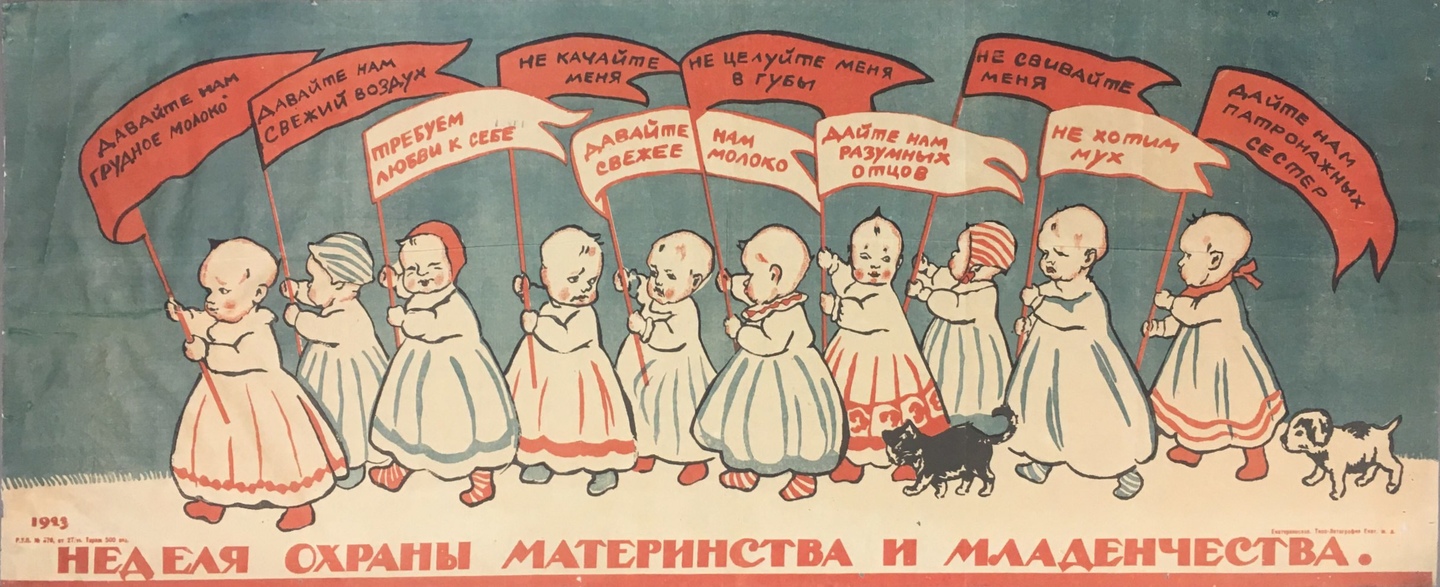
One of the departments of this Institute is a remar able exhibition of posters and models relating to the care of mothers and infants. Several large rooms are filled with the beautiful hand painted originals of the lithographed posters and postcards prepared for general distribution. Carefully made wax models show diseased conditions, and accompanying placards show their cause and cure. Shelves of natural-looking artificial food tell the mother what should and should not be eaten by herself and the baby. Cases of recommended and harmful toys are on exhibition. One room is fitted as a model playroom, another shows the proper sleeping and bathing arrangements for the baby. Thousands of visitors, individually, and in organized groups, come to this exhibition, and those from foreign countries regretfully admit that there is nothing in their own lands to compare with it as scientific and artistic health propaganda.
The results of all this activity are now beginning to be evident. For several years past one could see new institutions, better prepared doctors, poster propaganda; these were records of effort. But now one can point to results, for all the statistics of the last two years unite in registering a lower infant mortality. Naturally this shows most definitely in the two cities of Moscow and Leningrad where the campaign has been under the most scientific direction and where funds have been more abundant. Moscow Gubernia now has a death rate of 13.7 for every hundred infants under one year of age, as compared with the 27.6 of pre-war days; Leningrad has dropped from 23.0 to 12.9 per hundred. Other gubernias like Vladimir, Tver, Ryazan show almost equally great improvement. (From the Report of the People’s Commissariat for the Protection of Health to the 12th All-Russian Congress, 1925, p. 32.) For the whole of Russia it is estimated that the infant death-rate has fallen from 27.0 per hundred in 1913 to 17.0 per hundred in 1923. (“Vital Statistics in the U.S.S.R.” by Professor Michaelovsky in the Report of the Third All-Russian Conference for the Protection of Motherhood and Infancy, Moscow, 1926, p. 147.) What corollary these figures have in reduced morbidity, in conservation of maternal life and vigor, it is impossible to estimate. They stand as a permanent monument to the devotion and energy of the head of the Department and of hundreds of her inconspicuous fellow-workers.
IX. THE DEPARTMENT FOR THE PROTECTION OF CHILDREN’S HEALTH
At three years of age the children who have been under the care of the Department for the Protection of Motherhood and Infancy are given their final examination and discharged with a record of their medical history to the Department for the Protection of Children’s Health, which is responsible for the safe-guarding of all children from three to eighteen years. The aims of this department (as stated in the Report of the People’s Commissariat for the Protection of Health to the 12th All-Russian Congress, 1925, p 35) are:
a. The supervision of school-house sanitation with emphasis on the prevention of overcrowding, as well as the supervision of the health of each pupil.
b. The supervision of the school regime with the aim of bringing the conditions in the ordinary schools up to the standards of those provided in open-air schools.
c. Dispensary service to the child population, of a prophylactic as well as a therapeutic nature.
d. Conducting a campaign against the mental and physical over-straining of children and adolescents, not only in schools but in their social and club life.
e. Special provision for the “homeless children” showing mental and nervous abnormalities.
f. Regular physical examination and follow-up work with adolescent workers.
g. Medical control of the program and check-up on the results of physical culture (provided by the Commissariat of Education) for children and adolescents.
The formal school life of children is supposed to begin with the kindergarten, to which applicants are admitted at three years. An increasing number of kindergartens are being opened, but they are still far from sufficient even for the city children, and in the country districts they are practically non-existent. As in America the greater number of children first enter school at about seven years. Here they are given a thorough physical examination by physicians who are trained and assigned especially to this work. Unlike those of the American schools these doctors are expected to prescribe treatment as it is required, so that there is minimum of time and effort wasted in what we know as “follow-up work.” In cases requiring the services of a specialist the children are sent to the clinics where that particular defect is treated, but the great mass of the work is expected to be done in the regular children’s dispensaries. These dispensaries show another difference between the American and Russian system, in that the doctor does not have his office in the school building, but in a separate dispensary especially equipped for this work, with rooms for examination and treatment, all the furniture, instruments and utensils being adapted for work with children. Not the least effective item is a central registry room for records. Although a definite time is assigned to each child for this physical examination, no compulsion is brought to bear on him to present himself at the dispensary. He may absent himself for the whole year from the examination if he wishes. The signature of the school physician, however, to the effect that the pupil has been examined and has cooperated in trying to remedy his defects, is obligatory before he is passed into the next higher school grade.
Owing to a lack of funds and of personnel, it is estimated that only about 34 percent of the school children of the U.S.S.R. have the advantage of these dispensaries since there are only fifty-five of them in existence up to the present time, but in 1924 over 1,000,000 children were examined and each year there is an increase in the number of the dispensaries. In the Republic of Georgia, for example, there were ten school doctors employed by the Health Commissariat in 1921 and fifty-four in 1925; throughout the entire U.S.S.R. there were 1,094 school doctors in 1926.
In addition to their routine medical work these doctors are frequently members of the committees organized by the children themselves in each school to take charge of the sanitary conditions of the buildings and the personal hygiene of the pupils. The cleanliness and repair of the school-rooms and the discipline of the student body in regard to health matters comes under the direction of this sub-committee of the general student executive committee. It also arranges for lectures on health and sanitation to be given in the school, and tries in every way to fulfill its functions of making the children themselves feel the responsibility for their own health.
In the winter of 1925 a Congress of the Sanitary Committees of all the city schools was held in Moscow.
Original posters relating to health were prepared by pupils of all grades and a judging committee of children was elected to choose those considered worthy of exhibition. In crowded homes hygiene is often dependent on the prejudices of other members of the family, so that the large red letter question “What does a Pioneer (boy-scout) do the first thing in the morning?” was proudly answered, pictorially, “He gets up and opens the window.” A small parenthesis added that some intrepid souls even slept with their windows open all night. A school-room before and after the advent of the Sanitary Committee, tables spread with model meals for growing bodies, and other devices familiar to public health workers in America were also prepared for the Congress, which was held in a large central hall. The afternoon was devoted to showing visitors about the exhibition, whose popularity was evinced by the long line of parents and friends who waited in the snowy street for a chance to enter. In the evening the business session opened, presided over by a girl of fourteen who was the chairman of the sanitation committee in one of the large schools. Reports were read, some by nine-year-old children, of the activities promoting health in various schools; statistics were given by school doctors; telegrams of congratulation were received from the Commissariat of Health and other important officials; and then the meeting was turned over to the entertainment committee which staged four or five short plays and ballets embodying health propaganda. This Congress was exceptional in being held in a large hall and attended by several thousand people, but it is quite usual even in the villages for the sanitary committees of the schools to give evening entertainments of a similar nature to the peasants.
The statistics of the Moscow City Department for the Protection of Children’s Health are arresting in their portrayal of the general low vitality among children, a condition which many of the examining physicians believe to be the effect of the famine years. The following table shows the percentage of malnutrition, anemia, and functional heart disease found among 20,000 school children in Moscow examined in the years 1919 to 1924, and is taken from the Report of the People’s Commissariat for the Protection of Health to the 12th All-Russian Congress, 1925, p. 37. The figures are not to be taken as a history of the same 20,000 children, since the statistics were compiled from alphabetically arranged lists and each year some new children were admitted and others withdrawn.

In reading these figures, one should bear in mind that the recent health statistics in all countries show an increase in heart disease among children and adults—an increase which in Russia as elsewhere may be partly accounted for by earlier and more accurate diagnosis.
The present very crowded housing conditions in Moscow make it difficult for children to have the proper play space and resting space which they require for their complete recovery. Tuberculosis is known to be very widespread, but there are no reliable statistics at hand in regard to it. It has been found, however (according to the Campaign for Health, a publication of the Committee for Organizing an Anti-Tuberculosis Tag Day of the Moscow City Soviet, p. 71), that only 5.6 percent of all the children in Moscow have a separate room for their own use, and that more than 40 percent live in one-room apartments which they share with an average of five other people.
As a result of these conditions a type of school has been evolved by the central Commissariat of Health and is now being duplicated throughout the country whose aim is to admit certain borderline cases and surround them with such remedial conditions that actual disease may be prevented. These are called “Forest Schools” and are usually located in former country homes in the suburbs, often really in pine forests. Hither on the recommendation of the school doctor some forty or fifty children at a time are sent to live for a period of three months’ intensive cultivation of health. Actually tuberculosis children are not admitted, nor any others whose condition requires hospital care. The institution is intended as a preventorium for the undernourished and anemic. A doctor is in charge of each Forest School and after examining the child prescribes an individual regime according to its requirements, but in general the program includes a regular school period of three to four hours a day held out of doors except in the coldest weather, an obligatory two hours of sleep or complete rest each afternoon also out of doors, an especially nourishing diet (at one time the exportation of caviar from Russia was prohibited because the entire supply of the country was needed for these schools), a great deal of play and work out of doors in the flower and vegetable gardens and with small domestic animals. The children of the crowded city tenements are so happy in these schools that they often regret their almost inevitable improvement in health with its accompanying discharge from the school at the end of their term. Dr. Khalevsky, who is in charge of the model school of the central Commissariat near Moscow, spent several months in 1926 studying such preventoria in Germany, France and England and feels sure that they are the best means of raising the standards of adolescent health in any country. There are now 57 of these boarding schools in Russia.
One of the most difficult problems facing the health and education authorities at present is the great number, probably about 250,000, of bezprizorni, or homeless children, who for the past several years have led a street- arab life all over the country. One of the results of the chaotic years of war and famine, they are by now quite intolerant of any organized habits of life, finding it much more exciting to pilfer and to beg than to submit to even self-government in the schools which are hopefully opened for them. Disease is an inevitable result of their irregular lives; many of them show a definitely abnormal psychology. For such of these as reach the police courts or the regular children’s dispensaries the Commissariat of Health has opened special psychiatric-sanitoria to the number of nineteen, where a specially trained personnel endeavors to reconstruct the personality of these a-social children—and if this proves impossible, to protect them and society mutually from each other. Many of those still on the streets are vendors and users of narcotics, many are sex perverts, and almost all are expert pickpockets. Owing to the lack of funds in the Commissariat of Health there are far too few of these special and—it is to be hoped—temporarily needed institutions.
In pursuance of the general policy of the Commissariat of Health to emphasize prophylactic measures, much importance is now laid on physical culture. In former days the Russian youth was rather lethargic physically, and where a love of sports did exist it was apt to develop into a one-sided specialization in running, bicycling, pole-vaulting, etc. After the Revolution there was a tendency to consider these former champions as leisure class parasites. General physical culture, however, came to be valued as a means of keeping fit, whether for mental workers or for children or as a counter-balance to unhealthful types of physical work. The slogan “Physical culture twenty-four hours a day” was coined and people began rather doggedly to play football and to trot around a cinder path and to go through a daily dozen. What responsible workers may have adopted as a duty, however, was eagerly taken on as fun by the children. Few city schools have ever had any playgrounds attached to them, so that most of the athletic activity has to be carried on through other organizations. Many social clubs both for children and for adults are now building well-equipped athletic fields with trained instructors in charge. Institutes for Physical Culture have been opened in Moscow and in Leningrad and practical courses are offered to prepare doctors and physical directors for this type of work.
At fourteen years of age children may start on their career as workers. The factory or other employing institution, however, must guarantee them a four-hour working day and ensure their attendance at some educational institution the remaining four hours of the regular adult eight-hour day. The school doctors still have the health of these young workers under supervision until at eighteen years of age they enter the ranks of adults.
PDF of original book: https://archive.org/download/healthworkinsovi0000anna/healthworkinsovi0000anna.pdf

