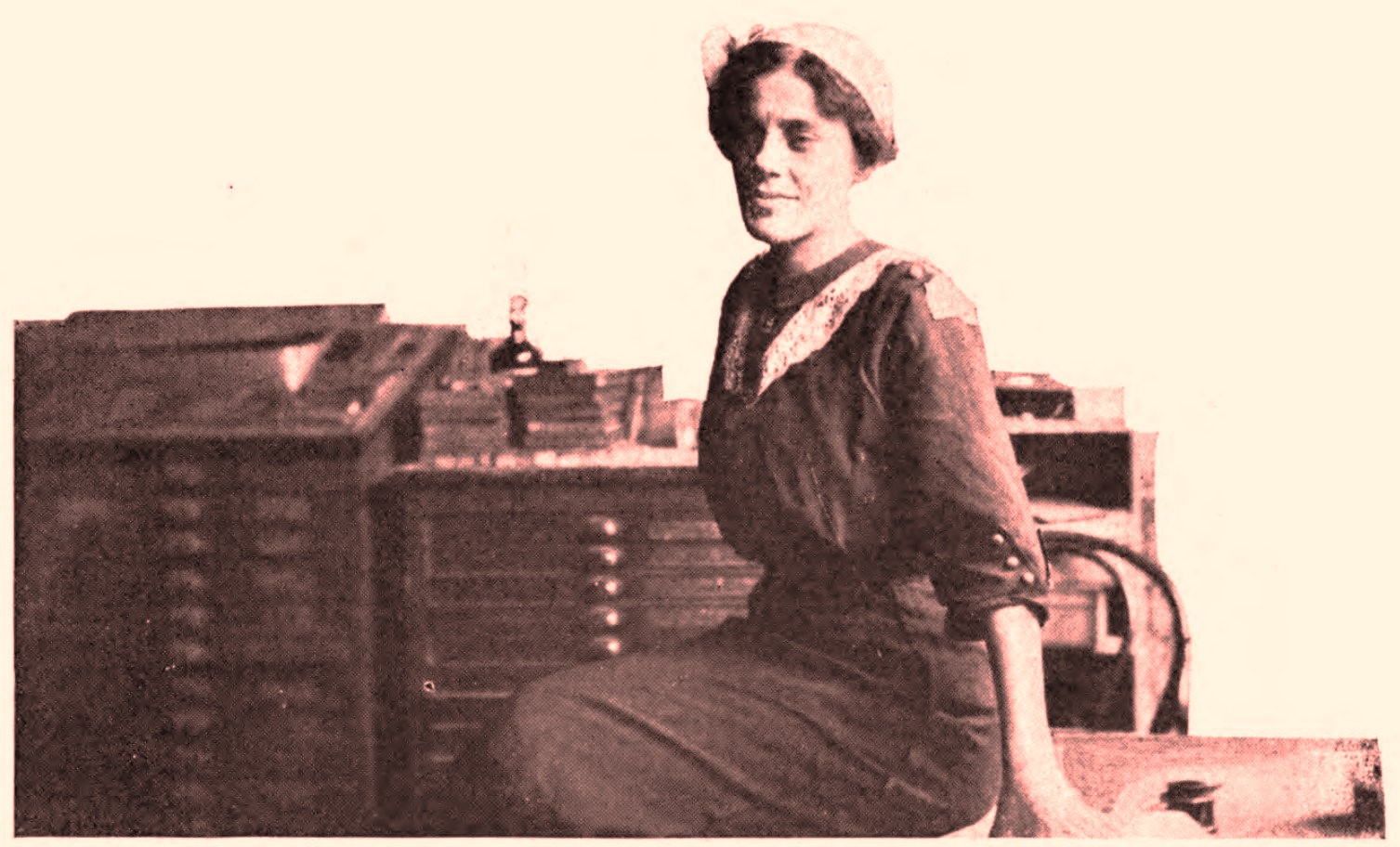
Mary E. Marcy begins her thinking on the socialization of agriculture, which she would develop over the next decade.
‘Insurance Against Crop Failure’ by John A. Randolph (Mary E. Marcy) from International Socialist Review. Vol. 12 No. 12. July, 1911.
WE Socialists have been almost criminally negligent (from the class struggle point of view) in not long ago pointing out to farmers just how largely they would all benefit by social, instead of individual, production on the farm.
To begin with, one of the greatest disasters overhanging the heads of millions of hard working farmers the world over, is a failure of crops. One of nature’s crying injustices is a late frost or drought that destroys all the hard labor of a season, for however diligent man may be in sowing and tending his crop, he has always the fear of his work going for naught. But Socialism–social production and distribution–proposes a way whereby the individual farmer may toil with the full knowledge that he shall reap the fruit of his labors.
It is first of all our purpose that all men and women have full and free access to the instruments of production–the mines, the mills, the shops and the land, these great tools of production on which the lives of men and women depend. It is our aim that the workers who till the land, who mine the coal, who work in the factories, shops and mills shall own these things collectively, so that no worker shall be compelled to divide his product or crop with the owner of the mine or the land in order to secure an opportunity to dig coal or sow wheat.
To the man or woman who lives by the profits made through the labor of others, we have nothing to offer, except a job besides the man who adds to the world’s wealth by his labor.
The Fate of the Small Farmer.
Of late we have been in communication with a number of the best known farm experts in America. One and all have given the opinion that big capitalists, already entering the farming territory, will in a very few years drive the little farmer from the land.
Almost universal has come the report that larger and more marvelous machines were being made for farming-machines that it will be unprofitable to use on a small scale. More and more as farm machinery is perfected and used, will these machines come to represent large investments of capital–that only very wealthy farm owners can furnish. With the introduction of modern machinery, the small farmers, and farm tenants will find themselves unable to compete with their capitalist neighbors. The prices of farm products will fall so that there will not be enough to support the tenant and the landlord. And eventually the small landlord will be compelled to sell out to farm corporations with immense capital.
By the use of modern machines the men employed in large furniture factories make many chairs in a single day. The man who carves chairs by hand–although he may spend several days in producing a single chair–can get no more for his commodity that cost him many days of labor than the machine chair, made in an hour, will bring. Useless labor, hand labor can no longer compete in the machine process.
All through the history of machine production, the new–or modern–method has become the general–and in many instances the only method.
From all quarters comes the report of the farm experts: “The small farmer will be driven from the farm through his inability to furnish capital to buy modern machinery and larger farms which alone can make the use of such machinery profitable.”
Modern farm machinery will cheapen all farm products and only the capitalists using the cheap method will be able to stay in the game.
As the use of modern farm machinery becomes general, the world over, more and ever more capital will be required for farming. Farm lands are already rising in price and greater is the capital required to buy. The bankers will refuse to lend money on a mortgaged farm for the purchase of the expensive machinery required to work a farm profitably.
In a recent number of the REVIEW, Mr. Ellis described some of the large farms run on a modern factory basis, where the farm hands work all the time-=day and night–in two shifts and the hard work is performed by steam or gasoline tractors. The capitalist system of society is already forcing the small farmer off the farm, just as it has forced and will continue to force the business man of small capital to the wall. Competition is no longer a fact in the world today; it has given way to concentration, and monopoly.
The Hope of Socialism.
Socialism is the inevitable outcome of monopoly and the capitalist system of society which finally divides the people into two great opposing groups with the owners of the means of production and distribution, the mines, land, mills, factories and railroads on one side and the propertyless wage workers, who have only their labor power to sell, on the other.
The interests of these two groups are diametrically opposed. It is perfectly obvious, if a farm laborer raises forty bushels of wheat to the acre that the more the idle farm capitalist takes, the less there will be left for the laborer; or the more wages the laborer receives the lower will be the profits of the farm capitalist.
Hence arises on the farm, as in every other industry, a continual conflict between the idle owners and the propertyless wage workers. Socialists call this conflict the Class Struggle.
Then comes Socialism representing the millions of suffering workers on one side and opposing the few idle capitalists on the other.
It is not the aim of Socialism to turn society backward and inaugurate again the era of wax candles in place of gas and electric lights. It does not propose to divide the great Standard Oil Company into a thousand little competing oil plants.
There are excellent features contained in the trusts. They have introduced everywhere labor saving machinery; they have put one vast industrial organization in the place of thousands of wasteful competing little plants. In other words they have learned how to produce oil and shoes, and sugar with the least possible expenditure of human labor. They have brought system out of chaos. All this they have done for the sake of personal profits and at the expense of the working class. With some of these achievements of the trusts, Socialism has no quarrel. It proposes to continue shortening the hours of labor necessary to produce wheat and oil and other commodities. But Socialism is the instrument of the working class and proposes to take over the factories, mines, land, mills and railroads to be run by and for the workers themselves.
One of the Evils of Individual Production.
Today, the man who owns a small factory, a bakery shop or a restaurant does not expect any one to be foolish. enough to insure him against failure.
The same is true of the small farmer. Nobody cares to insure him against crop failure or loss of the small farm.
It is only in a socially owned industry, socially supervised and managed that it would be possible for the organization (or government) to insure the farmer against crop failure.
To explain more fully, Socialists declare that the necessary labor contained in a commodity (for example, we will say a pair of shoes represents two hours of necessary labor) determines its value. In a socially, owned industry, where every worker had an equal voice in its management, the organization would see to it that the most modern machinery was used in the production of wheat or shoes. This is one of the aims of Socialism, that labor be lightened by the use of machinery wherever possible in all industries, and that scientific methods be employed everywhere, so that the greatest amount of food, clothing and houses be produced with the least necessary expenditure of labor.
Under Socialism agricultural experts will advise the farmers about the best crops to plan in the soil he is to work. The best seeds will be supplied by the industrial administration and the individual farmer will be glad to accept expert advice in order to get bigger and better crops.
Under Socialism the value of shoes or wheat will be determined by the average amount of necessary labor required to make shoes with the use of the most improved methods. And the individual worker will be paid for the hours of necessary labor he has spent in shoe making or wheat growing when using the most improved tools or machinery.
The agricultural department of the industrial administration will supply farmers with expert advice regarding crops, fertilizer, and will supply them with the best farming machinery. And the total farming output will be valued according to the total necessary number of hours of labor spent in producing it.
The farmer who has worked 600 hours during the year will receive twice as much as the man working only 300 hours.
If a late frost kills off part of the Michigan crops, neither the Michigan farmers, who have toiled in vain, nor other farmers will suffer. The total number of bushels of wheat will represent exactly the same number of hours of labor as the larger crop would have represented, if there had been no frost in Michigan. Think this over, you farmers. Socialism will give you a sure payment for all your labor. In an early number of the REVIEW we will publish articles showing what Socialism will do for the farmer and why every small landowner, every farm tenant and farm laborer ought to be a Socialist.
The International Socialist Review (ISR) was published monthly in Chicago from 1900 until 1918 by Charles H. Kerr and critically loyal to the Socialist Party of America. It is one of the essential publications in U.S. left history. During the editorship of A.M. Simons it was largely theoretical and moderate. In 1908, Charles H. Kerr took over as editor with strong influence from Mary E Marcy. The magazine became the foremost proponent of the SP’s left wing growing to tens of thousands of subscribers. It remained revolutionary in outlook and anti-militarist during World War One. It liberally used photographs and images, with news, theory, arts and organizing in its pages. It articles, reports and essays are an invaluable record of the U.S. class struggle and the development of Marxism in the decades before the Soviet experience. It was closed down in government repression in 1918.
PDF of full issue: https://www.marxists.org/history/usa/pubs/isr/v12n12-jun-1912-ISR-gog-Corn.pdf

