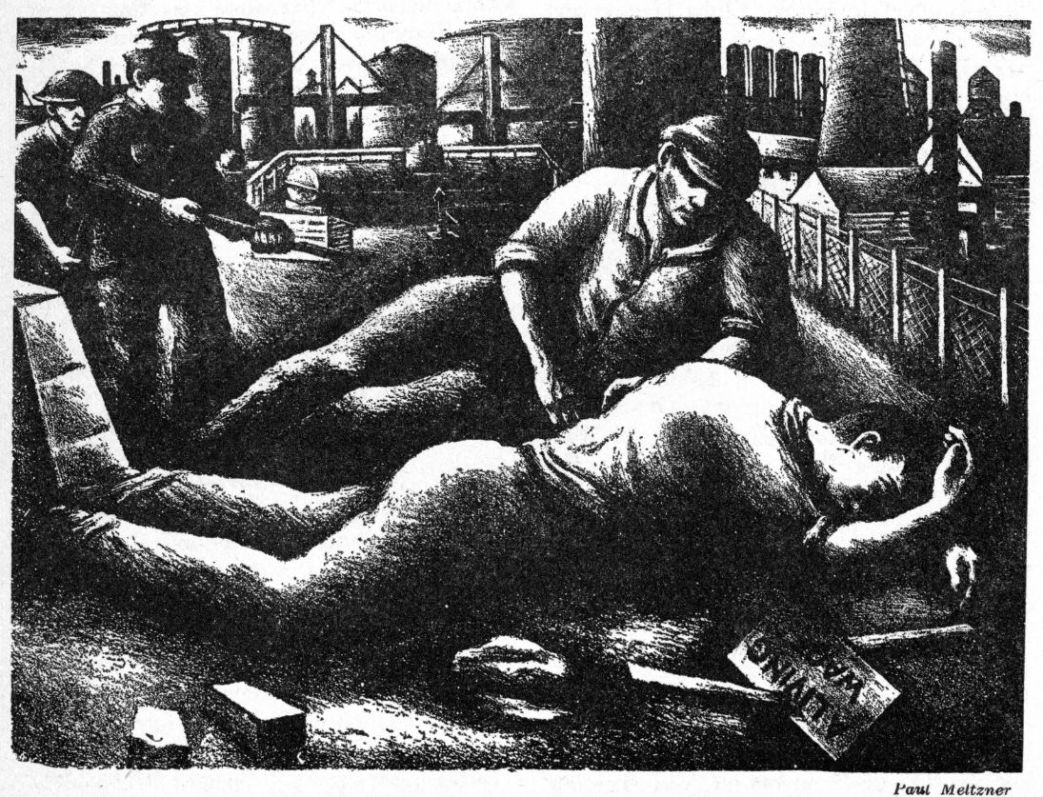
Anchored by the post-1934 militancy and organization of Bay Area waterfront workers, labor unions became increasingly self-confident as it put down strong roots among workers on the West Coast.
‘The Attack on West Coast Labor’ by Amy Schechter from New Masses. Vol. 18 No. 5. January 28, 1936.
SAN FRANCISCO. YOU can’t get away from the waterfront or the unions in San Francisco. The steep streets look down on the Bay. From Nob Hill where San Francisco’s wealthiest live, the whole sweeping curve of the Embarcadero is visible. It is not impossible that looking down at the Embarcadero, dwellers on Nob Hill may—if they have heard of it—think of labor’s iron ring around Paris.
But San Franciscans, wherever they live, are keenly aware of the maritime unions and the attack that is being prepared on them, despite the fact that San Francisco papers almost entirely suppressed the sensational announcement of open warfare on West Coast maritime unions made by Elisha Hanson, attorney for Swayne and Hoyt. The New York papers carried front-page stories of the plans revealed by Hanson and others in close touch with the shipping companies on the Pacific Coast. These plans were reported to include federal action against the Pacific Coast Maritime Federation (to which 99 percent of maritime unions on the Coast are affiliated), indictment of Harry Bridges and some twenty-five other union leaders, placing the unions in the hands of the Ryan-Olander machine, taking over union hiring-halls, etc., and mobilization of a coastwise vigilante organization described as already set up and ready to function.
On the day the story broke, December 31, the early edition of Hearst’s San Francisco Call-Bulletin carried an Associated Press Dispatch from Washington on Hanson’s statement, under the heading, “Seek U.S. War on San Francisco Unions.” This item was entirely deleted in the later edition and since then the story has been ignored in the Hearst and other San Francisco papers.
The reason is obvious. Shipowners here know the white-hot pride of San Francisco maritime workers in their unions and the rank-and-file leadership under which they have made such remarkable gains since the General Strike gave the deathblow to company unionism on the waterfront. They realize, perhaps not fully, the welded resistance they face once San Francisco labor is aroused to the attack; and from the time of the secret coastwise meeting of shipowners’ associations, Chambers of Commerce, etc., held here the second week in December to coordinate the offensive, every effort has been made to maintain strict secrecy until time to go.
The announcement of an open attack hardly comes as a surprise. Ever since the formation of the Maritime Federation, ten months ago, the attack has gone on under one form or another, with employers constantly maneuvering for a position in which they could declare a general lockout and drive full force against the unions. In the critical days of October, when the San Francisco Waterfront Employers Association had blacklisted 1,800 of the 4,000 longshoremen on the docks for refusal to handle cargo, from the striking port of Vancouver, B.C., and other hot cargo and were all set to take over the I.L.A. 38-79 hiring hall, this plan to engineer a lockout came dangerously close to success.
The attempt was halted at the last moment by the joint strategy carried through by the San Francisco and Vancouver unions. The moves which checkmated the shipowners were possible only because of the exceptionally high organizational level existing on the West Coast and the solidarity displayed by the Vancouver strikers who sacrificed their immediate interests and released the Vancouver cargo at the San Francisco docks, in order to remove the basis for an attack on the San Francisco unions which they realized might have endangered the very existence of the Maritime Federation. Time after time in the past months only this highly developed union consciousness on the part of the West Coast maritime unions, their capacity for organized action and the cool-headed and undeniably brilliant generalship displayed by Harry Bridges and the other men that the rank-and-file unions have chosen to lead them, have averted an open clash.
In bringing forward the refusal of West Coast unions to handle hot cargo as proof of “irresponsible” leadership, Elisha Hanson and the other advance agents of the drive on the Maritime Federation, carefully omit mentioning that this policy on hot cargo had been officially adopted at the annual convention of the International Longshoreman’s Association held in New York early in 1935. In fact, the Ryan machine supported the resolution.
Ryan repeatedly gave lip service to this decision during the Gulf strike, dramatically announced midnight of October 31 as the deadline for handling Gulf cargo in every port on both coasts. Then Ryan broke up the attempts of longshoremen in eastern ports to execute the embargo, went through the same farce a couple of times more, forcing the West Coast to assume the whole burden and the peril of carrying through the national decision.
The refusal to handle goods from strike areas is of course not the radical innovation, as the shipowners and reactionary officials claim, but a basic principle of American trade unionism—one that has played an important part in union procedure for over a century. It must be emphasized here that the maritime unions, linked together loosely in the Maritime Federation for greater organizational strength, are all A.F. of L. unions in good standing, with the exception of the American Radio Telegraphers Association, which is negotiating for affiliation. Here in San Francisco, in 1916, when shipping interests were already preparing for the World War, there was a prolonged and bitter struggle on the San Francisco waterfront centering around this same question of the refusal of maritime unions to handle hot cargo. An interesting parallel.
The attitude of the West Coast unions on arbitration is listed by Elisha Hanson and others as another proof of the “irresponsibility” of rank-and-file control. The facts in regard to the West Coast unions and arbitration are that these unions have demonstrated that strong and militant unions under capable and honest leadership can to some extent lessen the effectiveness of arbitration as a weapon in the hands of the shipowners. In other words, shipowners have not been able to use the Arbitration Board to chisel agreements, because of the organized action on the job with which the unions have immediately met every such attempt. Whence the desire, expressed repeatedly and with increasing vehemence in the course of the past months by bitter-enders in the ranks of the San Francisco Waterfront Employers Association to scrap agreements and arbitration or rank-and-file leaders or preferably both.
Incidentally, there is nothing in the agreement between the shipowners and the Pacific Coast unions which obligates any worker to handle goods declared unfair by other unions or to walk through picket lines. Recently, several important companies operating out of San Francisco specifically recognized the principle involved in the refusal to handle hot cargo and incorporated clauses to that effect in agreements with Bargemen’s Local 38-101, I.L.A., San Francisco, and Bargemen’s Local 38-102 I.L.A., Stockton, both rank-and-file controlled. The clause in part reads:
“…it is agreed that in the event that the employes refuse to work in, on or about any docks, piers, vessels or cargo which has been declared unfair by any maritime labor organization, or where any maritime organization has established a picket line, such refusal by any employe to work shall not constitute a violation of this agreement.”
The Penalties Clause
One thing the waterfront refused and rill continue to refuse: to arbitrate.
This is the demand of the shipowners for the so-called “penalties” clause which the Water: front Employers Association presented on October 21 for insertion into the I.L.A. 3879 agreement. In addition to constituting a definite violation of the agreement, this is an openly fascist provision, copied directly from Hitler’s labor code and opposed to American democratic traditions and everything for which American trade unionism stands. The central provision of the penalties clause is he following:
Longshoremen who shall refuse to turn to after having been dispatched for work or who shall strike or stop work on any job, or who shall “refuse to work cargo as ordered shall for each offense be subject to the following penalties:
a) For the first offense shall suffer a reduction of 50 percent in the maximum work hours for the ensuing four-week work period.
b) For the second offense shall suffer permanent elimination from the registration list and loss of further employment under the award.
Other provisions of the penalties clause give the employers the right to “summary dismissal” for smoking; provide that longshoremen “found guilty of pilfering or stealing cargo shall be permanently dropped from the registration list and suffer permanent loss under the award,” etc., provisions which would make it possible for an employer to frame up any active unionist that he might want to get rid of, precisely as is done today in the company-union-ruled steel plants and in Southern textile mills.
The union-smashing intent of this penalties clause is clear. If the I.L.A. accepted it, they would be putting an end to their own existence as a labor union and thereafter would exist only as a fascist Labor Front unit. According to this clause which binds workers to jobs as inexorably as in fascist Italy or Germany, the union is itself made the jailor of the workers, in exactly the manner prevailing in these countries.
The attempt to force the penalties clause on the waterfront unions is the key to the shipowners’ present strategy. When they charge the rank-and-file leaders of the Pacific Coast maritime unions with “irresponsibility,” they mean that these leaders refuse to turn over to the shipowners the unions they have been elected to lead or allow the shipowners to transform the unions into jails for the workers or accept the position of jailors. A longshoreman summed up the position of the union: “The union refused to become a dick agency and the plan blew up.”
However, if Bridges and the other rank-and-file leaders will not accept the fascist role the shipowners wish to assign to officials of the maritime unions, others can be found who will. Hence the move to force out Bridges, and the other rank-and-file leaders (re-elected to office in the annual elections in various of the San Francisco maritime unions held in the course of the past months by overwhelming majorities) and to allow the Ryan-Olander machine to take over.
National Anti-Labor Drive
CONFIDENTIAL memorandum from the files of a leading shipping company in San Francisco, disclosed, a few weeks back, that the company was bothered by the solidarity of the West Coast maritime workers and the growing influence of the Maritime Federation. Also, that in the opinion of the company “Harry Bridges is more solidly entrenched than ever before, and that if anything is to be done about the situation it must be done from the East.”
Action from the East has begun. The various moves of the past couple of weeks all fit nicely into a plan. In Washington, Elisha Hanson of Swayne and Hoyt broadcasts his appeal to the federal authorities for action against the Maritime Federation and its leaders; R.J. Baker of New York, President of the American Shipowners Association, issues a statement on the renewal of the 1935 agreement by Olander and other East Coast officials of the International Seamen’s Union, in which he contrasts the “amicable” situation in the Atlantic Coast Branch of the I.S.U., “under the guidance of Andy Furuseth, Victor A. Olander and other reputable leaders” with the “continued strife’ prevailing on the West Coast. “The difference lies simply in the leadership of these two branches of the union,’ Mr. Baker says. In New York, Paul Scharrenberg, leading I.S.U. reactionary and ex-member of the Sailor’s Union of the Pacific, demands that the “revocation of West Coast charters and the reorganization by the convention” be carried through by the international convention of the International Seamen’s Union set for Washington, January 14. (Scharrenberg was expelled from his local for two reasons—the unauthorized calling of the tanker strike without referring it to the rank-and-file of the Seamen’s Union for a referendum; and his statements made at arbitration hearings that “I hope we have a war with Japan, because we will be sitting on top of the world then”; “We don’t care how much the shipowners is able to make out [of the government funds] as long as we get our share.”
Following a general survey of the situation in the Sailors Union of the Pacific since the 1934 strike, the report goes into what it describes as “the unhealthy tie-up of the sailors with the longshoremen” in West Coast ports.
It has become a fetish along the waterfront to argue that the sailors cannot get along without the support of the longshoremen, and vice versa— the report continues—this idea was inculcated into the minds of the new members of both unions, particularly the Sailors, during the 1934 strike, the cry was all for a “United Front,” which may be all right for tactical purposes in fighting a battle, but once that battle is over, history has proved that the interests of the two organizations are not the same.
Harry Bridges, his “large following up and down the Coast” and the existence of the Maritime Federation, are, according to the report, responsible for the coastwise unity it deplores. Approaching the question of how to remedy the situation the report states:
With this picture in front of us, the natural question is, “What is to be done?” And the answer is that any one of several things could correct the situation:
1) Cancellation of the charter by the International Seamen’s Union. This would mean. the confiscation of the funds of the union; seizure of books and records; probably issuance of 4 charter to a new union, and in the meantime, leave the sailors without an agreement. with the employers. This method would very likely produce trouble.
2) Suspension of the charter by the international. Under this plan restoration would probably hinge upon the Union’s agreement to purge its ranks of all radicals, and put itself in a position to abide by agreements and awards.
3) The government could step in. The government would probably work through the immigration department or Department of Justice. Their angles of course would be illegal entry, failure to take advantage of citizenship laws, and criminal and subversive activity.
4) Vigilante activity. This might be effective, but deplorable. It is also dangerous, because too often, there is no discrimination between innocent and guilty. It would have to be carefully planned to avoid this, and should not be considered.
The Spread of Unionism
THE prestige and influence of the Maritime Federation -has spread from the West Coast to the Gulf, to Canada and now to Hawaii. In a Washington ultimatum, Elisha Hanson specifically listed the part played by the Federation in aiding the organization of the Gulf maritime workers as an imperative reason for the liquidation of the Pacific Coast federation. The move to set up a Gulf Coast Maritime Federation, similar to that in the West has been directly fostered by the West Coast organization. Such steps are of genuine importance in the drive for industrial unionism in the maritime industry on a national scale—a step in line with the principles advocated by the Lewis-Gorman Committee.
In Vancouver, the maritime unions declared for some time their intention of affiliating to the Pacific Coast Federation after their admission to the I.L.A. and the I.S.U. In Honolulu, waterfront unionization has been initiated with funds and forces voted by the headquarters branch of the Sailors Union of the Pacific. Longshoremen as well are affected; a group of them wrote to Joseph Ryan for a charter, but Ryan is making use of the fact that some of them are Japanese and other non-citizens to withhold the charter. And the Red scare is raised by the great sugar plantation owners in their attempt to prevent organization.
The d also spreads inland. The longshoremen aided the Mine, Mill and Smelter Workers Union in setting up a local in Selby, where it is said three-quarters of the world’s refined lead is stored. In Crockett, they helped to organize the workers in the Crockett sugar plant. They have brought into unions the unorganized bargemen along the Sacramento and San Joaquin Rivers—extending the organized workers’ movement into the rich agricultural vallies of California. In Stockton, in Fresno, everywhere longshoremen are hired, they bring organization to the working class, organization along militant lines that will benefit California workers.
And in San Francisco the waterfront unions have extended their influence to the teamsters in a way that alarms the shippers. Solidarity established during the 1934 strike over the opposition of the reactionary Mike Casey, has grown steadily. This is especially true of teamsters hauling to and from the docks—today the longshoremen can pretty definitely rely on these men to support job action on the waterfront.
And that is the story up and down the Coast. As one delegate to the San Francisco Central Labor Council from a non-maritime union put it: “Due to the waterfront unions we organized our shop. Due to the waterfront unions we organized that shop—” pointing to another delegate. The waterfront unions have brought union organization to the Pacific Coast.
UNION signs are thickest along the Embarcadero—union restaurants, barber shops, filling stations, saloons, drugstores, tailor-shops…about 100 percent out in the Fillmore and Mission sections where most of the waterfront workers live. Car conductors wear large union buttons…the Market Street line which Tom Mooney was framed trying to organize is for the most part organized now, again with the help of the waterfront…despite reactionary officials controlling the car-men’s union.
San Francisco is probably the strongest union city in the United States today, with the largest measure of rank-and-file control, despite the fact that the Vandeleur-Rossi machine is still in power. The fact that such a situation exists a year and a half after the General Strike is probably more alarming to the shipowners and notorious open-shop forces of California that back them than the General Strike itself.
The New Masses was the continuation of Workers Monthly which began publishing in 1924 as a merger of the ‘Liberator’, the Trade Union Educational League magazine ‘Labor Herald’, and Friends of Soviet Russia’s monthly ‘Soviet Russia Pictorial’ as an explicitly Communist Party publication, but drawing in a wide range of contributors and sympathizers. In 1927 Workers Monthly ceased and The New Masses began. A major left cultural magazine of the late 1920s and early 1940s, the early editors of The New Masses included Hugo Gellert, John F. Sloan, Max Eastman, Mike Gold, and Joseph Freeman. Writers included William Carlos Williams, Theodore Dreiser, John Dos Passos, Upton Sinclair, Richard Wright, Ralph Ellison, Dorothy Parker, Dorothy Day, John Breecher, Langston Hughes, Eugene O’Neill, Rex Stout and Ernest Hemingway. Artists included Hugo Gellert, Stuart Davis, Boardman Robinson, Wanda Gag, William Gropper and Otto Soglow. Over time, the New Masses became narrower politically and the articles more commentary than comment. However, particularly in it first years, New Masses was the epitome of the era’s finest revolutionary cultural and artistic traditions.
PDF of full issue: https://www.marxists.org/history/usa/pubs/new-masses/1936/v18n05-jan-28-1936-NM.pdf

