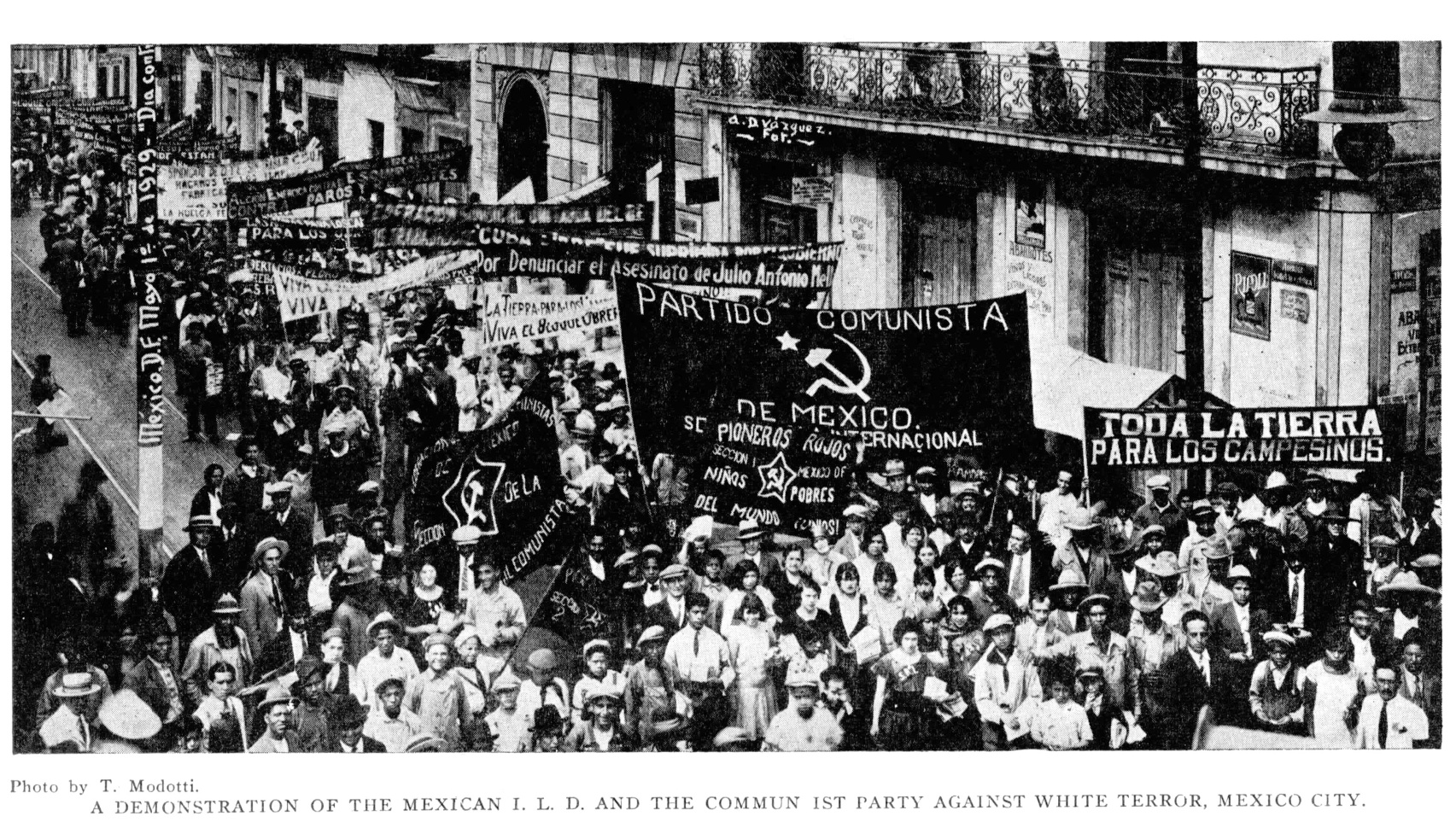
William Simons, a participant from the U.S., reports on two conferences held in May and June of 1929. The first in Montevideo, Uruguay where the R.I.L.U.-aligned Latin American Confederation of Labor was formed to compete with the State Department and A.F. of L.’s Pan-American Federation of Labor, followed by a gathering in Buenos Aires of Communist Parties of Latin America held to consolidate the Comintern’s affiliates in the aftermath of the Sixth World Congress, the first with real Central and South American participation, and orient themselves towards an Americas increasingly dominated by U.S. imperialism, and in revolt.
‘The Sharpening Class Struggle In Latin America’ by William Simons from The Communist. Vol. 8 No. 8. August, 1929.
A Tale of Two Conferences: Montevideo and Buenos Aires
The Montevideo Congress where the revolutionary Latin American Confederation of Labor was founded, and the Buenos Aires Conference of Communist Parties of Latin America, held between May 18 and June 12, have done much to equip the revolutionary movement of Latin America for the present campaign to defend the Soviet Union from imperialist attack, and for a struggle against imperialism, especially United States imperialism.
These Conferences are landmarks in the revolutionary development of the Latin American workers and peasants. Both were held for the first time on Latin American soil, and were much larger than the groups of Latin American delegates who attended either the Fourth R.I.L.U. or the VI Comintern Congress. The Montevideo Congress was attended by 56 delegates from 15 of the most important countries and by representatives o! the R.I.L.U., the French C.G.T.U., and the T.U.E.L. of the U.S.A. The Buenos Aires Conference had 37 delegates from 14 countries, and also a representative of the Communist Party of the U.S.A.
The tasks of the Conferences were: at Montevideo, to forge a strong, revolutionary trade union continental center of industrial and agricultural workers, for the improvement of their miserable living conditions, and for a struggle against imperialism and the danger of war; at Buenos Aires, to lay down the revolutionary perspective, a tactical line, and plans for the organization and consolidation of the Communist Parties.
INTENSIFIED IMPERIALIST RIVALRY
The dominant note in the Latin American situation is the sharpening of the rivalry between Great Britain and America, a worsening of the miserable conditions of the working masses, and a leftward drift of these masses. Latin America is becoming ever more important in the world rivalry between the two outstanding imperialist countries. The Draft Thesis presented to the Buenos Aires Conference states: “Latin America is one of the most important battle grounds of British and American imperialism…Latin America is of the greatest importance as one of the sources of conflicts and of new imperialist wars.” Furthermore, there is considerable sentiment among the Latin American masses for the Soviet Union, which will undoubtedly express itself in demonstrations and strikes for the defense of the Soviet Union.
The relation of British to American imperialism is not one of subordination, but of struggle. Her loss of position after position only steels her determination to fight. British imperialism is still powerful. As the VI Congress Thesis puts it: “The rapid expansion of the United States inevitably brings her interests into conflict with the interests of decaying, but still extremely powerful British imperialism.” Struggle is the keynote of the relation of imperialist forces. The VI Congress Thesis correctly states: “As a result of the squeezing out of British capital, South America is gradually becoming an enormous ‘sphere of influence’ of the United States.” To affirm that the process is completed means to underestimate the strength of British imperialism, to underestimate Latin-America as a source of imperialist conflict and consequently to underestimate the danger of imperialist war.
THE SITUATION IN LATIN AMERICA
As a result of imperialist competition there is a constant drive to lower the miserable wages of the Latin American workers, while the cost of living increases. The workers have engaged in a series of strikes for betterment of conditions; the Colombian banana workers strike of 1928; the two strikes on the Ford rubber plantations, in Amazonia, Brazil of 6,000 workers, in November, 1928 and February, 1929, crushed by machine guns and troops; illegal strike of 6,000 printers in Sao Paolo, Brazil, April-May, 1929. The militancy of the workers is shown by the disarming of eighty company police (killing ten of them) in the Colombian banana strikers. Native reaction is completely in the service of the imperialist powers, most of the countries being under the heel of American imperialism. The Pan-American Federation of Labor and Amsterdam have their agents in the labor movement of Latin America, usually weak, but still a source of danger; the P.A.F. of L. generally where American influence exists, Amsterdam where European powers are influential, as in Argentine. The countries of Latin America are colonial or semi-colonial, depending generally on one or two industries either directly owned or whose market is controlled by imperialist powers, which ties them to imperialism’s apron strings. Heavy industry is not developed, these products being imported from imperialist countries. There is a crisis in several countries; in oil and copper in Mexico; in sugar in Cuba; in meat in Argentine, and in coffee and public works in Colombia. This crisis, the result of imperialist relations with these countries, a part of the world crisis, will grow in intensity. To sum up, the situation in Latin America is marked by a growing crisis, sharpening of the class struggle, and increasing militancy of the working masses.
MONTEVIDEO FOLLOWS A CLASS LINE
The Montevideo Trade Union Congress adopted the following program of action: (1) a struggle for improvement of conditions of the industrial and agricultural workers, which is a struggle against imperialism, primarily American imperialism; (2) a struggle against the war danger arising from the rivalry between Great Britain and America, and reflected in the Tacna-Arica and Bolivia-Paraguay clashes, and for the defense of the Soviet Union; (3) a fight against the reformists—against the P.A.F. of L., Amsterdam and the anarchists; (4) a struggle against native reaction, tool of the imperialist powers (5) the organization of the agricultural workers, who play an important role in Latin-America; (6) the organization of the Indians who in some countries (Peru, Bolivia) are a majority of the population—an All-Indian Latin American Conference is contemplated; (7) propaganda among the Negroes of Haiti and Jamaica to discourage their influx into Central America where the United Fruit Company uses them against the natives (this is our task primarily); fraternization of the Negroes and natives on the plantations; (8) more attention to the youth and women problems; (9) activity among immigrant workers; (10) a drive to organize the workers of Latin America (percentage of organization being low), and to put the movement on a dues-paying basis; (11) a struggle for national and international unity; (12) the establishment of closer relations with the revolutionary workers of the U.S.A., signing of the Solidarity Pact with the T.U.E.L. of the U.S.A.
This is a class struggle line. No wonder the Montevideo Conference was attacked bitterly by sectarian, anarchist elements, by Amsterdam, by the P.A.F. of L. Montevideo saw the birth of a powerful revolutionary trade union organization, a mighty weapon in the anti-imperialist struggle.
BUENOS AIRES PLUMBS DEEPER
The Buenos Aires Communist Conference dealt with the basic, fundamental problems of Latin America, as the perspective for revolution, the bourgeois-democratic revolution and the workers and peasants blocs. This Conference made the following estimate: (1) The U.S.A. controls a whole series of countries, and even where Great Britain is still dominant (Argentine, Brazil, Uruguay) the U.S.A. is fortifying its position. (2) The dominant class in almost all countries of Latin America, whatever their political form, is the class of the large landowning proprietors in the service of, and in close relation with British or American imperialism. (3) The exploitation of the natural resources of Latin America by the United States accelerates its industrial development, and thereby increases the number, concentration, class consciousness and the role of the industrial proletariat. But this industrial development of Latin America is one sided, is the expression of its colonization, of its more rapid transformation into a vast colonial dominion, and not of its independent capitalist development of its decolonization. (4) This proves that the national bourgeoisie arising in some countries cannot develop except in close dependence upon foreign capital, and that like the large landowning class, it cannot be a revolutionary factor in the struggle against imperialism. (5) The revolutionary movement in Latin America can be characterized in general as the bourgeois-democratic type in semi-colonial countries where the agrarian and anti-imperialist problems dominate. (6) The perspective is of the growth of the working class, and its influence, weakening of the influence of the petty bourgeoisie; crisis in agriculture, more violent struggles of the agricultural workers; strengthening of the dictatorial and fascist character of the local governments, backed by American imperialists. (7) A swift transformation is possible from the bourgeois democratic revolution to the proletarian revolution.
COMMUNIST PARTIES TASKS AND TACTICS
The general tasks and tactics of the Communist Parties were indicated as follows: (1) the formation and consolidation of Communist Parties, strengthening their base in imperialist concerns, mines, factories, railways, plantations; (2) active participation in all revolutionary movements of the masses against imperialism and the large landowners, even though these movements should be led for the moment by the petty bourgeoisie; (3) the organization of the agricultural masses, and the establishment of close relations with the Peasants Leagues; (4) the petty bourgeoisie resorts to coup d’etats, using the masses to get themselves into power, after which they compromise with imperialism; to them action of the army is the decisive factor—but under the hegemony of the working class, the arming and organization of the masses of workers and peasants is the important factor; (5) during the agricultural uprisings and revolutionary movements, the Communists must not only put forward the question of arming of the workers and peasants, but also the creation of bodies elected by the workers and peasants, capable of directing the struggle and which will be transformed from directing bodies of the insurrection into organs of the workers and peasants government after victory—the slogan for the creation of agricultural soviets on the farms, and of workers’ and soldiers’ soviets in the cities, should be put forward in the course of every insurrectional movement of the working masses and peasants; (6) only a workers’ and peasants’ government can carry through the historic tasks of the democratic bourgeois government with the following program: a. confiscation without compensation of land and minerals; b. confiscation and nationalization of foreign enterprises (mines, etc.); c. repudiation of foreign debts and all forms of imperialist control; d. an 8-hour day and the abolition of semi-slave conditions of work; social insurance; e. arming of the workers and peasants; creation of a workers’ and peasants’ militia; f. abolition of power of the large landowners and of the church; and the establishment of the power of soviets of workers’, peasants’ and soldiers’ representatives; (7) the slogan for Latin America must be the Federated Union of the Workers’ and Peasants’ Republics of Latin America; (8) the Communist Parties of Latin America are ideologically and organizationally weak—they must be strengthened; (9) parties which are based on membership of affiliated unions, etc. (Colombia) must be changed to individual membership base; (10) the idea of workers’ and peasants’ parties must be rejected—workers’ and peasants’ blocs can be used as a close alliance of the proletariat and peasants, by which our Parties lead backward masses to revolutionary struggle.
A NUMBER OF SPECIFIC PROBLEMS
The Buenos Aires Conference laid down a line of action for revolution in any country of Latin-America. No Communist can argue that a revolution is impossible in view of probable intervention by American imperialism. Sandino showed the possibility of keeping the revolutionary fires burning for several years. Had the Colombian Party established a Soviet during the banana plantation strike, even if it were suppressed, it would have been a beacon light, an example of revolutionary courage, of inspiration for the working masses of Latin America.
A series of resolutions were worked out by small commissions, editing. These included questions of race, agriculture, organization, which were submitted to the South American Secretariat for final youth, women, struggle against war, and on the Argentine question. Progress was made on the race question, it being generally admitted at this Conference that there was a Negro and an Indian question in Latin-America. At the VI Congress of the Comintern, many Latin American delegates denied this. No final decision was taken on the Indian question, the commission’s resolution and that of the Peruvian comrades passing to the E.C.C.I. for final solution.
While the agricultural question is of the utmost importance, there has generally been little study of it by the Communist Parties of Latin-America The line laid down for this work was for concentration on the organization of the workers in coffee, fruit, sugar plantations and among the forest workers.
On organization, the Conference agreed that the base of the Party must be among the workers in imperialist factories, plantations, etc. Emphasis was placed on the building of shop and farm committees. It was decided that there would be no affiliation of individuals to the workers’ and peasants’ blocs. Membership in the Communist Parties must be on an individual basis. The discussion of the youth question disclosed the prominent role the young workers play in production, and the weakness of the Youth Leagues, not concentrated among the exploited youth, not given sufficient support by the Communist Parties. The Resolution Against War declared that “Latin America will be an object and probably a seat of war,” and outlined the specific tasks of the Parties in connection with fighting war. The increasing role of women in industry was noted, and the necessity of more attention by the various Parties to this problem. The work of the Anti-Imperialist Leagues in Latin America was discussed from a theoretical and organizational angle. The trade union work was reviewed, and tasks laid down. The international situation, and the danger of was presented as the first order of business by the South American Secretariat.
Our Parties in Latin America are in the main ideologically and organizationally weak. In Colombia, the Party did not link up the banana strike with the possibility of armed uprising, because it had the conception of co-operation in an armed revolution under the leadership of the liberals. In Brazil, the C.P. was completely submerged in the Workers’ and Peasants’ Bloc, an error which was only recently corrected. In Mexico, the C.P. failed to pursue sufficiently an independent role within the Workers and Peasants Bloc. The parties are generally indifferent to the danger of war. In Peru, the Communist group created the Socialist Party, with a program different from the Comintern program, since “the masses would not join a Communist Party now.” But one must never forget the heroic struggle of the Colombian workers, under the leadership of the Colombian Party, nor the splendid anti-Hoover demonstration in Argentine and Uruguay. Most of the Latin American Parties are young, but they are worthy allies for the struggle against imperialism.
AN ESTIMATE OF THE BUENOS AIRES CONFERENCE
The Buenos Aires Conference did valiant service in clarifying the tactics of the Parties. The Conference approved the line of the draft thesis. It approved of the action of the Argentine Party and condemned those elements expelled from the Party who were trying to undermine the Argentine Party in the eyes of the other parties.
The Buenos Aires Conference did valiant service, but in one important respect it was lacking. It failed to draw the lessons from or even discuss the right danger in Germany, Czech-Slovakia and the United States. It failed to characterize the right danger in Latin America as marked by the May First Manifesto of the Brazilian Party, which called upon the trade union workers to put pressure upon their leaders to follow a revolutionary line, or else, “let them give up their posts,” by the failure of the Uruguay General Confederation of Labor to adopt an independent line in the meat packing strike conducted by anarchists, by the failure of our comrades to call out the overwhelming mass of workers, with demands for all, and to lead the strike.
There must be no exceptionalism for Latin America. The Conference rightly treated Latin America as a part of the whole world scheme, but the lessons of the international Communist movement must be learned by the Communist Parties of Latin America if they are to measure up to their tasks.
OUR DUTY TO THE COLONIAL MOVEMENTS
The VI Congress Thesis of the Comintern declared: “The C.P. of the U.S.A. fails to carry on a sufficiently impressionable struggle against the predatory policy of the United States in Latin America.” The Thesis on Latin America presented to the Buenos Aires Conference by the E.C.C.I. confirms this:
“The oppressed peoples of Latin America should find an ally in the revolutionary proletariat of the United States, which should support the anti-imperialist struggle of the peoples of Latin America. This solidarity has not yet been displayed with sufficient force either toward the oppressed proletariat of the colonies under American imperialism, as Cuba; or toward the valiant defenders of the independence of Nicaragua; or with respect to Mexico.”
This is a true indictment of our Party and efforts must now be made to live up to our responsibilities toward the Latin American workers and peasants.
The presence of a T.U.E.L. delegation to the Montevideo Congress, the signing of the Solidarity Pact between the Latin American Confederation of Labor and the Trade Union Educational League, the presence of a delegate of the Communist Party of the U.S.A. to the Buenos Aires Conference, and of a representative of the All-American Anti-Imperialist League (U.S. Section) to the Argentine National Anti-Imperialist Congress have helped bring these movements together. The Solidarity Pact must be popularized, and carried out. (The Solidarity Pact with Mexico has remained a scrap of paper.) The organizations in the various fields of work, Party, trade union, anti-Imperialist, labor defense, relief, etc. must establish regular correspondence, exchange of newspapers, must make their membership understand the situation in Latin America, and the necessity of joint struggles in imperialist enterprises (Ford, General Motors, Armour, Swift, etc.). Especially must we support the strikes in Latin America in American owned factories or plantations. This is our special duty, because Latin America is particularly exploited by American imperialism. Oil plays such an important part in Latin-America, that we must make efforts to establish a base among the workers of this industry in the U.S.A., and establish relations with the oil workers of Latin-America.
ORGANIZATION OF THE LATIN AMERICAN WORKERS IN THE U.S.A.
It is the duty of the revolutionary movement of each country to see that emigrant workers adopt a class attitude in the country to which they go. The revolutionary Parties and trade unions of Latin America are therefore keenly interested in the organization of the four million Latin American workers in the U.S.A. We must plead guilty to the charge of failing to do our duty, despite a provision in the Organization Resolution of the Third Conference of the T.U.E.L. in December, 1927, about the importance of this task. The Latin American workers here are a link with the revolutionary movement of Latin America; their organization will facilitate our gathering support for the revolutionary struggles of the workers in Latin America. We must begin to include work among the Latin Americans as one of the major tasks of the Party; it must be added to “work among youth, women and Negroes” and then must be actually carried out in practice.
There must be an ideological campaign among the membership of the Party and other working class organizations concerning Latin America. Our press must reflect the struggle of Latin-American workers and peasants against imperialism. Pamphlets and leaflets must be issued. Our apparatus for contact with Latin America and for work among Latin Americans in the U.S.A. must be strengthened.
There are a number of journals with this name in the history of the movement. This Communist was the main theoretical journal of the Communist Party from 1927 until 1944. Its origins lie with the folding of The Liberator, Soviet Russia Pictorial, and Labor Herald together into Workers Monthly as the new unified Communist Party’s official cultural and discussion magazine in November, 1924. Workers Monthly became The Communist in March, 1927 and was also published monthly. The Communist contains the most thorough archive of the Communist Party’s positions and thinking during its run. The New Masses became the main cultural vehicle for the CP and the Communist, though it began with with more vibrancy and discussion, became increasingly an organ of Comintern and CP program. Over its run the tagline went from “A Theoretical Magazine for the Discussion of Revolutionary Problems” to “A Magazine of the Theory and Practice of Marxism-Leninism” to “A Marxist Magazine Devoted to Advancement of Democratic Thought and Action.” The aesthetic of the journal also changed dramatically over its years. Editors included Earl Browder, Alex Bittelman, Max Bedacht, and Bertram D. Wolfe.
PDF of full issue: https://www.marxists.org/history/usa/pubs/communist/v08n08-aug-1929-communist.pdf

