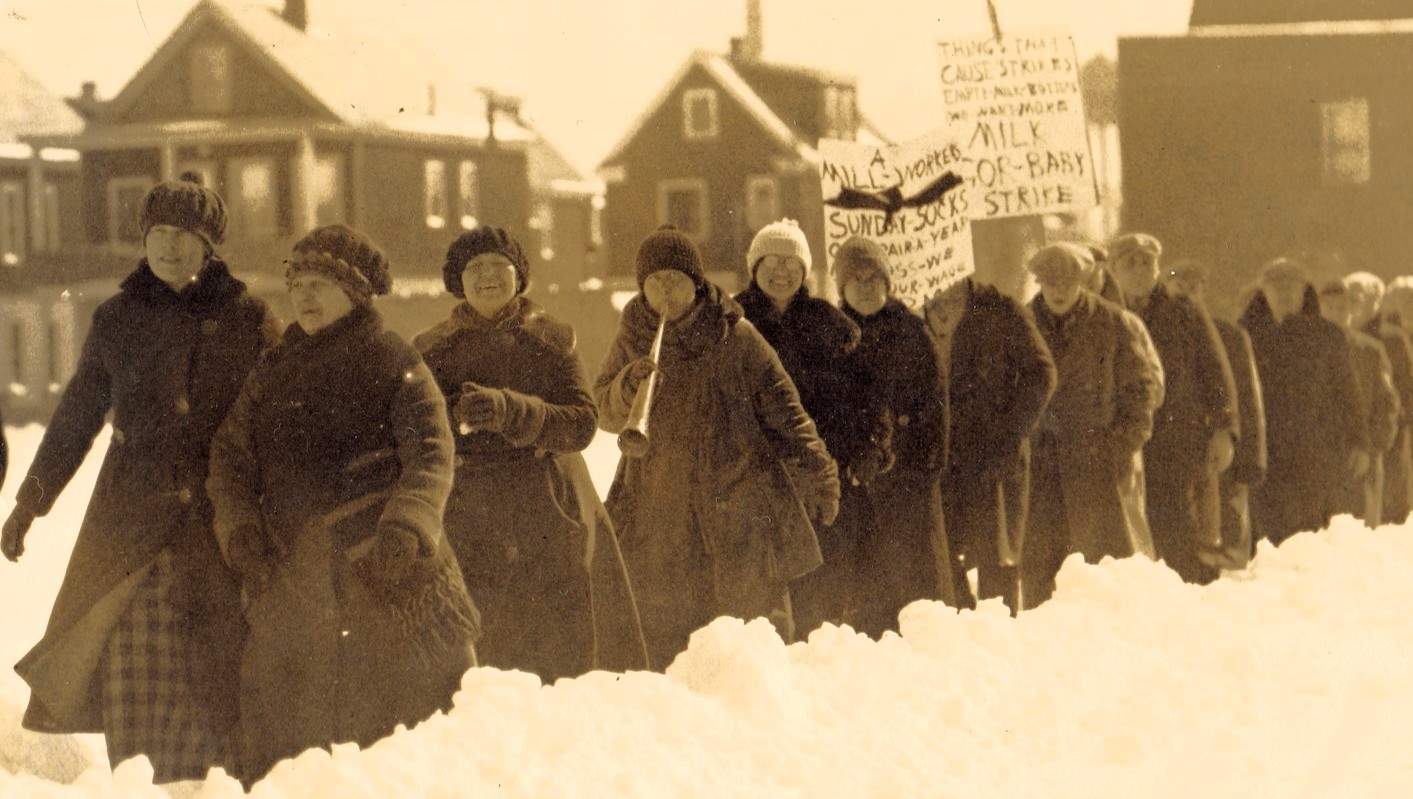
Vorse with a portrait of a real person and a proletarian archetype, Anna Breznak, “she never misses a strike meeting,” who came into her considerable own during the 1926-27 struggle of Passaic’s mill workers.
‘Mrs. Breznak’ by Mary Heaton Vorse from The Daily Worker Magazine. Vol. 3 No. 70. April 3, 1926.
Publicity matter issued by the Passaic Textile Strikers’ United Front Committee, by the famous novelist, Mary Heaton Vorse.
***
SHE never misses picket line. You always see her tramping sturdily along, a short, powerful figure, broad-shouldered, deep-breasted, a heavy-built woman, strong. Her mouth is a determined line. Her nose juts out obstinately. Her eyes are two bright sparkling points. Humor and intelligence are in them and often indignation and anger. She never misses a strike meeting. After the meeting you could see her in the hall talking. Maybe she’s telling what happened on the picket line. Maybe she’s telling how her husband first made fifteen cents an hour and pretty soon that is all the workers will be getting if they don’t win this strike.
Round and round, she’s always at strike meetings at night. She is a delegate of the united front committee from the Botany mills. Some way she embodies the spirit of the strike more than any other one person. Strong, powerful, persistent—she is fortified with the indignation of years. That is Mrs. Anna Breznak. She is not an individual—she embodies the working mothers, whose slow anger is now kindled.
THE reporters have called several of our young picket leaders Joans of Arc of the strikers. It is fun for a young girl to lead a parade and see the glitter of danger flickering around in the air. When you are young any change has romance. When you are fifty-two years old, crawling out of bed at five o’clock in the morning and walking miles and miles, passing and repassing the police, patrolling the high ramparts of the mill back and forth, miles and miles, is quite a job. There is a sturdy defiance about her as she plods up and down. She is tireless. She always acts as if there was an inward indignation boiling in her. And why shouldn’t there be?
HERE is a part of the true story of Anna Breznak. She came to this country from Czecho-Slovakia when she was a very young girl. She married a coal digger and went to live in Pennsylvania. The little Pennsylvania mining towns are very nice towns. They have substantial brick houses. There are no mean tenements there. The country is hilly and wooded and full of streams. Those Pennsylvania hills are good places for children to grow up.
Work was very slow in the mines and Mrs. Breznak had a relative who wrote her that there was plenty of work in Passaic. She came to Passaic many years ago. During this time she has had twelve children, nine of them are living yet. Many of them are small and still in school. Breznak found work in the Passaic mills for fifteen cents an hour. Recently he has been making $18 a week. Mrs. Breznak makes $16.08.
This has been Anna Breznak’s life. Always more children. Children to be looked after. Children under school age to be cared for. A whole family living in four rooms and with herself working in the mills. A life full of effort and toil, of bringing up nine children. A life-time spent in the service of the mills, piling up money for somebody else. At the end of all these years of effort nothing to show for it except her nine children. No house for them. No possessions. A bare living and nothing else to show for a lifetime of work.
Then a wage clash.
Mrs. Breznak went on strike. She went on strike with all the power of her strong body, with all the power and high courage which made it possible for her to bring up her children. She went on strike with all the strength of her powerful body that makes it possible for her when over fifty to stand the gaff of the terrible night shift in the mills, ten hours a night, five nights a week, and a quarter of an hour at midnight for all recess. Indignation was her motor power. Mrs. Breznak is mad clear through, a fiery indignation sends a hot color to her cheeks when she thinks of what happened to the workers in Passaic.
Mrs. Breznak goes around the picket line to the halls where the strikers get their coffee. From there to the meetings and to the picket line again and to strike meetings at night. She plods through the long strikers’ day and she is never weary. The hot fire of indignation never dies down. It is there at the heart of the strike, smouldering a red-hot coal. There is no girl that is as tireless as she, for she knows the whole story of a workers’ life. That is why she is striking with the indignation bred of the accumulated injustice of years.
WHEN Mrs. Breznak went to Washington she took with her her indignation. She walked down through the marble hallway that led to Senator Borah’s room, a sturdy figure. Come to tell the capital what the workers in Passaic go through, come to shout to America from the senate steps, “We don’t make enough to eat in Passaic.” She strode down to Borah’s office chewing a piece of gum. Why shouldn’t she? This was only another kind of picket line. She was used to picket lines. This was another way of winning the strike.
Mrs. Breznak sat in Borah’s office and told Senator Borah and Senator Lafollette about her nine children. She told how her husband made fifteen cents an hour when he first began work in the mills. The reporters of all big papers were there looking at Mrs. Breznak sitting squarely In her chair, a hand on each knee, her head thrust out a little, answering clearly the questions that were asked her. Her answers seemed almost unbelievable. She answered loud and clear, did Mrs. Breznak. She told her story to senators, and she did not speak for herself alone. She spoke for all those other mothers in Passaic who work all night because the rich mills do not pay enough to their husbands to support their families.
“Sure I got to work nights,” says Mrs. Breznak, hands on knees, chewing a piece of gum. “How would we eat—me and all the kids? You see the more kids you got, the more youngsters in the house, the more in Passaic a woman’s got to work nights.” She spoke as though she were telling a commonplace. A murmur went through the company. Borah called it pitiful.
Yes, it is pitiful that the mothers of children have to work nights. “The more children they got the more they got to work nights,” but it is a commonplace In Passaic. That’s the way life goes in Passaic.
Mrs. Breznak finished talking to the senators, and by the time she had finished talking and the other members had finished talking, Senators Borah and LaFollette were sure that they ought to have a senate investigation. More ought to be kwon of the textile workers of the country, was what Mrs. Breznak said to them in a tone that had hot indignation behind it. No one was ever more convincing than she.
Mrs. Breznak and the others took a look around. They sat awhile in the senate gallery and they walked around the imposing Capitol grounds and wondered if the grave gentlemen inside there were going to do so much as give the textile workers a hearing. Next day Mrs. Breznak knocked on the door of the white house and they let her in, but she could not see the president.
From the white house the way led to the department of labor. Mrs. Breznak told Secretary Davis the story of Passaic. So she went through the picket lines at Washington tramping sturdily along. All the senators in the white house and the department of labor heard her story, told from the white heat of her indignation. She never misses a picket line.
The Daily Worker began in 1924 and was published in New York City by the Communist Party US and its predecessor organizations. Among the most long-lasting and important left publications in US history, it had a circulation of 35,000 at its peak. The Daily Worker came from The Ohio Socialist, published by the Left Wing-dominated Socialist Party of Ohio in Cleveland from 1917 to November 1919, when it became became The Toiler, paper of the Communist Labor Party. In December 1921 the above-ground Workers Party of America merged the Toiler with the paper Workers Council to found The Worker, which became The Daily Worker beginning January 13, 1924.
PDF of full issue: https://www.marxists.org/history/usa/pubs/dailyworker/1926/1926-ny/v03-n070-supplement-apr-03-1926-DW-LOC.pdf

