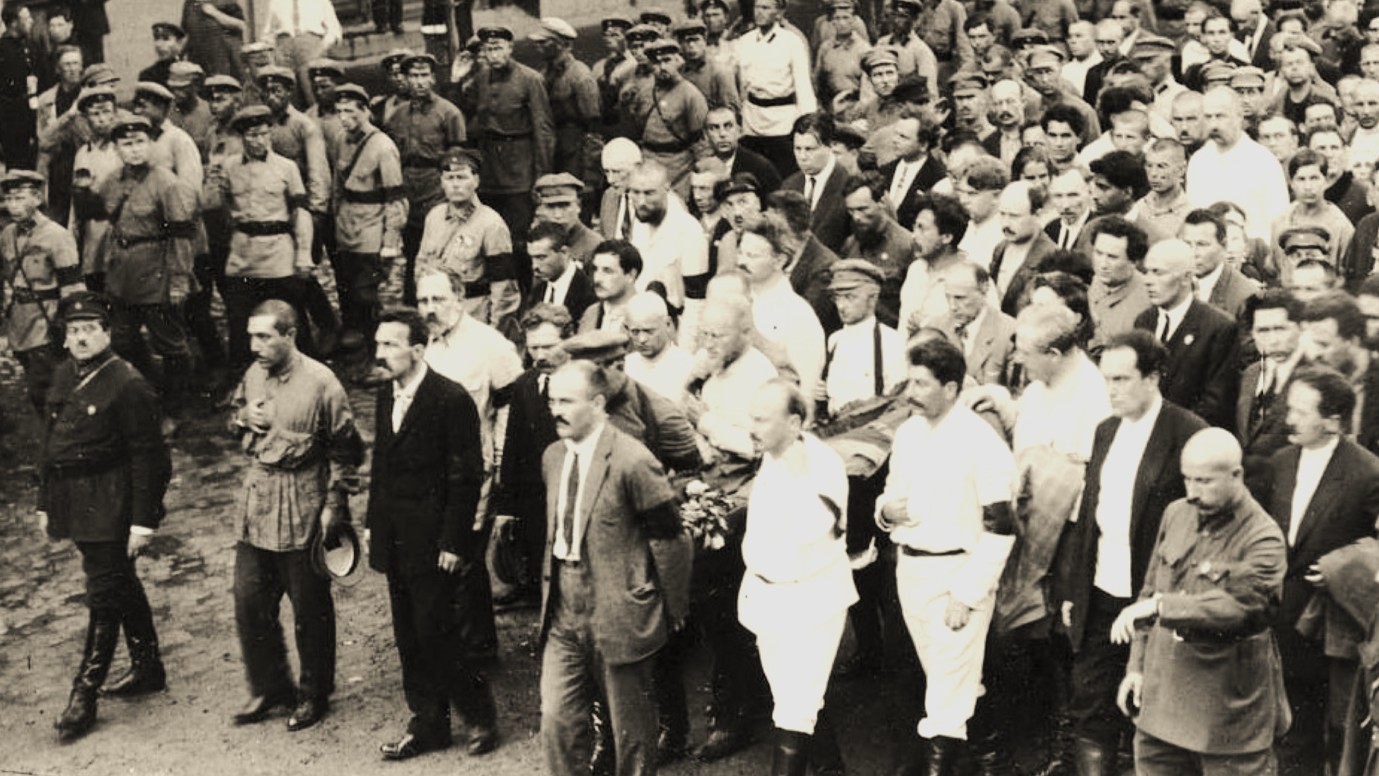
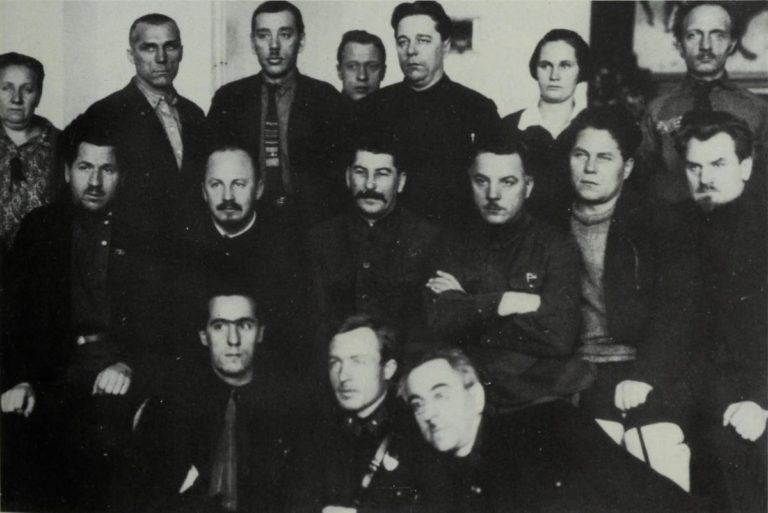
A major speech by Bukharin, and an important one for Soviet history, as Bukharin makes a lengthy report to Leningrad C.P. functionaries on the results of the recently-held Plenum meeting in which the new ‘United Opposition’ was decisively beaten. A meeting that became so heated, it is said Dzerzhinsky’s fatal heart attack during the over week-long meeting was exacerbated by, if not the cause of. In early 1925 factional allegiances began shifting in the Russian Communist Party. The ‘triumvirate’ of Zinoviev, Stalin, and Kamenev that defeated Trotsky and the Left Opposition at 1924’s 13th Party Congress broke down. Unresolved divergences over the NEP and associated questions, particularly related to the peasant classes, ‘Socialism in one country,’ industrialization and foreign capital, and Bukharin’s’ inflammatory ‘Peasants, enrich yourselves!’ The disputes came to a head at the 14th Party Congress in December 1925 which saw Zinoviev, Kamenev, Krupskaya, and Sokolnikov form the so-called New Opposition. Trotsky was not a direct participant in this dispute. Stalin allied himself with the ‘Right’ bloc centered on Bukharin, Rykov, and Tomsky, forming a majority of the Central Committee. With only Zinoviev’s Leningrad base (unanimously) supporting the New Opposition, they were defeated with the Stalin-Bukharin faction gaining even more seats on the Central Committee, Politburo and the Party’s policy bodies. While Zinoviev retained his position in the Politburo, he lost his base in Leningrad to Sergei Kirov and was relegated to the Comintern, for the moment. While Kamenev was demoted to alternate and lost his position as head of the Moscow Soviet for Bukharin. Trotsky was reelected to the Central Committee and Politburo; he and Stalin would be the only two consistent members of that body for the Revolution’s first decade. Those New Oppositionists, based in Leningrad, forces of the old Workers Opposition and the variations among Trotsky’s Left Opposition, joined together in May, 1926 commonly known as the United Opposition, to struggle against the Stalin-Bukharin Bloc at the 15th Conference. That conference was delayed, not happening until December, 1927 after the Opposition’s defeat and, in many cases, expulsion. In July, 1926 as a substitute for that year’s Congress a Joint Plenary Session of the Central Committee and the Central Control Commission met, where Opposition puts forward the “Declaration of 13,” signed by C.C. and Politburo members. It was the first confrontation in the new factional struggle and saw the Opposition roundly defeated in votes with leading Oppositionist Ossovsky expelled from the party, Lashevich removed from the C.C., Zinoviev and Kamenev (an alternate) lost their seats on the Politburo, and Bukharin’s authority would rise exponentially as he and Stalin would depose Zinoviev from the International’s leadership, which he had overseen since before its 1919 founding, with Bukharin effectively leading the Comintern, until he too would break with Stalin at the end of 1928.
‘The Party and the Opposition Block’ by Nikolai Bukharin from International Press Correspondence. Vol. 6 Nos. 57 & 58. August 19 & 26, 1926.
Report at the Functionaries’ Meeting of the Leningrad Organisation of the C.P.S.U., on 28. July, on the Results of the Plenary Session of the C.C. and the C.C.C.
Comrades! My present report on the results of the Plenary Session of the C.C. and the C.C.C. will differ to a certain extent from the customary reports on this theme, for the reason that the work of the Joint Plenum itself has been of an unusual character. A number of practical questions which formed the agenda have been dealt with from a general and from a fundamental standpoint, with reference to those political declarations and those attacks against the majority of the Central Committee which have been made on a developed scale against the C.C. by the opposition during this Plenary Conference.
In my present report I shall thus have to restrict myself solely to fundamental questions of principle in the political life of our country, to questions of principle concerning our Party, both with regard to inner policy and in part to foreign policy, as also to special inner Party policy. Before analysing the standpoint of the new opposition, I must thus give a brief survey of the general situation in the country, for the fundamental differences existing between the overwhelming majority of the C.C. and the comrades of the opposition arise from the estimation of the situation in our country, and of the role played by our Party at the present juncture. It is these varying estimates which give rise to the varying opinions as to the correct measures to be taken by our Party at the present stage of its historical development. Permit me then to first make a brief analysis of the general situation in our country.
The Economic Situation.
The Economic Growth of the Country.
I begin with the analysis of the economic situation. I must apologise for having to make recourse to figures here, though only to a very few. In our own ranks the growth of our economics, and the growth of the productive forces of the country, have become a generally acknowledged fact; and even our most obstinate opponents admit this fact. Even our bitterest and blindest class enemies have been forced by the pressure of undeniable facts, facts which cannot be even ignored under present conditions, to acknowledge our economic progress.
But for us Marxists-Leninists, for us who are building up a new state of society, the question of the general economic progress of the country is no more than the first and most general point in the analysis of the economic situation. We must follow up this question by others, and ask ourselves if our industry, which is the basis of socialist development, is progressing. If it is, we must ask its rate of progress, whether it is overtaking agricultural development, or if on the contrary agriculture is overtaking industry. We must ask whether the disproportion between our state industry and the 22 million farms is increasing, or if our industry is growing more rapidly. This is the first of the supplementary and decisive questions which we must put to ourselves after being assured of the fact of the general economic growth of the country.
The So-Called “Disproportion” in the Development of Agriculture and Industry.
I now pass on to this first question of the relations between the development of agriculture and of our industry. Here the position may be characterised by the following figures: The gross production of agriculture has risen between the economic years 1922/23 and 1925 26 from 66,8% to 88,1% of the pre-war level. During this period the gross production of industry has increased from 34,7% to 95%. Expressed in absolute figures, agricultural production increased from 7,8 milliard pre-war roubles to 10,3 milliards, that is, an increase of 32 per cent in the time given. If we refer to the gross production of industry, we find the following figures: In 1922/23 production amounted to the value of 1949 million pre-war roubles, in the economic year 1925/26 to 5215 million pre-war roubles. Our industry has thus increased by 274 per cent during this time).
Now to the living basis of our industry, that is, to the strength of the working class, for the question of the class struggle and our socialist development is in reality a peculiar form of proletarian class struggle will naturally be decided by those living people who represent in various combinations the main base of the socialist structure. The working class forms the fundamental human material of this socialist structure. It is the ruling class, the leading class, the vanguard class of the present transitional state of society.
If we ask how the working class itself is developing, and in particular what changes have taken place in its numerical strength, which represents under uniform conditions the decisive factor of its social class force, we find the following dynamics of development:
In the economic year 1921/22 the average number of industrial workers was 1,240,000. By June 1925 this number had increased to 1,555,000; June 1926 shows us the figures at 1,898,000, that is, in the course of one year, from June 1925 to June 1926, the most advanced stratum of the proletariat, the industrial working class, increased by more than 300,000. We can put the same question in another way, not merely with reference to the numerical increase of the persons belonging to the working class, but from the standpoint showing us what proportion of our total national income is represented by the income of the working class, that is, by their wages. I may assume that you are fully aware that our country is in the first place an agricultural country. The working class is still an insignificant minority in this country: We must therefore not be surprised at the smallness of the absolute sum; the important point is the change which has taken place in the proportion of wages contained in our total national income. In the economic year 1922/23 the sum total of wages, that is, of the income of the proletariat, amounted to 20 per cent of the total national income. By 1924/25 this sum had increased to 28,1 per cent for the whole Union, that is, almost 50% increase in a comparatively short time.
Thus matters were up to now. We have however now reached a stage in our economic constructive work in which our organs of planned economics are able to set themselves the task of fixing plans of orientation for comparatively long periods in advance. For one thing we have worked out a statement, which it need not be said, is only approximate and intended to serve as information, on the development of our economics during the next five years. This statement has been drawn up with the greatest caution by the collaborators in the Planned Economic Commission. According to this statement, the growth of agricultural, production is calculated at about 20,8 per cent for the five years 1925/30, whilst the growth of industrial production is estimated at about 110 per cent. The growth of all agricultural and industrial production is dealt with. The proportions change somewhat if we take into consideration not the growth of the gross production of agriculture, but only the part of this production put on the market, the part consisting of goods. Our provisional calculations would then yield figures anticipating that the goods obtained from the peasants’ agricultural production will increase by about 42/43% during the next five years.
This 110 per cent growth of industrial production shows us that the informative calculations for the next five years, based upon a careful study of existing factors, indicate that the growth of industry will surpass that of agriculture. This is the fundamental tendency underlying our economics, and was consciously adopted as such at the last XIV. Party Congress.
If we ask at what speed industry and agriculture will develop, we may receive the confident answer, both with regard to the years behind us and those coming, that the balance is in favour of industry, that our industry has outstripped agriculture in its development up to the present. And a study of all available data enables us to prophesy for the next five years, with equal confidence, further progress for the industrialisation of our country.
The Extent and Importance of Private Capital.
The second question which we must ask ourselves is: To what degree has private capital established itself in our country, and what are the comparative proportions of state economic development and private capital development. Here I must anticipate a little, and insert a small observation: We must differentiate strictly between private economics in our country and private capitalist economics, a point upon which many comrades–especially those of the opposition, as we shall see later–are by no means clear. Not all private economics, are private capitalist economics. The agricultural undertakings of the poor peasantry, and of the medium farmer employing no outside labour, are private economical enterprises, but do not represent private capitalist economics. But when we speak of our competition and our class warfare with private capital, we must inquire into the comparative powers of our state economics in all their forms on the one hand, and private capitalist economics, that is, economic undertakings employing paid labour, on the other. It is unfortunate that precisely in this point we are short of statistics, which should be compiled with special care on this point in our state.
The data at our disposal on the movement of private capital, its enlargement or diminution, cannot lay any claim to accuracy. We must devote particular attention to this aspect of this question.
A functionary of the People’s Commissariat for Finance, Kutler, recently made an attempt at calculating the extent of private capital and the annual accumulation within the private capitalist undertakings. An enquete was held among the private undertakings, but was extended to only about ten per cent of the private capitalist undertakings classed under the clearing tax. This last fact shows in itself how difficult it is to find firm ground in Kutler’s conclusions. However this may be, Kutler’s investigations into the role played by private capital are more favourable for private capital than any other inquiries which have been made.
According to his calculations, the technical side of which I shall not discuss here, as involving an indirect and complicated method, the gross proceeds of the 328,855 private capitalist undertakings existing in our country are expressed in a very considerable sum, according to Kutler somewhere between 319 and 585 million roubles.
At the C.C. Plenum one of the most respected members of the opposition, and one of our highest economic functionaries, Comrade Pyatakov, calculated the net gains of private capital at 400 to 500 million roubles, arriving at this result by another method, a method in which comrade Dzershinsky and other comrades have observed a number of errors. I need not deal with these errors here. I need only mention that Comrade Pyatakov made his calculation in the following manner: 11 per cent of industrial production is placed in the hands of private dealers. In reality, however, the private dealer trades in a very much larger proportion of industrial production; his share has been calculated at 40 per cent and even more. Comrade Pyatakov based his sum total of private capitalist accumulation on these figures.
Here he committed a number of errors, the chief of these being the following: If we place 11 percent in the hands of the private dealer by legal methods, and he receives in reality more than this 11 percent, then this is done by means of repeated re-sales. Let us say that the co-operatives, or our subordinate state organs, which buy goods from our state organisations at wholesale prices, resell these to private capital. But where such things happen and they do happen–we need not imagine that the private trader pockets the whole difference between the factory and the retail price. When he thus buys the goods at the third step of their sale, then the second link of the chain, the strata trade organ or the co-operative from which he buys, has already secured its profit, so that the private trader does not receive the whole difference between factory and retail prices.
Let us even assume the gross proceeds of the private capitalists to actually attain the 400 million roubles of Kutler’s favourable estimate, (I take the mean between 319 and 585 million roubles.). This figure is calculated to alarm us all, for either 300 or 400 million roubles is a very nice sum. If the gross proceeds of private capital are really expressed in such a sum, then this represents a very real social danger to our class. It would signify that private capital has intruded too far in its contest with us. But in my opinion this calculation neglects a fact of decisive importance. This sum does not represent net profits, expressing the amount of private capitalist accumulation, and therefore this sum cannot by any means be compared with the net profits of our state undertakings, our trade organs, and our state industry. Such a comparison is made the more impossible by the fact that the proceeds thus calculated include the whole gross profits of the capitalist trader, including that part of the profits which he consumes.
In the present case: What is the number of undertakings yielding this profit of 319 to 585 million roubles? There are 323,855 such undertakings. If we assume that it costs about 80 roubles monthly to maintain a family (here of course I may be greatly in error, but it is an error which can be easily corrected on one side or the other), this means sum of about 1000 roubles yearly. Thus 323 million roubles are consumed, and these 323 millions of “consumed” roubles must be deducted from the 400 millions of the gross profits, if we are to reach the actual accumulation fund of the private capitalists. This sum cannot therefore be compared for a moment with those figures expressing the net profits of our industry. When we calculate the net profits of our industry, we reckon our accumulation fund only, that is, the sums which can be employed for further expanding industry; we do not calculate the costs of maintenance of the technical staff, of the requisite apparatus, etc. But as soon as private capital is concerned, then the accumulation fund, that is the net profit which can be employed for enlarging the undertaking, is merged in the gross profits. This one correction alone suffices to throw quite another light on the actual comparative forces.
I have examined a large quantity of correspondence from the provinces on the growth of private capital in these different districts. In the Leningrad district (this is the one extreme) private capital has for instance been steadily retrogressing during the whole time, and its importance decreases from day to day. There are other parts of our Union in which private capital has won further positions of late. The greatest strengthening of the position of private capital has taken place in Ukraine. But even here, where private capital has grown at the greatest speed, it has just reached the level of 1924, our severe pressure upon it in 1923 having forced it to retreat. We have now loosened the reins again a little, so that private capital is beginning to press forward, and at the most dangerous point of its attack it has regained the level of 1924. Thus matters stand at present.
Turning to our state economics, communal undertakings, and co-operatives, we find the net proceeds of our socialised economic enterprises to have been 1025 million roubles in the year 1924/25; in the economic year 1925/26 the sum will probably be 1586 millions (the final calculation is not yet finished, so I can only take the probable figure). This is clear profit. Thus if we accept the most favourable estimate of the gains of private capital, as calculated by Kutler, first correcting the amount in the manner described above, by deducting the amount of capital consumed by private capital from its net profits, then we shall see that our state economics are established on a firm basis, and give no cause of anxiety as to the future of our development towards a socialist state of society. I believe that the further progress of our economics is bound to strengthen our position.
We must not forget that we have already proved our manoeuvring capacity in this sphere. A few years ago, quite a comparatively short time ago, we exercised pressure upon private capital, and began to supplant it with extraordinary rapidity; as soon as we saw that we had drawn the reins a little too tight, we loosened them again. It has been seen that we are able to do this. These repeated tactics for the control of private capital have shown clearly that our state power is fully able to regulate at will, and that, should actual danger arise from private capital, we can at once apply the lever of our credit system as we have already done before the lever of our railway transport, of our taxation apparatus, and of our whole economic apparatus, and thus rapidly push aside private capital if needs be.
The existing relations of class forces show us where to apply the necessary levers at any given moment. We see for instance that private capital has now turned its attention to the villages. This must stimulate us to strengthen our own position there. We see that only recently private capital was using our state credit to too great an extent. Here we had to apply pressure. We see that we can learn from private capital how to increase the rapidity of circulation, for we observe that the means of private capital circulate much more quickly than our means in the more unwieldly and bureaucratic state institutions. Here pressure must be exercised to accelerate circulation. We see that private capital exploits the investor, especially the contractors with whom it deals, and attracts outside capital with the aid of a minimum of its own. We have not yet shown ourselves capable of doing this. We have not yet adequately exploited agricultural accumulation for the uplift of our industry and our co-operatives. Here it is again needful to draw the logical conclusions. That we must draw these conclusions is true, but it is quite wrong to say that private capital hangs over us like a threatening thundercloud. This is perfect nonsense.
The Class Differentiation in the Villages.
A few words on the peasantry problem. There are some comrades who imagine the differentiation among the peasants to have already reached such a point that the problem of the medium farmer practically exists no longer. Unfortunately, our statistics fail to give us the required information here. We have no figures showing the present differentiation, or its progress of late. Still I should like to make a general observation on a point which in my opinion can and must be accorded attention. If you look at any capitalist country, even a capitalist country developing with tempestuous rapidity on capitalist lines, we Marxists-Leninists recognise (and Lenin himself would have recognised) that the solid mass of the medium peasantry cannot be changed within a few years; it can be hollowed out by the current of capitalist development, but the process will be much slower here than in the industrial class, where the middle class, the medium city bourgeoisie, is forced out of existence much more quickly.
And if this is the case in a capitalist country and under capitalist rule, where the whole mechanics of capitalist society drift forward at the speed prescribed by the maximum speed at which the middle peasantry is decomposed and the differentiation of the peasantry accomplished, it is much more the case in the Union, where the nationalisation of the land has rendered a rapid differentiation impossible in any case. Lenin emphasised this frequently. I may even refer to that speech of Lenin’s which was recorded for the gramophone, and sent to all the villages and towns of the Soviet Union as one of the most important and popular speeches ever made by Lenin on the peasant question. This speech dealt directly with the nationalisation of the land, and with the importance of the middle stratum of peasantry in connection with this. Thus, whatever may be asserted on the subject, we cannot conclude that any very great change has taken place with regard to the differentiation of the various strata of peasantry during the past two years. It is impossible.
The Growth of the Co-operatives.
One of the factors characteristic for the situation in our country, and one which is universally admitted to play an important rôle, is the stage of development attained by the co-operatives, especially by the agricultural co-operatives. If we examine the balance of the agricultural co-operatives, we see that this increased to four and a half times the original balance between 1. January 1923 and 1. January 1924, and between 1. January 1924 and 1. October 1925 it was again nearly doubled (90%). This extreme rapidity of agricultural co-operative growth speaks to a certain extent for itself. It shows that although our efforts are still extremely faulty in this direction, and though we are still lacking in the necessary energy in this task, still a mighty work is developing here.
The Total Balance is in Our Favour.
Having established the fact of the general economic progress of the country, we may ask ourselves the second question, the question of the relations between the positions of state economics and of private capitalist economics. We shall find that private capital, expressed in absolute figures, has increased, whilst at the same time the position of the socialist elements in our economics has become comparatively stronger. It may be observed that this same specialist Kutler, to whom I have referred here, and who has estimated the maximum figures for the accumulation of private capital, himself declares that the comparative participation of private capital in our collective economics is falling steadily. That is, despite the fact that in his opinion the gross proceeds of private capital amount to 400 million roubles, still the sphere of socialised economics is increasing with so much greater rapidity that the percentage of private capital is sinking. Thus even this expert has acknowledged that our growth is outstripping that of the private capitalist, and assuredly and finally this is the decisive factor. If private capital has increased to this extent, and we still outstrip it, then this a proof of the general growth of our whole country, and of the strengthening of our position within this growing economic life.
We thus see, firstly, that the city, city industry, and all industry, are outstripping agriculture; and secondly, that nationalised economics, that is, state economics, communal economics, and the co-operatives, are outstripping private capital.
These are the most important conclusions to be drawn from the analysis of our economic situation. It need not be said that when I speak here of these conclusions. I am not asserting that the progress is not accompanied by contradictions, on the contrary, I am assuming their existence. I do not in the least attempt to conceal, either from you or from myself (it would simply be stupid to do so) the fact that private capital is growing. I have intentionally adduced the figures showing most clearly the extent and importance of private capital in our country, and its relatively favourable position. And yet the total balance, after according due consideration to the contradiction involved in the growing power of our class opponent, is in our favour, in favour of the working class, in favour of the proletarian dictatorship, in favour of the socialist part of our economics.
The Political Situation in the Soviet Union.
We now pass on the political situation in our country. I shall make this part of my speech extremely short, for the political situation mirrors in all essentials the events of the economic situation.
The Pacification of the Peasantry.
If we regard the situation from an entirely general standpoint, we must first mention, as one of the most important factors determining the political situation in our country, the pacification of the peasantry, the pacification of the mass of the middle peasants.
Our life develops at such a rapid pace nowadays, that we often forget what the situation was like only a short time previously. But if you will recall to your memories the time before our XIV. Congress, and go back a few months, you will remember the unrest at that time among the peasantry, including the masses of the medium and poor peasantry. In many districts the middle peasants joined with the kulaks, and actively expressed that dissatisfaction with the Soviet power which took its rise among the big peasant elements. We see that this peasant unrest has died away. Confidence is growing in the Soviet power, in the Communist Party. This is an immediate consequence of our correct political line, especially of our course towards vitalising the Soviets, towards revolutionary legality, towards the regulation of the conditions in the whole system of our Soviet organs on the one hand, and towards creating a number of economic facilitations the sphere of agricultural taxation on the other.
This pacification of the peasantry can only be rightly considered if taken in its connection to the strengthening of the proletarian dictatorship. The political state of the peasantry is one of the most decisive factors for the security of the proletarian dictatorship. A proletarian dictatorship at war with the peasantry and with its main mass, the middle peasants, can never be secure. It was not by accident, and not an empty phrase, when Lenin told us that the supreme principle of proletarian dictatorship is the alliance with the peasantry.
It is not by accident that this saying has become a winged word. It was and remains one of the most important theses of Lenin’s teaching. The favourable alteration which has taken place in the political temperature of our peasantry, and not at the cost of growing passivity, but accompanied by growing activity among the peasants, is one of our greatest successes in the political life of our country. It signifies the firmer establishment of the proletarian dictatorship, and an increase in the guiding influence of our party.
Our Growth is Acknowledged Abroad.
The shifting of proportionate forces within our country, thus resultant on our economics growth, and on the increasing preponderance of the socialist section of our economics in our collective economics, has inevitably led to a regrouping of forces in the international arena. Our growth is admitted by our enemies. The fact of our growth forces them in itself to trade with us, to negotiate with us, etc., and yet at the same time to attempt to paralyse our growth. I need only remind you of the various preparations made by the English government and the English bourgeoisie for the financial and economic blockade against our Union.
With regard to our semi-friends, the broad masses of Social Democratic workers, it is clear to everyone today that the fact of our growth and the strengthening of the socialist element is making its way into socialist heads, even through the log of bourgeois mendacity. We see this in the increasing frequency of visits from workers’ delegations. A communist comrade accompanying a German delegation told me yesterday that anyone who still maintained, in Germany, that our steel industry is no socialist industry, that the number of our workers is lessening, and that everything is going backward in the union, would forfeit all confidence, even among the Social Democrats, who would recognise this repetition of the lies of the bourgeois press and of the most reactionary leaders of Social Democracy.
We Develop more rapidly than our Opponents.
The above is a brief sketch of the economic and political situation of our country. It is obvious that the strength of the enemy is growing, both in the sphere of politics and of economics. It is clear that we must face the political dangers confronting us. It is clear that we must face the danger threatening us from the rich farmers, the NEPmen, the bourgeois intelligenzia so often combining with these, etc. We must never forget these for a moment. We must realise that these dangers are growing. This is true. We should be very bad politicians if we did not cast a glance at this aspect.
But when we draw the general balance, when we observe the right proportions of light and shade, of our growth and the growth of our opponents, of our achievements and our faults, then we can tell ourselves the plain truth here, and this truth is: in general we are growing more rapidly than our opponents, in general there is no threatening thundercloud hanging over our heads, in general we are on the right road.
II.
The Ideological Differences Between the Party and the Opposition.
After this brief sketch of our present position, we pass on to the questions raised in part in the C.C. Plenum by the comrades of the opposition, in part outside of the Plenum in connection with the work of the Plenum, or appearing in the utterance of other oppositional writers, journalists, theoreticians, and political economists. I shall classify remarks on the questions in accordance with the main problems confronting our Party at the present time, from the correct estimation of which our policy, our political standpoint, and the conclusions which we as leaders of the policy of the Party must draw for the immediate future from the present situation, depend at the present time.
Economic Policy in its Relations to the Industrialisation of the Country.
I shall first deal with the problem which I should like to name the problem of economic policy in its connection to industrialisation. I shall endeavour, though briefly, to dissect those theses of the oppositional comrades which express in their totality the system of the views of the opposition and their economic platform, and to compare these with the standpoint of the whole Party.
The first thesis advanced by the opposition is the assertion that our industry is retrogressing, and that the disproportion between agriculture and city industry is increasing, to the detriment of city industry. I settled with this thesis to a great extent in my introductory remarks. It is characteristic of an opposition to paint the situation in exaggeratedly dark colors, but there should be limits to this process. However, the comrades of the opposition maintain that our industry is falling behind agriculture, that it is not developing so rapidly as agriculture, and that the policy pursued by our Party and the policy of the majority of the C.C. are to blame for this.
As early as 1923, during the discussion on the price policy, our Central Committee was accused of so acting that industry remained backward as compared with agriculture, and in particular it was accused of a price policy detracting from the necessary growth of our industry. But you will remember, comrades, that facts have confuted these accusations. During the first economic year following the discussion of 1923, our industry made a spring forward of 60%. In the following year there was another advance of 40%. Our industry developed with amazing rapidity. This thesis of retrogression in industry is based in the first place on incorrect figures. At the beginning of this report I put the question in a positive form, and you have seen that the total balance is undoubtedly in favour of the growth of industry as compared with agriculture.
The second thesis advanced by the opposition in the sphere of economic politics, in their relation to the industrialisation of the country, is the thesis that we must now carry on a greatly intensified industrial policy, this to be accomplished in the first place by increasing the prices of our industrial products. Comrade Pyatakov, speaking in the Plenum on behalf of the opposition, spoke in favour of a rise in the factory prices of our industrial products, the rise to be actuated by our state economic organs; in his opinion this is one of the measures which has to be taken. These comrades are of the opinion that it would lead to a more intensive industrialisation of the country if we were to pursue a policy excluding reductions in prices, and aiming rather at increased prices for the products of our industry, and even at higher wholesale and factory prices.
We believe this policy to be entirely wrong, and we cannot agree to its pursuance. One reason, why we cannot accede to it is the fact that a rise in the prices of our industrial products, consumed as these are for the most part in the towns, would involve a change in real wages, so that such a rise would endanger us both with regard to wages and with regard to the stability of the currency. And we cannot accede to this policy, because it would not only fail to help us to overcome the main evil of our industrial organisation, the evil of bureaucracy, the evil of unwieldiness, of enormous costs entailed both in the industries themselves and in the trade apparatus, the evil of irrational organisation of work, but it would make it even more difficult for us to rectify another category of our sins, those represented by the weakest points of our industry. Were we to accustom our industry and our economic organs to a higher price policy just at this juncture, then our economic functionaries would not move a finger towards the improvement of the whole organisation itself, towards the diminution of unproductive tasks, and for rational working arrangements, decreased working expenses, reduction of costs of production, improvement of quality, etc.
Every monopoly runs a certain danger of rusting, of resting on its laurels. The private capitalist and private owner is constantly being spurred onward by competition; if Peter works badly and has great working expenses, whilst Paul manages at less expense, then Paul beats Peter. But if we, who have practically all big industry in our hands, who have a state super-monopoly and own all essentials, do not stimulate the leading staff of our industry to cheapen production, and to produce on more rational lines, then indeed we have arrived at the prerequisite stage for the rusting of our industry on the basis of its monopoly. That which is actualised by competition (which does not exist, or exists in a very slight degree among us) in a capitalist state, we must attain by conscious pressure under the impetus of the needs of the masses: produce better and cheaper, supply better goods, supply cheap goods!
But if our price policy deviates from this principle, then we shall not fulfil Lenin’s behest that our industry is to supply the peasant with cheaper goods than capitalism has done; we are more likely to find ourselves in a position in which the workers, and a thousand times more the peasants, will say to us: “What has been the object of the whole matter, if your economics lead to higher prices for your industrial products? You understand nothing of economics.”

We must prove in actual practice that we understand economics very well indeed, and must thus devote our main attention to a policy of steady reductions in prices, actualised by reducing the costs of production and by creating better order in our state economic machinery. I stated, above, when analysing the question of private economics, that the private capitalist contrives to keep his capital in quicker circulation, that his working expenses are lower, that he works with greater thrift etc. and that our apparatus is unwieldy, that its capital circulates slower, that its working costs are enormous etc. This depresses us. If we are not to stand aside before the capitalist, and if we are to make progress ourselves, to improve the quality of our products, to cheapen our goods, to develop the economic alliance with the peasantry, then we must exert our utmost endeavours for the reduction of prices, not for their increase.
The opposition is of the opinion that its policy of higher prices would ensure more rapid growth for industry, but we are of the opinion that this view is entirely wrong, an illusion, a self-deception. The policy of high and rising prices would lead on the contrary to stagnation and rust in our industry. Our industry would rest on its laurels and trust in being able to cover everything out of the state exchequer. It would do nothing for its advancement, for its development, or for the attainment of a position as progressive technical and economic factor in our economics.
The third thesis which must be analysed in connection with this, or must at least be mentioned, is the thesis of the danger threatening us from private capital. I dealt with this thesis in my introductory remarks. I assumed the most favourable estimates on private capitalist profits to be correct, and am confident of having proved that even these most favourable calculations show no signs of that threatened private capitalist danger which is supposed to be hanging over our heads.
The fourth thesis, finally, advanced by the comrades of the opposition, is the assertion that our state organs are almost completely degenerated, that they have become entirely detached from the masses, and that the state, economic, trade union, and co-operative organs, as also the Party organs and above all the state economic organs, are joining forces with the NEPmen, the kulaks (rich peasantry), etc. To this I must observe: It is true that through the fault of our bureaucracy there is a tendency to such degeneration among us; this cannot be contested. But we must contest with the utmost decision and energy the suggestion that our state industry is already degenerated, that it no longer represents the industry of the working class. This is an assertion towards which the oppositional comrades are steering, and they have very nearly ventured to express it outright.
Our industry is the state socialist industry of the working class, but it has fallen a victim to the bureaucratic spirit. This is our definition. The fight against bureaucracy must therefore form one of our leading tasks, and here we must unfold ever increasing energy. But still we are very far from a position which would justify the comrades of the opposition in advancing such a thesis.
The Peasantry Question.
This is how matters stand with regard to the first problem the problem of economic policy in its relations to the industrialisation of our country. I now pass to the second problem, one of most decisive importance: to the problem of the peasantry, and to the economic aspect of this problem.
When we attack this question first from its theoretical side, one point stands forth conspicuously, and I draw your attention to it because it represents, so to speak, the springboard from which the “New Opposition” takes its leap when solving this or that question in connection with the peasantry. This is the manner in which private capital and peasantry are identified with one another, and agricultural economics confused with capitalist economics. Private economics are regarded as identical with private capitalist economics, and there is a lack of comprehension of the fact that there can be such a thing as non-capitalist private undertakings. The discussion at the XIV. Party Congress dealt with all this, but it has not been so completely formulated until now.
I must first of all draw your attention to a theoretical compilation of all oppositional proposals, ideas, assertions, theses, etc., to comrade Preobrashensy’s book “On the New Economy”. Here the economics of our country are regarded as follows: On one side we have state economics, on the other private economics, and nothing besides. Private capitalist economics, the economics of the small peasantry, and every kind of private economic undertaking among the poor peasantry, the middle peasantry, etc. are all thrown together.
It need scarcely be emphasised that this standpoint is entirely wrong. When Lenin asked “Who is going to defeat whom?”, we the capitalists or the capitalists us, he put the question from the viewpoint of: Who is going to win over the peasantry? Shall we win over the main mass of the peasantry, or will the capitalists do it? In Lenin’s conceptions the peasantry played chiefly the role of an object subject to the influences of the opposing class forces. And when we put the question of “Who is going to defeat whom?”, the answer will be essentially decided by the question of who succeeds in drawing over the peasantry to his side, for the struggle between the working class and the capitalist is a struggle for the peasantry. It is thus entirely absurd, and flatly contradicts Lenin’s standpoint, when private capitalist economics are identified with agricultural economics in all their various strata.
This brings us to the second question of this series of peasantry problems: the question of “pumping over” means from agricultural sources, and from private economic undertakings, into industry and into state economics. This is no simple question. It is perfectly clear that our state industry cannot obtain the means for its expansion solely from the work done by the working class within this state industry itself, and that it must necessarily draw on the non-industrial reservoir for the means to support and expand industry. One of the resources upon which we must draw, is the peasantry. The peasantry must take its share in helping the state to build up a socialist state of industry, and thus the tax revenues, the industrial profits on the goods which we sell to the peasantry, and other various revenues, are drawn to a certain extent from the peasantry.
It would be entirely wrong to say industry should develop solely upon what is produced within this industry itself. On the contrary, the whole question is: How much can we take away from the peasantry, to what extent and by what methods can we accomplish the pumping over process, what are the limits of the pumping over, and how shall we calculate in order to arrive at favourable results? This is the question. Here lies the difference between us and the opposition, a difference which may be defined by saying that the comrades of the opposition are in favour of an immoderate amount of pumping over, and are desirous of putting so severe a pressure upon the peasantry that in our opinion the result would be economically irrational and politically unallowable. We do not in the least hold the standpoint that we are against this pumping over, but our calculations are more sober, we confine ourselves to measures economically and politically adapted to their purpose.
If we look at the matter with the eyes of comrade Preobrashensky and a number of other comrades who do not notice the difference between private capitalist economics and peasantry economics, then it is only natural that anxiety as to the limits to be observed appears to be entirely superfluous, since we deprive the private capitalist of everything which we possibly can and only permit his continued existence as a possible milch-cow for the future. But we cannot adopt the same attitude to wards the peasantry as to the private capitalists. We cannot find a common formula applicable alike to the middle peasant, the rich farmer, and the poor of the villages, as comrade Preobrashensky would like to do. This is not the right way to put the question. Theoretical standpoints such as this lead us to different conclusions in practical politics as in other things.
The opposition proposes: Sell as dearly as possible. In selling goods at higher prices to the peasant, you are taking more from him. “Take more!” this is the whole wisdom of the opposition. The formulation laid down by one of the comrades of the opposition, comrade Ossovsky, in an article which we published as discussion article in the “Bolshevik”, consists of the statement that we are now taking less from the peasantry than the Czar did. We should take more, and all evils will vanish from among us. But we must not judge like this, not merely because it would be inconsistent with our policy with respect to the peasants, but because it is incorrect from the standpoint of economic adaptedness to purpose, it is a naive illusion, self-deception. It is ridiculous to suppose that our industry could develop with maximum rapidity under such circumstances.
Let us take a rough example. This year we could take ten times as much from the peasants as we are actually doing, and invest this in industry. But what would happen next year? Next year our agriculture would be worth nothing, we should have no raw materials, no cotton, no export grain, etc. At the same time industry receives an enormous influx of capital, everything which we can possibly squeeze out of the peasants. It would be nonsense to believe that this would secure the most rapid speed possible in the development of industry; obviously the first result would be a narrowing down of our markets, an absence of buyers.
I have chosen a rough example intentionally, but it serves to show that the maximum speed of development of our industry is by no means guaranteed by the maximum sum extracted from the peasantry. The matter is not so simple as all that. If we take less today, we thereby promote accumulation in agriculture, and ensure for ourselves a greater demand tomorrow for the products of our industry. If we secure higher gains for agriculture, this will enable us to take more next year than we could last. We thus secure for ourselves a still greater increase of revenue for the following year, and this revenue we can employ in our industry. This policy naturally involves a somewhat slower rate of speed this year, but will be compensated later by a rapid rise in the curve of our development. But if we adopt the policy of the opposition, we fly to a high summit of capital investment during the first year, only to fall the more inevitably, and probably with a very abrupt drop. We can by no means guarantee our progress by these means. The policy pursued by the C.C. is adapted to the actualisation of our industrial development. The policy recommended by the opposition would not only plunge us into a series of political difficulties, but would retard and destroy the speed of progress of industry.
Now to the third question, which I have already discussed in my positive consideration of the situation The comrades of the opposition exaggerate most frightfully the differentiation within the peasantry, and thus they constantly tend to fall into the mistake of ignoring the middle peasant; they devote too little attention to the question of the uplift of the middle peasantry, to the question of the co-operatives, etc. In connection with this aspect of the peasant question they have further failed to grasp the problem of the transformation to be undergone in the economics of the peasantry, the problem of the guidance of the peasants into other systems of work and other paths of development, their guidance into socialist methods through the agency of the co-operatives, and through the growing influence of the organs of the proletarian dictatorship on the economics of the middle peasantry. This question plays an extremely important part in our discussion. It is expressed in various combinations, forms the basis of various differences, and remains one of those fundamental bones of contention between the great majority of the C .C. and the leaders of the opposition.
The Social Character of the Soviet State.
Let us now turn to the third problem, the problem of the power and the dictatorship of the proletariat, and the policy of the proletarian dictatorship within our country. You may perhaps ask: Has this question then become a matter of contention in our Party? And yet it is true; the opposition has made even this question a matter of contention. Even in this question it has begun to express its doubts in a series of attacks and assertions. At first it was only the character of our socialist industry which was made the subject of doubt, then came the doubt as to the correctness of our tactics in the peasantry question, and now the character, the class character of our Soviet power in our country is being questioned. This is another step in the development of the oppositional idea, another step away from the true Leninist standpoint.
Comrade Trotzky, in one of his speeches at the Plenum of the C.C., advanced the thesis of the “extremely non-proletarian character” of the Soviet power existing in our country. When the peasant question came under discussion, in connection with the results of the elections, the opposition stated that we are threatened by a deviation in the direction of the rich peasantry, and demanded decisive intervention on the part of the Party, in order to prevent any further shifting in a state already far from proletarian.
It must be observed that the idea that our state is not a workers’ state, that it is no longer the state of proletarian dictatorship, is gaining continual ground in oppositional circles. It might be thought that this sentence simply escaped from comrade Trotzky in the heat of discussion. This is possible; but in this case it would have been his duty to withdraw the assertion afterwards. This was the more necessary that I drew attention, in my speech at the Plenum of the C.C., to this sentence, as something entirely foreign to us.
I repeat that it is possible for comrade Trotzky to have made this assertion in the heat of the discussion. But this sentence does not stand alone. An article will appear in the next number of the “Bolshevik”, by comrade Ossovsky of the opposition. I have already made mention of another article of his in the “Bolshevik”, in which he maintained that we should not by any means take less from the peasants than Czarism and the landowners took. Comrades, you must accord more attention to this question, for you will well be able to grasp that the question of the character of our state power is to us the central question. Have we a proletarian dictatorship or have we not? All other questions decidedly depend on this one, for if we have no proletarian dictatorship, this proletarian dictatorship must be actualised. And then we have to clear out of the way every obstacle hampering the realisation of this proletarian dictatorship. Comrade Ossovsky writes:
“It would be well for us at the present moment to recollect the words spoken by comrade Lenin at the session of the communist fraction of the VIII. Soviet Congress. He said that our state is not a workers’ state, but a workers’ and peasants’ state. It is only now, six years later, that it becomes comprehensible why comrade Bukharin is by no means able to draw the conclusions rising from the fact that our state is no workers’ state, but a workers’ and peasants’ state. The Lenin view of the workers’ and peasants’ state assumes a certain inevitable distance between this state and the state consisting of the proletariat and to a certain extent of the peasantry. The attempts to ignore the inevitable distance between the workers’ and peasants’ state and the proletariat are likely to be disastrous to the proletarian revolution.”
This, translated into ordinary language, means: We have no proletarian dictatorship, our state is not a workers’ state, but a workers’ and peasants’ state; the proletariat must however defend its interests, and must thus oppose to a certain extent this workers’ and peasants’ state. Thus, if the proletarian Party wants to remain a proletarian Party, it must contend to some degree against the Soviet power. One thing must be said first of all, that it is becoming the fashion to try and find support in Lenin’s authority for all kinds of nonsense, and those who do this, think it is going to cost them nothing, and that they may practise this art as long as they choose.
Here comrade Ossovsky directs his fire upon me. Lenin grasped the fact that our state is a workers’ and peasants’ state. Bukharin fails to grasp it. And since Bukharin is well known to be an adherent of the majority of the C.C. it is only natural that the C.C. comprehends nothing of this question, and is thus pursuing a policy which, as comrade Ossovsky points out, can become extremely disastrous from the standpoint of proletarian revolution. First of all, I must challenge the testimony, and utterly reject this reference to comrade Lenin as witness, or rather, I myself call upon him as witness, in order to prove that comrade Ossovsky is entirely in the wrong, and that his standpoint leads in reality to conclusions disastrous to proletarian revolution.
The following was written by comrade Lenin (Complete works. Vol. 18/1, in the article: “The crisis in the Party”, page 33, Russian) with reference to the trade union discussion:
“When dealing with the discussion of 30. December, I must correct an error of mine. I said that: ‘Our state is in reality not a workers’ state, but a workers’ and peasants’ state’. Conrade Bukharin at once interpolated: ‘What kind of a state?’. In reply I referred to the VIII Soviet Congress then just concluded. Now, when reading the report on the discussion, I see that I was wrong, and comrade Bukharin right. I should have said that: ‘The workers’ state is an abstraction, and yet we have in reality a workers’ state, but firstly with the peculiarity that it is not the proletarian but the peasant population which preponderates in the country, and secondly it is a workers’ state accompanied by bureaucratic distortion’.”
This is surely perfectly clear, and comrade Ossovsky ought to have known that Lenin wrote this. Lenin here states directly, when speaking of the character of the state power: “We have a workers’ government, but the peasantry is in the majority in the country”. Right! “We have a workers’ state, but accompanied by bureaucratic distortion”. Right! Thus our proletarian dictatorship, our workers’ state, has the peculiarities of working in an agricultural country and of having its state apparatus burdened with various bureaucratic aberrations.
This is perfectly true. But what is the class character of the state? It is a workers’ state. To state that our state is not a workers’ state, that it is already semi-bourgeois, is to assert that our state is already in a condition of degeneration, and to throw doubts upon the existence of the proletarian dictatorship in our country. And where comrade Ossovsky says this in so many words in a printed essay, comrade Trotzky expresses the same in his sentence on the “extremely non-proletarian character of our state.” If this really were the case, it would be a very serious matter indeed. If we really had no proletarian dictatorship, then we should have to pursue a very different line, and our Party, in so far as it is a proletarian Party, would obviously place questions on the agenda aiming at a radical purging of the present Soviet power. Could it be otherwise? This is the first thesis.
The Rumour of the Bureaucratic Degeneration of the Soviets.
This brings us to the thesis of the degeneration of our whole state apparatus, and of the deviation of our policy, and of the policy of the present Soviet state, from the interests of the broad proletarian masses. Comrade Kamenev has declared in Iso many words:
“The line you take is departing from the line of proletarian revolution, and is deserting more and more the interests of the broad proletarian masses.”
This is entirely in harmony with the idea that “our state has an extremely non-proletarian character”, and with Ossovsky’s assertion that we have no workers’ state. It harmonises entirely with the whispers and rumours on the degeneration of the Soviet power at present occupying so much of the time of “pro-new-Soviet” (“Smyenovyekhovzy”) elements and various other liberal opponents of our policy. The opposition has pointed out that the numerous bureaucratic groups in our state apparatus are complemented by the equally numerous bureaucratic groups in the economic organs, the co-operatives, the trade unions, etc. It would thus seem that the whole of the groups composing our apparatus have practically nothing in common with the interests of the broad masses.
We have been believing in our simplicity that our Party is the vanguard of the proletariat; but now it turns out that it is a bureaucratic clique entirely detached from the masses. We believe the Soviet power to represent a form of the dictatorship of the proletariat, but it appears that all we have is an extremely non-proletarian state, headed by a completely declassed caste. The logical continuance of this train of thought is bound to lead sooner or later to the idea of the overthrow of the Soviet power it can lead nowhere else.
And I repeat: Were I personally convinced that the situation among us has reached a point at which we have no longer a dictatorship of the working class, and we are being ruled by an oligarchy detaching itself from the interests of the broad masses, then my only conclusion would be that of Kautsky: Overthrow of the ruling power. Our comrades of the opposition have not yet reached this logical conclusion, and are not likely to. I for my part believe that the “God” of the Bolsheviki will yet stay their steps in time, and this will be an excellent thing from the standpoint of the interests of the Party. But we should be very dense indeed if we did not comprehend that this remarkable ideological development takes a straight line in this direction.
The Rumour of the Submerging of the Soviets in the Peasant Petty Bourgeoisie.
There is another assertion of the opposition which tends in the same direction, the thesis that whilst our upper stratum, the Party, the Soviet power, the state and economic organs, are all submerged in a bureaucracy opposed to the interests of the working class, at the same time our subordinate Soviet organs are being submerged in the peasant petty bourgeoisie. The comrades take the election results and say: “Look, there are peasants in the village Soviets, and there will be more and more of them here this is the way in which the Soviets are being vitalised”. The upper stories of our building are being flooded by a bureaucratic clique, the lower stories by the petty bourgeoisie, and nothing but complete catastrophe is to be seen on both sides. The two waves will close over our hands and we shall suffocate.
This thesis of the submerging of our village Soviets under a flood of peasants is truly a pearl of creative thought on the part of the new opposition. The opposition appears to imagine it possible to govern an agricultural country in such manner that the working class non-existent in the village is still to maintain a numerical ascendency. How can anyone imagine that the industrial proletariat is to have the majority in the village Soviets? Anyone who can arrive at such an idea must truly have a cabbage in place of a head. (Applause.)
Everyone in possession of even the most elementary political knowledge is aware that the Soviet power and the apparatus of our Soviet state represent a special system actually composed of several stories. No other than comrade Zinoviev has often told us, with the greatest enthusiasm, that the non-Party peasants should be induced to participate. To participate in what? In the Soviets. Do we suffer from the fact that the principle of vitalising the village Soviets has led to the election of non-Party peasants to the Soviets? I am of the opinion that we do not suffer in the least from this. Where is the laboratorium in which we convert the peasantry, overcome their individual psychology, induce them to follow us, educate them to co-operate with us in the Soviets, and lead them on the proletarian and socialist road? This is best done in the Soviets. And now we are told that the peasant is to be forced into a dark room–he may learn over the wireless. This is nonsense. We convert the peasant by actual practice, we induce him to follow our lead, to help us to secure the proletarian line.
The structure of our Soviet machinery is as follows: There are supreme, middle, and subordinate organs. At the top there is a very powerful cadre, working under the leadership of cur proletarian Party, and composed in the main of Party members. The further we proceed downwards, the more non-Party participators we find, and in the villages we find the structure supported by non-Party peasants who have hastened to cur aid. We gradually introduce the non-Party peasants, who represent a petty bourgeois stratum, into the lower stories. We are secure in our firm proletarian leadership, and influence the peasants in our own way, introduce them into our system of work, teach them to work in the new way, and induce them to take part in the work of socialist construction. In this way the peasantry is guided by the proletariat. And when we admit the peasantry into the lower stories of the Soviet power, this is a necessary prerequisite towards the guidance of the peasantry by the proletariat.

We may take another example of the same kind, but from the experience of another country, for the purpose of refuting the clever assertions of our remarkable opposition. There is England for instance. England too has carried on imperialist war. As is generally known, Lloyd George, a bourgeois prime minister, admitted Henderson to his cabinet as representative of the working class and the trade unions. The same kind of thing has occurred in other countries. Now tell me this: is there a single Marxist who can maintain that at that time the English state was a bourgeois proletarian state just because Henderson was in the government? It need not be said that such an assertion would be absolute idiocy. You know who made this assertion. It was the opportunists. They said: Now, Henderson is a minister, and since he is a minister, this signifies a fresh epoch in the development of capitalism; the workers share the power, and we have no longer a bourgeois imperialist state, but something quite different. The proletarian dictatorship is being judged by the opposition essentially in the same manner.
When Lloyd George admitted Henderson into his cabinet, England did not cease for a moment to be a bourgeois imperialist state. Why? For a very simple reason. Because the bourgeoisie had sought out Henderson and his like for the purpose of transforming the ideology of the working class, and making the workers amenable to bourgeois ideology. Henderson fulfilled the task set him by the bourgeoisie. The bourgeoisie was enabled to take the working class in tow for the time being, and thus the nomination of Henderson as minister was the line on which the bourgeoisie drew the working class behind it, without altering the class character of their bourgeois power by a hair’s breadth. They simply took their class antagonist in tow.
But in cur case the greater part of the peasantry is not our class enemy, it is our ally, and when we admit these peasants into the apparatus of our state administration, and thus induce them to follow as, then it is surely a remarkable state of mind which can maintain that, because we do this, we have no workers’ state, but some schismatic petty bourgeois two-class state, etc. and that therefore we have to conclude it to be our duty to protect the purely proletarian ranks against the Soviet state.
The root of the theoretical error of the opposition lies in the fact that these comrades fail to understand that the proletarian dictatorship must admit its class allies to the organs of the dictatorship if it is to convert these allies to its standpoint, to guide them, and to lead them into the socialist path in the interests of what was to Lenin the supreme principle of the proletarian dictatorship, i.e. of the alliance between the working class and the peasantry.
This it the real definition of the standpoint. And if the existence of a proletarian dictatorship in our country is doubted because we have no industrial proletariat in the villages and in the village Soviets, because we have no industrial proletarians in our organs in places where not even a magnifying glass can discover a proletarian at all, then this simply means that the main task incumbent upon the proletarian dictatorship, the task of inducing the poor peasantry and the great mass of the middle peasantry to take part in the work of actualising a socialist state of society, has not been properly grasped. This lack of comprehension is a striking example of that lack of faith in the possibility of the actualisation of socialism in our country, of that lack of understanding for the methods towards this actualisation, which was discussed in such decisive terms at the XIV. Party Congress.
The Results of the Election Campaign.
In this connection I must say a few words on the recent Sovie: election campaign.
The last election campaign is the first which we have carried out without recourse to administrative pressure. We have applied new methods for the first time, and have transferred our preponderant attention to gaining the convictions of the voters and to exercising an ideological influence over them, and thus the various strata to whom our constitution accords the suffrage, enjoyed a greater amount of freedom at this election. What was the result of the elections? The result was that in the villages the proportion of communists elected was lessened, and that elements have thus been admitted to the village Soviets, and in part to the city Soviets, which have hitherto been practically suppressed. This circumstance has given our opposition the opportunity to maintain that this is evidence of our becoming submerged in the petty bourgeoisie, and that the pressure put upon us by the petty bourgeoisie is here expressed by the machine of state slipping from the proletarian rails.
To this the following may be observed: In the first place very many comrades have observed the following in the provinces: If there have been fewer communists elected to the village Soviets than at the last election (and in many places this is doubtless the case), those communists who have been elected this time, are supported by the whole village, whilst hitherto they have only been nominally elected, and in actual fact they were simply appointed, and possessed no authority among the villagers. It is true that there were more communists last time: but these communists had no contact with the masses and did not lead the masses. But at the present moment, when we are drawing the total balance of our Soviet elections, we may confidently state that even where only a small proportion of communists have been elected to the lower stories of our Soviet building, this does not signify any weakening of our growth, but is rather an expression of our growth, the proof that we are basing our leadership upon ideological conviction. One communist backed up by his whole village is worth ten communists standing alone.
Every great manoeuvre, and every considerable change of course, incurs expenses and renders a regrouping necessary. When we declared at the XIV. Party Conference that a regrouping had become necessary, some of our comrades lost their heads. They did not know what to do. Some abandoned their own Party opinions and yielded to the pressure exercised by others. Other again completely lost their bearings and did not know which way to turn. The real regrouping did not begin until after a considerable time. It is true that we have admitted a great number of peasants into the peasant Soviets without bringing them everywhere sufficiently under our influence at the same time. This has been our minus. We have not been able to rearrange our ranks with sufficient speed, but still we had to take the first step in this direction, we had to change our course in order to advance more rapidly upon the new path. There is really nothing terrible about this. Our ranks now rearranged, we are now beginning to influence fresh masses hitherto not quite within our reach.
At one time Comrade Zinoviev proposed that non-party conferences should be held, and a newspaper published for the non-Party peasants fraction, whilst Comrade Sokolnikov demanded the legalisation of the Menshevists and of the S.R. They made these proposals when they felt the ground somewhat insecure beneath their feet. They were prepared to abandon any position because the villages actually were grumbling against the Soviet power at that time. But when we make a carefully calculated evolution, calmly and collectedly, without fearing anything, and strictly calculating the proportions, then they shriek that we are slipping down. We are not slipping down, we are establishing the proletarian dictatorship more firmly, and tomorrow we shall establish it more firmly still, if we do not deviate from the line which we are now following, but pursue a correct policy.
In concluding my remarks on the problem of our power, I repeat and emphasise that even if the opposition had no doubts on the class character of our power at the time of the XIV. Party Congress, there is now an undeniable tone of doubt, of scepticism, of disbelief in the proletarian character of our power.
From the Idea of Freedom for Groups to the Idea of Political Democracy in the whole Country.
I now pass on the fourth problem, the problem of Party mechanism in the system of the proletarian dictatorship. You are aware that up to now we Leninists have regarded the unity and coherence of our Party as the first prerequisite for the maintenance and firmer establishment of the proletarian dictatorship. We Leninists have always imagined that the proletarian dictatorship can only be secure in our country, if our Party plays its role properly, and when this Party is in the first place the sole party in our country, that is, when the legal existence of other parties is made impossible, and in the second place the Party is consistent in its structure, that is, represents a structure excluding any independent and autonomous groups, fractions, organised currents, etc.
I shall not remind you, Comrades, of the expenditure of energy, the many words and the many gestures, which we have witnessed from Comrade Zinoviev, from this very platform, in his efforts to demonstrate this elementary Leninist truth. And now this has all changed at one blow. Now the whole opposition, the whole oppositional block–Trotzky, Kamenev, Zinoviev, Krupskaya, etc.–demands freedom for fractions within the Party. The first signal for this change of front was given by Comrade Zinoviev from the platform of our XIV. Party Congress. As you will know, Comrade Zinoviev declared on this occasion that we should call upon all former oppositional groups to share the leadership of the Party. This germ has since developed, not merely into a bud, but into a full blown, if not particularly sweet smelling and aromatic flower. (Laughter.)
It must be observed that if the opposition now insists on having our Party reconstructed on a basis permitting a freedom to form groups and fractions, some of the comrades of the opposition are arriving at conclusions of which we must take careful note if we want to know which way the wind is blowing. Comrade Ossovsky, of whom we have already spoken as a member of the opposition, pronounces the following judgment in the article quoted: In our country there is no unity of economic interests. The working class has its interests, and the peasant class has its interests, differing somewhat. And then there are private capitalists in the Union, again a third group of interests. But we have only one Party. And if we have only one Party, and will not legalise other parties, then we must arrange matters so that there can be elements within our Party itself who represent capitalist interests. I am telling you all this in my own words, but comrade Ossovsky writes in a learned language as follows:
“The positive solution of this question (that is, the question of the unity of our Party) would not be difficult if we had not to prove the possibility of the unity of a party not the only legal one”. (That is, if there were other parties as well.) “We should then be the sole ruling Party, but not the only party in the country. It is a much more complicated matter to prove the possibility of absolute unity in the sole legal party in a country containing extremely multitudinous economic tendencies. Noone denies that our economics include spheres in which capitalist spirit of enterprise could play a positive role. In this case the Party, remaining a united and sole party, has to actually protect all the interests in the country, including those of capitalist enterprise.” These are the super-clever theoretical arguments with which Comrade Ossovsky seeks to justify the demand for freedom to form fractions. If you want to one party only in the country, he says, and there are various interests to be considered, then strive to give “freedom” to those who protect the interests of the rich peasantry and the capitalists. It is difficult to defend the interests of the rich peasantry and the capitalists within the confines of our Party constitution. Let us open the door, and you will have a fraction of NEPmen, a fraction of the petty bourgeoisie, and all this together will be called the C.P.S.U. Then the dictatorship will flourish in our country, for then the Party will correspond to a workers’ and peasants’ state. Strictly speaking, we could go even further in the same direction. Presently he will be saying: “Workers’, Peasants’ and NEPmen’s State”. Then everything will be in the best of order. Workers’-Peasants’-NEPmen’s State, Workers’-Peasants’-NEPmen’s Party, one sole Party in the whole country, and everything in perfect order. (Laughter.) You will now understand what lies at the bottom of all this. The fractional groups in our Party are naturally based upon various social currents, and if we permit the formation of fractional groups, if we permit the existence of fractions, then the next stage will be nothing more nor less than the legalisation of other parties.
An example: There is a Medvedyev fraction, whose standpoint has been made known to you in an article published in the “Pravda”. (See “Inprecorr” Vol 6., Nr. 54, 29th July 1926, p. 904. “The Right Danger in our Party”.) Comrade Medvedyev demands that our state industry be placed in the hands of the concession capitalists, and that the Comintern and the R.I.L.U. be liquidated; he demands immediate affiliation to the Amsterdam International; he demands the cessation of all discussion on the peasantry, for the peasantry is the “dreary village”. This is a well-developed Menshevist programme.
We are told that we should grant freedom to this legitimate view to this fraction. Do they not call themselves, seriously. the “Workers’ Opposition”? It does not matter that they want to dissolve the Comintern and perform other revolutionary wonders; all this signifies nothing if only they call themselves the “Workers’ Opposition.”
Let us assume that we permit the existence of these fractions, and that our Party includes a legally recognised Medvedyev fraction. Then the Menshevists would next come to us and say: We ask for nothing more, at present we only want what Medvedyev wants: close the Comintern, destroy the Red International of Labour Unions, pursue policy of extensive concessions, and ignore the peasant, for why should you bother with him. They would say to us: “Why will you not legalise us, since there is already one such legal fraction in your Party?” It is obvious that we should then have to legalise the Menshevists. If we legalise such a fraction as this in the Party, we legalise by this another party, and if we legalise another party, then we are truly slipping down from the line of proletarian dictatorship to the line of political democracy. That is, to the line so long advocated by the Menshevists, by Kautsky, by the S.R. and by many others of our political enemies.
It is to be observed that oppositional circles seem to like to dally with the idea of two parties. This same Ossovsky prophesies that we shall have two parties in the immediate future, both which will call themselves communist at first: One party which will be in favour of withdrawal from the Anglo-Russian Committee and will stand for a very “international standpoint”, and another party which imagines that socialism can be built up in our country alone, a sort of “national-communist” party. This entertaining of the idea of two parties has already become extremely popular in oppositional circles. The standpoint taken by the opposition on the freedom to form groups and fractions is one step on the road to this idea, which in its actual essence is the idea of the justification of a split in the Party.
This is in our opinion the fourth fundamental problem dealt with at the Plenum of the C.C., and I believe that the opposition has here too wandered completely from the path of the ABC. of Leninism with respect to the importance and the character of the Party in our country, and from the ABC. of Lenin’s teaching on the organisatory character of our united and sole Party.
Results and Conclusions.
In what Direction is the Ideology of the Opposition Developing?
Comrades, I now come to the question which must have occurred to every one of you: In what direction is the ideology of the opposition developing, what is its ideological marching route, where is it going? I must refer once more to Medvedyev’s standpoint, but shall not repeat its outlines, as these are already well known to you.
It was not for nothing that the central organ of our Party entitled its article against Medvedyev’s standpoint: “The Right Danger in our Party”. Nobody with ordinary common sense can deny that the extreme Right is represented in our Party by a group of the one-time Workers’ Opposition, for it is impossible to imagine a more extreme Right in the sphere of international revolutionary politics than a standpoint in favour of the liquidation of the Comintern, a standpoint which names the West European Communist parties a “rabble of petty bourgeois lackeys” living “on Russian gold”, which demands the liquidation of the Red International of Labour Unions, the abandonment of cur socialist industry to foreign capital, etc. This standpoint inclines further to the Right than any other in our Party, strictly speaking, it is ideologically already quite outside of our Party. And we must never forget that the present opposition, which represents a block comprising various oppositional currents, includes as one constituent the group around comrade Medvedyev. The opposition has given us no sensible reply to our repeated requests to turn aside from the Medvedyev standpoint, at least at the Plenum of the C.C., and join hands with us for a determined attack upon it.
But this is not all: About a year ago a group of comrades commissioned Comrade Zinoviev to write an article against a letter in which Medvedvev explained his viewpoint, and to publish this article in the names of a number of comrades. Comrade Zinoviev did not execute this commission. When he was asked at the C. C. Plenum why he did not fulfil this duty, he replied literally: “Since you are directing your fire against the Left, I did not think it suitable to attack the Left comrade Medvedyev.” Thus Comrade Zinoviev regards the standpoint of comrade as a “Left” standpoint. Thus it would appear that, if Medvedvev is of the “Left”, then Comrade Zinoviev stands to the Right of him. I do not know what is to be thought of this logical conclusion. In reality Comrade Zinoviev is of course not Right of Comrade Medvedvev. This is happily not yet the case, but if we regard the ideological position of the various appositional groups, objectively and without consideration of persons, we can find an ideological bridge connecting the components of the opposition block.
What does Medvedyev Write on the Peasantry Question?
“It is foolish” he writes, “to suppose that the economic position of the small peasant can now be saved; it is inevitably doomed to decay and to complete extermination. It is mere petty bourgeois Utopianism to believe that there can be any hit in peasant economics.”
This is what we all said under the capitalist regime. But to speak like this under the conditions furnished by the proletarian dictatorship is to accept a standpoint widely differing from the Leninist. Comrade Medvedyev comes to the conclusion that there is no use in troubling about the “dreary” village. For him the peasantry is represented by this pseudonym of the “dreary village”. Why should we, real proletarians, trouble ourselves about the “dreary villages” (or with the “stupid rabble” in the Comintern)? Let us rather give our industry to the concession capitalists, in order that we may earn a few more pence. Such is the weak, flaccid, trade unionist countenance which peers forth from behind this platform. But when the comrades of the new opposition maintain that the differentiation in the peasantry has made such strides that the middle peasant comes scarcely in question, or when Comrade Preobrashensky fails to observe the difference between private capitalist and peasant economics, then we have here an undoubted ideological relationship to Medvedyev. These two standpoints are not identical, but they are ideologically related.
If our opposition throws doubts on the socialist character of our state industry, and Comrade Medvedyev attaches so little importance to this socialist character of our industry that he is prepared to abandon this industry to the concession capitalists, this is the second bridge connecting the ideology of the two groups.
If Comrade Medvedyev does not believe that we have a proletarian dictatorship, and is of the opinion that it is the task of the proletarian organisation to exercise pressure upon the state, and at the same time we find other comrades of the opposition letting slip such sentences as that on the “extremely non-proletarian character” of our state, then we have here the third ideological bridge between the group of oppositional comrades and the group around Comrade Medvedyev, which latter group may be said to be leading the way as “vanguard” of the whole oppositional block.
If Medvedyev believes that our Party is rotten, that it has run off the rails of proletarian policy, and Comrade Kamenev asserts that our policy deviates from the interests of the broad masses of the workers, again this ideological similarity forms a bridge, the fourth uniting these two groups with one another. All deviations begin in this manner and lead in their later development to entirely anti-Bolshevist conclusions. This is where the collective opposition and the Medvedyev group are ideologically related.
We shall be told that the most far-reaching, revolting, and evil-smelling proposition made by Medvedyev is that for the liquidation of the Comintern, whilst there is nothing similar to be found in either Zinoviev’s or Trotzky’s utterances. This is true, for the present. We should be the first to thank destiny were it to remain true for ever. But if the opposition continues on its present path, it may still lead to such a crisis. Ossovsky so often mentioned an adherent of Comrade Trotzky–has already hinted at this conclusion. He writes approximately as follows: Our Party, the C.P.S.U., is exposed to the pressure of various forms of economics, etc. (Here we must recollect what has already been said above on the representation of capitalist elements.) Consequently it must renounce its role as leader of the Communist International.
Let us think this thought to its logical conclusion: If the C.P.S.U. does not renounce its role, this means that in no case will it lead the Comintern further on the path of revolution. This means that its “degeneration” will involve the degeneration of the Comintern. The ultra-Left in Germany are already saying this today. Their conclusion is the necessity of creating a IV International. What will our opposition say when it maintains that our Party has fallen away from the line of revolution, and vet it still remains the leader of the Comintern? In this case the opposition will begin to declare loudly that the Comintern has fallen away from the proletarian path with the Russian Party. The further development of the views of the opposition will then be along the line of a false, neglectful, and declinatory attitude towards the Comintern.
I repeat: We shall be the first to thank destiny if this does not come to pass. We shall be the first to be pleased. But if it is not to happen, then the opposition must leave the path of destruction which it is now treading. It must pause and think whither its ideology is leading it.
The Opposition at an Intermediate Station–on the Platform of Trotzkyism.
What is the ideological current thus developing in the opposition? The current is tending in the direction of Shlyapnikov and Medvedyev, it is becoming a completely liquidatory tendency on the basis of disbelief in the building up of socialism in our country. At the present moment, the opposition is resting at an intermediate station, called Trotzkyism. The official ideology of the whole opposition in its totality including Comrades Zinoviev, Kamenev, Krupskaya, etc. is obviously that of open Trotzkyism.
At the time when we prophesied that the matter would end in Trotzkyism, we were not believed by many comrades, members of the opposition. They said: That will never be the case. You will remember how Zinoviev rose up against Trotzky, what thunders he called down upon him, both at home and in the foreign Party press. How many pamphlets were written by Zinoviev, Salutzky, Ssafarov, Kanatchikov, and a large number of other comrades, many of them somewhat evil-smelling pamphlets, which aggravated the question to a point to which it should never have been brought. But now Comrade. Trotzky has become the ideological leader of this whole oppositional group, whilst neither Comrade Zinoviev nor Comrade Kamenev has a single independent idea. They come forward with common declarations, with a common standpoint, with common signatures; and the main point is that all the ideas contained in these utterances are the ideas of Comrade Trotzky.
This is in accordance with the facts. I have already described these ideas. Whose opinion is the present opinion held by the opposition in the peasantry question? It is Comrade Trotzky’s opinion. I have detailed our differences in questions of economic policy; I have described Comrade Preobrashensky’s standpoint. Whose standpoint is this? It is Trotzky’s standpoint, which has borne away the victory in the opposition, whilst Zinoviev and Kamenev have capitulated befoe it.”
And in the question of organisation, in the question of granting the freedom to form groups and fractions whose are the views defended here by the opposition? It need not be said that these are Trotzky’s views, for he has stood for them for decades. These are views which Trotzky expounded in 1923/24, at the same time as his demand for freedom of groups and fractions. Comrade Zinoviev, at a Moscow Functionaries’ Meeting, held on 11. December 1924, spoke as follows:
“We therefore beg you, the Moscow organisation, to give us a clear and unequivocal answer (the subject dealt with was the discussion with Trotzky). If you beileve the time to have come for legalising the fractions and groups, say so plainly. (Thus spoke comrade Zinoviev in 1923 and 1924.) We do not believe that this time has come yet, or that it will come at all during the period of the dictatorship of the proletariat. It cannot come, for this is a question bound up with the freedom of the press and the political rights of the whole of the non-proletarian strata of the population, etc. Those who do not grasp this do not understand anything whatever of the whole situation. It is our attitude towards the peasantry which is involved. We cannot permit a schism in the Party, for we should thereby, permit a split in the state.
“The slightest disorder in the Party takes immediate effect upon the whole apparatus of state. This is being discussed by both the specialists and the other categories of employees. Schism in the Party inevitably engenders schism in the whole state apparatus. Thus the question of fractions is a question of ‘life and death’ to the Party.”
Thus comrade Zinoviev spoke against Trotzky. But today it is he who is contending for fractions and groups; he has forgotten everything, and appears to consider all that he said so recently, on II. December 1924, as empty chatter.
“Trotzkysm is and remains at bottom to a great extent Left nuance in the European, that is, opportunist pseudo- Marxist anti-communistic spirit.”
This is what comrade Zinoviev wrote on Trotzkysm. In another place he writes:
“It has often been said that all the misfortunes of the Party started from the Tenth Party Congress.”
Why this? It was precisely the X. Party Congress which declared such a discussion within the Party to be superfluous.
“The policy of the X. Party Congress is the policy of Leninism. The attack made by Comrade Trotzky against the fundamentals of Bolshevist policy, against the fundamentals of Leninism, on the basis of the balance drawn by the X. Party Congress with respect to the freedom of fractions and groups, cannot be acknowledged as right”. And so forth. Thus comrade Zinoviev wrote at one time. And now all this has been thrown upon the dustheap. Now all this is forgotten. It was spoken with the greatest enthusiasm, but is none the less forgotten. Trotzky remains as victor in the block established on the basis of withdrawal to a distance from Lenin’s ideological principles, though it was Zinoviev who designated Trotzky’s standpoint as nothing more nor less than a variety of Menshevism, containing nuances fundamentally hostile to Bolshevism, etc. etc.
The Ideological Sources of the Opposition Block.
Let us turn to the question of the ideological sources from which the opposition block derives its ideas. I am of the opinion that the bed-rock foundation of the ideology of this opposition block in all its constituents is actually, as seen at the XIV. Party Congress, disbelief, or at best doubt, of the possibility of building up socialism in our country, and I maintain that this arises out of the former viewpoint held by all the representatives of the present opposition block.
Thus for instance in Comrade Trotzky’s case his lack of faith is associated with his conviction that if international revolution is not victorious, then the counter-revolutionary peasantry are inevitably bound to overthrow the dictatorship of the proletariat. This is the fundamental standpoint developed by him in his theory of permanent revolution, and is the standpoint from which he has not departed.
In the case of Comrades Kamenev and Zinoviev their lack of faith is a part of their past; at the time of the October revolution they thought that we, as sole Party backed by the proletariat, were not capable of coping with the tasks imposed by power.
And then comes the “Workers’ Opposition”. Here again I must remind you of a fact which many of us have forgotten. One of the deserters at the time of the October revolution was Comrade Shlyapnikov; he left his post at this turning point. He was People’s Commissary at that time, and sent in his resignation. It may of course be assumed that he did not do this on his own initiative, but probably after consultation with those sharing his views.
The three main elements of the present block have shown by their historical past that their estimate of the class forces in our country is such that they doubt the possibility of the working class, under the leadership of our Party, proving capable of drawing the mighty wagon of our backward country out of the bog into which it has fallen. These are the first and deepest sources of the ideology of the present opposition block.
The Party will not Permit a Fractional Split.
I think it will now be fairly plain to you why the opposition has had recourse to such unheard of action as that leading to the affair of Comrade Lashevitch and others. (I shall not enter into the nature of this affair here, since it is as well known to you as to me the decisions of the Party will be published). The steps taken by these oppositional comrades have led to a violation of Party discipline perfectly unheard of in the history of the Party, and it has been possible that a candidate to the C.C., with the undoubted approval of members of the Polit-Bureau, has held mass meetings in the forest, against the Party, against the line pursued by the Party, for the purpose of overthrowing the present leaders of the C.C. of the Party, and of creating a new organisation actually representing the germ of a new Party whose influence was to extend over the whole country.
Comrades, I shall not here demonstrate to you the entirely criminal character of such action from the standpoint of the Party. This seems to me entirely superfluous: You all understand it without explanation. But I honestly want to understand how it could come about. I think it has been made possible because these comrades, as regards ideology, have fallen away from the line of the Party, to such an extent, and are internally so completely convinced that, without them the Party will fall over a precipice, slip from the proletarian pathway, and drive the country to the verge of the abyss, that they feel themselves impelled to grasp at any available means– they rush into the forest and cry for “help”. This is the only possible subjective justification for them.
But from the standpoint of the Party there is no justification. The Central Committee and the Central Control Commission have been faced by the fact that a number of comrades, including some holding extremely responsible positions, had actually taken such steps as the convocation of an illegal meeting against the Party and its leaders. Were we to tolerate such actions, our Party would cease to exist tomorrow as a Leninist Party. We cannot tolerate this. We say to these comrades: Defend your principles, declare your standpoint, speak in the Party meetings; but if you take to the forest, if you will not reply to our questions, if you refuse to make statements before the Control Commission, if you choose the method of organising a new Party within our Party, the method of illegal organisation, then we shall fight you relentlessly. But we shall not let matters go so far as this. Comrade Zinoviev was perfectly right, two years ago, when he said that the question of schism in the Party is a matter of life and death to the Party and to the proletarian dictatorship.
The danger is somewhat lessened by the fact that the comrades of the opposition have only in their imagination the masses of the proletariat behind them. In reality they will continue to be more and more like generals without armies, or admirals of the Swiss fleet. (Laughter and applause.) This will come about the more rapidly as the Party itself attacks the work of enlightenment more energetically, and steels its own ideology.
This work of enlightenment is the leading point on our agenda. This is the first task to which we must devote attention.
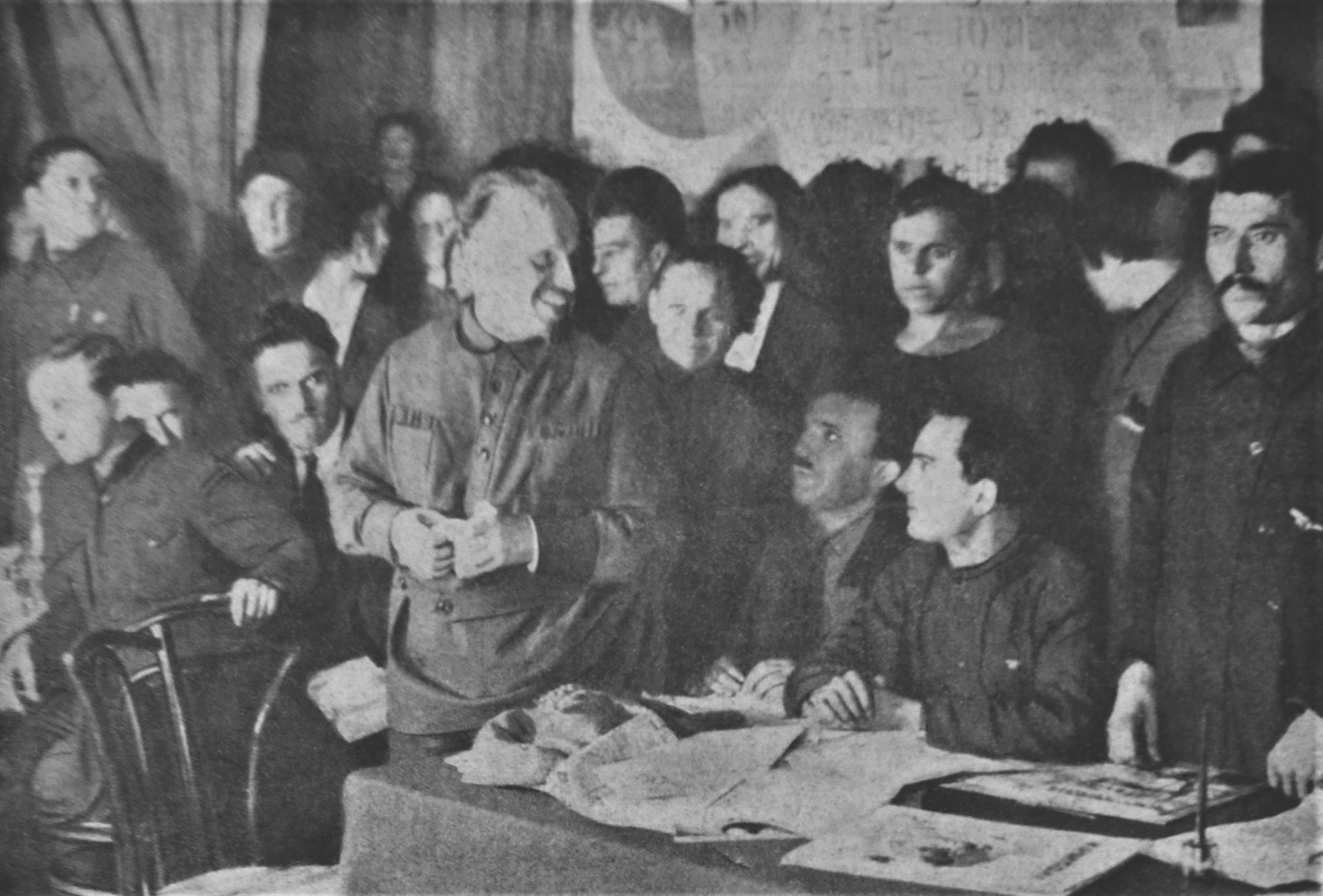
The opposition is speculating upon various possibilities. It is speculating upon our economic difficulties. It is speculating on the fact that we suffer many shortcomings in our present life, that many different trends of feeling have arisen among the workers during the past year, and will probably be followed by many others. And finally, it is speculating on the supposition that the present Central Committee will not be capable of leading the Party without them, the highly gifted supermen. The opposition believes that we shall break down under a task too difficult for us. But we, comrades, are confident that if the opposition will not help us to lead the party, then we shall do it without them. (Enthusiastic applause.)
We Shall Overcome the Difficulties, Remove the Excrescences, Correct the Errors.
We are confident, comrades, that however difficult our economic position is at times, still our economic prospects are good, and the excellent crops which we shall have this year will make it possible for us to really overcome the economic difficulties being undergone by the country at the present juncture. And we are even more confident that we shall be successful in leading both our Party and our country forward on the broad road of development. There are none so blind as those who will not see. There are many who believe the situation to be still the same among us as it was at the beginning of the revolution, when anyone able to write an article with correct spelling could consider himself a Party leader. Since then a new generation has sprung up. We have a new generation of functionaries in the provinces, we are supported on all side’s by thousands of hands, and we stake confidently upon this magnificent collective power of our Party. We are fully convinced that we shall win. (Enthusiastic applause.)
The present opposition, like every other opposition which has hitherto arisen in our Party, and like even those oppositional groups which contend against our Party outside of its ranks, has a certain foothold upon which if bases its position. Were we to live in Paradise, and had we no faults whatever, so that everything worked at a hundred per cent rate of smoothness, then there would be no foothold for an opposition. I have often made this observation, and am not ashamed to bring it forward again here. During the rising at Kronstadt in the spring of 1921 the armed counter-revolutionary opposition was again based on a rational idea, for a certain disorder had found its way amongst us, and things had occurred which demanded a corresponding reaction on our part. This reaction consisted of the introduction of free trade, in the cessation of grain requisitions, etc. etc. And if there were no bureaucracy among us at the present time, if wages were not still so low in a number of branches of production, and if the village poor had not to live under bad conditions, then the opposition would have no ground under its feet.
Of course, every opposition in the Party exploits out faults. The whole point of the question lies in what is criticised, and in how and why the criticism is exercised.
When the comrades of the opposition declare: “Bureaucracy is strangling you”, then we reply: “Yes, bureaucracy is an excrescence very detrimental to us.” But when they go further and say: “Your state has ceased to be a state of the proletarian dictatorship, it is a state of bureaucrats who have nothing in common with the masses”, then we reply: “That is not true; we refute this criticism as a slander against our workers’ state.”
If we are criticised and told: “This has not been done, and that has not been done”, and if we are criticised for the purpose of making capital for the formation of a fraction, instead of for the purpose of helping us to remedy our faults, if we are criticised in enormous exaggerations, if our Party and the Soviet power are slandered, if individual errors, individual mistakes, and individual weaknesses in our state and our Party apparatus are multiplied a thousandfold, if a fraction platform is formed of these, and if the critics do not help us to overcome the real inconsistencies and difficulties, but take the opportunity to fry their own fraction” fish, then we take up arms against such a criticism, for this is no capable help coming to aid us to overcome our deficiencies, but a system of repeated attempts to shake the unity of the Party, and to attain the legalisation of other Parties by means of fractions and groups. This is a falling away from the proletarian line, even if it is not acknowledged as such.
The opposition, after making several accusations against the C.C. of the Party, maintained that the Party should learn the following lessons from the election campaign: 1. Real industrialisation; 2. real organisation of the poor peasantry; 3. real alliance with the main mass of the middle peasantry under the leadership of the proletariat; 4. real fight against bureaucracy; 5. real inner Party democracy. It would thus appear that our industrialisation is not real apparently we only assert that we are building new factories, whilst in reality they do not exist. It appears that we are not organising the poor peasantry, that we have no real alliance with the middle peasantry, that only the opposition proposes a real alliance, etc. etc. The opposition gives a false testimony against our whole policy,” and believes that it alone is creating something “real”, whilst all that we have done and are doing is fundamentally “wrong”.
We however are straight forward enough to believe that those persons who contend in the crudest form against a current in our Party one day, only to let themselves be borne on this current the next; who today proclaim the question of fraction to be a matter of death to the Party, and tomorrow a matter of life we believe that these elements have found their way into “real” Leninism to a certain extent on false passports.
I must tell you a funny story. In oppositional circles comrade Zinoviev’s book on Leninism has been regarded as a hundred per cent gospel. This will be known to you. A considerable part of this book was directed against comrade Trotzky. But now comrade Zinoviev; for the sake of the block with comrade Trotzky, for the sake of the realisation of real Leninism, has let this book fall under the table, and is not Having a further edition published. This is the way they treat the principles of Leninism. Not merely a word, which might have slipped out accidentally, but the “gospel” of Leninism.
Our Tasks.
In conclusion a few words on the tasks now facing us. In economic politics our main task is to steer an efficient course towards industrialisation, to seek means for the acceleration of the speed of development for our industry. Our next task, in view of the coming autumn, consists of inquiring into the possibility of a rise in real wages, especially in the wages of those categories of workers whose wages have not kept pace with the others. Although we were unable to fulfil this task a few months ago, it is certain that if we now succeed in manoeuvring our exports skillfully, in bringing in our grain properly and selling it well, etc., we shall be in a position by the autumn to raise the real value of wages. This must be carefully considered and calculated a hundred times, but we must make preparations for it.
The next measure to be taken in our labour policy must be to combat the excrescences which have grown up about the saving regime. In some places the necessity of saving has been so interpreted that the workers have been deprived of water to make tea with, with the result that there have been small revolts here and there in the provinces. This is not a regime of saving, but a caricature, a perfectly criminal caricature of a regime of saving. Our C.C. or its Secretariat must send an explanatory letter to the organisations on this subject. One of our main tasks all over the country must be the combat against the bureaucratism which is throttling us. I may remind you that one of the main thoughts in comrade Dzershinsky’s last speech, held just before his death and directed against the opposition, was a declaration of determined war against the immobility, the unwieldiness, and the bureaucratism of our apparatus, against conditions which oblige an urgent matter to pass through the hands of ten to twenty authorities before it can be decided upon and executed. Here we have still a great deal to do, and here the collective endeavours of many workers’ hands and heads is truly necessary.
And finally, I am of the opinion that in the sphere of inner Party politics we must not only carry on this direct struggle against fractions and groups, but at the same time we must strive more energetically for inner Party democracy. We must enlighten the mass of the Party at any price, strengthen and steel its ideology, and do this in the firm conviction that the line pursued by the majority of the Party is right. This is one of the greatest tasks.
The Communist Party is the mainspring of the state administration of our great country. We are entering the autumn season faced by extremely complicated tasks. We must manoeuvre with our grain prices, and manoeuvre in such a manner that we bring in the largest possible quantity of grain. We must export and sell this grain on advantageous terms, and upon this basis we have to arrange our programme of production, and find our way to a certain improvement in the housing question, the wages question, etc. We begin with these operations every year almost simultaneously with the realisation of the harvest. A very great deal depends upon how these operations are begun. They are almost determinative for the results of a whole economic year. And though we have our hands full with this great practical task, still we must increase our activity in the work of strengthening the ideology of the whole of the Party members, of closing the ranks of the Party on the basis of a definite political standpoint. May every member of the Party know and realise that the majority of the C.C. has a clearly defined standpoint, one for which it stands, which it continues, and which serves as rule for its guidance of the Party:
We are not adherents of Party methods which maintain one thing today, and something diametrically opposite tomorrow: which declare a crusade against deviations today, and submit to the lead of these deviations tomorrow. We have our line of policy, and we follow it consistently. We shall continue to stand for this line, to fight for it, to lead the Party unwaveringly by it, and we are firmly convinced that the whole Party with the Leningrad organisation, which has always been and always will be a pillar of the C.C., in the front rank will pursue this line in every respect. The most important point is: the struggle for the right political line; everything else depends upon this, everything else is determined by the struggle for the right polictical line. Our line is actually a Leninist political line, from which we never deviate, for which we fight without ceasing, and which will be the means of leading us to victory. (Prolonged applause).
International Press Correspondence, widely known as”Inprecorr” was published by the Executive Committee of the Communist International (ECCI) regularly in German and English, occasionally in many other languages, beginning in 1921 and lasting in English until 1938. Inprecorr’s role was to supply translated articles to the English-speaking press of the International from the Comintern’s different sections, as well as news and statements from the ECCI. Many ‘Daily Worker’ and ‘Communist’ articles originated in Inprecorr, and it also published articles by American comrades for use in other countries. It was published at least weekly, and often thrice weekly.
PDF of full issue: https://www.marxists.org/history/international/comintern/inprecor/1926/v06n57-aug-19-1926-Inprecor.pdf
PDF of full issue 2: https://www.marxists.org/history/international/comintern/inprecor/1926/v06n58-aug-26-1926-Inprecor.pdf

