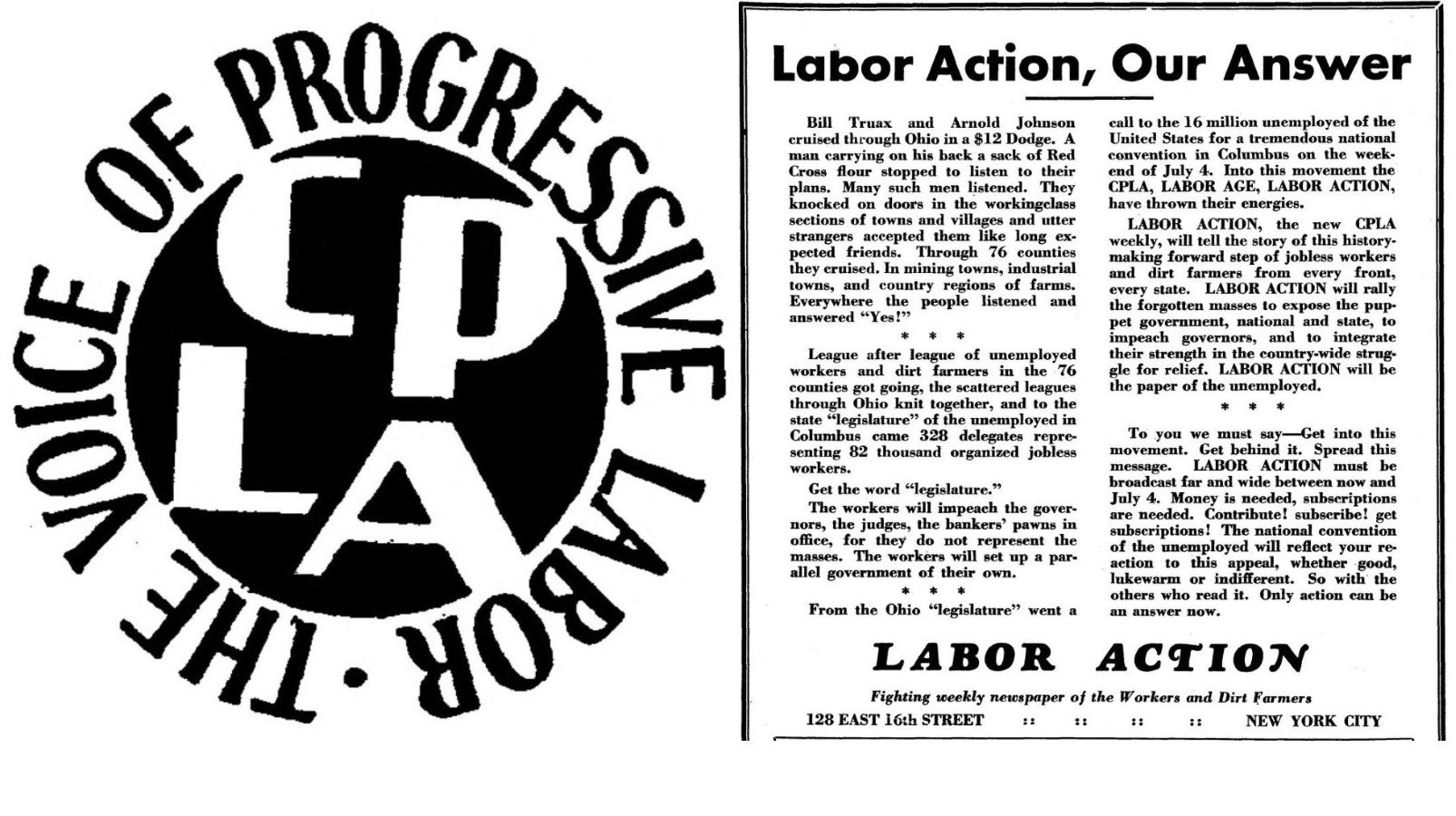
On the road to the creation of the American Workers Party, a leftward marching Committee (now Conference) for Progressive Labor Action met over Labor Day weekend in 1932 to formally adopt a name, establish a newspaper (Labor Action), elect a leadership, and confirm its revolutionary opposition to capitalism and need for a new political party. A.J. Muste was a leading figure of that ongoing transformation and here reports on the meaning of the event. Also includes a list of the newly elected leadership and the language a their new preamble reflecting the changed outlook.
‘The Meaning of the Convention’ by A.J. Muste from Labor Age. Vol. 21 No. 9. September, 1932.
THE Conference for Progressive Labor Action has ceased to be a committee and has become an organization. That is one very important achievement of the first official CPLA convention held in New York City over the Labor Day weekend.
Even as a “Committee,” functioning in a provisional way, the CPLA made important contributions to the labor movement. The movement which for the past three years has stimulated and helped the insurgents’ fight against the Lewis regime in the United Mine Workers (sometimes being the only force to keep that insurgency alive) ; which helped to build the West Virginia Mine Workers Union and the Independent Labor Party of West Virginia; which has kept alive the memory of the Marion martyrs of 1929, building the Southern Industrial League and the Farmers League in North Carolina, gradually laying the foundations of a sound textile organization in the South and now furnishing help and leadership in the High Point and other strike areas; which has built a sane but militant opposition in the Hosiery Workers’ Union; has stimulated the progressives in the Amalgamated Association of Iron, Steel and Tin Workers and at the same time formed units of the Brotherhood of the Mills among workers to whom the present regime in the A.A. pays no attention; helped the campaign among the Edison Employes in New York; effected the amalgamation of the Paterson Silk Unions, assisted in the leadership of the Paterson General Strike of 1931, kept the union fighting in the face of an unprecedented depression, stimulated the building of an autonomous National Federation of Silk Workers within the U.T.W.; assisted opposition groups in many unions in campaigns against bureaucracy, racketeering and gangsterism, as e.g., the notable campaign in Local 3 Electrical Workers, New York, which has already, at least for the time being, restored numerous rights to the membership; which has kept in the forefront the idea of a mass labor party; and which through the national organization, branches or members has been wholly or largely responsible for the organization of Unemployed Citizens Leagues in Seattle, Tacoma, Youngstown, O., Pittsburgh, Allentown, Philadelphia, Kanawha Valley of W. Va., Belmont County, Ohio, McDowell County in North Carolina, and many other places—such a movement has certainly already justified its existence!
Groups and individuals may, however, do a lot of work yet never achieve the clear philosophy, the definite and sound program, and the structure necessary for an organization, which is to stay on the job and grow. The New York convention demonstrated that we have a philosophy, a program, a membership that will stick and is determined to build up the CPLA.
It is not only that delegates present at the convention voted to have an organization. The delegation showed that we had the makings of an organization right there. Twenty CPLA branches from 8 states were represented. Twenty-five unions, unemployed leagues and other organizations in which CPLA has been active sent fraternal delegates. The membership of the organizations thus represented totals over 40,000—another convincing piece of evidence on the extent to which the CPLA has been striking down its roots among the workers especially during the past year.
Our Weekly Paper
The single concrete action which aroused more enthusiasm than any other is another illustration of the fact that we have now a real membership and that this membership is determined not only to help build a labor movement but to build the CPLA as an indispensable means to that end. I refer to the decision to start not later than January first a weekly paper, Labor Action, retaining LABOR AGE as a monthly or bi-monthly organ. The demand for the weekly paper came in overwhelming volume from CPLA branches and organizers, from friendly unions, unemployed leagues and other bodies, who want to bring news of the workers in America and throughout the world, news culled and reported from a CPLA viewpoint to the masses.
What is the character and platform of this organization which has now taken definite form? It is an organization of active, devoted, militant workers, who will be expected ta give time and energy to the work of the CPLA and in no case to subordinate CPLA attitudes and principles to those of other organizations. It seeks active members, not paper adherents. It excludes exploiters of labor from membership.
While we hold that such a militant organization can flourish only if it has a devoted membership possessed of a high morale and enthusiasm, we recognize also that morale in an organization suited to American conditions today cannot be built up by mechanical discipline and theoretical hairsplitting. Discipline of the right type will develop naturally out of the work of the organization as it expands and calls forth devotion and enthusiasm.
Similarly we hold that our role in the general labor movement must be to educate, advise, guide, inspire rather than to attempt the impossible and dangerous role of a center which works out blueprints for every situation throughout the land and then gives forth commandments which must be slavishly obeyed. An effective left-wing vanguard for the American labor movement cannot be built by main force from the top. Unless, on the one hand, the masses move and, on the other hand, militants from all sections capable of carrying on in their own localities rally to us to receive inspiration and help and to give them to us in turn, we shall but break our heads and wear out our spirits in a vain attack upon the entrenched forces of American imperialism.
The CPLA aims to abolish capitalism, not to reform it, and to build a workers’ republic and a planned economic system operated by and for the workers. To this end it will everywhere stimulate and help the building of a fighting labor and farmer movement in all its phases, economic, political, cooperative and educational. It will not urge the workers to depend upon one type of organization or any single method to achieve power and build a new world, but to advance on all fronts and by the realistic use of whatever methods changing conditions dictate.
The CPLA seeks to root itself in American soil, face the realities of American life and talk to American workers in their own language and about their own problems, though recognizing clearly that the struggle against capitalism is international, standing for the defense of Soviet Russia against its capitalist and imperialist enemies and promoting worldwide solidarity of labor.
Members will work within existing economic organizations, commit them to progressive fighting policies and to cleaning out bureaucracy, racketeering and gangsterism where they have crept into these organizations. They will carry on the movement to organize the unemployed, to demand relief and unemployment insurance as well as more fundamental measures. They will continue as in the past to initiate and help movements to organize the masses of the unorganized in basic industries into industrial unions.
On the political field CPLA will work in the present period for the building of a unified labor party based upon or closely related to the economic organizations of the industrial workers and dirt farmers. It will engage in such political activities as may in its judgment best promote that end, political activities including, as the N.E.C. report stated, “all activities of a mass character which aim at something more than simple and immediate economic gains, the business of getting votes for candidates in an election being never an end in itself but only a means, and often a secondary one.” Wherever and whenever a mass labor party is in existence, CPLA will work loyally within it, seek to advance a sound, radical program, and to secure the nomination by the mass party of candidates who can be counted upon to advance such a program. We are not just another party soliciting votes from workers in rivalry with some other labor party.
Above all, to quote again from the N.E.C. report: “It will be our task to combat vigilantly and relentlessly such corrupt and collaborationist tendencies as have often led European Labor and Social Democratic Parties to betray the workers.”
Unity in Action
The convention made it clearer than ever that CPLA will be increasingly the rallying center for those militants who are disgusted with the divisions, bickering and hair-splitting within the labor movement and who stand for labor unity—unity in action, not on paper. By this we do not mean uniformity; nor does our stand for unity mean that we have no distinctive position of our own and do not propose to stand by and defend it. But we shall strive with all our might to put an end to the situation which prevails today, when all too often workers are confused by the babel of voices which comes to them from radical and progressive ranks, and when their forces are divided, even in the midst of strikes when they are in direct conflict with the boss. The experience of the post-war period seems to have demonstrated pretty conclusively that at least in industrial countries a divided labor movement cannot effectively oppose the advance of Fascism. We stand, therefore, day in and day out, for genuine and effective labor unity in every phase of the movement.
Above all, the preamble to the newly adopted CPLA constitution suggests, “the movement of the working masses must be imbued with the will and the courage to fight.” CPLA will be an organization of activists and fighters. It will try to make an active and fighting force out of the American labor movement. We shall, as in the past, contend against the notion that unions can be formed by persuading the boss that it would be a good thing for him if his workers were organized, instead of going to the workers and telling them that they can protect their own interests against the exploiters only by solidarity, courage and militancy. On the political field we shall contend against the fallacy to which Labor and Social Democratic Parties in Europe and elsewhere have so largely fallen a prey in the post-war period, namely, that when the capitalist business system is seriously threatened, the first job is for everybody to sacrifice and put the system back on its feet, and to collaborate to that end with middle class parties or even capitalist dictatorships. On the political field also we hold it is the business of the workers to fight capitalism.
Action in politics, action in the unions, action among the unemployed, action among the farmers, action in the unorganized basic industries, this is the CPLA emphasis. In our title the important word is not Conference and not Progressive, but Labor Action.
In full accord with this emphasis the convention put the working out of some important jobs up to the N.E.C,, such as a unified labor campaign for the release of Tom Mooney; the pressing of the fight against racketeering and allied evils in the unions, including the sending of a committee to deal with this matter at the A. F. of L. convention to be held in Cincinnati in November ; the setting up of a trade union committee to work out the technique of insuring the right of minorities in unions; a national clearing house for unemployed leagues, to give them information about successful methods; vigorous prosecution of our work in textiles and steel; cooperation with the miners in Illinois, West Virginia and other states in building a progressive miners’ union on a national scale.
Militant Rallying Center
Thus the CPLA convention is indeed a landmark in American labor history. The lack of an inspiring, militant rallying center has constituted the most alarming aspect of the present crisis in American labor. If the working masses of a nation are politically backward they can be educated, sometimes under the pressure of conditions with amazing rapidity. At this very moment, in struggles of the unemployed in various parts of the country, in strikes of farmers in such supposedly conservative agricultural sections as Iowa, Nebraska, Illinois and Wisconsin, in the renewed revolts of Southern textile workers, in the valiant struggle of Illinois miners against wage cuts, in the activities of the Bonus Expeditionary Force, in battles being waged by the rank and file in many unions against bureaucracy, corruption and gangsterism, we find abundant evidence of the militancy, courage and working-class intelligence latent in the American masses. A labor movement on its part may be stagnant, weak, corrupt, and yet be revived, revolutionized or replaced.
The natural militancy and courage of the masses go to waste, however, and a weak and degenerate labor movement cannot be reformed or removed, unless the active, devoted, militant spirits among the workers are effectively organized to give unity, coordination, leadership and inspiration to the masses and to mass organizations. If these militants are weak, divided, petty, visionless, then the situation is indeed dangerous.
Now the CPLA is definitely and permanently in the field as an organization in which militants band together in order that they may learn to know each other, may train themselves to do real work, may plan to act together and not in a haphazard fashion.
Forward, March!
Members and branches must now put their shoulders to the wheel, carry on more vigorously than ever their activities in the labor movement and build up the CPLA itself.
We call upon all working-class organizations, whether they can subscribe to our full program or not, to cooperate with us in the many labor activities where cooperation is possible and desperately needed. We are not out to hamper or destroy other labor organizations but to develop more and more unified activity with them.
We appeal to workers, farmers, sympathizers with the labor movement, even if they cannot join us, to give us and our activities the utmost moral and financial support. No activities for the building of a new and sane social order, political or otherwise, will avail unless a realistic, fighting, intelligent labor movement is developed. This job CPLA is doing right down among the workers on the industrial battle front, where the rank and file workers are up against the toughest kind of fight, day in and day out. They must be supported in that struggle. Nowhere is help more needed, nowhere does it count for more.
Above all, we invited all militant workers, regardless of their previous affiliations, to join us in the tremendous task which we have undertaken. The job cannot be done by a handful of militant workers, no matter how devoted, in one section of the country. Let militants all over the land, from every industry, stand solidly together. The CPLA is on the march!
***
Preamble to CPLA Constitution
Planless, profiteering, war-provoking, imperialistic capitalism must be abolished. It cannot be reformed. Sham political democracy which has been the tool of capitalist business and finance must also go. We must have a workers’ republic and a planned economic order under which the masses will labor to create plenty, security, leisure and freedom for themselves, not profits, privilege and arbitrary power for a few.
The job of abolishing capitalism and building a new social order must be done by the workers, industrial, agricultural, clerical, technical, professional, who stand to gain, materially and spiritually, by the change. We, the workers, must ourselves provide the revolutionary will, the courage and the intelligence for the task.
To realize our aim we must achieve power. To gain power, we must organize.
Effective working-class organization in the modern world consists not merely of militant industrial unions, or farmers’ unions, or a labor political party, or cooperative enterprises, or educational agencies, but of all these fused into a living movement advancing on all fronts, toward its goal of a new society.
Above all, this movement of the working masses must be imbued with the will and the courage to fight. We do not delude ourselves with the notion that under present conditions the people have genuine democracy and have but to vote a new order into being if they so desire. The schools, the press, the radio, the pulpit, the courts, the police, the control of the job, are almost entirely in the hands of the possessing class. Though it may consent occasionally to slight reforms, provided it retains the reality of power and the right to profits, for the most part it makes increasingly lawless and violent use of the institutions which it controls. Unless, therefore, we choose submission to a Fascist dictatorship of big business and finance, the masses must oppose this lawlessness and tyranny by struggle on every front and by realistic and courageous use of the means which will accomplish their final emancipation. They must depend on their organized strength, not on the machinery of a capitalist government. As always, so now in this crucial period in the history of the American working class, the responsibility of giving inspiration, help and leadership to the masses in their struggle rests upon the active, devoted, militant workers. These active elements in order to be effective must know each other, must train themselves to do real work, must plan and act together and not in a haphazard fashion.
The CPLA has therefore been formed in the U.S.A., the very stronghold of capitalism and imperialism, to band militant workers together. It is an organization of militants, which talks to American workers in their own language about their own problems, which brings them help and inspiration in their daily struggle with the boss, which seeks in every way and on every front to unify and build up the power of labor, so that the workers may take control of industry and government, abolish the system which makes cannon-fodder out of them in time of war and machine-fodder in time of peace, and build a sane and just economic system and a workers’ republic to be united in bonds of comradeship with workers’ republics throughout the world.
***
The National Executive Committee and Officers
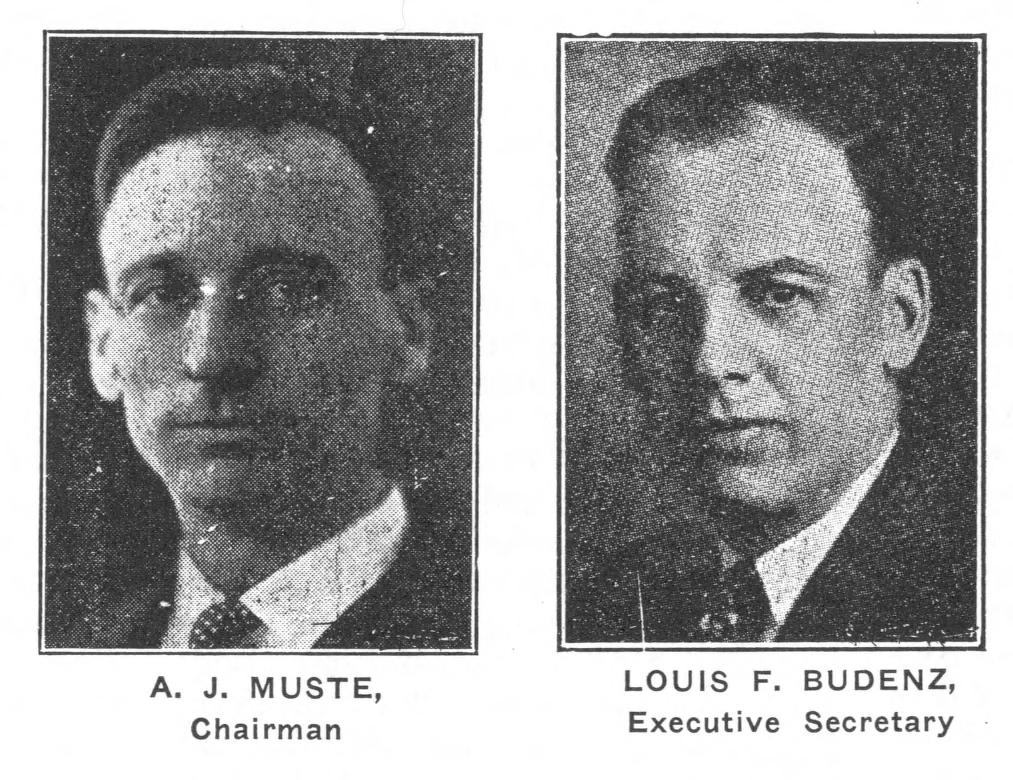
Chairman, A.J. Muste, Vice President, American Federation of Teachers and Director, Brookwood Labor College.
Executive Secretary, Louis F. Budenz, leader of hosiery strikes in Kenosha and Nazareth, and executive secretary, Paterson general strike 1931, etc.
Treasurer, E.J. Lever, member International Association of Machinists, former president Philadelphia Labor College.
Members of National Executive Committee: Carl Brannin, director Labor College, Seattle, Wash.; Justice Ebert, official editor Amalgamated Lithographers Union; Elmer Cope, member of Amalgamated Assn. of Iron, Steel and Tin Workers, Pittsburgh organizer for CPLA; Clinton S. Golden, member of International Association of Machinists, farmer: J.B.S. Hardman, official editor Amalgamated Clothing Workers of America: Abram L. Harris, Negro economist, Howard University; Lawrence Hogan, head of Southern Industrial League, textile organizer, etc.; Harry A. Howe, editor of Labor Age: J.C. Kennedy, former head Seattle Labor College, Director of Studies, Brookwood Labor College; Edmund F. Ryan, Jr., Hosiery Workers Union, Philadelphia; David J. Saposs, labor historian, member of faculty, Brookwood Labor College; Karl Lore, organizer of Brotherhood of Steel Mills; William Stoffels, Dllinois miner; Tom Tippett, Educational Director, West Virginia Mine Workers Union; Lucile Kohn, educator, New York; George Scherer, Secretary-Treasurer, West Virginia Mine Workers Union; Walter Seacrist, leader Kanawha Valley Unemployed League; Sam Bakely, leather goods’ worker; William R. Truax, former official United Mine Workers of America, director Belmont County (Ohio), Relief Council; Anna Kula, member International Ladies Garment Workers Union, New York; Herman Gund, official editor Amalgamated Food Workers of America; William Beedie, New York, former I.L.P. member from Clyde, Scotland, and associated with the organization of Brotherhood of Brooklyn Edison Employes’ campaign.
Labor Age was a left-labor monthly magazine with origins in Socialist Review, journal of the Intercollegiate Socialist Society. Published by the Labor Publication Society from 1921-1933 aligned with the League for Industrial Democracy of left-wing trade unionists across industries. During 1929-33 the magazine was affiliated with the Conference for Progressive Labor Action (CPLA) led by A. J. Muste. James Maurer, Harry W. Laidler, and Louis Budenz were also writers. The orientation of the magazine was industrial unionism, planning, nationalization, and was illustrated with photos and cartoons. With its stress on worker education, social unionism and rank and file activism, it is one of the essential journals of the radical US labor socialist movement of its time.
PDF of full issue: https://www.marxists.org/history/usa/pubs/laborage/v21n09-sep-1932-labor-age.pdf

