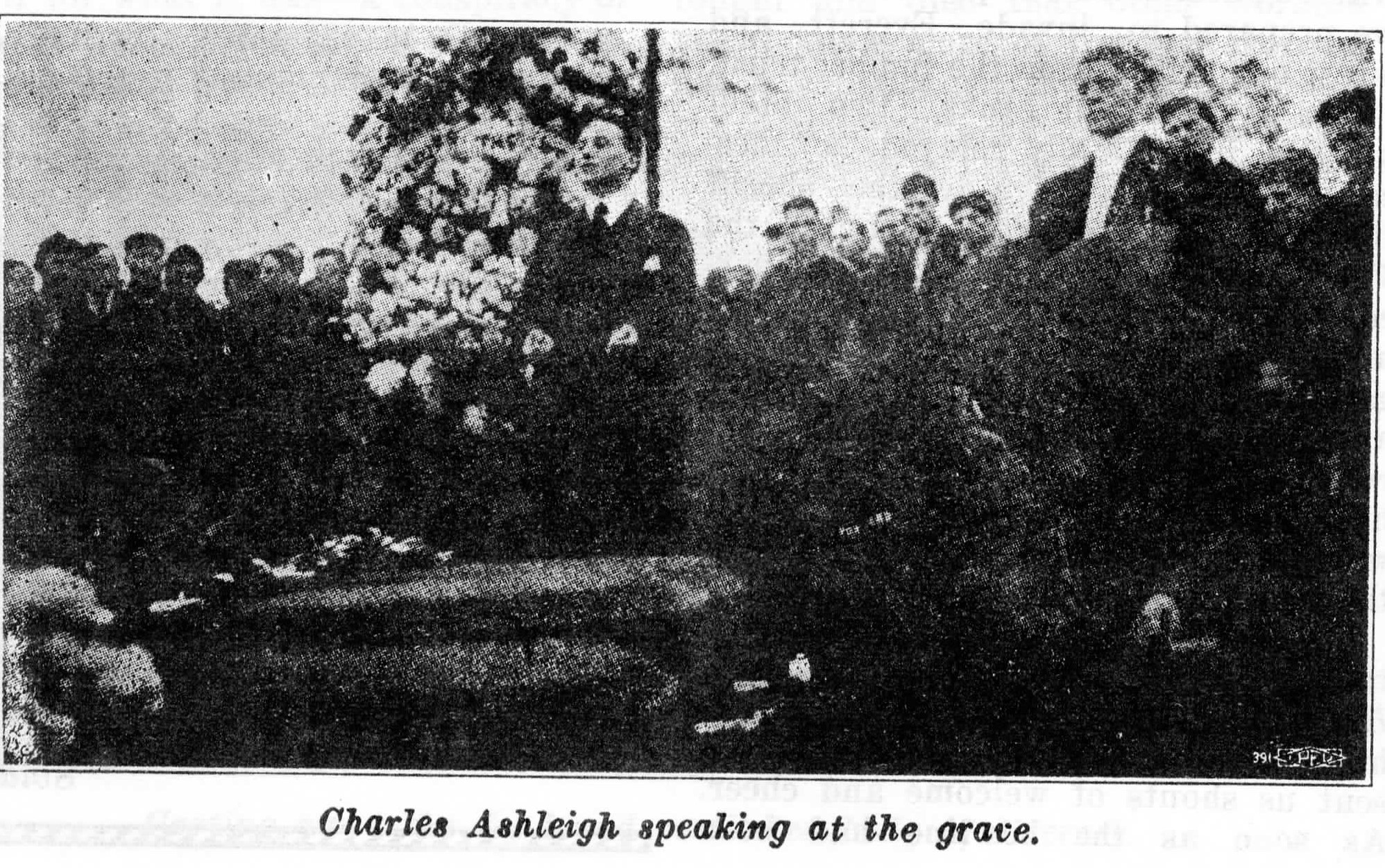
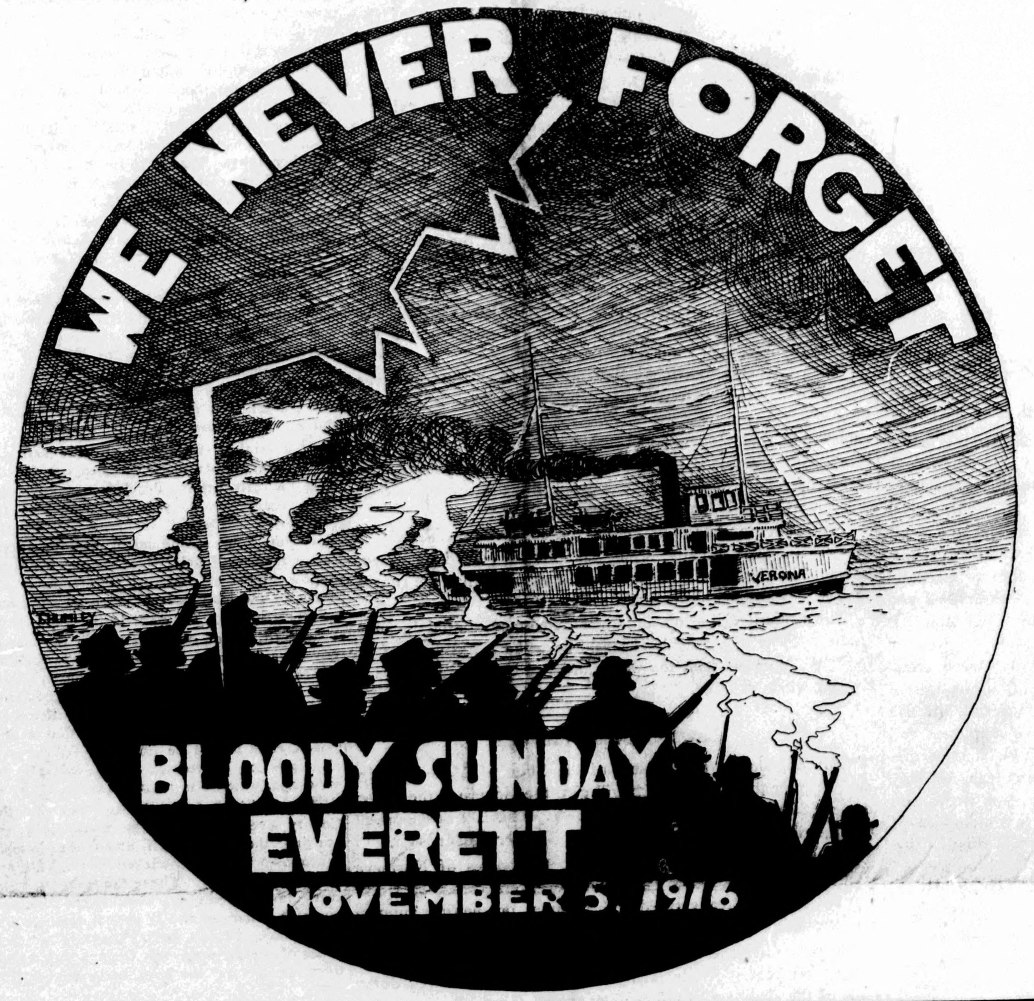
At Seattle’s Dreamland Rink over five thousand workers gather to protest and raise funds, listening to Charles Ashleigh, Elizabeth Gurley Flynn, Sam Sadler, J.A. MacDonald, and Scott Bennett, in the aftermath the ‘Everett Massacre’ of November 5, 1916 in which hundreds of armed thugs attempted to prevent the landing of of I.W.W. activists from Seattle onboard the Verona as it docked in Everett. The I.W.W. defended itself. 2 gunthugs were killed and two dozen wounded at least five wobblies died, potentially a dozen more drowned, and another thirty were wounded.
‘Labor’s Growing Solidarity at Monster Meeting’ by C.E. Payne from Industrial Worker. Vol. 1 (new) No. 42. January 27, 1917.
That the workers of Seattle are awake to the doom which the masters of the open shop are preparing for them, and that they are marshalling to the call of class solidarity, was proven on Sunday, January 21st, when between five and six thousand people crowded Dreamland Rink in protest against the methods of the employers. Faces grim, sad and resolute filled the vast auditorium tier on tier, telling better than could any on the platform of the growing consciousness of class identity of interest and class struggle for freedom.
Charles Ashleigh, chairman for the afternoon, was introduced by Mr. Parker of the Seattle Everett Prisoners’ Defense Committee. Fellow Worker Ashleigh said that the Everett tragedy was to be considered at this meeting not as a detached event, but as part of the organized action used by the organized employers against the organization of the workers.
He then called for the singing of the song which the men on the Verona sang as they neared the Everett dock, the song which Rabinovitz died singing. A choir of some three hundred grim and determined men sang this battle song of the English Transport Workers, now one of the marching songs of the proletarians of the world.
Our Representatives.
Then spoke Sam Sadler, president of the I.L. A., of Seattle. The keynote to this address was “Too long has Labor turned the other cheek.” He showed that the Everett affair was “but an incident in the age-long struggle of the workers for freedom.” “The working-class, may they always be right–but in any event the workers. The martyrdoms in Everett are but a goad to us. These workers did not die in vain; those who are in jail are but our representatives in the class war. Everyone here should so act that you, the working-class, can say that you are worthy of their deeds. The object of all workers should be to consecrate themselves to the working-class. The masters have no fear of servile slaves. We will take for our slogan the world for the working-class as the only useful class in society.” He made a plea to place no reliance on leaders, but to educate and organize.
The next speaker was J.A. Macdonald, the editor of the Industrial Worker. This speaker said that he saw many other groups of workers back of this group here today. Six thousand workers, as grim warriors of the class war, were tying up the biggest paper mill in the world and demanding the release of the men in Everett. A new thing, the same thing, was manifest in Australia where conscription was destroyed by the solidarity of the workers; where the workers have broken the fetish of the British Parliament and forced the release of twelve men from jail. The workers are awakening to a clear view of the meaning of Bloody Sunday. In the place of five murdered in Everett, there are five thousand agitators here today. He spoke of the fact that the “Industrial Worker” of Nome Alaska in order to keep in touch with the greatest outrage in labor history yesterday, ordered 1,500 words on the Everett outrage cabled there.
Go to the Signal Corps Cable office and you will find it costs you twenty-eight cents a word to send a message to Nome.
Not Safe to Convict.
Free speech will yet be established in Everett on a scale made possible through the murder of our five fighters. The courts are realizing that it is not always safe to convict, as back of their court stands the Supreme Court of the working-class. Today I go to Everett and I will tell them of this meeting. I will say to them: “Don’t worry boys. Behind you are the workers of the world. You represent workers who are no longer asleep.”
Would Rather Have Murdered Them All.
Then followed Gurley Flynn. She said that a week ago she had spoken to Jews, Russians and Italians on the East side of New York. She said that they were watching Everett as closely as was this audience and with the same determination. “The only reason there are seventy-four being tried is that they were not killed. Nothing would have pleased the Lumber Trust so well as seeing them all killed and none of them tried.”
“The death of the workers is nothing to the bosses. They have regard only for one of their own members. There is no evidence of the worker’s guilt, but there is plenty of evidence of the bosses’ vengeance.
“The Everett tragedy was not primarily the result of a free-speech fight; it was a fight against all organized labor on the Pacific Coast. Winning means better conditions for us, but we are fighting the capitalist class which goes back to the most brutal barbarism the moment their dollars are jeopardized.
“The men in Everett are seeking no one’s sympathy; now is the time to defend yourselves in the persons of these seventy-four, for the heritage we leave to the next generation will be in the conditions that we make here and now. The day will come when we will do more than ask for collections, when we will declare the general strike, but now we must call for a collection to carry on the fight.”
The Audience Express Solidarity.
Here Miss Flynn stopped while the audience expressed their feelings of revolt against their condition of social and industrial enslavement by donating three hundred and thirty-one dollars and fifty-two cents to carry on the fight.
Fellow Worker Ashleigh then introduced Scott Bennett, one of the great radicals of Australia, who has been touring the United States for some time. He said that it was a mistake to suppose that the Everett tragedy was a detached affair. “The masters are ready to repeat that or worse at any time that their profits are endangered. No matter where we are, in what part of the world, the rights of the people are as nothing compared to the power of the masters so long as exploitation and private ownership of industry exist. How long will it take the workers to understand that all governments are but committees of the masters?” He showed how the press and the courts are used to keep the workers in ignorance. “But,” he said, “when soporifics fail the club and the gun are ready.” I am not an I.W.W. myself, but they are dear to me, for by God, they fight, they fight, THEY FIGHT!–Here the audience went wild and for a minute he was unable to continue.
His next statement was, “To Hell with submission and apathy, what the workers need today is the same spirit that animated the commune, and Jim Connolly, and the Australians.” As a child of the world who had visited many nations, he said he was within the truth in saying that the capitalists of America are the most relentless, the most merciless and the most ruthless in the world. “There will,” he said, “be other tragedies as long as there is red blood in the working-class and industrial slavery endures. A great wave of militancy should sweep the workers of America.”
Ending, he said: “The Everett victims will not have suffered in vain if they arouse the workers to their duty to their class.”
After the singing of a number of songs of revolt, the vast audience marched out of the hall with expressions of resolutions to materialize the solidarity of words and thoughts into the dynamic hitting and conquering force of the solidarity of action.
The following resolution was unanimously carried by a standing vote during this greatest meeting of fighting workers in the history of the city of Seattle:
Resolution.
WHEREAS, it has been claimed that an organized movement has been made by members of the Everett Commercial Club and others affiliated with the employers’ interests in Everett, Wash., to suppress Free Speech and Labor Organization, and
WHEREAS, there has been a long series of acts of brutal and illegal repression in which official authority has been used as a cloak for the suppression of Labor, and,
WHEREAS, these atrocities culminated in the bloody tragedy of November 5th, when the then Sheriff McRae and a group of so-called citizen-vigilantes, armed with rifles, refused to allow passengers on the steamer Verona to land and enforced this refusal at the point of a gun, resulting in the killing of five and the injury of forty, therefore
BE IT RESOLVED by this meeting of five thousand citizens of Seattle, Washington, that the President of the United States, the members of the House of Representatives and the Senate appoint a committee of members of the United States Congress and the Senate to immediately undertake an investigation of all facts leading up to this. controversy to the end that the true facts may be known to the people of the United States.
Resolution unanimously adopted January 21, 1917, at Protest Meeting held at Dreamland Rink, Seattle, Wash.
The Industrial Union Bulletin, and the Industrial Worker were newspapers published by the Industrial Workers of the World (IWW) from 1907 until 1913. First printed in Joliet, Illinois, IUB incorporated The Voice of Labor, the newspaper of the American Labor Union which had joined the IWW, and another IWW affiliate, International Metal Worker.The Trautmann-DeLeon faction issued its weekly from March 1907. Soon after, De Leon would be expelled and Trautmann would continue IUB until March 1909. It was edited by A. S. Edwards. 1909, production moved to Spokane, Washington and became The Industrial Worker, “the voice of revolutionary industrial unionism.” A victim of finances and internal disputes, the IW ceased publication in 1913, only to be revived in 1916 and surviving as a weekly, sometimes more, until 1931. Easily among the most important working class newspapers in U.S. history and an essential resource on the wobbly, and larger radical labor experience.
PDF of full issue: https://washingtondigitalnewspapers.org/?a=d&d=IWW19170127

