
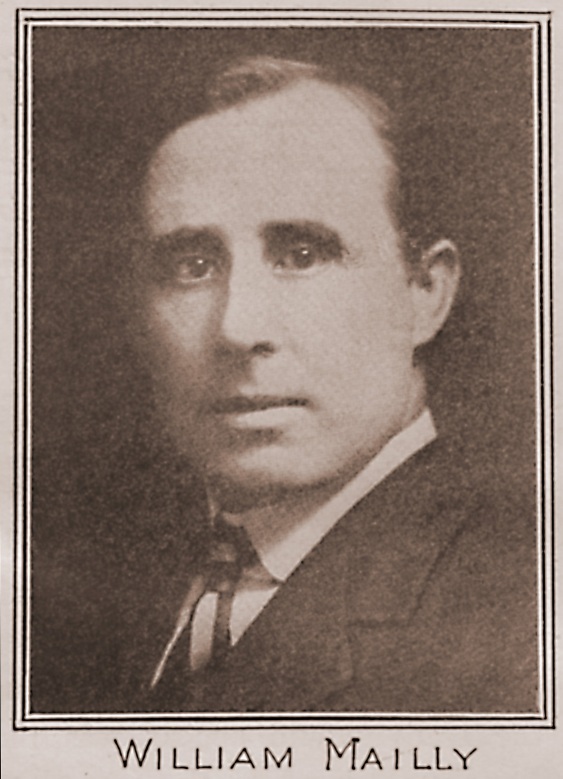
William Mailly was an interesting, and central, figure in the early Debsian Socialist Party. Born in the U.S. but raised in Liverpool, he returned to be an Alabama coal miner, becoming an early U.M.W.A. organizer and active in the big 1894 strike, for which he was blacklisted. Briefly joining the S.L.P., in 1896 he would be a formative member of the Social Democratic Party the following year. Moving to the Socialist stronghold of Haverhill, Massachusetts he was part of the negotiations and conferences that would found the Socialist Party in 1901, and became the Massachusetts Party’s state secretary in 1902. Moving to New York City, he was elected the Party’s National Secretary in 1903, holding the position until 1905, living in both Nebraska and Ohio. In 1906 he became managing editor of the Worker in and then in 1908 became the first editor of the New York Call, and then the Metropolitan Magazine, often writing on music, a passion. Cancer took his like in 1912 at age 40, His wife and comrade was the writer Bertha Howell Mailly. Here he writes on a topic he knew well, the hugely important 1902 U.M.W.A. coal strike which brought the 8 hour day to the mines and made that union a genuinely national, powerful working class force.
‘The Anthracite Coal Strike’ by William Mailly from The International Socialist Review. Vol. 3 No. 2. August, 1902.
There is only one issue in the present struggle between the anthracite coal miners and the mine and railroad owners. That issue is the right to organize. There were other issues when the strike began—wages, hours, dockage, weighing, etc., but they have all been subordinated to this one. The coal trust wants to get rid of the union; the miners want to preserve it. No other question will be settled, or will even be considered, until this one is disposed of: The right of the miners to organize—that is, the issue. The mine owners refuse to arbitrate because that will mean recognizing the union. This they will not do, unless forced to it. The miners, having exhausted every other means, say they will compel recognition.
In order to fully understand how much the preservation or the destruction of the miners’ union means to both sides, one has to be right on the ground and hear direct testimony. For twelve years, following upon the failure of the Hazleton and Panther Creek Valley strike in 1887, there were practically no unions in the anthracite region. Strikes broke out spasmodically, but were soon crushed. Lattimer became famous through one of these in 1897. The operators had everything their own way, and that way was simply one of extortion and oppression. There are no gentler names for it—and these are too mild. The miners were discouraged, cowed and spiritless. Those among them who tried, secretly or openly, to organize were “spotted” and blacklisted out of the region. I met several such men, who had returned after the strike of 1900. During this time the mine owners were organizing. Untrammeled by any resistance from their employes, they had free scope to fight one another in the market. Inevitably combination resulted. Small owners were wiped out or absorbed, until now the coal trust controls the anthracite output, the transportation facilities and dictates prices to the consumer. There are individual operators, but they are dependent, more or less, upon the trust, and their position makes them even harder task masters than the trust companies.
In 1899 the Vanticoke miners succeeded in organizing, and in winning a strike which lasted five months. Wages were increased, docking regulated, hours reduced and several minor grievances adjusted. This victory awoke the miners of the whole region. A clamor for organization arose from various quarters. President Mitchell answered the cry by sending “Mother” Jones and other organizers into the field. They worked all winter. Every corner of the region was invaded. The capitalists fought them tooth and nail. At some places the miners themselves, goaded on by their bosses, mobbed and jeered the agitators. There are exciting stories told of those time, but this is not the place to tell them.
Out of those feverish days and nights of dangerous and difficult work came the strike of 1900. Not all the miners responded immediately to the call. Persuasion was required to get some, exhibition of numbers to get others. After six stormy weeks the strike was settled. It was won, whether politics had anything to do with it or not. True, the union was not directly recognized, but it was established. And that was the main point.
From that time, organization spread and strengthened. Every mine in the region has its local and the districts are well organized. Last year, when the mine owners refused to consider the miners’ demands, a strike was avoided through the advice of President Mitchell. He counseled peace, told the men they were not ready to strike, the organization was not compact enough and that they slacked resources. They should accept the situation and prepare for decisive action later. The advice was taken. The men continued to organize and they did prepare. And the present strike is the result.
There can be no doubt that the capitalists really wish to destroy the union—just as ardently as the miners desire to preserve it. With many of the miners this desire amounts virtually to a passion. This has to be seen to be understood. It arises from the changed conditions prevailing since 1900. Not that wages, hours or docking have materially changed, although some advantages have been gained. The men acknowledge that the operators are able, in diverse ways, to circumvent and evade rules and agreements. But the miners have more liberty than ever before. From one end of the region to the other this is the one thing they harp upon. They have been able to force consideration where before they were treated with contempt. Formerly, if a man complained, he was ignored or insulted. If he complained again, he was told he “could bring his tools out if he didn’t like it.”
Things have been different during the past two years. There has been more freedom, more independence. Local unions can send a committee to the boss now and have that committee received courteously, at least, where before its members would have been discharged. Petty exactions have been wiped out, irritating grievances remedied. And having tasted a mite of freedom, the miners want more of it. They are determined not to surrender their newly gained privileges without a bitter struggle.
Nevertheless, the existing situation would have been impossible if it had not been for the confidence felt in John Mitchell. Whatever opinion Socialists may hold of his policy, the miners believe in him, radical and conservative alike. And yet Mitchell opposed the strike. It was declared over his vigorous protests, for Mitchell is extremely cautious and naturally conservative. At the Hazleton convention he spoke at length against the strike, and then, when the resolution was carried, the delegates cheered him until they were hoarse and he shed tears. Those who witnessed it say that no more dramatic scene has occurred in the history of the American labor movement.
In view of this, Mitchell occupies a decidedly interesting position, and we might well ask: What is the secret of his hold upon his people? He was unknown to the anthracite miners four years ago. He seldom goes out among them, remaining entirely in his headquarters. He is very reserved and apparently shuns publicity. His reticence makes him the despair of the reporters, who, nevertheless, respect him highly and consider him one of the ablest public men in America. Every utterance is well weighed, every statement issued carefully considered in company with his colleagues, with whom he is in perfect harmony.
Mitchell’s success of two years ago is, of course, largely responsible for his popularity. Still, such a man was necessary at this time. Some one the miners believed in, whom they could trust their interests with. They are loyal to their union, because they believe John Mitchell is loyal to them. They know he is no orator, that he is still young and that necessarily he is surrounded by temptations. But they believe in his honesty, his ability and his intentions, and they feel secure. The only serious criticism I heard of President Mitchell was about the thirty days’ armistice proposed by the Civic Federation and accepted by Mitchell and his colleagues. The operators violated an agreement and stocked coal during the thirty days. Even then, Mitchell is not blamed but the Civic Federation is damned and doomed.
The business men of the region are not with the strikers. There are exceptions, here and there, mostly in the smaller towns. In the cities the merchants seem unable to understand the conditions of the miners or the necessity for organization. Apparently, they can imagine no other lot for the miners than that which obtained for years before the union appeared. They only know that then there were no strikes and the men worked steadily. Now business is dead, bills are hard to meet, goods are piled upon the shelf. They want the strike settled in some way. If the miners lose—thank God, it will be all over! If they win—well, the union will still be here, and won’t that mean more strikes?
Then the miners’ boycott, endorsed and carried on by other workmen, is exceedingly troublesome. Its necessity or meaning is entirely lost to the merchants. They are blind to everything but that their business is interfered with. The question of justice for the miner, good conditions, restriction of docking, shorter hours, or even higher wages, never illumines their mental horizon. So, encouraged and assisted by the trust emissaries, they join “Citizen’s Alliances” which attempt to prosecute boycotters and disturbers of the peace.” These “Alliances” have had strikers arrested and prosecuted upon charges which, at any other time, would be thrown out of court, but they have never moved toward the apprehension of drunken and riotous deputies or the conviction of the coal and iron police who shed the only blood spilled so far in the strike.
Membership in the Alliance is usually kept a secret. Only a few dare reveal themselves in connection therewith, and these few are generally broken down politicians, lawyers or professional men. The merchants keep discreetly in the background, for they know that, won or lost, they will be remembered when the strike is over. So they confine their activities to giving money and attending meetings, which are held in secret. Only to some one whom they believe to be in sympathy with themselves, will they acknowledge their hatred of the union and display their indifference to the miners’ grievances.
There is a gubernatorial election in Pennsylvania this year and the politicians have to be careful. So have the papers, for election day is not so far away that the workingmen may forget, ll happens, therefore, that the politicians are scarce in the strike field, and the papers, with very few exceptions, have done nothing but give advice or scold. The politicians heard of are prolific of schemes how to settle the strike, but they are careful not to be seen too much among the strikers.
The Republican Governor, Mr. Stone, sat up nights when the strike started signing commissions for coal and iron police to serve the companies. When the Republican convention met at Harrisburg, Matt Quay openly bought up the delegates instructed for Mr. Elkin and had Pennypacker nominated. As Quay had Stone elected Governor, the miners, with their usual guilelessness, turned towards the Democratic party to see whom it would nominate and what it would offer to do for them. They were rewarded by seeing ex-Gov. Pattison nominated through the assistance of Mr. Guffey, Standard Oil magnate, who is the Quay of the Pennsylvania Democracy. Pattison has been hated by the workmen ever since 1892, when he sent the troops to Homestead and broke the famous strike. It was most encouraging to note that this act of Pattison’s is vividly remembered by the workmen throughout the State. Both old party conventions gave forth no sign of sympathy for the miners.
To further accentuate the political situation it should be noted that the officeholders, constables, squires, sheriffs, burgesses, judges, on up to Governor, have uniformly displayed only antagonism to the strikers. Except in conspicuously rare instances, the trust, in the various localities, has had the powers of government used in its favor. Wherever a man attempted to act with the miners, his efforts have been nullified by the actions of others. Party lines are obliterated to serving the capitalists.
This somewhat lengthy and yet incomplete explanation of the strike situation has been necessary in order that outsiders can understand why the Socialist agitators received such a warm welcome in the strike region. We came with a new message to the strikers and they heard us gladly. Thrown into the position of fighting simply to save the union that had protected them for two years, harassed and antagonized by the business men whom they had formerly believed their friends, deserted and deceived by the politicians who had always proclaimed themselves their champions, misrepresented and discouraged by the papers they had always supported, they were ready to listen to those who came and spoke the truth. In my experience I have never seen men who listened so eagerly and with such unfeigned enthusiasm to the Socialist presentation of the situation as did these strikers.
But the way had been prepared for us. “Mother” Jones had not been through the region for nothing. Everywhere she had left a trail of Socialist books and papers behind her. Few of the officials but had subscribed for a paper, and many of the miners received one she had subscribed for them. And “Mother” Jones’ name is a talisman that opens the hearts of the anthracite miners to any Socialist that comes to educate and not abuse.
Then National Secretary Greenbaum’s “strike bulletins,” following upon his messages of friendship to the miners’ conventions, had also familiarized the name of the Socialist Party. These bulletins were much appreciated and made a good impression.
It did not take long, therefore, for the Socialist agitators to secure a hearing. Nothing could more emphasize the different effect produced by the Socialist Labor Party tactics and those of the Socialist Party than the treatment accorded our representatives. Wherever I went in the region I heard stories of how the S.L.P. agitators had made themselves obnoxious by their attacks upon the union and their efforts to disorganize the men. It sometimes became necessary to explain the difference in the parties to enquirers who classed all Socialists as “union wreckers.”
I think the members of the Socialist Party are justified in believing that the presence of their representatives in the field was beneficial to the strike and the miners’ union. We preached the necessity of Solidarity and explained the industrial situation so that the miners could not help but become imbued with an increased faith in themselves. They were not slow to acknowledge this, and to show their approval of what we said. It became a very easy matter to get up a meeting for a Socialist speaker and, in some cases, men were known to walk several miles to hear us. The Socialists presented the case with a force and clearness that went home and made, I am sure, a lasting impression, especially as the situation provided all the necessary features for Socialist arguments of unlimited length.
There was no antagonism to the Socialists exhibited by any of the officials. On the contrary, there was an evident desire to allow us to be heard, and local officials gave us much assistance. Personally I received a letter from President Mitchell introducing me to the locals, which, as representative of the “Worker,” was of great help to me. I did not have to use the letter to get up meetings. Just as soon as it was learned I was a Socialist and “all right,” meetings were arranged for me. There was no danger of not having anything to do.
Wherever Vail, Spargo, Geiger and Collins had spoken, the same encomiums of their work were heard. We had a clear field, for none of the capitalist party politicians were in sight, and the miners were in the mood for the truth. Collins couldn’t begin to organize locals fast enough, and he’ll probably never do harder or better work again. Fortunately, we had comrades at Carbondale and Wilkesbarre, who took advantage of every opportunity presented.
Two things are to be regretted. First, that more agitators could not be kept in the field, and second, that more literature and better facilities for handling it could not be provided. I was never more impressed with the necessity of a well-formed, efficiently conducted Socialist organization. The national and State officials of the party did their utmost, but their hands were tied for lack of funds. I am of the opinion that half a dozen good Socialist agitators, speaking different languages, following each other through the region, would do more toward winning the strike than all the money the Socialist Party can give to a strike relief fund.
The demand for literature cannot begin to be filled. The miners are reading and discussing what they read as never before. Such an opportunity to reach a large number of workingmen so receptive and hungry for knowledge will seldom be presented again. As it is, we can feel that not only have we. done our utmost to propagate Socialism, but we have also inculcated into the hearts and minds of thousands of workingmen the true spirit of the class struggle and some conception of the prevailing industrial phenomena.
A final word about the strike itself. That the conditions around the mines justify organization goes without saying. Nevertheless, I believe these conditions might have been endured a while longer if tyranny had not been exercised to such an extent.
To be continually insulted and reviled when seeking redress, to be cursed by the boss and subjected to his open contempt, to be ignored by the employer when seeking recognition—this was more than the miners could stand forever. The union has offered them the only medium of expression for their grievances, the only form of protection from the domineering of under bosses and the larger tyranny of the operators they have ever had. The strike is the harvest of years of arbitrary and selfish corporate misrule.
Whatever the outcome may be, the fact that the fight is one to preserve the right to organize should be of encouragement to all Socialists. There is one thing also of which I am morally certain: that, even if the strike be lost, the union will not wholly be destroyed. It has the elements of permanency in it, for men like those to be found in the anthracite region are not conquered by one defeat. The union is there to stay, no matter how this strike may result or who the officers may be. The seed of Solidarity is too deeply planted to be uprooted and destroyed so easily as the mine owners wish. And if the Socialists have only succeeded in planting that seed a little deeper, this alone should recompense us for any money or energy expended during the strike.
William Mailly. Boston, Mass., July 23, 1902.
The International Socialist Review (ISR) was published monthly in Chicago from 1900 until 1918 by Charles H. Kerr and critically loyal to the Socialist Party of America. It is one of the essential publications in U.S. left history. During the editorship of A.M. Simons it was largely theoretical and moderate. In 1908, Charles H. Kerr took over as editor with strong influence from Mary E Marcy. The magazine became the foremost proponent of the SP’s left wing growing to tens of thousands of subscribers. It remained revolutionary in outlook and anti-militarist during World War One. It liberally used photographs and images, with news, theory, arts and organizing in its pages. It articles, reports and essays are an invaluable record of the U.S. class struggle and the development of Marxism in the decades before the Soviet experience. It was closed down in government repression in 1918.
PDF of full issue: https://www.marxists.org/history/usa/pubs/isr/v03n02-aug-1902-ISR-gog.pdf

