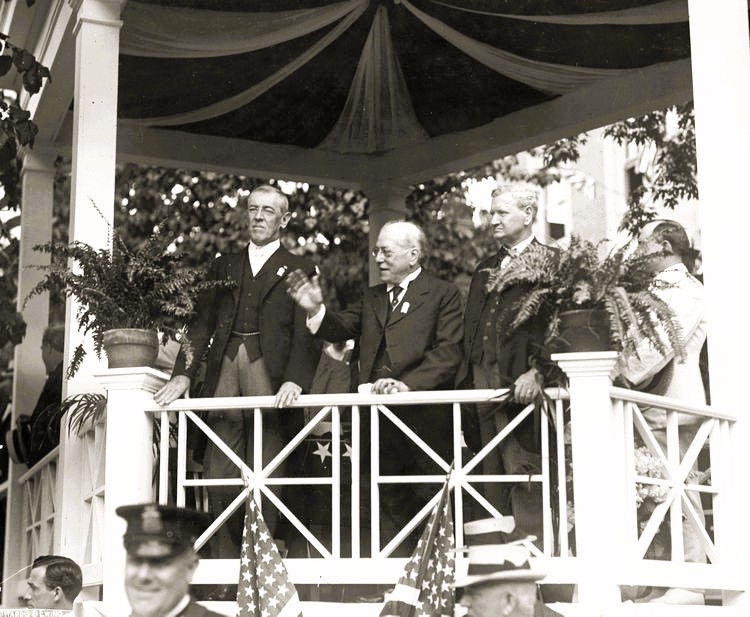
State holidays aside, the left has remained ambivalent, if not hostile, to Labor Day since it was declared by President Grover Cleveland in 1894, a bone thrown to labor before the midterm elections while he was using the federal government, including troops, to crush the Pullman strike led by Debs and the A.R.U., the leaders of which would be sent to prison. William McDevitt, San Francisco-based Socialist, writer and radical bookstore proprietor, in Revolt on Labor Day, 1911.
‘Craft Labor Day: Court Clowns for King Capital!’ by William McDevitt from Revolt (San Francisco). Vol. 2 No. 10. September 2, 1911.
Labor Day, the conventional and utterly respectable Labor Day signalized by the appearance in California of the Chief Labor Lieutenant of Capital as the spokesman for the Labor party, is the special day for stock-taking of the labor movement.
Of course to the self-conscious worker of this city. Labor Day means just as much as the Labor party–a sum-total of nothing. Labor Day signifies about as much to the really self-centered toiler as does an election visit from “Alias” Jimmy (Valentine) Rolph, hat in hand, a campaign smirk of L.F. & E. on his gleaming visage, and the usual salutation, “Yes, I’m Jim Rolph, the candidate for Mayor.”
Labor Day of 1911 finds the workers of this country still thoroughly conventional, thoroughly and merely echoes for the ideas of their masters. The ordinary workingman, when he wants to think well of himself, assumes an imitation of his master or his master’s chosen parasite; he looks at himself in the guise of a capitalist and through capitalist eyes–a distortion of a man seen through distorted eyes.
Hence the popularity of a workingman’s politician like Alias Jimmy the Dummy Director of the Sugar works and the puppet plutocrat. Hence likewise the popularity of an equally false figure, the figure of “P.H.,” the labor leader, the “People’s Choice,” the candidate who has crowded the “limit of human endeavor” off the dump in his anxiety to “make good.”
The conventional Labor Day disposes the ave rage workingman to feel satisfied with either Alias Jimmy or the omnific Patrick H…
The conventional Labor Day is a time of disguise, of compromise, of masquerading; it is the carnival day for capitalism’s cajolery, and the peddling of petty capitalist confetti for the toilers to wallow in. The god of things as they really, are gets his best laughs of the year out of the farce of the conventional Labor Day, when the addled pate of the hypnotized worker (hypnotized with political and industrial legerdemain and hocus pocus) gets a new consignment of topsy turvy labor-capitalist notions and ideas. And in order that the job of organized deception, and deluding may be consummately complete, the parson and the pastor are being called in to pulpetize and sanctify the dope, and bring Scripture and the Gospels to prove the identity of interest of the master and the slave, at least the GOOD master and the slave.
Press and pulpit and labor politician make a tremendously powerful combination for deception: and, in passing, let it be noted that here in San Francisco where the uncommon reaches the Nth degree in so many fields, we have one grand exponent of the most sublimely incongruous ideas of the respectable Labor Day–the man who consolidates in one Tartuffian personality the trinity of press, pulpit and polly–the Reverend Editor Candidate Walter Macarthur. The triune Walt is a labor editor, who scatters capitalist ideology: a labor pulpiteer on Labor Day I forget what, church pulpit he is programmed adorn): and, in politics, a perennial Goo-Goo candidate of the utterly respectable petty burgess class–and just now righthand man for capitalist James Rolph, Jr., alias proletarian Jimmy.
So long as workingmen are fools enough to believe that one man can serve both labor and capital in government or in the union, Labor Day will be simply April Fool’s day for the workers. It should be celebrated April 1st. instead of in September. As Puddin’ Head Wilson, according to Mark Twain, says of April Fool’s Day, “It is the day when we are reminded of what we are the other 364 days of the year.” On the conventional and respectable and Walter Macarthur Labor Day, the working mule comes nearer being an ass than on any other day in the 365.
However, the times change; and even the stupid farce of Labor Day as played by workers in the guise of dummy capitalists, is being lightened up with some gleams of returning class-consciousness. Especially when the workers ponder over the English strike, with its splendid display of incipient solidarity, and its terrible menace to decrepit capital, they must feel that sooner or later the conventional and respectable Labor Day will be consigned to the rag-bag of played-out absurdities, and they will prepare to celebrate Labor’s Labor Day, May 1st. the international day of the great international class, the workers of all the world.
May 1st as a day for labor to commemorate bears a profound class significance, while the September Labor Day is merely a mockery of the hypnotized toiler rejoicing in his own condition of absolute imbecility as King Capital’s Court Clown.
Revolt ‘The Voice Of The Militant Worker’ was a short-lived revolutionary weekly newspaper published by Left Wingers in the Socialist Party in 1911 and 1912 and closely associated with Tom Mooney. The legendary activists and political prisoner Thomas J. Mooney had recently left the I.W.W. and settled in the Bay. He would join with the SP Left in the Bay Area, like Austin Lewis, William McDevitt, Nathan Greist, and Cloudseley Johns to produce The Revolt. The paper ran around 1500 copies weekly, but financial problems ended its run after one year. Mooney was also embroiled in constant legal battles for his role in the Pacific Gas and Electric Strike of the time. The paper epitomizes the revolutionary Left of the SP before World War One with its mix of Marxist orthodoxy, industrial unionism, and counter-cultural attitude. To that it adds some of the best writers in the movement; it deserved a much longer run.
PDF of full issue: https://www.marxists.org/history/usa/pubs/revolt/v2n10-sep-02-1911-Revolt.pdf

