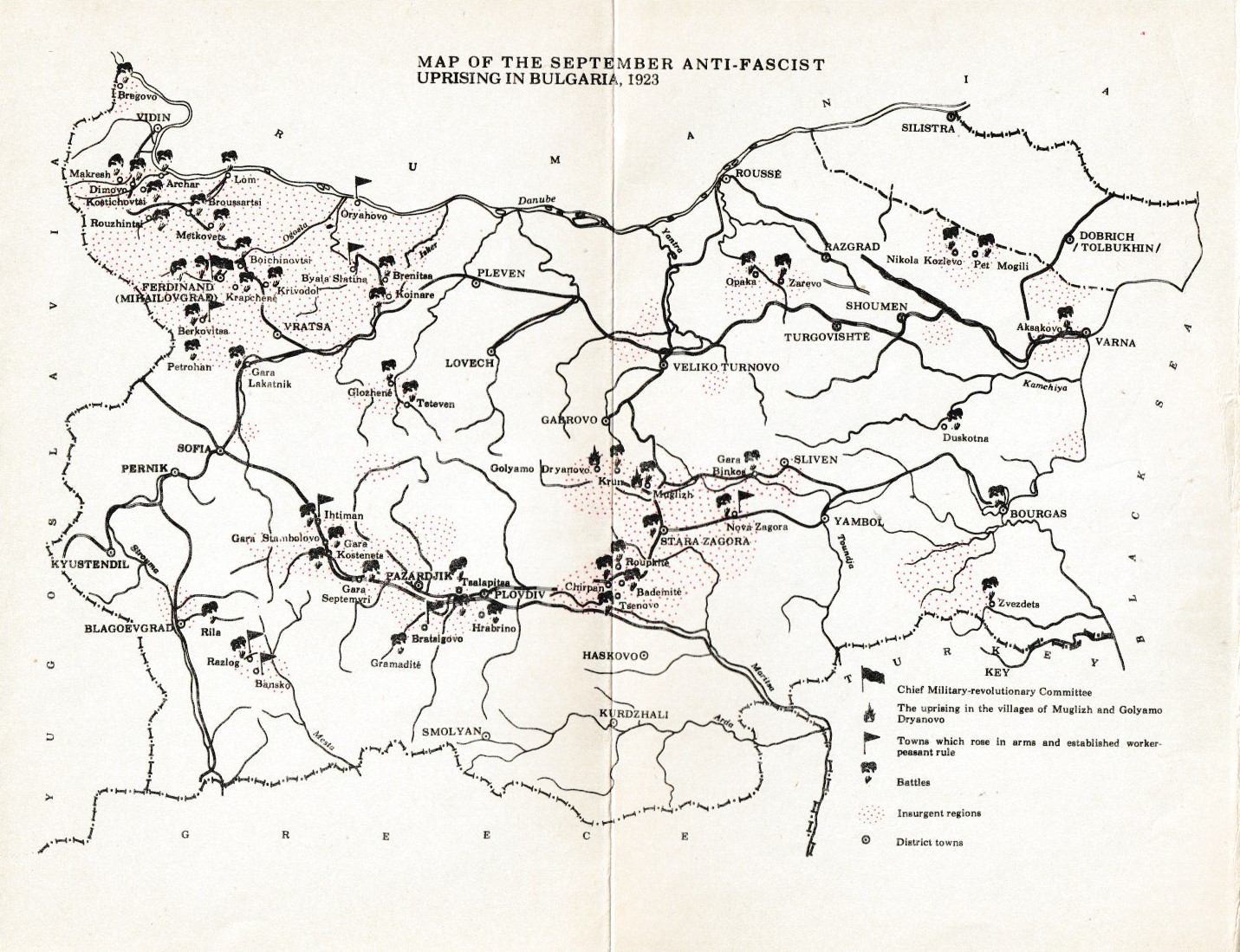
Stung by its inaction during the June 9, 1923 rightist coup that overthrew Agrarian Party leader and Bulgarian Prime Minister Stamboliyski, the Bulgarian Communist Party and Comintern quickly set to redress the failure with an armed revolt, what has been called the first anti-fascist uprising. A turning point in 1920s Europe, the coup began a fascist wave in the Balkans, instituting a reign of terror under the White Guard rule of Aleksandar Tsankov. At the time the Bulgarian C.P. was one of the most influential in the world, a genuine mass party it was the largest single Party in Bulgaria and failed to fight, let alone stop the coup. The heroic, but failed, rising that September was an enormous cost in lives and organization. Here, the Chair of the Comintern responds to initial news of the revolt and its suppression.
‘The Meaning of the Events in Bulgaria’ by Gregory Zinoviev from Communist International. Vol. 1 No. 28. November, 1923.
The uprising of the Bulgarian workers and peasants last September was crushed. A merciless vengeance followed which has already demanded the lives of thousands of the foremost members of the working class and the peasantry and will demand the lives of thousands more. The meaning of the events of September can be understood only in conjunction with the events of June, 1923.
The state of affairs which prevailed at the time of the White coup d’état of June 9th, 1923, was as follows: The political leadership of the peasantry, grouped around the Stamboliski Government, was just then engaged in a brutal campaign against the working class of the towns headed by the Bulgarian Communist Party. The Executive Committee of the Bulgarian Communist Party neither understood the necessity for nor was capable of reforming its ranks so as to act in conjunction with the peasants against the Whites. This was partly owing to the exasperation which had accumulated at the time of Stamboliski’s persecution of the Communist Party. Stamboliski himself, and his nearest friends, were blind. When, some days prior to the White uprising, Stamboliski was warned by certain of his most reliable officers that a counter-revolution was in preparation, he replied carelessly and confidently that since he had a majority in Parliament, he had no reason to fear a coup d’état. The peasant masses who had long followed Stamboliski–for he had in the past rendered great services to the peasants were at the time of the June uprising standing at the cross-roads; they were beginning to lose confidence in the bankrupt party leaders grouped around Stamboliski, but still had not sufficient confidence in the Communist Party, which at that time failed to do what was required in order to win the confidence of the peasants.
The political disintegration of the peasantry, the objective impossibility of their playing an independent political role, the political helplessness and demoralisation of the peasant leaders, who believed naively in the unshakableness of “democracy”–these constituted one of the reasons for the success of the White coup d’état of June 9th. The inability of the Communist Party, which had for decades been educated in peaceful propaganda work, to pass over to fighting action, the doctrinaire psychology of the leaders of the Communist Party, who failed at the right moment to understand the necessity for an immediate union with the peasants against the Fascist bourgeoisie of the towns–these constituted the second reason for the success of the White coup d’état led by Tzankov.
The masses were against Tzankov; but their disintegration, their political helplessness, the mistaken tactics of the leaders of the Communist Party, made it possible for a few shock divisions of the Fascist bourgeoisie to seize power.
But only a few months elapsed since June 9th, and a complete change had taken place in the frame of mind of the peasants. The Bulgarian peasantry no longer stands at the cross-roads. It has given its almost undivided sympathy to the Bulgarian Communist Party. The whole of the rural population of Bulgaria, with the exception of the few rich peasants, hates the Tzankov Government (which has taken land from the peasants) with a sincere, unbounded and unshakable hatred. A profound enmity towards the White régime is prevalent throughout the whole of Bulgaria. Every honest peasant, with clenched teeth, awaits the moment when this detested régime can be overthrown. The Bulgarian peasants are assuming a political fixity of purpose, for they have begun to understand that to veer between the bourgeoisie and the peasants, as Stamboliski attempted to do, must lead to inevitable ruin. They have under- stood that only in alliance with the working class of the towns can they throw off the yoke of the Tzankov régime. Never before, says the Bulgarian Communists, has the Bulgarian Communist Party enjoyed such universal support among the peasants as it does at the present day.
“We believe in you; we know that you alone are capable of leading us in the struggle,” so say the peasants.
The first reports of the September uprising might have led one to the conclusion that while on June 9th the Bulgarian Communist Party had been too late, in September they were too early. However, it is now clear that it was faced with the dilemma of either perishing without a struggle under the demoniacal persecution of the Tzankov Government, or to run the risk of a serious defeat by not declining the fight when the Fascist Government had made up its mind to annihilate the Communist Party. And as far as one can judge from this distance, it acted correctly. It did not gain a direct victory, it suffered heavy losses, but it did not submit without a struggle. It proved both to the workers and the peasants that it was prepared to lead the revolutionary forces of the country for its emancipation from the power of the bourgeoisie. All the news coming from Bulgaria serves to prove that in spite of the severe defeat, the revolutionary prestige of the Bulgarian Communist Party has been increased immeasurably, especially in the countryside. The September defeat is one of those defeats which bears within itself the certainty of future victory.
The peasants, almost to a man, are prepared to follow the Communist Party. Every peasant clenches his fist at the Tzankov Government. The peasants are blockading the capital, refusing to send foodstuffs there. The peasant youths are burning for a fight.
But they have no weapons. They have to fight almost with naked hands against an enemy who is armed to the teeth. Stamboliski in his simplicity left the peasants without arms, and so, once again, a few shock formations settled the matter. The Russian Wrangelites assumed the task of gendarmerie and spies, and a few White Macedonian divisions played the decisive role.
But a ferment has begun in the ranks of Tzankov’s regular army, which consists to a large degree of peasants. And, indeed, it could not be otherwise, for the soldiers are bound by a thousand ties to the villages which cherish an intense and irreconcilable hatred for the Tzankov Government.
By correcting its doctrinaire errors, the Bulgarian Communist Party opened the way to early victory. In a country like Bulgaria no régime can govern against the will of a peasantry which is revolutionary-minded and recognises the necessity for acting with the workers and their Communist Party. A flame of intense party warfare has been started, which will flare up still more violently and will end in the victory of the workers and peasants. The Bulgarian Communist Party gave the correct slogan to the insurrectionaries in the town where the uprising was unsuccessful, when it ordered them to retire to the villages and the hills and there to undertake partisan warfare. The Tzankov Government has not sufficient forces to fill the whole Bulgarian countryside with counter- revolutionary troops. The attempt to occupy the revolutionary Bulgarian villages will more rapidly than anything else drive the peasants to organise themselves into a permanent army on the side of the revolutionary population.
The White Bulgarian Social-Democrats played an unprecedentedly shameful role, which has earned the right of the leaders of the party to a share in the laurels of Noske. Even the Russian Socialist Revolutionaries took up the campaign abroad against the Bulgarian Mensheviks, who had acted as the executioners of the Bulgarian peasants. The yellow Second International is silent as to the villainous part played by its Bulgarian section. The railway- men and postal and telegraphic servants, who up to the time of the September uprising were still under the influence of the Bulgarian “Socialists,” are now beginning to understand the evil role played by the latter hitherto.
The Bulgarian events from June to September, 1923, are full of profound lessons which will be useful in estimating the position of the peasantry not only in Bulgaria but everywhere. Together with the working class, led by the Communist Party, the peasants are everything. Without the working class, and attempting to occupy an intermediary, “independent” position between the bourgeoisie and the working class, the peasants are nothing. Every such attempt ends in the undisguised dictatorship and the naked reaction of the landowners.
Peasants of the world, take to heart the lesson of the events in Bulgaria! The Bulgarian experience deserves the attention of the active sections of the peasantry of every country. On the basis of this experience the Communists must open the eyes of the peasantry, with whom the petty-bourgeois parties are attempting to play a demagogic game.
The Communists must reply to the unscrupulous tampering with the peasantry by class elements which are inimical to it by an intensive propaganda on behalf of the slogan of a Workers’ and Peasants’ Government, and must make it clear to the active section of the peasantry of the whole world that only in alliance with the working class of the towns will it be able to defend its true interests. This is the meaning of the events of Bulgaria.
The lesson has been purchased at a terrible price. Let the Communist Parties of all countries take it to heart and profit by it.
G. ZINOVIEV.
The ECCI published the magazine ‘Communist International’ edited by Zinoviev and Karl Radek from 1919 until 1926 irregularly in German, French, Russian, and English. Restarting in 1927 until 1934. Unlike, Inprecorr, CI contained long-form articles by the leading figures of the International as well as proceedings, statements, and notices of the Comintern. No complete run of Communist International is available in English. Both were largely published outside of Soviet territory, with Communist International printed in London, to facilitate distribution and both were major contributors to the Communist press in the U.S. Communist International and Inprecorr are an invaluable English-language source on the history of the Communist International and its sections.
PDF of full issue: https://www.marxists.org/history/international/comintern/ci/old_series/v01-n26-27-1923-CI-grn-orig-cov-riaz-r3.pdf

