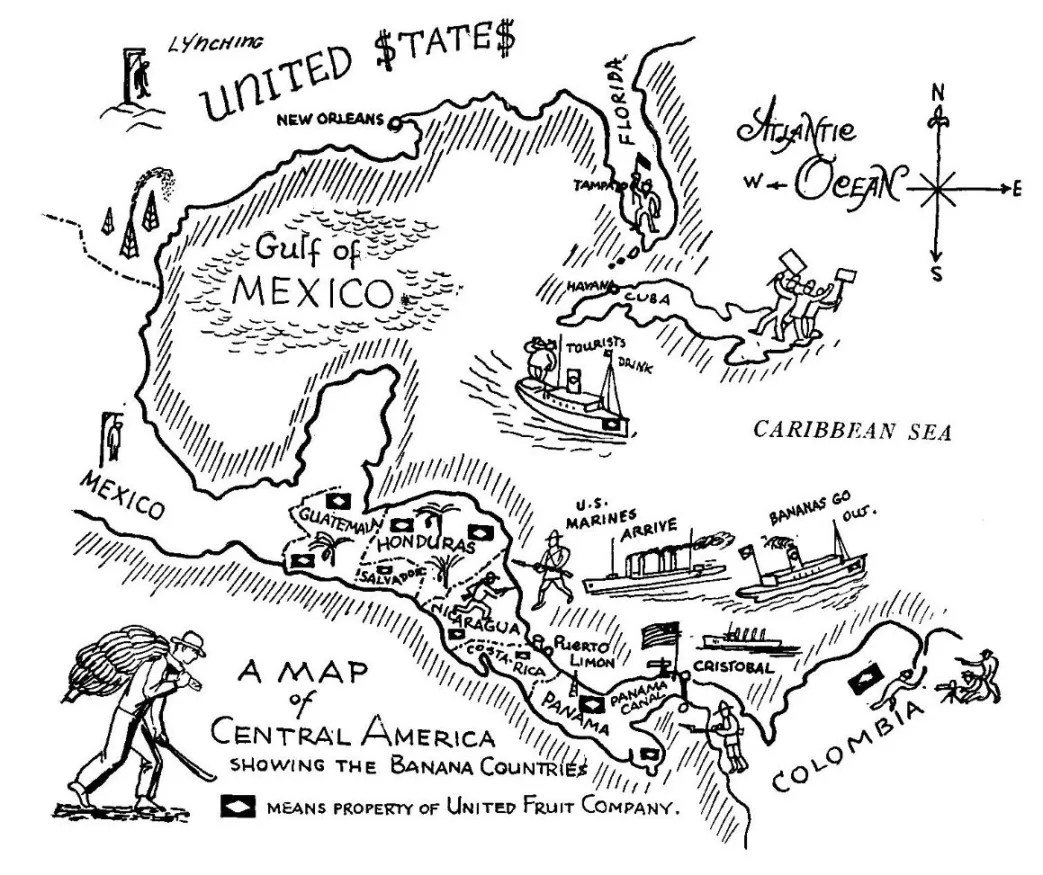
The rule of the Boston-based company of the country of Honduras, guaranteed by bayonets.
‘The Dictatorship of the United Fruit Company’ by O. Rodriguez from The Daily Worker. Vol. 9 No. 95. April 21, 1932.
IN several countries of the Caribbean the United Fruit Co. exercises a dictatorship over practically the entire life of those countries. Being one of the largest Yankee monopoly corporations operating in Latin America, the United Fruit Co. functions as one of the chief representatives of Yankee imperialism. And as such, it not only owns and controls immense tracts of land, plantations, shipping, railroads, mines, etc.; it not only robs these natural resources and exploits mercilessly the workers and toiling peasants for the aggrandizement of Yankee imperialism; it not only owns and controls the puppet governments of many of the Caribbean countries; but it itself exercises the functions of government directly, especially when it comes to suppressing the struggles of the workers and tolling peasants that are employed by the United Fruit Co.
The enterprises of the United Fruit Co. in the Caribbean, particularly the banana plantations, are practically armed camps. The United Fruit Co. maintains there numerous armed bands that are systematically terrorizing the workers and small poquiteros and, in times of strikes or other struggles of the masses for the improvement of their conditions, these armed bands of the Company undertake to crush these struggles by the utmost violence and wholesale murder, always with the support of the armed forces of the puppet governments of these countries. In doing so, the United Fruit Co. knows that there are always close at hand Yankee warships and marines “to protect” its life and property, when necessary.
One of the most recent displays of the dictatorship of the United Fruit Co. in some of the Caribbean countries has been given to us in the January struggles of the workers and small poquiteros in the banana zone of Honduras. That zone is almost completely dominated by the United Fruit Co. The workers went on strike against a 20% wage cut. The small poquiteros joined the struggle to fight against a 25% cut in the price of bananas that they are selling to the United Fruit Co. The strike was joined by the longshoremen in Tella backed up by all transport workers. Mr. Trumbuk, general manager of the United Fruit Co. in Honduras, took charge of the situation and under his command the government of Collindres undertook to crush the strike by declaring martial law, invading the strike area with troops, at the same time “a pealing” to the strikers to accept the wage cut “in the national interests of Honduras.” The troops that came to the banana zone on January 3 from La Ceiba, most of them recruited from the unemployed, began to fraternize with the strikers and upon the order of the United Fruit Co. these troops were withdrawn from the strike zone and more “reliable” ones sent instead.
But the United Fruit Co. did not confine itself to merely ordering Collindres to crush the strike, not because Collindres was unwilling to obey the commands of the United Fruit Co. but because he was not “efficient” enough in crushing the strike which the troops from La Ceiba, were unwilling to attack and which had the active support of the poor non-working class population of the cities in the banana zone. Hence, the United Fruit Co. stepped forward to handle the situation more directly. On January 15, the armed bands of the United Fruit Co. began to carry through a series of arrests, picking out those that appeared to be more militant, placing these kidnapped workers on one of its ships–the “Dry”–and sending them to Puerto Barrios. When these workers were refused permission to land, the United Fruit Co. brought them to the Aviation Field at San Pedro Sula, placed them on one of its own airplanes and sent them out to Salvador, from where they have not yet been heard of. There is great danger that these strikers, that were kidnapped by the United Fruit Co. and deported to Salvador, may have been murdered. This is how Yankee imperialism is exercising its dictatorship in the Caribbean countries.
At the present time, the United Fruit Co. and its servant, the Collindres government, are making the most desperate effort to wipe out the revolutionary organizations from the banana zone, especially the revolutionary unions and the Communist Party. The leading working class and peasant militants are being hounded and persecuted with the utmost violence and brutality. Yankee imperialism and its puppet government in Honduras are carrying on this wild white terror against the struggling masses in order to forestall and check the coming new struggles of the workers and toiling peasants against the robbery and exploitation of the United Fruit Co.
But the brave and courageous workers of the banana zone will not be cowed by this terror. They will continue to build their revolutionary unions into powerful mass organizations, rooting them on the plantations and in the ports, as well as the organization of the Committees of Unemployed. Learning from the shortcomings and errors of the January strike, especially the lack of preparation and failure to build up wide rank and file strike committees on each plantation, the revolutionary workers will more than ever before concentrate on the banana zone as the most important field of their activity, preparing the coming struggles of the workers against the wage cuts, lay-offs, unemployment, etc., combating mercilessly the legalism and surrender to compulsory arbitration of the right opportunists and the sectarian putchist distortions of the “left” opportunists. The organization of the small poquiteros and toiling peasants generally into Peasant Leagues, struggling jointly with the workers against the United Fruit Co. and its native supporters, remains one of our chief tasks in Honduras.
Against the dictatorship of the United Fruit Co. and the rule of Yankee imperialism in Honduras we must arouse the widest mass anti-imperialist movement of the workers, peasants and poor petty-bourgeoisie of the cities. The situation now is highly favorable for the development and organization of such movements, also because of the sharpening danger of a new world war and especially the immediate danger of war against the Soviet Union for which the Collindres government is preparing under the direction of Yankee imperialism. We must place on the order of the day the organization of a League Against Imperialism in Honduras, based upon the workers and peasants and including all militant anti-imperialist elements, to unify and intensify the struggle against Yankee imperialism and the United Fruit Co. and for the defense of the Chinese people and the Soviet Union.
The Daily Worker began in 1924 and was published in New York City by the Communist Party US and its predecessor organizations. Among the most long-lasting and important left publications in US history, it had a circulation of 35,000 at its peak. The Daily Worker came from The Ohio Socialist, published by the Left Wing-dominated Socialist Party of Ohio in Cleveland from 1917 to November 1919, when it became became The Toiler, paper of the Communist Labor Party. In December 1921 the above-ground Workers Party of America merged the Toiler with the paper Workers Council to found The Worker, which became The Daily Worker beginning January 13, 1924.
PDF of full issue: https://www.marxists.org/history/usa/pubs/dailyworker/1932/v09-n095-NY-apr-21-1932-DW-LOC.pdf

