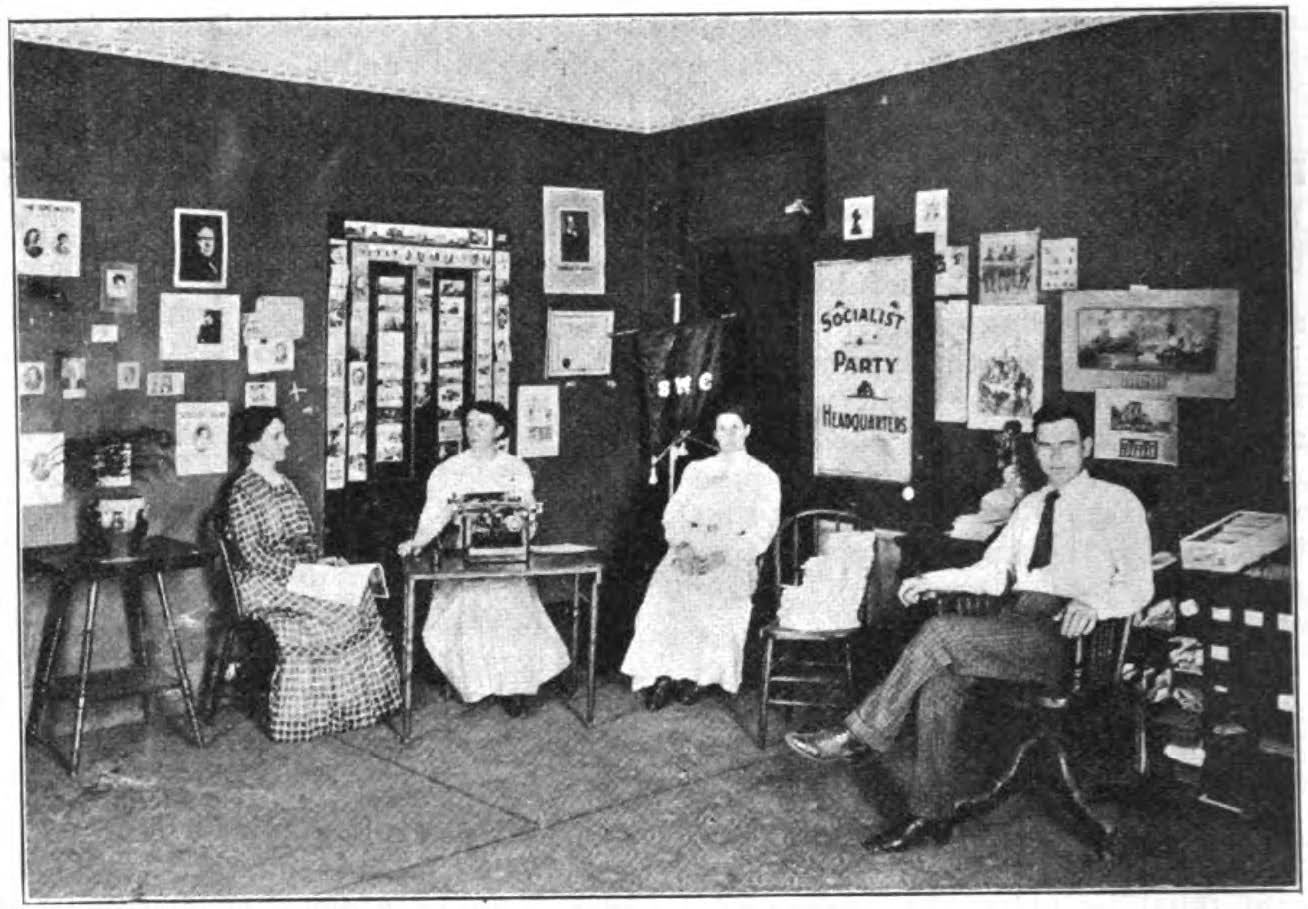
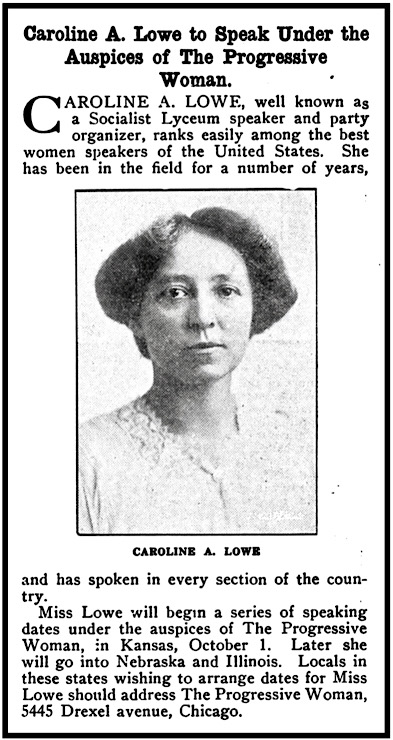
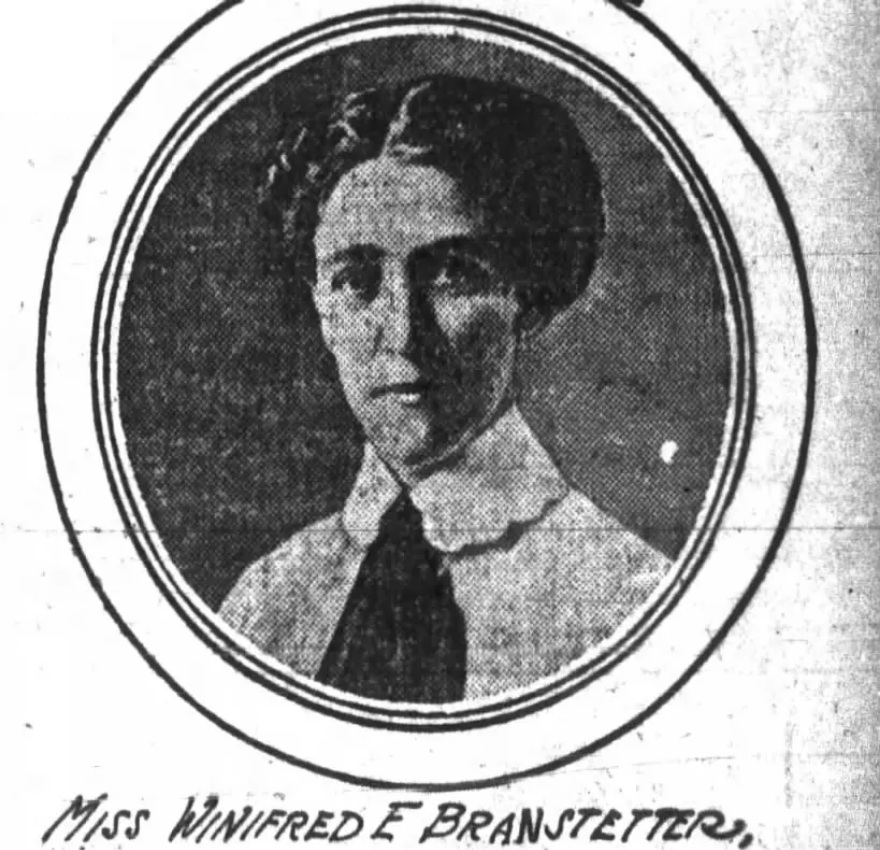
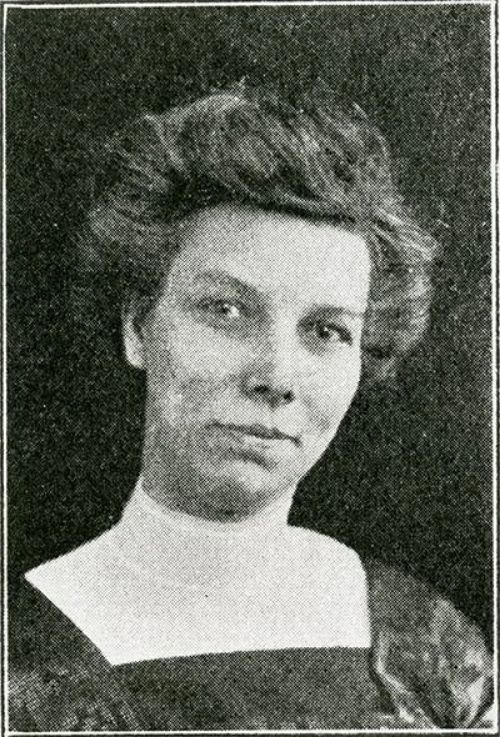
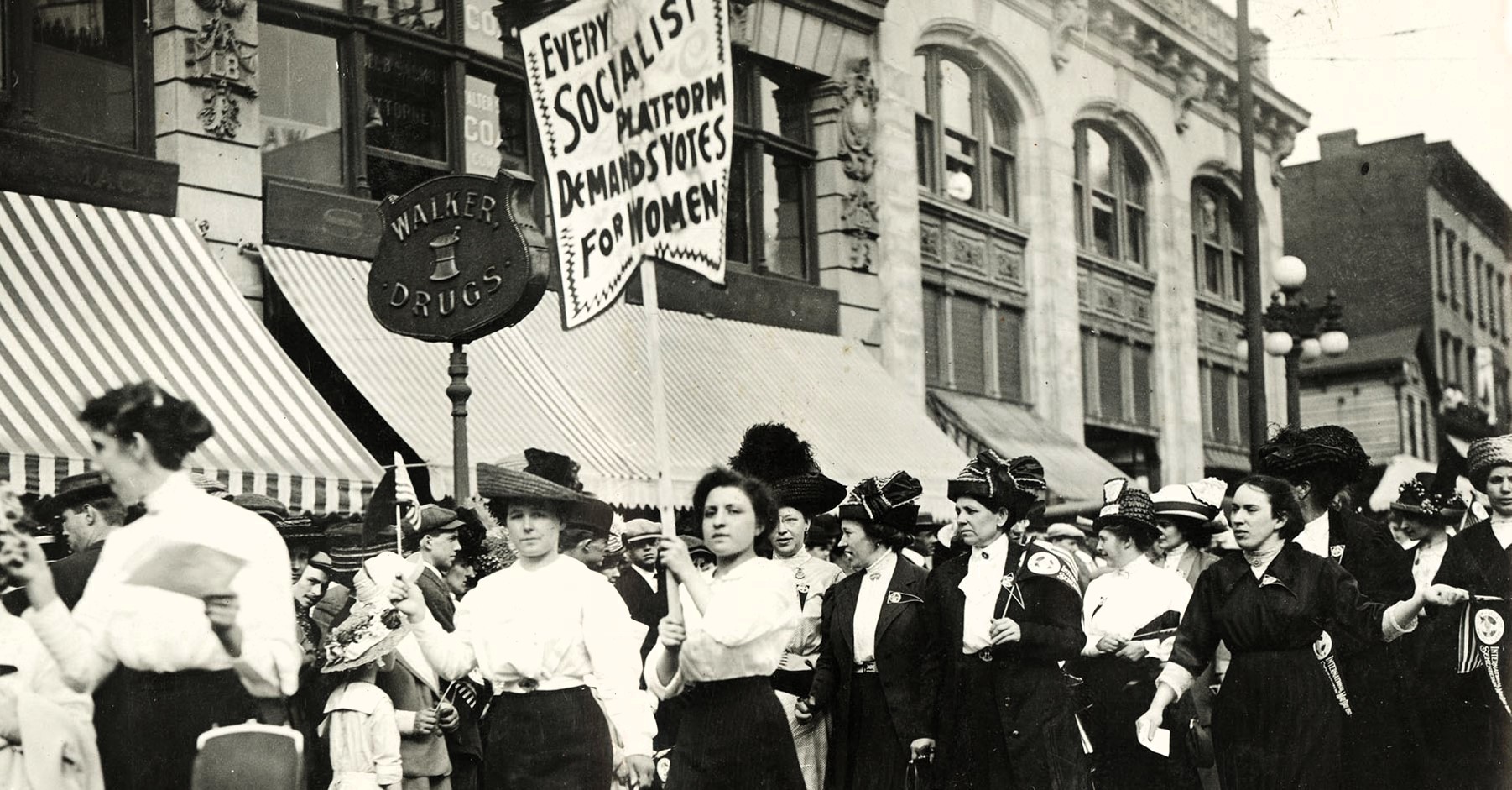
Much here for students of women’s Socialist history–from the local to the international, practical and political–in the full minutes from August, 1911’s three-day meeting of the Socialist Party’s leading women’s institution held in the Chicago national offices. It was attended by Carrie W. Allen, Winnie E. Branstetter, Octavia Floaten, May Wood-Simons, May M. Strickland, Anna A. Maley, Nellie M. Zeh, Florence Wattles, Josephine Conger-Kaneko, Kate Richards O’Hare, Elsa Unterman, and Caroline A. Lowe along with guests and other reporters. The Socialist Party’s Woman’s National Committee was inaugurated at the behest of women delegates by the 1908 National Convention, and would become an important institution in the Party for a number of years owing to the energy and persistence of activists like the leading ‘General Correspondent’ of the Women’s Committee, the teach, later lawyer Caroline A. Lowe, who was so central to development of women’s Socialist organizing in the U.S. Lowe joined the Socialist Party in 1903, was a teacher (in 1908, Vice President of the Kansas City Teachers’ Association), founder and leader of National Women’s Committee in the Socialist Party of America, prioritizing and regularizing ‘women’s work’ in the Party for the first time. On the Party’s left, Lowe returned to school after Haywood’s recall, earned a law degree and became a leading counsel for the I.W.W., defending many victims of persecution during the original Red Scare years. Still later, until her 1933 death, she worked with the International Labor Defense.
‘Minutes of the Woman’s National Committee, Socialist Party’ from Socialist Party Official Bulletin. Vol. 7 No. 12. August, 1911.
Sessions August 11, 13, 15, 1911. Submitted by Caroline A. Lowe, General Correspondent.
The meeting of the Woman’s National Committee opened at National Headquarters on Friday morning, August 11. Two full sessions were held on Friday, beginning at 10:30 in the morning and closing at 6:00 in the afternoon. The committee then adjourned to continue their work in Milwaukee, and to attend the conference of the elected officials of the party, and the National Executive Committee. Saturday was spent in gaining information from the discussions at the conference. An informal session of the committee was held on Sunday morning. Sunday afternoon the various sub-committees met to prepare their ports. The Sunday night session was held in Brisbane Hall, and the sub-committees submitted their reports. Monday was given to the work of the conference. Tuesday’s session was held in Brisbane Hall, opening at 9:00 in the morning, and ending at 6:00 in the afternoon. The meeting adjourned sine die at 6:00 p.m., August 15.
MINUTES OF THE MEETING.
Those present at the opening were: Carrie W. Allen of New York, Winnie E. Branstetter of Oklahoma, M. Octavia Floaten of Colorado, May Wood-Simons of Kansas and May M. Strickland of Indiana. Also Anna A. Maley, National Woman Organizer; Nellie M. Zeh and Florence Wattles, District Organizers; Josephine Conger-Kaneko, editor Progressive Woman; Caroline A. Lowe, General Correspondent, Woman’s National Committee.
Comrade Lena Morrow Lewis was attending the meeting of the National Executive Committee, of which she is a member. Comrade Kate Richards O’Hare was unable to be present the first day because of a lecture date.
Meeting was called to order by Caroline A. Lowe. May M. Strickland was elected chairman, and Elsa Unterman secretary.
The following was adopted as an order of business:
ORDER OF BUSINESS.
1. Call to order by General Correspondent.
2. Election of Chairman and Secretary.
3. Adoption of Order of Business.
4. Election of Committees. (a) Rules governing Woman’s National Committee. (b) Woman’s Day Program. (c) Napolitano Case.
5. Report of General Correspondent.
6. Report of National Organizer.
7. Report of District Organizers.
8. Propaganda and Organization.
9. Unions. Clubs. Foreign-Speaking Organizations.
10. Financial. Dues for Women. Separate treasury.
11. Progressive Woman.
12. Sunday Schools. Organization of Children.
Intercollegiate Socialist Society, Child’s Welfare, Suffrage Petition, Lyceum Bureau, Organized Labor, Peace Proposal, etc., as time permits. The following committees were elected:
Rules–Comrades Allen, Branstetter and Strickland.
Woman’s Day Program–Comrade Maley.
Napolitano Case–Comrades O’Hare and Lewis.
REPORT OF THE GENERAL CORRESPONDENT.
Moved by Comrade Allen that in view of the fact that the committee, not knowing which part of the report of General Correspondent was most important, might spend more time on unimportant than on important matter, the report as a whole should first be read, and then taken up seriatim. Motion carried.
Caroline A. Lowe, General Correspondent, read her report for the year beginning September 1, 1910, up to August 1, 1911. It was then taken up under the various headings, and action taken according to the judgment of the committee. This report is herewith, given in full, together with the actions taken by the committee upon each subject.
Chicago, Ill., August 11, 1911.
To the Woman’s National Committee: Dear Comrades–I respectfully submit to you the following report.
It includes within its scope information regarding the work of the Woman’s National Committee of. the Socialist Party from September 1, 1911, to August 1, 1911, arranged under the following headings: Woman’s State Correspondents; Woman’s Local Correspondents. Under Departments of Work the subjects are: Newspaper Articles; Literature Leaflets; Monthly Programs; Sunday School Organization; National Organizers; District Organizers; State Conventions: Foreign Speaking Organizations; International Notes.
I feel that we have every reason to be encouraged with the outlook before us. While in a few cases our work among women has not been recognized as of vital importance to the welfare of the Socialist movement, upon the whole the party membership has shown a most earnest desire to enlist the women into the party.
Despite the fact that most of our State Secretaries are overworked, a large part of them have shown a sincere appreciation of the work we are doing, and have expressed their willingness to aid us in our efforts. If the past year has brought forth good results from our endeavors, we are largely indebted for this to the hearty support which we have received from our National Secretary and National Executive Committee.
Because of her years of experience in the organization work of the party, and of her earnest devotion to the cause of Socialism, Comrade Mabel Hudson has gladly rendered most valuable service to our Woman’s Department during the past year.
I wish to take this opportunity to express my appreciation of the kindly encouragement that our woman’s movement has received from every side, and trust that the good seed sown during this, our first year, shall bear good fruit in the future.
I. STATE CORRESPONDENTS.
All of the states of the United States, with the exception of North Carolina, South Carolina and Delaware are organized into the Socialist Party. Of this number Oklahoma, Nebraska, Arkansas and California have elected a Woman’s State Committee. Fifteen states have secured a woman State Correspondent.
These are as follows: Washington, Ina M. Salter; Massachusetts, Charlotte Kimball Kruesi: Colorado, M. Octavia Floaten; Connecticut, Matilda Rabinowitz; Indiana, Rosa Lehnert; Illinois, Martha Beigler; California, Mary E. Garbutt; Oklahoma, Ora Barnard; Idaho, Laura I. Motley; Louisiana Hazel Putnam; Arkansas, Vera Stevens; Iowa, Myron T. Wiltse; Wyoming, Lucy E. Bode: and Nebraska, Ida Ginsburg. I have had reports of efforts to organize the women of their respective states from the state correspondents of Washington, Colorado, Connecticut, Indiana, California, Louisiana, Idaho, Oklahoma, and Massachusetts. The correspondents of Arkansas, Iowa and Utah haye just taken office, and are now ready to start in on their work. The correspondent of Illinois is engaged in business, and has sent in her resignation saying that she is unable to attend to the duties of state correspondent.
OUR DUTIES TOWARD THE STATE CORRESPONDENT.
We should place in the hands of the State Correspondent all of the printed organization material needed for her work. For this purpose she should have, Plan of Organization and Plan of Work, Leaflets, Literature Leaflets, Sunday School Leaflets, National Party Platform, Application Blanks and National Constitution. This makes a complete set of Organization leaflets.
The present “Plan of Work” and the present “Literature Leaflets” are obsolete. At this meeting we should decide upon plans for new ones.
The printing of a form letter would be a great help to the State Correspondents. In this connection Comrade Salter of Washington says:
“I wrote a very urgent appeal to these women to correspond with the State and National Offices, but to no avail. I believe a good way would be to have the National Office have a list of questions printed and sent to the State Correspondents, these in turn to be sent to the Local Correspondents.”
I would suggest that a form letter, applicable to any state, be prepared and submitted to this committee. When it has met with your approval it should be printed in sufficient quantities for use by the State Correspondents.
A printed report blank by which the State Correspondents may send monthly reports to the General Correspondent I will greatly simplify the work of both of these officials.
The State Correspondents can give assistance in the circulation of our press articles for the newspapers by securing permission to have them published in as many state papers as will accept. In this connection, Comrade Kruesi, State Correspondent of Massachusetts, says:
“The newspaper matter from the Woman’s National Committee, I have been unable to use at all. Massachusetts newspapers do take Socialist stuff now, especially the Boston Globe and Transcript. But they insist it be brightly and newsily written. I think syndicated matter on propaganda work among women very hard to do satisfactorily.”
The State Correspondent, through cooperation with the Intercollegiate Socialist Society, could do good work in reaching the larger educational institutions throughout the state, if some means were devised by which she could reach them with printed matter alone. The State Correspondents, as a rule, have no typewriters and must write their letters by hand.
ACTIONS TAKEN ON STATE CORRESPONDENTS.
In discussions as to ways of getting in touch with active, capable women in various states, it was moved by Comrade Branstetter that in states where a woman State Correspondent has not yet been secured, that organizers be requested to report to the General Correspondent names of women comrades fitted to fill this position. That the General Correspondent report same to the State Secretary and urge the importance of securing one of them to serve as State Correspondent. Motion carried.
Moved by Comrade Branstetter that each National, State and District Organizer be requested to send in list of earnest, reliable Socialist women who can be depended upon in case of special need. Motion carried.
Moved by Comrade Floaten that wherever possible, and for the purpose of facilitating co-operation between the work of the State Secretary and the State Correspondent, that the State Correspondent be elected from the same city as that in which the office of the State Secretary is located. Motion carried.
Moved by Comrade Simons that the Woman’s National Committee dispense with the Woman’s State Committees. Amended by Comrade Floaten that the existing state committees serve their unexpired terms. Motion as amended carried.
Moved by Comrade Branstetter that in conformity with the suggestion offered by Comrade Salter, that the General Correspondent be instructed prepare a form letter for use by the State Correspondents. Motion carried.
Moved by Comrade Floaten that the General Correspondent prepare monthly report blanks for use by the State Correspondents. Motion carried.
The General Correspondent was instructed to have the form letter printed if funds permitted; the report blanks to be mimeographed.
II. LOCAL COMMITTEES.
On December 12, 1910, I submitted the following report to the National Executive Committee: “Various organizers have reported the organization of 156 local womans’ committees. As a result of two communications sent to each party local, out of 3,200 locals, 225 have responded. The combined report of these show 1,550 women members of the party, and 60 local committees. This is the number of the women represented in 6 per cent of the party locals. We have no information upon which we can base an estimate of the total membership of women in the party.”
Since that time I have sent letters to the State Correspondents and State Secretaries requesting answers to the following questions:
1. Have you a woman State Correspondent? If so, give her name and address.
2. How many local Woman’s Committees in your state? Secure the names and addresses of the correspondents of these committees. We need these names on file in this office, just as the National Secretary has a list of the local secretaries of each state.
3. How many women members of the party in your state?
4. What do you know of the activity of the women party members in your state during the past year?
5. What suggestions for future work, or criticism of past work of the Woman’s National Committee have you to offer for our consideration at this meeting in August?
In answer, only twenty-two, or less than one-half of the organized states, made any attempt to answer the questions. Fifteen of these merely returned the list that I had sent them, with corrections and additional names. From this meager information and from the reports sent in by Anna A. Maley, John M. Work and others, the following figures are obtained:
Four states have elected Woman’s State Committees; 15 have secured woman State Correspondents. Only 148. Local Correspondents, 735 party members, and 665 sympathizers were reported.
Such an estimate as this is an absurdity. It but represents the lack of appreciation of the importance of reports. When our membership realizes that if we are to do effective organization and propaganda work we must get in touch with those who are already party members, then we shall receive the needed information, and our work will go forward to success.
OUR DUTY TO LOCAL COMMITTEES AND CORRESPONDENTS.
In conformity with the precedent established by the party office, the Local Correspondent should be furnished with a monthly report card upon which to report to the State Correspondent all matters pertaining to the work of the Local Committee during the month. She should also have a supply of organization leaflets.
The Local Woman’s Committee should be impressed with the fact that its work should be conducted as a regular committee of the party in co-operation with the local organization. At the same time, the Woman’s National Committee should place definite, concrete work in the hands of the Local Committee.
Since January of this year, we have done this by publishing a Monthly Program in the Progressive Woman; also, by preparing leaflets for circulation by the local comrades. It is now for us to decide whether or not we shall continue this plan.
It may be necessary to prepare two kinds of local committee work, one for the committees in the large cities, and one for those in the small towns and country communities. Comrade Kruesi, of Massachusetts says–“Will the committee consider propaganda methods in large cities? The lesson or entertainment outlines in the Progressive Woman do not appeal to Boston or towns nearby, I find, because there are already so many lectures. They seem good for towns that are smaller, and excellent for village communities.”
It rests with the Woman’s National Committee to place work at the disposal of each community that is best fitted to its needs.
ACTION TAKEN ON LOCAL COMMITTEES.
The discussion regarding the Local Correspondents and Committees centered about the Plan of Organization and the Plan of Work,
Moved by Comrade Allen that a committee of three be elected to draw up Plan of Work along the lines suggested by the General Correspondent. Motion carried. Comrades Allen, Simons and Maley were elected.
At the session of August 14, the committee reported, and it was moved that the Woman’s National Committee go into a committee of the whole to discuss and outline a Plan of Work for 1912. The following motions were carried:
1. That the basis of the year’s work be distribution of literature.
2. That four distributions in meetings of all kinds be undertaken on the following days: May Day, July 4, Labor Day and Woman’s Day.
3. That we make the Progressive Woman a special feature of the year’s work with a view to bringing the circulation up to at least 30,000.
4. That the Monthly Programs be continued in the Progressive Woman throughout 1912, with such modifications as may be desirable.
5. That the sending of articles on the Woman Question to the Socialist press be continued through 1912.
Moved and carried that these five features constitute the basis for the Plan of Work for 1912.
That Socialist women in large cities might be prepared for quick action in industrial crises, the following action was taken: “Moved and carried that in industrial centers, the women elect a permanent strike committee to take charge of strike crises, and to continue the work of agitation and organization after the strike is ended.”
Moved and carried that Comrade Allen be a committee of one to formulate her ideas on activities among women during times of strike.
DEPARTMENTS OF WORK.
Newspaper Articles.
According to your instructions regarding the newspaper work for 1911, I wrote to a number of comrades requesting them to furnish us with articles upon certain subjects for certain months.
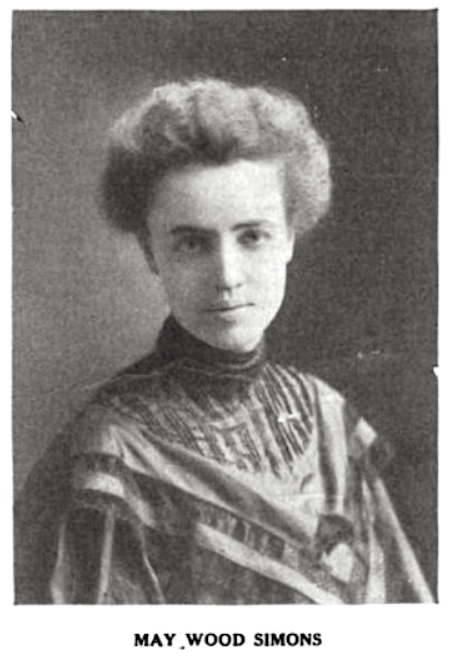
Since January we have received newspaper articles from Georgia Kotsch, Agnes H. Downing, Mary E. Garbutt, Mila Tupper Maynard, Grace D. Brewer, May Wood-Simons, Anna Maley, Eugen V. Debs, John M. Work, Robert H. Howe, Joseph E. Cohen, Elizabeth H. Thomas, Charles Lincoln Phifer, Dr. Edwin E. Bowers, F.J. Gould of London, and Caroline A. Lowe.
Each article has been sent to 125 papers. I have been unable to keep any account of the number that has been published.
Eighteen articles have been sent out since the first of the year. If each paper had printed each article (which it did not, of course) an equivalent of 2,250 articles would have been published in the past eight months.
I am submitting to you five more articles:
The Lonely King, by F.J. Gould, of London, which is a Socialist story for young people; Labor Legislation Affecting Women and Children, by Charles Lincoln Phifer, associate editor of the Appeal to Reason; The Worst of Social Diseases, by Agnes H. Downing of California; Why We Have Outgrown the United States Constitution, by Eugene V. Debs; The United States Constitution, by John M. Work;
In the future our articles will go out with those sent out by the National Office, thus combining our press work with that of the National Office. Our articles must conform to the regulation length of about one thousand words. Since the exchange list of the National Office is twice that used by us, our circulation in the future will be doubled.
The newspaper propaganda is developing into one of the most important departments of our work. Comrades are coming to realize that we will furnish articles for their home papers, and several requests have come to us for them. No other United States’s organization in the–I might say of the world–has such an opportunity as we have to carry its propaganda into the working-class homes. We should make the best possible use of it. We have at our disposal 250 Socialist or near-Socialist papers that will print, upon the average, two articles pertaining to women each month. This means an equivalent of 500 articles a month, or 6,000 a year. And each week the list increases in number.
O Comrade Grace D. Brewer, associate editor of the Appeal to Reason, submits the following suggestion:
“The thing I want you to bring up for me in the woman’s meeting is this: That the committee officially ask the editors of the various Socialist papers in this country to install a woman’s department, same to be consistent with the policy of the paper. If this can be accomplished we will have the various kinds of literature in circulation needed for the various classes of women. I am in favor of asking these publications to do this on their own responsibility, asking them that this plan be tried a year. Let them bear what expense it might entail and be responsible for the articles appearing in the paper. Of course, all women of the Socialist Party would be earnestly solicited to contribute what they can to whatever paper it would be best suited.”
ACTION TAKEN.
Moved by Comrade Branstetter that the suggestion of Comrade Kruesi requesting that newspaper articles should be from 600 to 800 words instead of 1,000 be concurred in. Motion carried.
Moved by Comrade Simons that we ask editors of Socialist papers to have one or more articles for women in each issue instead of a special woman’s department. Carried.
LITERATURE LEAFLETS.
Until the first of May the Progressive Woman published the leaflets prepared by the National Committee. All orders for leaflets were sent to the Progressive Woman. This resulted in confusion and loss of time. Since the first of May the National Office has published the leaflets belonging to your committee.
Before that time by far the larger part of the orders for the leaflets were sent by the local comrades direct to the Progressive Woman, so that I have no means of knowing how many were in’ circulation during these months. From September to May orders to the amount of 45,000 passed through my hands. From May 1 to July 1 about 75,000 leaflets have been sent out by the National Office. During the past year many hundreds of thousands of leaflets for women have been distributed.
The only leaflets belonging to the Woman’s National Committee are the following:
To the Working Woman, by Theresa. S. Malkiel.
Why the Professional Woman Should Be a Socialist, by May Wood-Simons.
Crimes of Capitalism, by John M. Work.
Woman’s Enfranchisement, by Mila Tupper Maynard.
Women Ain’t Got No Kick, by Kate Richards O’Hare.
The Teacher and Socialism, by Caroline A. Lowe.
Why You Should Be a Socialist, by Theresa A. Malkiel.
I am submitting for your consideration at this time
The Principles of Socialism, by John M. Work.
Poverty the Cause of Intemperance, by Mary E. Garbutt.
Woman Suffrage and Socialism, by Jennie Ream.
Wives of Toilers, by Meta A. Stern,
Some of the leaflets prepared recently by the National Executive Committee can be used to good advantage in our appeal to the women. “The Children of the Poor” by Eugene V. Debs, “The Party and Woman Suffrage,” by Lena Morrow Lewis, are especially applicable to our work.
The following suggestion is offered by Comrade Grace D. Brewer, associate editor of the Appeal to Reason:
“While I am not offering any criticism of the leaflets circulated by the Woman’s National Committee, I want to urge that some more elemental ones be prepared, some that would deal strictly with the every-day problems of the wives of the wage workers. Miners’ wives know something about the unions their husbands belong to; they know how hard it is to pull through a strike. We could appeal to them through that line–leaving out the scientific terms and clothing the appeal in the simplest language, for we must remember that many of the miners’ wives are not very familiar with the English language. You understand the different sorts of pleas that should be made to the different groups of women, industrially speaking.”
Mary E. Garbutt of California writes: “We ought to have more good, practical literature in the way of leaflets than we have. Something especially for the different classes of wage-earning women–one for teachers, one on the children who toil, one on the department-store girl, etc. Then if we get the ballot here we should have something on the use of the ballot. Everything must be made very plain and simple in the way of instruction for work. So many of our women have had little or no experience in working together. They do not know how to plan or how to work, so do not prepare work over their heads.” It rests with your committee to decide. which leaflets shall be prepared to answer these demands.
ACTION TAKEN.
Moved by Comrade Branstetter that the Woman’s National Committee prepare such leaflets as it deems necessary and have them published as heretofore through the National Office. Motion carried.
Moved by Comrade Simons that a committee of three be elected to prepare a list of subjects for leaflets and submit it to the Woman’s National Committee. Motion carried.
Comrades Allen, Simons and Branstetter were elected to the committee. At the August 14 session the committee reported as follows:
“We now have on hand the following leaflets: To the Working Woman, The Teacher and Socialism, Woman’s Enfranchisement, Wimmin Ain’t Got No Kick, Children of the Poor, Why the Professional Woman Should Be a Socialist, The Socialist Party and Woman Suffrage, The Crimes of Capitalism, “We recommend that leaflets upon the following subjects be prepared: The Farmer’s Wife, The Socialist View of Suffrage, The House, or Organized Women (unions), First Principles of Socialism, Anti-Militarism, The Boy Scout, Waste of Capitalism, The Department-Store Girl, and The Liquor Question.”
The report of the committee on leaflets was adopted, and the matter of their publication submitted to the General Correspondent.
MONTHLY PROGRAMS.
According to our plan of work for the year 1911, each month I have prepared a special program for the use of the local committees and have had it published in the Progressive Woman. Readings, songs and recitations upon the following subjects have been arranged for use, as lessons for class, study or as propaganda entertainments:
Universal Peace, Woman’s Enfranchisement, Socialism and the Home, Anti-Militarism, Our Needs in Education, White Slave Traffic, Social Diseases, Solidarity Among Working Women.
Because of the tense situation in relation to conditions in Mexico, the April subject was changed from “Woman’s Relation to Socialism” to “Anti-Militarism.” In the name of the Woman’s National Committee the entire issue of the Progressive Woman was given over to this subject. Thirty thousand copies were published, and over twenty-seven thousand have been sold. Three thousand yet remain to be disposed of, and we should devise some means for putting them into circulation.
For the September program both Comrade Debs and Comrade Work have prepared splendid articles upon the subject under discussion, “Why We Have Outgrown the United States Constitution.” For October, Comrade Charles Lincoln Phifer has made a most exhaustive report upon “Labor Legislation Affecting Women and Children.” These programs have necessitated a great deal of work upon my part. I cannot say whether or not they are meeting the needs of the local committees. It is for you to decide whether we shall continue our efforts along this line.
ACTION TAKEN.
Moved by Comrade Branstetter that, the matter of monthly programs be submitted to the committee on plan of work. Motion carried.
On August 14 the Woman’s National Committee in a committee of the whole Moved that the monthly programs be I continued in the Progressive Woman throughout 1912, with such modifications as may be desirable. Motion carried.
EDUCATIONAL WORK AMONG CHILDREN.
Reports from Ethel Whitehead of Los Angeles and from Bertha H. Mailly of New York were read, and a verbal report given of the work of Mary Livingston of Chicago. Suggestions and plans for future work were discussed.
It was suggested that lessons should be prepared for in three grades, primary, intermediary and advanced. The primary lessons should be planned along kindergarten lines, the various little plays and stories to be used in such a way that the Socialist message would be taught to the smallest children, and the spirit of class solidarity developed. The intermediate grade should teach nature stories along geological and biological lines, thus familiarizing the mind of the working-class child to the idea of evolution–developing into a thorough understanding of the social evolution through which the race has passed.
The advanced grade should take up the study of scientific Socialism–the lessons to deal with the fundamental principles of Socialism and with a brief history of the movement in the various countries.
ACTION TAKEN.
Moved by Comrade Simons that Comrade Lowe call a conference of the Socialist teachers of Chicago and place the matter, as the committee had roughly outlined it, before them. That these teachers be requested to arrange three sets of 52 lessons each for use in the educational work among children and young people. Motion carried.
NATIONAL ORGANIZERS.
The plan that has been adopted by means of which we secure the co-operation of the National Organizer is fully-outlined in the following letter, which is sent to the local secretaries along the route of the organizer:
Chicago, Ill.,
July 5, 1911.
Dear Comrade: The Woman’s National Committee is making use of every opportunity to call the attention of the membership of the Socialist Party to the necessity of securing the aid of the women in our movement.
To this end we are sending press notices in advance of the National Organizers and lecturers, bringing out the fact that Socialism stands for woman’s enfranchisement and urging the women to attend the lecture.
We ask the local comrades to co-operate with us to the fullest possible extent by carrying out three definite things
1. See to it that the enclosed notice is published in your local paper as a news item as one means of advertisement.
2. See to it that you ask the National Organizer for a short synopsis of his lecture, which should include his reference to the need of women in the movement, and then publish this as a news item the day following the lecture.
You should add to his synopsis of the lecture a few lines telling of the number present, and the interest manifested. If new members were secured, or a local organized you should state the fact, and give the time and place of the next meeting of the local. Be sure to make it clear that women are expected to attend the local meetings.
3. Send for special leaflets for women and distribute them at this meeting. Make every effort to get women to attend. Have some woman comrade call at the schools and invite the teachers to come, and then ask permission to make an announcement to the children, urging their parents to hear the lecture. When I was in the field work I followed this plan, and it had most excellent results.
I am enclosing a sample set of leaflets, and hope to receive an order for them at your earliest convenience. Do not fail to push the circulation of the Progressive Woman, the only English-speaking Socialist woman’s magazine in the United States. The price is 50 cents pear year; in clubs of four, 25 cents. In bundle orders, 2 cents a copy. For the Progressive Woman, address 5445 Drexel avenue, Chicago, Ill.
Hoping for your hearty co-operation in our endeavors to organize women into the party, and with best wishes for a most successful meeting, I am
Fraternally yours, CAROLINE A. LOWE, General Correspondent, Woman’s National Committee.
With this is enclosed a press notice written in such a way that almost any newspaper will print it as a news story. This article advertises the meeting and calls special attention to the activity of the women in the political life of today, and urges upon them the importance of hearing the message of the speaker.
This plan has been carried out with excellent results in the work of Comrades Fred and May Strickland, Comrade Theresa Malkiel and Comrade O.F. Branstetter. It makes it imperative that the National Organizer recognize the need of bringing the women into the party and to bring this out in his speech. Also that he leave a short synopsis of his lecture in the hands of the comrades for publication after his meeting is over.
DISTRICT ORGANIZATION.
Two plans for district organization have been adopted by the Woman’s National Committee. Each plan is fully outlined in the following letters which were sent out asking for dates for Comrades Nellie M. Zeh and Florence Wattles, both of whom have been selected as District Organizers for your committee:
Letter to state secretaries outlining plan for Comrade Zeh and asking for dates:
Chicago, Ill., July 15, 1911.
Dear Comrade: Today the tendency in our movement is toward thorough anu more systematic organization. To accomplish this it is necessary that concentrated work be done. More and more the comrades are asking for organizers, rather than agitators.
This is especially true in the work of enlisting the women into our party. The agitator can arouse the sympathy of the women, but to secure them as active members of the party requires personal work.
After careful consideration, the Woman’s National Committee is prepared to place before you a plan that, it is hoped will be successful not only in bringing women into the party, but also in very materially strengthening the general membership. We are sending out Comrade Nellie M. Zeh as a special organizer to work along lines as explained below. Comrade Zeh has had years of experience in work of this kind, and is especially fitted to render efficient service. The plan has met with the approval of National Secretary Barnes, and he assures us that the National Office will guarantee its share of the expense.
Read carefully the plan as outlined below. Then let us know whether you can use Comrade Zeh in this capacity. There is no woman in the movement better qualified to make it a success, and we are desirous that it shall be given a trial. The details are as follows:
1. That Comrade Zeh be sent into your state to work for from one week to ten days in a place.
2. That she be paid $3.00 per day and expenses. That $1.50 of this be paid out of the National Treasury, and the remaining $1.50 and traveling expenses out of the state treasury. The state may make such arrangement with the local as it deems best to meet this expense.
3. That each local securing her services obtain a suitable boarding place where she shall be welcome during her stay. This expense to be defrayed by local, whether she boards with a stranger or with a comrade.
4. That she sell books and take subscriptions for Socialist papers, the proceeds of which shall be divided equally between the local and state.
5. That she endeavor to bring about the reinstatement of delinquent members and the payment of back dues.
6. That at least one propaganda lecture be given by her during her stay; also a woman’s meeting and an organization meeting, if necessary. If desirable, outdoor meetings could be held.
7. That she do visitation work by calling on members, their wives, and sympathizers.
8. That she train some woman or man to continue this plan of organization after she leaves.
9. As a preparatory measure, and for the sake of economy of time, she will secure from the Appeal to Reason, the Rip-Saw, the Daily Socialist and any other Socialist publication having a large circulation in the town, their list of subscribers for her use in reaching the members and sympathizers.
10. That a full list of all known Socialists and sympathizers in the town be furnished her for the same purpose.
11. That all arrangements for the first propaganda lecture be completed from three days to one week previous to her coming. Lecture should be given the first night.
12. That advertising posters be furnished by the National Office. That the local advertise in local papers and I use all other means of advertising at its disposal. This last named expense to be met by the local.
13. That should organizer need car fare or postage to carry out her work the same should be furnished by the local.
We desire to put Comrade Zeh to work as soon as possible. If you can use her upon these terms let us know at your earliest convenience. Hoping to hear from you soon, I am Fraternally yours,
CAROLINE A. LOWE, General Correspondent, Woman’s National Committee.
Comrade Floaten of Colorado accepted this plan and asked for two month’s work by Comrade Zeh.
Letter to state secretaries asking for dates for Comrade Wattles:
Dear Comrade: The Woman’s National Committee has elected Comrade Florence Wattles of Indiana as a special organizer, whose duty it is to put forth every effort to interest women and bring them into the party.
They wish to have her work concentrated in one district for a year. With your co-operation, the district assigned Comrade Wattles will be Illinois, Indiana and Ohio. She will give four months of the year to each state, under the direction of the state secretary.
The arrangements for her work are the usual ones. If a local can accept but one date, she will give a general propaganda lecture, but will make it of special interest to women, and will put forth every effort to bring women into the local. Wherever possible, however, she should be given at least two days, in order that she may have an opportunity to reach the women personally special meeting for women. Her terms are the usual ones, $3.00 per day and expenses.
The Woman’s National Committee is making every effort to strengthen the general movement, and they believe that the surest way to accomplish this is by strengthening the woman membership of the party. No one can do this so well as a capable, conscientious woman organizer.
Can you use Comrade Wattles in your state for at least four months in the year? Can you put her to work by the first of September?
Hoping to receive a favorable reply assuring us of your hearty co-operation, and of the acceptance of Comrade Wattles, I am
Fraternally yours, CAROLINE A. LOWE, General Correspondent, Woman’s National Committee.
Indiana and Illinois have accepted, and Comrade Wattles will start in Indiana on September 10.
Verbal reports were given by the District Organizers regarding the needs of the work as they had found them to be from their experience in the field.
Comrade Wattles reported that she found the greatest effort need be made along lines that would bring women to realize that they should come into the party, pay dues and fight the battles of the working class with the men comrades.
Comrade Zeh reported conditions as she found them in the extreme South. She stated that she had found the conditions favorable to active propaganda among the women, and told of the readiness with which the newspapers gave space for write-ups of her meetings.
STATE CONVENTIONS.
One of our best means of placing our plans before the active membership of a state, and of securing quick action upon the points submitted, is through the state conventions. I have sent letters: giving detailed instructions regarding our plan of work, and a full set of organization leaflets to state conventions of Mississippi, Indiana and Maryland.
This plan is productive of good results and should be followed up with each state convention, until each state has adopted the plan for organizing women into active working committees of the party organization.
The following letter explains the nature of these instructions to the delegates to State Conventions:
Chicago, Ill. August 2, 1911. Delegates to the Maryland Convention, Baltimore, Md.:
Dear Comrades: Realizing that in the midst of the many things that will come before you for your consideration, some important questions may be overlooked unless special attention is called to them, the Woman’s National Committee begs leave to submit the following suggestions:
At the National Convention of 1908, and again at the National Congress of 1910, the delegates made provision for active, organized effort along lines that would educate women to an understanding of Socialism, and bring them into the party. According to Article 15 of the National Constitution, a Woman’s National Committee, was elected, and since then the activity among the women has greatly increased.
The Woman’s National Committee has prepared a plan of organization which has met with the full approval of the National Executive Committee, and is now in successful operation. Fifteen states have secured earnest women comrades, who are serving as State Correspondents, and one by one the other states will fall into line. Now is the time for Maryland to add its name to the list of active, progressive states. We request your careful attention the following plan of organization:
PLAN OF ORGANIZATION.
(Taken from report accepted by the National Executive Committee, December, 12, 1911.)
“We now have a Woman’s National Committee, composed of seven women, which has elected one of its members as its General Correspondent. We should have each state organized in similar manner with a Woman’s State Committee, which elects one of its members as its Woman’s State Correspondent. Each party local is instructed to elect a local Woman’s Committee, and this committee should elect its local Woman’s Correspondent.”
In conformity with this plan there are three distinct propositions that should be brought to your attention:
1. You should elect a Woman’s State Committee. As far as possible the women elected should represent the various parts of the state. After the election of this committee it should proceed with the election of its State Correspondent. The State Correspondent should be in position to co-operate with the State Secretary, as she should be supplied with a list of the locals and with stationery and stamps from the state office. The convention should take action upon this point, in order that there remain no opportunity for a difference of opinion. This arrangement corresponds with the action taken by the National Congress in regard to the Woman’s National Committee. (See Article 15, National Constitution.) It is the duty of the Woman State Correspondent to render all possible assistance to the Local Woman’s Committee and to the Woman State Organizer; also, to report to the General Correspondent of the Woman’s National Committee of the work within her state.
2. A Woman State Organizer should be arranged for at this convention. She should be elected by the Woman’s State Committee, in conjunction with the State Secretary. It shall be her duty to lecture throughout the state under the direction of the State Secretary. She shall make special effort to bring women into the party, and then to organize them as committees of their locals.
3. The to this convention should be impressed with the idea that our work is to organize women into the party, and to form them into active, working committees of the locals. Just as each local has a Literature Committee, and a Program Committee, it should have a Woman’s Committee. This committee should elect its most capable woman as its Local Correspondent, whose duty it shall be to report the work of her committee to the State Correspondent.
By following this simple plan of organization, we are assured a strong intelligent body of women within the Socialist Party.
We wish to call your attention to the plan of work we have used with most gratifying success throughout the year. It is conducted along two main lines. Educational programs upon selected subjects have been published each month in the Progressive Woman. These have been used either as propaganda, entertainments, or as lessons for a study class. Many thousands of propaganda and organization leaflets have been put into I circulation and the demand for them is ever increasing.
The Progressive Woman is the official organ of the Woman’s National Committee. It is deserving of your support, and we urge upon the comrades of Maryland that you put forth every effort to place it in the hands of each woman in the state.
Will you bear with me while I reiterate the points upon which you should take action at this convention?
1. Make provision in your constitution for Woman’s State Committee and the necessary work involved in its activities.
2. Elect a Woman’s State Committee.
3. Make provision for a Woman State Organizer.
4. Take action urging the locals to elect the women members into committees.
5. Push the circulation of the Progressive Woman.
We are hoping to learn that Maryland is the next state to include within the scope of its efforts the entire working class–women as well as men–that both may be brought to an understanding of their class interests, and present a solid front to the enemy.
With every good wish for a successful convention, I am,
Fraternally and cordially yours, CAROLINE A. LOWE, General Correspondent Woman’s National Committee.
ACTION TAKEN.
It was suggested by Comrade Branstetter that the General Correspondent secure a list of women delegates to each state convention.
The committee took action discontinuing the organization of Women’s State Committees. They recommend that at least one woman in each state be elected a member of the State Executive Committee.
FOREIGN-SPEAKING ORGANIZATIONS.
Thus far the work of the Woman’s National Committee has been confined to the English-speaking organizations. The time has arrived when the foreign comrades are looking to us for assistance in bringing their wives and daughters to an understanding of Socialism.
I am submitting to you letters from the leading foreign organizations, telling of their work and their needs. They request the translation of our leaflets for women into foreign languages. They also request us to urge upon the foreign newspapers the necessity of translating and publishing the articles dealing with the woman question that we have been sending out to the Socialist press since the first of the year.
The Finnish Woman’s Agitation Committee of Aberdeen sends in the following recommendation:
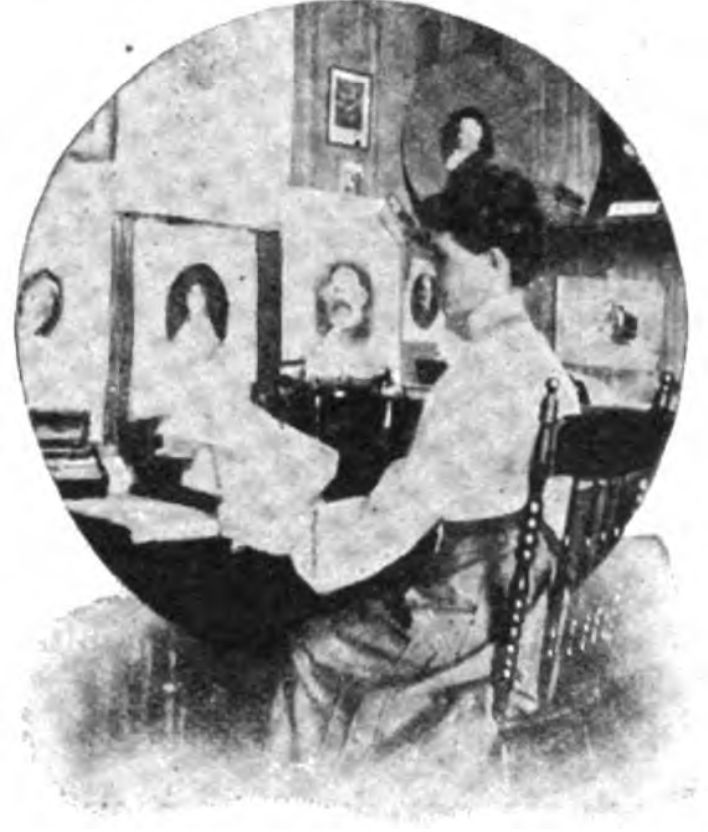
“Aberdeen, Wash., Box 868, “July 25, 1911. “To the National Woman’s Committee, Socialist Party, Chicago, IL: “The Woman’s Committee of the Aberdeen Finnish Socialist Local, at its regular meeting, July 25, 1911, decided to recommend and request your committee to undertake the gathering statistics about the conditions of women in their, working and home life, as, for instance, the wages, length of their working day, confinement and other conditions, and also about child labor and children’s school going, etc., in the largest industrial centers and as wide as possible all over the United States. As the means to get such statistics we would suggest printed question blanks, which are to be sent to Socialist and union local organizations with request that those be filled and returned to the committee within certain time limit.
We believe that this would bring us good results here, as it has brought in the European countries. It would be of benefit to the organizers in their work. And it would make it possible to publish pamphlets with numerical statistics and help to unveil the grave conditions of servants and mothers that now are largely beyond comprehension.
“By order of the Women’s Agitation Committee of Aberdeen, GUST KINNUNEN, Chairman of the Committee.”
I am submitting to you letters from the following comrades, representing their respective organizations:
Victoria Licci, Italian Translator-Secretary: J.W. Sarlund, National Finnish Translator-Secretary: Hipolit Gluski, National Polish Translator-Secretary: N. Juel Christensen, National Scandinavian Secretary, and Morris Siskind, Secretary West Side Jewish Branch, Chicago.
The work of the Finnish comrades. deserves our special attention.
It is estimated by our National Sesretary that the women constitute about one-tenth of the membership of the entire party.
According to the report of the National Finnish Secretary, the Finnish women constitute about one-third of the Finnish membership.
I wish to quote verbatim from some of these reports, as I believe they contain many suggestions we cannot afford to overlook.
FINNISH REPORT.
Chicago, IL. August 11, 1911.
To the Woman’s National Committee: Dear Comrades: Being asked by Comrade Lowe, the Woman’s National respondent, to make a brief the women’s work in the Finnish a locals and branches of the Socialist Party, I am glad to give such report as can be made at this time.
The activity of our women comrades can be better noticed by looking into the general inside work of the Finnish locals. That a Finnish local has either a singing choir, a sewing society, men’s and women’s gymnastic clubs, brass band, show committee, an entertainment committee, or some, and often all, of these is very general and can be found almost everywhere. All these combined make up the programs for the entertainments. With the exception of a brass band, none of these committees could exist without women, and some of them require more women than men on order to accomplish anything on their line of work. Although the women are sometimes the principal part of these sub-committees, it is a known fact that they do not take much part in the practical work of a Socialist Party. In the propaganda meetings they seldom take part in the discussions and still less in the regular business meetings.
That the question of organizing also women in the Socialist party has been under discussion among our national organization is shown by the proceedings of every one of our national and district conventions. Although the decisions made on this question practically have not contained any new plans for the future work, but still the discussions and resolutions have been of considerable help in getting toward the organization of both men and women. In order to show the standing and general opinion of our organization in this question, I herewith present some resolutions passed by our conventions. The resolution on the question of the organization of women, passed in our last national convention, held in Hancock, Mich., August 23-30, 1909, reads as follows:
“This convention, recognizing the value of organizing the women worker into our organization, is in the in hope that the women will continue to develop themselves in this aim, in concord with the class consciousness of the working class, to work for the emancipation of men and women from the capitalistic class rule, in which purpose, as generally in every way, we demand an absolute freedom of organization and assemblage.”
Resolution passed by our Middle District convention, August 22-23, 1910:
“That we urge all the locals to organize a woman’s committee in each local, committees shall cooperate in their work with the National Woman’s Committee of the Socialist Party through our National Translator’s office; and
“That this convention deems it necessary that the District Committee shall always be composed of men and women comrades.”
Resolution passed by the Western District convention, April 21-23, 1911:
“Recognizing the fact that the equal suffrage for women is more and more spreading and becoming into practice in the United States, we see it imperative that organizing of women in our party shall be undertaken with all possible energy. In view of this, every local shall be bound by decision of this convention to establish a woman’s committee, and, where separate women’s branches may seem to be beneficial, organising of such woman’s clubs as sub-branches to the locals shall also be allowed.
Since July 11th, this year, we have had an eight-page weekly woman’s pa per, by the name of “Woman Comrade,” and having a woman editor, published in connection with our western paper at Astoria, Ore.
Keeping of foreign women in touch with the American Socialist movement can, I believe, be done best through co-operation of the Woman’s National Correspondent and Committee with the respective national Socialist translators, anyway as far as the Finns are concerned, for the Finns very seldom understand the English communications, etc. All necessary communications, and any suggestions intended for the foreign locals and foreign women, should be sent them in their own language (that means in the present time), when I hope they will bring results. Fraternally,
J.W. SARLUND, Translator-Secretary.
JEWISH REPORT.
Chicago, Ill August 10, 1911.
To the Woman’s National Committee of the Socialist Party:
Comrades: The West Side Jewish Speaking Branch of the Socialist Party of Chicago las at its last meeting decided to request the W.N.C. to cooperate with the Jewish comrades in the work of organizing the Jewish working women in the Socialist Party.
We would suggest that a mass meeting should be arranged at some future date for the purpose of agitation and organization. We will furnish the hall and advertising. It is also necessary to write in the Jewish Labor World, our party organ, about the conditions of the Jewish women wageworkers.
Comrades, there is a great field for good work, but it has been neglected, not only on our part, but on the part of the Jewish Socialist presa. It will therefore be timely to remind our press of the importance of educating the women workers to their class interest.
We are very sorry to inform you that only a few girls are members of our party in all our Jewish speaking branches, while a great many are members in their respective trade unions, and there is the field for active work.
We of the West Side Branch will do everything possible to assist you in this important work. Hoping to hear from you, we remain,
Fraternally yours,
WEST SIDE JEWISH SPEAKING BRANCH, SOCIALIST PARTY, Morris Saskind, Correspondent. 1114 Blue Island avenue, Chicago, Ill
POLISH REPORT.
Chicago, Ill August 7, 1911.
To the Woman’s National Committee:
Dear Comrades General Correspondent Comrade Lowe asked me for some suggestions on agitation and organisation among foreign speaking women.
In regards to this, I wish to state that the Socialist movement among the Poles in the United States has just started. Our organization is only three years old, but we have already a number of Polish women in the party. In Milwaukee, Wis., there is a Polish Woman’s Branch of the Social-Democratic Party.
The trouble is that we have not proper literature for women. I have looked through the leaflets published by your committee and found some of them very good for propaganda among women.
Therefore I would suggest to translate and publish in Polish some of the leaflets which are now in English only. I propose for translation the following:
“To the Working Woman.” “Why You Should be a Socialist.” “Wimmin Ain’t Got No Kick.”
These leaflets will not only appeal to women, but they will arouse more activity among men and women who are already in the organization. At present, when the woman gets interested and joins the party, there should be something in the local which will keep her active, otherwise she might be lost to the local in a short time.
There is a desire among Polish men and women that the dues should be smaller for women than they are now. Fraternally yours,
HIPOLIT GLUSKI, Translator-Secretary.
ITALIAN SOCIALIST WOMEN’S REPORT.
There is only one Italian Socialist Woman’s Local and it is located in this city.
It is composed of only eight members, very active and enthusiastic, but all working or married women, who meet every third Wednesday of the month at their local, 2440 South Oakley avenue, at 8 p.m.
Some other Socialist women in other cities of the country, on account of their very small number, belong to the men’s local.
As far as I know it is a very difficult thing to get in touch with the Italian women, as the Italian comrades are mostly alone here, having left their families in Italy, and the majority of the Italian women here are very poorly educated; most of them can hardly read and write and have the fatal prejudice that Socialism is something terribly fearful which has to be fled from.
The only useful thing would be to have some literature for women, leaflets which could be given away free. Among your English leaflets I saw many very good ones, which I would like to have translated into Italian. A few of them have already been translated for our paper, but this is not sufficient. Those articles should be printed in leaflets and given away on such days when there are some festivities in the Italian quarters.
Of great utility it would be to have some Italian woman propagandist, but presently there are very few cultured Italian women in our movement here in America.
I would suggest to institute some night schools for the Italian women. In these schools they ought to learn not only English, which is very hard for them and discouraging, but to read and write Italian, as this would be much easier for them and make them able, in a very short time, to read our literature, and understand it, and so become conscious of what Socialism is and what it wants.
Another thing to which I want to call your attention is that the dues stamps ought to be set at a lower price for our women, as they generally are very poor and hard working
Hoping that our little movement will obtain your attention and your aid, which it needs to grow to an imposing one, I remain,
Fraternally, VICTORIA LICCI, Secretary-Translator. Chicago, Ill., August 11, 1911.
SCANDINAVIAN REPORT.
Chicago, Ill.,
August 9, 1911. National Woman’s Committee, Socialist Party General Correspondent, Miss Caroline Lowe, Chicago:
Dear Comrade: In answer to your request for information regarding organizing the Scandinavian women, I herewith submit to you a short report, which I hope may give you an idea of our standing. We are just now trying to get a report from each local in order to and out our own strength, before receiving this report. I am unable to give you the exact figure as to how many women who are members of our organization, but personally I don’t believe that there are more than fifty.
According to this small number, I think that before we start to organize we will need to do some agitation work first, and I am sure that if you will recommend to us to do that our organization will be only too glad to follow your advice.
We are at present publishing two weekly papers, one in the Swedish and one in the Danish-Norwegian languages, and if you can supply us with short editorials, etc., of special interest to women, I am sure that the Executive Committee will instruct our editors to translate and publish them. I think it could be arranged so that at least one column in each paper could be used for that purpose.
If you are issuing propaganda leaflets in the Scandinavian language, then we shall do all we can to have them distributed.
When we have done agitation work for some time, I think we can start to organize and be successful.
Our Executive Committee will meet on September 10, so I hope that you will before that date inform me about what you think should be done, and I will submit it to the committee with recommendation.
Fraternally yours.
N. JUD CHRISTENSEN.
ACTION TAKEN ON FOREIGN-SPEAKING ORGANIZATIONS.
Moved that our General Correspondent ask the Socialist papers in foreign languages to translate and publish our articles, and that she arrange for publication of our leaflets in foreign languages as far as the funds in the National Office will permit. Motion carried.
Moved and carried that locals be urged to carry on the propaganda for the naturalization of foreign women, as 18 being done in the case of the men.
(The communication from Local Aberdeen, Washington, was overlooked at the meeting. It will be submitted to the committee by correspondence and action taken will be reported later.)
TEACHERS’ BUREAU.
Chicago, Ill., August 10, 1911.
To the Woman’s National Committee. Chicago, IL:
Dear Comrades: A Socialist Teachers Bureau will be of use to the Socialist party now. Inquiries come from Socialist teachers and from comrades who are on school boards.
The teachers want to teach in schools where their Socialism will not be muzzled.
The comrades on school boards are desirous of having the lesson of Socialism taught in their schools.
I ask that you comrades of the Woman’s National Committee cooperate in getting these comrades in communication with each other.
Some one person in the National Office can do this. A school teacher should handle this work. As the plan becomes known and is effective in quality and quantity of course the work will grow. You can instruct some one person to care for this work. It will be a great boost for the movement. It will help us all.
Thanking you for considering this proposition, I remain,
Yours for Socialism,
TERENCE VINCENT.
ACTION TAKEN ON TEACHERS BUREAU.
Moved and carried, that we recommend that the National Office establish a Teachers’ Bureau for the purpose of placing Socialist teachers where they are desired.
INTERNATIONAL NOTES.
Thus far we have had little communication with our women comrades in foreign countries. In January of this year I sent a copy of the report of work done during 1910, enclosing sets of organization and propaganda leaflets, to Comrade Clara Zetkin of Germany and to Comrade Annie Grundy of London, England.
SUNDAY NIGHT SESSION, AUG. 13.
Meeting called to order at 7:30 p.m. by the General Correspondent. Lena Morrow Lewis was elected chairman and Caroline A. Lowe secretary.
The first thing in order was the report of the Committee on Rules following report was submitted:
The Report of Committee on Rules.
Your Committee on Rules desires to submit the following report:
1. Four members shall constitute a quorum, both in business session and in correspondence.
2. The Woman’s National Committee shall elect a General Correspondent, who need not necessarily be a member of the committee.
3. The duties of the General Correspondent shall be those usually devolving upon a secretary.
4. The General Correspondent may submit work to the committee either by suggestion or motion.
5. When a motion has been submitted to the committee by the General Correspondent, fifteen days shall be allowed for the return of the vote. Comments reaching the General Correspondent within five days after sending out shall be sent to members of the committee.
6. On matters needing immediate attention the General Correspondent, in consultation with the National Secretary and the head of the department under which it would naturally fall, may take such action as necessity demands.
7. All money sent to the committee shall be turned over to the National Treasurer.
8. Any member of the committee who shall fail to respond to three consecutive communications from the General Correspondent, where a vote is involved, without giving a good and sufficient reason, shall forfeit her membership on the committee, and the National Secretary be requested to have her successor elected.
9. These rules may be revised or amended at any time by a majority vote of the committee.
Respectfully submitted, CARRIE W. ALLEN, Chairman. MAY M. STRICKLAND, Secretary. WINNIE E. BRANSTETTER
ACTION TAKEN ON REPORT.
Upon motion Article 5 was amended to read “within seven days,” in place of “in five days.”
Upon motion Article 8 was amended to read “shall after due notice from the General Correspondent forfeit her membership on the committee, and the one having received the eighth highest vote at the last regular election shall be declared her successor.” Upon motion the report of the Committee on Rules was accepted, and the rules as amended declared adopted.
It was moved and carried that we proceed to elect a member of the Woman’s National Committee to represent the committee at the banquet given by Local Milwaukee. Comrade Kate Richards O’Hare was elected.
The question of the circulation of a suffrage petition was taken up for discussion. Upon motion of Comrade Branstetter the following motions were adopted:
Moved by the Woman’s National Committee that a petition for amendment to the National United States Constitution, providing for the enfranchisement of women, be prepared by our General Correspondent in conference with the National Secretary, and circulated for signatures.
Moved that this motion be presented to the National Executive Committee, with request that they recommend to our Congressman that he present same to Congress upon completion.
Meeting adjourned to meet at 9 o’clock Tuesday morning.
TUESDAY’S SESSION, AUGUST 15th.
Session of Woman’s National Committee, Tuesday, August 14, 1911.
Called to order at 9 a.m. by General Correspondent Caroline A. Lowe. M. Octavia Floaten was elected chairman. Anna A. Maley, Recording Secretary.
All members were present with the exception of Lena Morrow Lewis.
The first order of business was consideration of the report of the Committee on Program for Woman’s Day. The recommendations of the committee were as follows:
1 That the day be devoted to agitation on white slavery.
2. That a committee be appointed to collect facts and outline an argument.
3. That this outline be printed and distributed among State Secretaries and Women’s Correspondents, with instructions that they take steps to secure speakers, either men or women, to discuss the economic aspects of white slavery at meetings to be held in every considerable town in the respective states.
4. That a leaflet on white slavery be prepared for distribution at these meetings. That, so far as possible, arrangements be made to have the Socialist and labor press feature the white slave question for that day.
MAY WOOD-SIMONS, ANNA A. MALEY, Committee.
The report of the committee was, on motion, adopted. Agnes H. Downing of Los Angeles, Carrie W. Allen of New York and Kate Richards O’Hare of St. Louis were elected a committee to collect the data and outline the argument as provided for in the recommendation.
Action upon the report of the committee to propose measures to secure the release of Angelina Napolitano was deferred until further information concerning petitions now in circulation could be secured.
It was moved and carried that the committee discuss the matter of the lowering of party dues for women, and the following recommendation was adopted:
We recommend that Article 12, Section 6, of the National Constitution, be amended by adding: In families where only the husband is a wage-earner, the combined dues for husband and wife shall cover state and national dues for both, and the local decide upon local dues per family. Comrade Winnie Branstetter voted against this recommendation, Comrade Lewis being absent.
Suffrage Petition.
The following was presented by a sub-committee to the National Executive Committee, and was by them unanimously adopted:
Motion by the Woman’s National Committee that a petition for amendment of the National United States Constitution, providing for the enfranchisement of women, be prepared by our General Cor respondent in conference with the National Secretary, and circulated for signatures. Carried.
Motion that this question be presented to the National Executive Committee, with request that they recommend to our Congressman that he present the same to Congress upon completion. Carried.
Comrade Branstetter was elected committee of one to place this before the National Executive Committee. It was unanimously passed by this committee.
Unions
Moved that work among trades unions be referred to the committee upon plan of work for the year, in conjunction with the leaflet committee. Carried.
The General Correspondent reported having received a letter from the secretary of the National Suffrage Association, inviting the Woman’s Committee to send a fraternal delegate to the Woman’s Suffrage Convention, to be held in Louisville, Ky., in October. A motion to accept the invitation Was adopted, but was reconsidered, and after some discussion was readopted. Comrade Carrie W. Allen requested to have her vote against the motion recorded. Caroline A. Lowe, General Correspondent, upon her report that she would have occasion to be in Louisville at that time and that her attendance at the convention would involve no expense to the committee, was elected to act as fraternal delegate.
Comrade May Wood-Simons reported that she was ill, and Comrade Caroline A. Lowe was elected to act with the Committee on Plan of Work for the Year in Mrs. Simons’ stead.
Recess was then taken until 2 o’clock. Upon reassembling, the report of the Literature Committee was read and adopted, and the matter of the publication of the leaflets submitted to the General Correspondent. This report is printed under the discussion of Literature Leaflets.
Following the report of the Literature Committee came the report of the Committee on Plan of Work. Upon motion the Woman’s National Committee went into a Committee of the Whole. A plan of work was drawn up and adopted. It is printed in full under discussion of Local Correspondents and Committees. Upon report by Comrade May Wood- Simons that anti-suffrage films are in use by moving picture shows in Kansas and other states, it was moved that we investigate the publishers of these films and authorize our General Correspondent to communicate with them, stating the protest of the Woman’s National Committee. Carried.
Moved that we write to locals in towns where anti-union and anti-suffrage films are used, requesting that our comrades do not patronize shows where such pictures are exhibited. Carried. Moved and carried that the committee issue attractive and artistic postcards for propaganda purposes.
Moved that Comrade Lowe communicate with Comrades Sloan, Nye and other Socialist cartoonists, requesting that they submit designs for postcards. Carried.
It was decided to request women to encourage children to sell Socialist publications as Socialist boy scouts, Comrade Katterfield, representing the National Socialist Lyceum Bureau, was given the floor and requested that the Woman’s Committee endorse the plan as a whole; urge women’s organizations to endorse the plan in their localities; get individual women to work for the plan and for all to boost the plan on behalf of The Progressive Woman. It was Moved that our committee endorse the plan of the National Socialist Lyceum Bureau and that we ask our women to push the subscription cards, especially of The Progressive Woman, and also that copies of The Progressive Woman be for sale on the literature tables in the meetings. Carried.
Intercollegiate Socialist Society
It was moved that the names of students be secured from the secretary of the society and that these students be supplied with our literature and copies of our plan of work. Carried.
It was moved and carried that the. General Correspondent be authorized to use the material available from the Child’s Welfare Exhibit, according to the best arrangements which she can make with the National Office.
Upon a request from Mary E. Garbutt of California that we give our assistance in an effort being made to collect funds for the erection of a peace monument, it was moved that it is the sense of the Woman’s National Committee that available funds must be devoted to the establishment of peace, indeed, rather than to building monuments to a peace which does not and cannot exist under capitalism. Carried.
Moved that an article upon the proposed peace monument be prepared and published as one of our press articles. Carried.
Moved and carried that we recommend to the Trade Union Department in the National Office that they include within the scope of their work the effort to reach organized women.
Moved that as the phrase “official organ” implies party control and ownership, and as no such relationship exists between the Woman’s National Committee and The Progressive Woman, that we cease to refer to The Progressive Woman as our official organ. Carried.
Moved that the Woman’s Committee concur in the action of the Conference of Officials in asking for the establishment of a Bureau of Information on Municipal Affairs and that this bureau also be used for the gathering of general information and statistics; also that the bureau be located in the National Office. Carried.
Moved and carried that this committee recommend that the services of a stenographer be placed at the disposal of the General Correspondent for such time as may be necessary.
The matter of the Napolitano petition was at this point taken from the table and it was moved and carried that the matter of a petition and its proper wording be left in the hands of the General Correspondent
It was moved and carried that the National Correspondent secure as far as possible the co-operation of all non-political organizations of women in the circulation of our suffrage petition.
It was moved and carried with enthusiasm that we extend to the Milwaukee comrades a vote of thanks for the courtesy and hospitality extended to all visiting comrades during the present conference.
Moved that a letter of thanks be sent to Comrade Debs for his kind thought in sending a message of encouragement to our committee.
Moved that we request that the names of State Correspondents for women be published in the National Bulletin with the names of State Secretaries.
Adjournment sine die was then taken. Attest:
CAROLINE A. LOWE, Secretary.
For a variety of reasons, the national Socialist Party of America did not have an official publication until May 1904 when the national convention mandated the monthly Socialist Party Official Bulletin as a way for the Party to communicate to its members. The name was changed to Socialist Party Monthly Bulletin in October 1911. The Party Builder became the name in 1913 and also became a subscription paper and a weekly. In 1914 the Socialist Party replaced The Party Builder with a regular propaganda newspaper, The American Socialist. These Party paper contain National Committee and National Executive Committee minutes, National Secretary reports, membership figures, financial statements, letters from party members, articles by prominent party leaders, and the figures for election of party officers and internal questions.
PDF of full issue:https://www.marxists.org/history/usa/pubs/spa-bulletins/110800-socialistpartyofficialbulletin-v07n12.pdf

