Harrison George on the marching-orders received by Colombia’s new President, Olaya Herrera, from his imperial masters in Washington D.C., themselves working at the behest of the Gulf Oil Co.
‘Concerning Lackeys’ by Harrison George from The Daily Worker. Vol. 8 No. 90. April 14, 1931.
CERTAIN Pecksniffian gentlemen, certain snooty objectors of the Second (Socialist) International frequently protest at the rude language of us Bolsheviks, and raise a disapproving finger at our “labelling” the native bourgeois politicians of colonial and semi-colonial dependencies of imperialist powers with the impolite appellation–“lackeys.”
Before going further, we, wishing to be precise in the matter, reach for our dictionary and therein we find:
“LACKEY: from the French ‘lecher,’ to lick; an attending servant; a runner; a footboy or footman; hence any servile follower.”
Leaving the dictionary for the pages of the New York Times of April 9th, 1931, we find a news item on the tenth page concerning the “Sovereign” State of Colombia, a South American republic. Colombia is no small place. It has an area of 482,400 square miles, compared to Germany’s 185,889 square miles. It has (1928) an officially estimated population of 7,967,788 inhabitants. It is some place. It is a nation.
It has a president, this nation of Colombia, with all the other paraphernalia and personnel of government. Of course, a capitalist government. It is not a part of the Soviet Union, and indeed its president and other Colombian capitalists have no wish that it should become such. And to prevent such a catastrophe overtaking “the nation”–likewise to prevent the banana plantation slaves of the United Fruit Co. from having any illusions about higher wages–the capitalist class of Colombia massacred some hundreds of these workers in the early part of 1929.
Aside from the production of bananas, however, the nation of Colombia, perhaps seeking to escape the injurious results of mono-culture production, diversified production in the 1930 elections, by producing one of the prize winning lackeys of this century, to wit, President Olaya Herrera.
In March, 1930, an election was held in the Republic of Colombia. And from it emerged a President-Elect. No other and no less than Senor Herrera. Thus it came about that, being a President-Elect of a South American republic, like the satraps of old Rome, Senor President-Elect Herrera was due to journey northward all the way to Washington, to pay obeisance to the Yankee Caeser, Mr. Hoover.
It is an unfortunate characteristic of this revolutionary age, that whereas proletarians may get along splendidly without capitalists, these much bedeviled capitalists cannot, in the nature of things, get along without proletarians. And hence it came about that in the journey northward of President-Elect Herrera, it became necessary for certain interested parties to send him a cablegram which fell into the hands of a certain proletarian in the city of Panama on April 15th, 1930, while Senor Herrera’s boat was passing through the famous canal.
This cablegram is most interesting, both from the point of view of its contents, and from the fact that it was sent to President-Elect Herrera by John L. Merrill, president of the All America Cables corporation, a up-and-coming Yankee imperialist concern. But we must put off the reader for a moment to specify the contents of the New York Times article above mentioned.
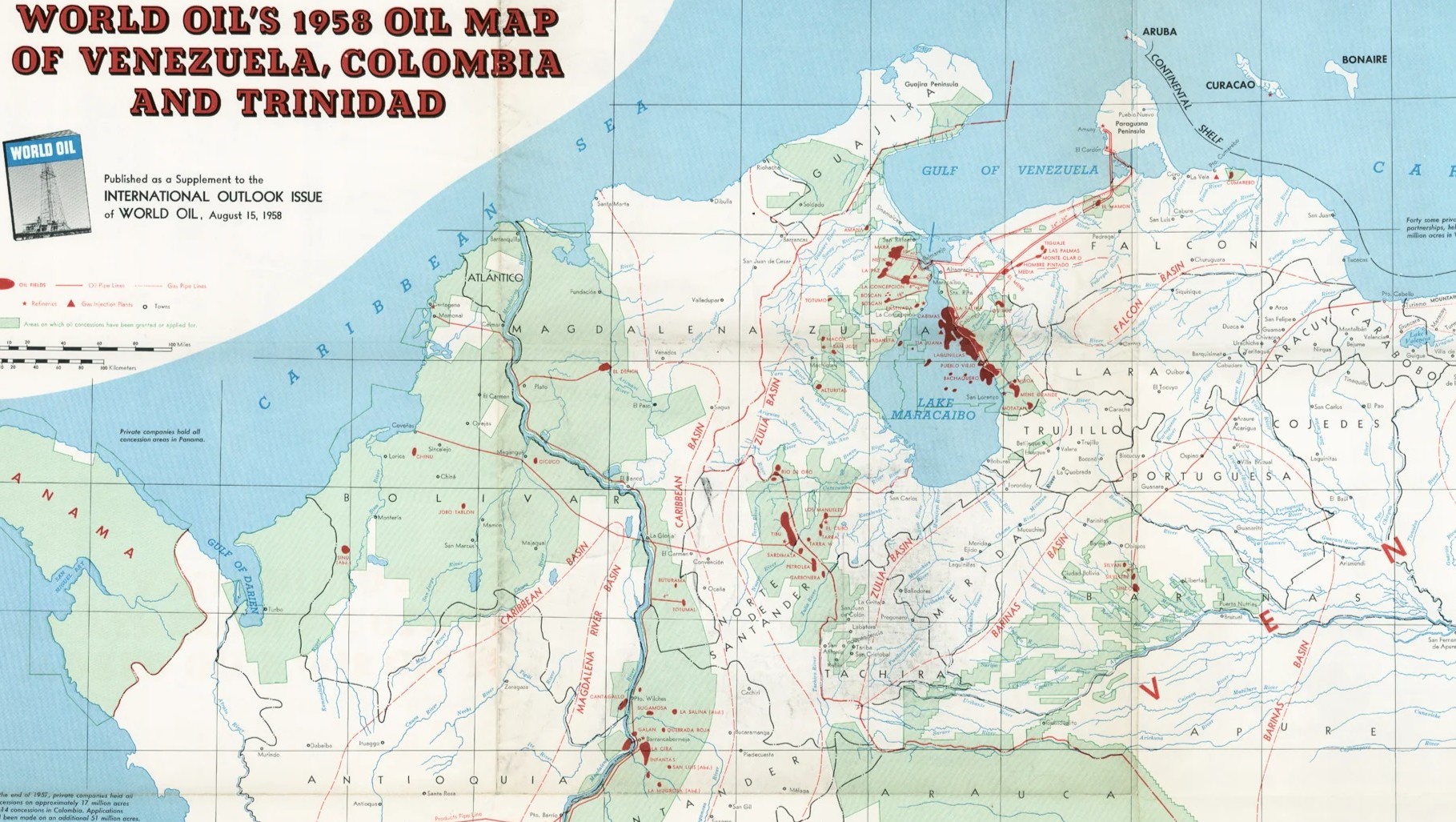
In it we find under date of April 8th, 1931, that President Olaya Herrera has sent to the Colombian Congress a message urging the passing of pending legislation approving the contract between the Colombian Government and the Gulf Oil Corporation for a concession to that corporation of what is known as the Catatumbo petroleum region. It is evident from the article that President Herrera is exceedingly anxious that this concession be approved.
Let us go now to the text of the cablegram received at Panama City, April 15, 1930, by the then President-Elect Herrera, from the imperialist corporation head, Mr. Merrill. It opens with the following brief line:
“In answer your message April 4th. Jefferson sends following.”
So it seems that President-Elect Herrera had written or cabled something in the nature of a request to Mr. Merrill, who, in order to advise the President-Elect of Colombia properly, consulted something or somebody called “Jefferson.” May we not suspect here, however, that instead of “Jefferson,” what was really meant was “Washington.” But we continue with the cable:
“After conferring Furay and Olano suggest following speech should last thirty to forty-five minutes. Recommend you write in Spanish and we will make free translation here in order to compel attention newspaper men. Furay requests you send Spanish copy to United Press representative, Perez, Bogota, who will be instructed regarding release to all Colombian newspapers at the proper time.”
The “Furay” referred to is an official of the United Press Association, a capitalist news corporation which makes some pretense of being more “liberal” than the known reactionary service of the Associated Press. Who “Olano” is, remains a mystery. But there is no mystery about the fact that Mr. Merrill, speaking for “Jefferson,” is instructing the President-Elect of the sovereign nation of Colombia about a speech; and specifying just how long that speech should take. It will also be noticed that the United Press is taking care that the speech shall be given proper publicity to the Colombian masses. But Yankee imperialism is noted for being thorough, and not only is the length of the speech “suggested,” but from the above quotation the cablegram proceeds to say:
“Recommend following outline:”–and in order that Senor Herrera might not miss anything, the points desired are specifically numbered as “1,” “2,” “3,” etc. So we find in the first the following text:
“Brief restatement your platform with appropriate preparatory remarks leading up to recent election including open-door policy, efficient administration, intensify development, sound economic political relation with U.S. and mutual confidence and respect.”
Readers will notice that “preparatory remarks” may be appropriate of anything or nothing, only they must “lead up” to certain things in which “Jefferson” is interested. And one of these things is the “open door policy.” But just how “open” the door is to be, may be questionable from the fact that Washington (beg pardon, “Jefferson”) is giving instructions that the door shall remain open. We may pass up the usual palaver about development and its “soundness” however, to concentrate upon “mutual confidence and respect.”
We assure all who may read these lines that the writer of this article has seen Senor Olaya Herrera in person; that he is a cultured and dignified gentleman wearing boiled shirts and high silk hat; and in no respect does he resemble, physically, a boot black. But for all this, we cannot repress a ribald Bolshevik horse-laugh for the “mutual confidence and respect” that is possible to exist between President Olaya Herrera of the sovereign republic of Colombia and his mysterious but very tangible task-master—”Jefferson.”
We may pass over for lack of space points No. 2 and 3, which instruct this lackey exactly and precisely what he is to say about the natural resources and products of Colombia, even specifying the exact number of bunches of bananas and bags of coffee exported to the United States. But we must quote from the last lines of point 3 which say:
“Because of importance, suggest statement as separate concluding item under this head (about products. H.G.), petroleum resources and new policy regarding developments.”
We then see the relation of cause and effect between the above quotation of the cablegram sent by “Jefferson” on April 15, 1930, and the message to the Colombian Congress on April 8th, 1931, by President Herrera, urging the concession of petroleum resources to the Gulf Oil Corporation.
“(4) Financial structure one of the soundest in South America. Brief statement on reorganization work of Kemmerer mission, the result therefrom and manner in which business of country supported during recent depression, particularly recently demonstrated ability and determination to maintain the exchange value of the peso at all costs.”
Here we have the instruction of Yankee imperialism ordering President-Elect of the “sovereign” nation of Colombia to praise the Kemmerer mission, whose business in a score of colonial, semi-colonial and vassal countries throughout the world has been to nail the financial hide of the national economy to the door panels of Wall Street. The maintenance of the peso “at all costs” is to be done, of course, at the expense of the millions of impoverished toilers of Colombia. One may, nevertheless, be allowed a cynical grin at the imperialist wiseacres who, in April, 1930, confidently mentioned the “recent depression” in view of the intensified crisis since that time.
But we go to point 5, which says:
“Development of friendly relations between U.S. and Colombia; tremendous trade development with U.S. since the war; participation U.S. in financial and public works, of American business method in progress of Colombia; existing cordial relationships.”
There is no doubt whatever of the existing “cordial relationships.” Indeed it could not be otherwise unless the nefarious agents of some unfriendly power, let us say, Great Britain, might protest in the form, perhaps, of subsidizing some semi-feudal military chief to make a coup d’etat and upset the pretty plans of that mysterious entity known as “Jefferson.”
With this cablegram, we, also are nearing a conclusion. But we must give the conclusion, which states:
“(6) Conclusion: Above gives background for making frank, honest and courageous statement advocating Colombians’ desire to come into closer contact with U.S. Furay says will have 100 to 150 of the elite American newspapermen at dinner.”
There is little left to say. The speech was delivered by President-Elect Olaya Herrera upon his arrival at New York City, exactly as ordered. And in the minds of those who read and believe the capitalist press, it no doubt appeared to be “frank, honest and courageous.” But we, the rude and ribald Bolsheviks, who have utterly no respect for boiled shirts and the polite hypocrisy of imperialist diplomats know that all of the “frankness,” “honesty” and especially the “courage” of the President of Colombia, a great nation of South America, could be put under the eyelid of Mr. J. Pierpont Morgan without that gentleman feeling the slightest irritation.
The Daily Worker began in 1924 and was published in New York City by the Communist Party US and its predecessor organizations. Among the most long-lasting and important left publications in US history, it had a circulation of 35,000 at its peak. The Daily Worker came from The Ohio Socialist, published by the Left Wing-dominated Socialist Party of Ohio in Cleveland from 1917 to November 1919, when it became became The Toiler, paper of the Communist Labor Party. In December 1921 the above-ground Workers Party of America merged the Toiler with the paper Workers Council to found The Worker, which became The Daily Worker beginning January 13, 1924.
PDF of full issue: https://www.marxists.org/history/usa/pubs/dailyworker/1931/v08-n090-NY-apr-14-1931-DW-LOC.pdf

