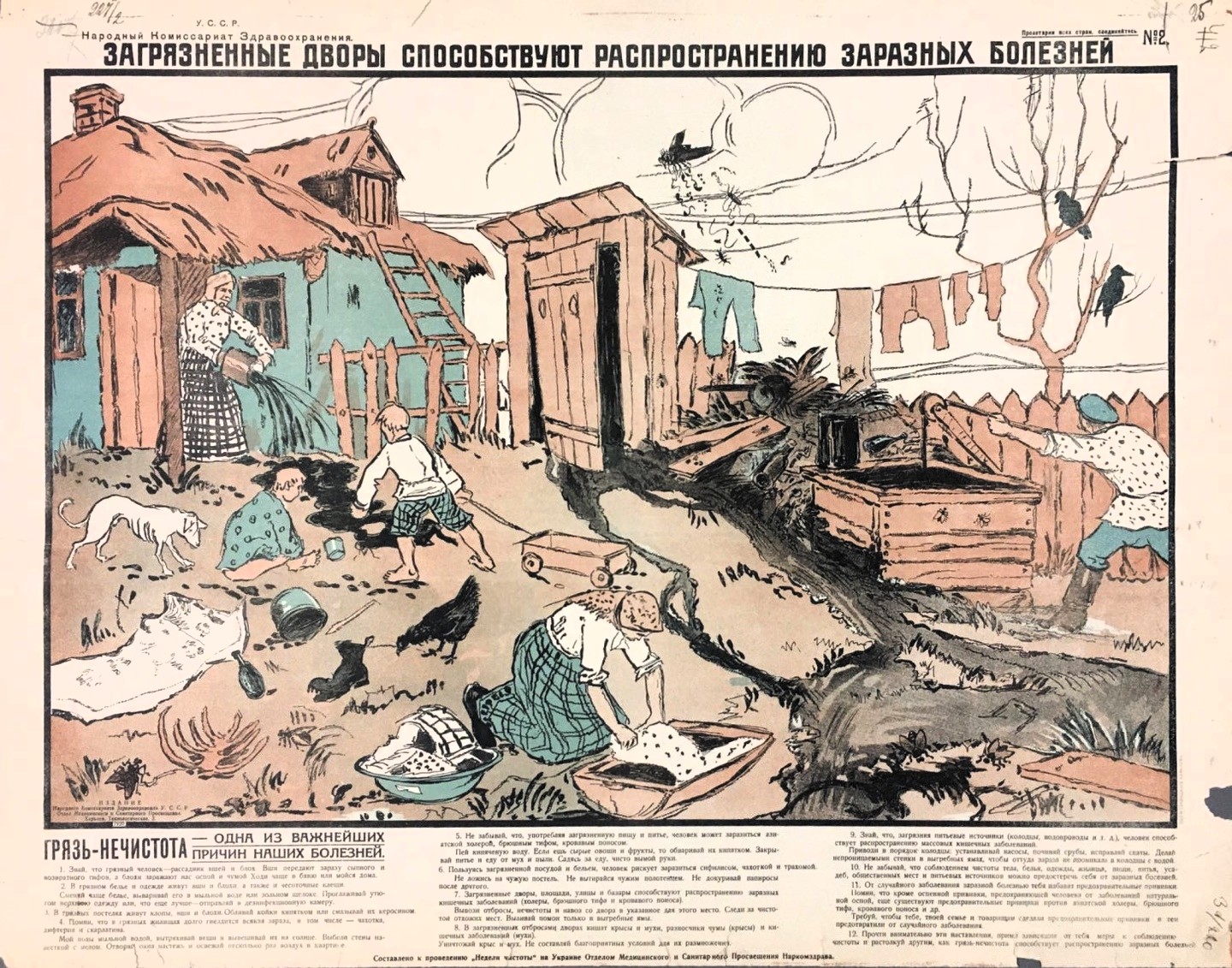
The following chapters of Haines’ 1928 work on Soviet health policies, X. Medical Institutions and Personnel XI. Epidemics, XII. The Anti-Tuberculosis Campaign in Russia.
‘Chapters X, XI, & XII’ by Anna J. Haines from Health Work in Soviet Russia; Vanguard Studies of Soviet Russia. Vanguard Press, New York, 1928.
X. Medical Institutions and Personnel.
IN spite of the modern emphasis on public health and prophylactic measures the hospitals and the out-patient dispensaries still remain the backbone of the work of the Commissariat of Health. It is true that not much money has been spent in building new hospitals for it is hoped that the “preventive” program will soon make the present number of beds sufficient for the needs of in-patients. Sound as this policy is in the long run, it means that many of the hospitals at present in active use were built from twenty to one hundred and fifty years ago.
They were planned on the basis of cheap human labor and are usually wasteful of space, inconvenient in lay-out and poorly supplied with conveniences and labor-saving devices. Central heating, for example, is often impracticable, and each morning—sometimes twice a day—the big tile stoves must be filled with wood; modern laundry machinery is almost unknown and most hospital linen is washed by hand. In consequence there is a very high ratio of personnel to patient, the former sometimes outnumbering the latter.
The wards are smaller than in most American public hospitals, seldom containing more than fifteen beds; private rooms are unknown. During the years of war and famine with their accompanying outbreaks of typhus, cholera, malaria and scurvy, the hospitals suffered terribly from overcrowding, lack of personnel, lack of medicines, instruments and linen. Even in Moscow sheets were a luxury and a new patient was placed between the unchanged straw mattress and the vermin-infested blanket of his recently deceased predecessor. Two adults or three or four children often occupied the same bed. To anyone who saw the Russian hospitals in those years their present condition seems an almost miraculous change for the better. Iron beds with metal springs and hair mattresses have very generally replaced the wooden cots with a straw pad; sheets are supplied and changed frequently; the blankets are cleaned and sterilized after use; floors are kept clear of food, clothing and all the litter that anxious relatives can supply; the windows are frequently opened and the wards aired, in some cases the little ventilators are permanently open even when the thermometer stands at 30° below zero. It is true that the food is neither very attractive nor very attractively served. Breakfast consists of bread and tea; dinner of a vegetable and meat soup or sometimes of meat with potatoes or macaroni and a compote of stewed fruit; and supper of a cereal of some sort with bread and tea. Special diets are just beginning to be used; relatives are allowed, even encouraged, to bring whatever supplementary food they wish to provide.
Medicines now abound, and to the surprise of most American visitors are placed on each bedside table to be taken by the patient himself according to the doctor’s prescription. A locked medicine cupboard with a nurse administering the drops or pills at stated intervals has not yet been made a part of the new economic policy; such a system has never been the custom in Russia. The nurse usually has charge of more than one ward and her time is fully occupied in taking temperatures and giving hypodermics and carrying out the more complicated orders of the doctor. All the personal attention required by the patient, as well as the simpler procedures like enemata, are given by ward maid or orderlies, who also do the cleaning of floors, windows and furniture. Bed-baths and “morning toilets” are not known, nor is bed-making performed daily, so that a ward seldom gives an impression of neatness or restfulness. On the other hand the patients are usually very well satisfied with the relaxed discipline which, for example, allows convalescents to sit on the edge of their beds and smoke, and they almost invariably speak highly of the kindness and attention shown to them by the doctors and nurses. Much modern equipment, especially for various forms of electrical treatment, is being imported from Germany, and doctors are sent from the provinces to Moscow for short periods to enable them to get in touch with new treatments and technique.
People are entering hospitals more willingly when they are ill and the hospital death-rate is lower than it formerly was. Figures recently published by the Commissariat of Health (in Statistical Material, Moscow, 1926, page xii) show a comparison between the number of patients presenting themselves for admission to hospitals in the years 1913 and 1923, in thirty of the central gubernias of Russia. Twenty-seven of these showed an increase in the use of hospitals and only three a decrease. In Moscow Gubernia which includes the city of Moscow, the increase has been 139 percent; in eight gubernias which include such cities as Leningrad, Archangel, Yaroslav, the increase has been from 50 percent to 100 percent; in five other gubernias from 25 percent to 50 percent; in ten others an increase up to 25 percent; while in two—Tambov and Pskov—there was a decrease up to 25 percent; and in the Don a decrease of 35 percent.
The following table (taken from the same source, pages 2 and 74) shows hospital conditions for the entire area represented by the present U.S.S.R for the two years 1913 and 1923:
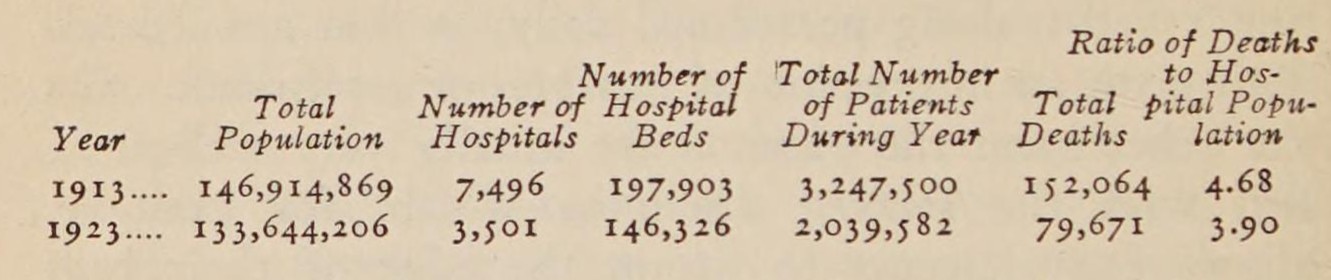
From these figures many interesting deductions can be made: for example, the fact that in 1913 there was in the region now occupied by the U.S.S.R. one hospital bed for every 742 persons, and in 1923 in the same area one hospital bed for every 913 persons. The cities show a better average than the country as a whole, furnishing about one bed for every 150 persons, while certain centers of industry are even more liberal, for example Tver has one bed for every 98 of its inhabitants, Leningrad one for every 111, Tula one for every 125 persons. The decrease in the number of beds had usually been the result of closing the small isolated hospitals which were under the care of feldshers or not fully qualified medical personnel. The actual decrease in the number of hospitals, however, is a cause of much anxiety to the health authorities. Since the institution of the New Economic Policy in 1922 it has been the rule to expect the local tax receipts to carry all permanent local health measures, receiving help from the central funds only in time of epidemics, or for temporary campaigns, “flying squads”, etc., but as in America, the rural population is often very slow to realize the benefits of medical aid and especially of prophylactic education. Many regions, moreover, have not yet recovered economically from the famine years. Therefore in 1925 a sum of over $3,000,000 was appropriated from the central budget for the strengthening of medical work in the country. Half of this amount was to be spent in salaries and the other half in repairs to existing hospitals and the building of new institutions.
An interesting example of the mixture of the old and the new was furnished at an operation for appendicitis performed in August, 1926, in the city hospital of Maxach-Kali (formerly Petrovsk), a fish-canning and kerosene-exporting town of 50,000 inhabitants on the Caspian Sea. It is the capital and largest city in Daghestan, an autonomous republic inhabited for the most part by Musselmen and Persians. The director of the hospital was a surgeon, the only one for the 900,000 people of the republic, and his days consisted of one operation after another. The operating room was large and well lighted and shining with freshly scrubbed yellow paint. When I entered, the surgeon was scrubbing up, a process which ended in soaking his hands in iodine since rubber gloves were an impossible luxury there; a feldsher assistant, also with iodine-painted hands, was removing the instruments from the sterilizer and sorting them into appropriate groups for the ensuing operations. The patient, a tall, middle-aged Musselman, was sitting entirely naked on the wooden operating table looking with some apprehension at the shining array of cutlery proudly displayed by the feldsher; a nurse was preparing a syringe for the spinal anaesthesia. The doctor explained that he used spinal anaesthesia almost always as it was more economical, quicker and easier in its after-effects on the patient. He then administered it, the patient swung around to a recumbent position, his eyes were covered with a towel and his abdomen with a small laperatomy sheet. When he ceased to wiggle on being tickled the incision was made and in an incredibly short time the appendix was out. There was a minimum loss of blood, only one small gauze pad being used. As the last stitches were being taken the nurse opened the door of the operating room and two large Turks came in, lifted the patient carefully while the feldsher put on a double spica bandage and then after throwing a sheet over him carried him off to the ward, chatting with him meanwhile in his own language. Two maids came in to wash the floor and the operating table, the feldsher filled out a record and the doctor changed his gown and began scrubbing for the next operation.
This hospital housed 150 beds with an active turnover of medical surgical and obstetrical cases. There were often ten births a day, all of the normal deliveries being attended by trained midwives. It was the first civilian hospital the city had ever had, although there had been an army hospital nearby before the Revolution.
Americans who have been ill in Russian hospitals criticize the lack of fresh air at night, the coarseness of the food and the failure to take into consideration the physical comfort or the peace of mind of the patients. They feel that the actual medical attention is good, that the wards and beds are clean and that the attitude of the personnel to each other and to the patients is good. In the university centers like Moscow and Leningrad many of the hospitals rival those of Western Europe in equipment and the patients remain under the doctor’s care until convalescence is well established, but scattered everywhere throughout Russia one sees these typical 150-bed provincial hospitals—in the ancient capital of old Novgorod; in Samara, the wheat center of the Volga region; in Tiflis, the largest city of the Caucasus; in the Siberian cities of Omsk and Irkutsk; and everywhere they present the same picture of heavy turnover of patients, of poor material equipment and enthusiastic personnel.
Out-patient dispensaries, frequently not connected with a hospital, have always played an important role in Russian medicine. Before the Revolution the Zemstvo medical aid in the country usually took this form; now in the cities as well as in the country the “ambulatories”, as they are called, are the chief out-posts against disease. It is the intention of the authorities to have these dispensaries provided with laboratories and staffed by grouped of specialists so that the patient may receive the most skillful and modern treatment, similar to that provided by the “group clinic” system in many of our cities, except that in Russia the entire service is provided by the state. Doctors and other personnel, as government civil servants, work for the six hours which is the regular working day of professional people. There are usually two and in some places three and four shifts of workers during the twenty-four hours. It has been estimated (in Statistical Method, page xi) that in the thirty central Russian gubernias in 1913, 88 percent of all the ill people were coming for treatment to these dispensaries, while 3.6 percent were admitted into hospitals, and the remaining 8.4 percent received medical help in their own homes. By 1923 these figures had changed to 92 percent attending dispensaries, 5 percent received into hospitals and 3 percent visited in their homes. The regime of economy imposed on all state institutions as a corollary of the New Economic Policy has had two injurious effects on these dispensaries. In the first place it has made it impossible for all the citizens of the U.S.S.R. to receive free medical treatment, as had been the first intention of the Commissariat of Health. What Dr. Kuchaedze, the Commissar of Health in Georgia, writes of conditions there may be taken as true for other parts of the Union.
In Fundamental Problems in the Structure of Soviet Medicine, published in 1926 (page 4), he says:
“With the establishment of the Soviet power in Georgia the first measure taken in the realm of health was the full liquidation of payment for medical services and the placing of all curative and sanitary institutions on the government budget. All types of medical aid and medicines were to be free to the whole population. But this principle, unfortunately, could not be fully materialized owing to a lack of funds. On the institution of the N.E.P. we had to draw in a bit, while at the same time maintaining the general policy. Absolutely free medical aid is now given to all those registered under health insurance, as well as to their families, both in the cities and in the country. Free service is also extended to the following categories of the population: to almost all peasants, to the families of Red Army men, to all wounded ex-service men and to all school children. First aid and dispensary service is absolutely free for everyone (with a very few exceptions). The categories of those receiving free medical attention will be widened as material and economic conditions improve.”
The second effect of the halting economic situation is that many of the “ambulatories” are understaffed in proportion to the number of people presenting themselves for treatment, so that many hours are wasted by the patients and their friends in the waiting-rooms. As a result of the insufficiency of medical personnel in the government institutions doctors are still allowed to receive private patients in their own homes and to collect fees from them, but it is hoped with a yearly increase in the number of doctors and with the greater appropriation of funds for salaries in the government institutions, that this private practice will die a natural death.
From the general “ambulatories” certain types of patients are sent to other institutions dealing in a more specialized way with their diseases. The most important of these are the tuberculosis and venereal disease dispensaries which will be more fully described in a later chapter. In this group also may be classed the dental dispensaries whose recent growth has been very rapid: oral hygiene for school children was one of the first innovations of the Commissariat of Health. Prophylactic and therapeutic dental care is now provided for children in almost all cities, even in those as far from the center as Archangel, Vladivostok and Tiflis. In many places the funds of the Health Insurance Department have been used to establish dental dispensaries on the theory that early attention to diseased teeth is one of the best means to prevent loss of time to workers through later illness. Although the total number of these dispensaries is only 629, they have an established place in the general health program and will gradually increase in number.
Special dispensaries for diseases of the eye are also much needed in Russia since blindness caused by trachoma, venereal disease and small-pox is believed to be increasing in certain neighborhoods which before the war were isolated from these diseases; accurate statistics in, this connection are difficult to obtain as diseases of the eye are especially prevalent among the Tartars, Musselmen, Mongolians, Armenians and other minor nationalities, living on the periphery of civilization. It is estimated, however, that four-fifths of the 2,000,000 cases of registered trachoma in the R.S.F.S.R. in 1925 were found among the non-Slavic population. As an average throughout the R.S.F.S.R. there is one oculist to every 830,220 persons. Many whole districts, like the republic of Daghestan and the oblasts of Yakutsk, Kalmick and Buriat, have no oculists at all, although it is in these semi-civilized regions that diseases of the eye are most prevalent.
Much attention is being given by the health authorities to the science of physiotherapy. In a recent report Dr. Semashko writes: “Before the war special institutions for physiotherapy, if we except a few private sanitoria for the wealthy, simply didn’t exist. During the imperial war which invalided a million soldiers, four institutions of this type were opened. At the present time (1925) in the R.S.F.S.R. alone there are forty-six physiotherapy institutions. Some of these function as entirely separate institutions, others are connected with hospitals of a more or less general type. The most important is the State Institute of Physiotherapy at Moscow with an in-patient department of 80 beds and out-patients numbering several hundred a day. Tiflis claims one of the most interesting of these institutions where 500 patients a day are treated. The building is an old palace surrounded by a small but attractive garden; the first floor is devoted to hydrotherapy of all kinds, including the sulphur and mineral mud bath: for which that region is famous; the second floor is equipped with the most modern German electrical apparatus and also has rooms for manual massage; the third floor consists of a narrow hallway of showers and dressing-rooms surrounded by a great porch screened off for treatments of natural heliotherapy. A special department with small wicker furniture and playthings is devoted to children. Although the sun here in summer is of tropical strength one can see the snow-capped mountains of the Caucasus from the couches of this porch.
In connection with the general medical dispensaries there have been opened within the last three years diet diningrooms, an experiment apparently unique to Russia. Where patients are found to be suffering from gastric ulcer, diabetes, heart disease, etc., they are given instead of, or in addition to, a prescription order on the drug-store, a meal order on the diet kitchen. This order enables them to attend the dining-room for all their meals for as long as the physician desires, during which time the progress of the case is checked up by the doctors and laboratory workers in the same building. If the condition is found to be chronic, someone visits the patient’s home and instructs the housewife in the purchase and preparation of the food permanently required. This service has been found to be of great value in industrial neighborhoods where the workers usually get their meals in cheap restaurants or in homes where intelligent preparation cannot be relied upon.
Among the medical institutions of Soviet Russia must also be included the health resorts, with their hundreds of sanitoria, rest houses and vacation homes. The most important of these are situated in the Crimea, along the eastern coast of the Black Sea and in the North Caucasus. The wide territory of the U.S.S.R. is characterized by an abundance of varied health resorts, such as no other country can show. According to Professor Schange, speaking at the 1915 All-Russian Congress of Hydrotherapy, there were more than 600 of these resorts in the empire as it then existed. In the immense area of the Workers’ Union are scattered mineral springs of a variety of healing powers, salt lakes and inexhaustible mud deposits of medicinal value, sea baths, mountain resorts of pure cold air, winter and summer (even subtropical) resorts, and finally the koumiss establishments of the steppes. There is no kind or method of natural healing treatment which is not prodigally represented in the most diversified form and some of these are found here exclusively.” (From the Report of the People’s Commissariat for the Protection of Health to the 12th All-Russian Congress, 1925, p. 88.)
Under the old regime the palm-shaded shores of the Black Sea and the sunny hills of the Crimea and the Caucasus were dotted with palaces and summer villas of the aristocrats and wealthy merchants. These are now the sanitoria and vacation homes of industrial workers and peasants as well as of state officials. Each year more of these resorts are opened until now there are over 25,000 beds in use under the oversight of doctors who during a year direct the regime of baths, diet, walks, etc. of the 70,000 visiting patients. In 1924 (according to the above source, p. 97), manual laborers comprised 41.5 percent of these patients, 1.2 percent were peasants, and the remaining places were divided among such groups as civil servants, children and wounded ex-soldiers. There is a distinct effort being made to interest the peasants in the protection of their own health, and to this end the former Czar’s palace, Livadia, in the Crimea, has been turned into a sanitorium exclusively for the use of peasants, a few rooms with their former imperial furniture in place having been reserved as a museum. A certain number of beds is allotted to each gubernia and “Every republic, oblast and gubernia chooses from its ill peasants those whom it will send to these free beds, which are provided by the Central Commissariat of Health. Beside these, other sanitoria are maintained for peasants by the funds of the gubernia executive committees, by the Union of Land and Forest Workers, and by various other social agencies.” (Quotation from What Health Resorts Are and How Workers Can Use Them, p. 45, published by the Commissariat of Health, Moscow, 1926.) The majority of patients sent to these resorts are suffering from diseases of the respiratory tract, of the heart and kidneys, of the nervous system and from rheumatism. It is claimed that 85 percent of them leave much improved, if not entirely cured, so that a popular slogan has been coined, “Health resorts—the repair shops of the workers.”
Drug stores and laboratories are another type of instiution coming under the control of the central and local health officials. During the years of war, famine and blockade there was an appalling lack of drugs and vaccines in Russia. In 1920 the gift from the Friends’ Relief Organization of a small bottle of iodine crystals was said to have increased the Moscow supply of iodine by 100 percent. The great increase of small-pox during that and the next two years was also due to the lack of prophylactic vaccine. Since that time conditions have gradually improved until now there are more pharmacies and registered pharmacists in the U.S.S.R. than there were before the Revolution, and all the holders of health insurance and the poorer peasants may receive medicine without payment. Prescriptions of doctors written for their private practice must be paid for at a rate somewhat higher than in America. Bacteriologic and hygienic laboratories have greatly increased in number recently, 46 having been registered in 1913 and 210 in 1923. As prophylactic medicine has been increasingly practiced the value of these laboratories has been more fully understood.
Turning now to the problem of medical personnel we find that there are many points of resemblance between the situation in Russia and in America. In both countries a great many young doctors are graduated each year, and each year there seems to be a growing tendency among the doctors, old and young, to settle in the cities rather than to go into the rural districts. In that part of Russia now included in the R.S.F.S.R. there were in 1913 (according to the Report of the People’s Commissariat for the Protection of Health to the 12th All-Russian Congress, 1925, p. 69), 12,677 doctors, of whom 71 percent practised in the cities and 29 percent in the country. In 1924 there were 25,326 doctors in the R.S.F.S.R., 86 percent of whom worked in the cities and only 14 percent in the country. The proportion of doctors to the population in 1913 was one to 1,400 persons in the cities and one to 20,300 outside of the cities; by 1924 this ratio has been changed to one to 700 in the cities and one to 24,000 outside of the cities.
Dr. Semashko discusses this situation at some length in the report just mentioned (p. 71). He says: “The fundamental reasons for such an uneven distribution of doctors between the cities and the villages are on the one side the concentration within the cities of the larger and better equipped medical institutions, the schools of medicine, the growth of new branches of medicine and the wide spreading out of medical aid to those holding health insurance (most of whom are city industrial workers); and on the other hand the extreme insufficiency of material equipment and the poor living conditions met with by the physician on duty in the *villages.”
After discussing the low salaries paid to all grades of medical workers he goes on in words which might apply to many rural parts of America: “In addition to this low income it is essential to mention other difficult conditions facing medical workers in the country—
a. The extreme insufficiency of personnel in the hospitals, the omnipresent and systematic failure to pay for overtime work, the irregularity of days of rest, the lengthening of the working day beyond the established norm, and the continual overwork reacting disadvantageously on the quality of the work done.
b. The lack or inadequacy of living quarters near the institutions where the doctors work.
c. The irregular payment of salaries and the uncertain provision of special clothing (sheepskin coats, felt boots, etc.) which are essential for the drives to visit patients in their homes and to carry on any sanitary inspection or prophylactic work in the neighborhood.
d. The lack of provision of scholarships for scientific study, resulting in the lowering of their professional standing.”
How to meet this situation is one of the problems of the Commissariat of Health. Five years ago under War Communism doctors were ordered to the “medical front,” as the rural districts with their epidemics and high death-rates were called. Such measures are no longer resorted to, yet it will be a long time before the local taxes can provide salaries or conditions either for work or for personal life which will attract doctors away from the cities, and in the meantime the mortality and morbidity rates in the country continue to soar far above those of the cities. In Russia as in America a community gets just as much health as it is willing or able to pay for.
XI. Epidemics
No account of the work of the Commissariat of Health would be complete without reference to the great burden put upon it in caring for the epidemic and pandemic diseases which swept over the country during the years of war and famine. Demobilized soldiers and fleeing refugees left a trail of infection and death everywhere along their paths. Funds which had enthusiastically been appropriated for prophylactic work were swallowed up in providing beds for typhus and cholera patients; doctors and nurses succumbed to disease in the very places where they were most needed. As Lenin once gloomily said, “A dirty louse threatens to conquer socialism.”
Statistics for these nightmare years are entirely unreliable, for no one in the regions where conditions were the worst had the strength or the desire to count the dying. As an approximate indication of what the country was suffering they may be accepted, with the realization that the registered mortality and morbidity were certainly lower than the actual. Lack of medicines, transportation facilities, personnel and fuel, added to the distress caused by the initial lack of food. From the handicap of those years the health of at least two generations of Russians will suffer, although since 1923 there has been a steady improvement in conditions and a decrease in serious epidemics.
The following figures show the incidence of certain diseases throughout the territory occupied by the U.S.S.R. in 1913, the last normal pre-war year; in 1921, a famine year; and in 1924, the most recent year for which the statistics are available:
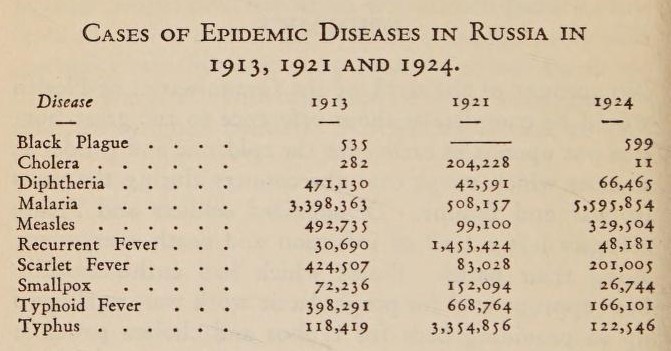
The above figures came in part from Statistical Material published by the Commissariat of Health in 1926, and in part from material in the Bureau of Statistics in Moscow, as yet unpublished.
The campaign against these diseases has of course varied with the nature of the disease. The Bacteriological Institutes are the directing headquarters of the war, their support coming from the central Commissariat, as it is felt that epidemics are of more than local importance and danger.
There are ten “flying squads” ready each summer to be sent to neighborhoods infested with the black plague. Most of their efforts are directed toward the extermination of the suzlicks, or little gophers, which carry the pestilential fleas; practically everyone contracting the disease dies, making therapeutic measures worthless.
Small-pox vaccination is now obligatory, and thirty-one laboratories are devoted exclusively to the preparation of vaccine for it. The decreased incidence of this disease witnesses to the activity against it.
Cholera, typhus and recurrent fever are disappearing as the filthy and diseased hordes of refugees from war and famine no longer crowd the stations and wagons of the railroads, the old army barracks and other public places, and as these places are being repaired and cleaned.
Typhoid fever and dysentery retreat more slowly as the safe-guarding of drinking water, milk, etc. requires a more complicated and costly type of sanitary inspection and control.
The infectious diseases usually connected with childhood have shown a slight increase in the last year, especially scarlet fever.
Malaria is, however, the endemic disease of Russia at the present time as it has been in the past. Thousands of the most fertile acres of the country lie in a region which “owes its fertility to spring floods with their sequel of stagnant pools. Drainage to be effective would cost millions of roubles; the prevalence of high winds, as well as the large areas involved, make the use of oil impractical, and many people grow immune to the salutary effect of quinine after several courses of treatment. As a result malaria is still a problem, in spite of the omnipresent anti-malaria stations and the fact that half the stock of every steppe pharmacy consists of quinine. Prophylactic measures both in the treatment of individuals and in the elimination of mosquitoes are being carried on everywhere. In the neighborhoods where the population is sufficiently intelligent to cooperate, and where the swamps and pools are of reasonable area for drainage, there has been a marked reduction in the incidence of the disease.
XII. The Anti-Tuberculosis Campaign in Russia
For more than a century tuberculosis has been recognized as one of the most prevalent diseases in Russia, but until recently there, as in other countries, its nature and treatment were not very well understood. Certain drugs were expected to be specific for it, but especially recommended was the drinking of koumiss, or mare’s milk. It was also observed that this treatment was most beneficial if taken actually on the steppe where grew a certain kind of grass on which the mares fed, a region almost on the edge of Asia and inhabited only by nomad tribes of herdsmen. In their zeal to obtain the fresh koumiss both the early doctors and their patients failed—to observe that the primitive living conditions in that part of the world necessitated sleeping in a tent and spending all day out-of-doors in the sunny, dry climate of the southeastern steppe, as well as adhering to an extremely simple though nourshing diet. Tolstoi as a young man was thought to have “consumption”, and his letters contain some interesting pictures of life among the Kirghez of the Orenburg region where he spent several summers in taking the cure, apparently with excellent results.
Very few Russians, however, could afford such expensive treatment and the normal living conditions in the country as well as in the city offered every encouragement to the spread of the disease. Even very intelligent people considered the night air dangerous at any time, while during eight months of the year the windows of all houses were sealed shut to keep out the cold. Among the peasants and working people overcrowding and undernourishment were as universal as the custom of eating from a common soup-bowl. The use of a common Communion cup, the eagerly sought privilege of kissing ancient martyrs’ reliques and the social sharing of the vodka bottle were all unsuspected as possible sources of infection. Early statistics for the country as a whole are not obtainable, but during the war years, 1914-1918 the records (from The Tuberculosis Three Days, report of the Committee for the Organization of the Tuberculosis Three Days in Moscow, 1922, p. 16), show that while Russia lost 1,700,000 soldiers from wounds and disease, she lost 2,000,000 of her total population from tuberculosis alone. According to the same source (p. 14), in Moscow in 1899, with no public nor privately maintained institutions or organizations for the cure or prevention of tuberculosis, there were 31 deaths per 10,000 persons from that disease.
Until 1900 the only interest taken by the medical profession in tuberculosis was shown in an occasional invitation extended to some foreign specialist to come to lecture before the students of the university or to one of the medical societies. In the first years of the new century, however, the Pirogoff Society, a well known group of socially minded people, formed a temporary committee for the study and improvement of conditions fostering tuberculosis. After several years of activity in various parts of the country this committee expanded into the All-Russian League for the Campaign Against Tuberculosis, which was officially recognized by the government but obtained practically all of its funds from private benevolence. Its first institution—the first anti-tuberculosis institution in Russia—was a forty-two bed hospital for women, opened in the Staro-Ekaterinskaya Hospital in Moscow in 1906. Considerable opposition both from doctors and from patients’ families greeted this attempt at segregation and intensive study of the disease. However, the League obtained a donation from the Royal family’s private purse and thus became somewhat of a social and financial success, so that other experiments soon followed—an out-patient clinic, a thirty-bed children’s hospital, an Anti-Tuberculosis Exposition, with a tag-day called the “Day of the White Daisy”. As a result of these efforts we find by 1909 the tuberculosis death-rate of Moscow reduced to 26.7 per 10,000 (according to the aforementioned report, The Tuberculosis Three Days, page 15), a figure as low as any recorded for that city until the intensive campaign of the last few years. Away from Moscow and the inspiration of the founders, the League was not so successful, and aside from the koumiss establishments of the steppes and the sanitoria in the Crimea, which catered to wealthy patients only, there were very few places where the tuberculous could receive treatment.
With the outbreak of the World War humanitarian work of a general nature suffered and even before the Revolution of 1917 the League saw its committees broken up and its medical personnel scattered to military duty. In 1918 the financial resources of philanthropic organizations were taken over by the state and the first phase of the anti-tuberculosis campaign in Russia—under private endowment—was over.
The disease itself, of course, gained by the lull in hostilities against it and when the Peoples’ Commissariat for the Protection of Health was organized in July, 1918, it was immediately recognized as one of the most dangerous enemies to the people’s health, an enemy requiring considerable funds and time to conquer. Funds just then were low and equipment for institutions very scarce—it was the period of civil wars and blockade–and so the Commissariat of Health, partly from necessity and partly because it realized the need of such a course, turned its attention to a program of education of the mass of the people into some sense of responsibility for the protection of their own health. A new tag-day was inaugurated—this time the “Three Days of the Proletarian White Daisy”, the change in title being intended to emphasize the emancipation from a certain patronizing attitude inherent in the earlier campaign. The protection of the workers from tuberculosis was to be the duty of the State and of the workers themselves now. An article called Then and Now appeared in the official report of the Proletarian Three Days which can be condensed into the following paragraph:
Under the old regime the struggle against tuberculosis in Russia had an almost exclusively private and charitable character—it was in other words irregular and accidental. The government took no sustained and active interest in it, although Nicholas II gave to it from his private purse five thousand roubles ($2500) a year, and the Moscow Duma appropriated two thousand roubles ($1000) a year. The workers themselves, the greatest sufferers from tuberculosis, had no part in the organization and stood entirely outside of the campaign…The Day of the White Daisy was then exclusively a handout from kind-hearted rich people. It is true that the amounts raised were considerable and several institutions were opened, but during the World War the founders of these institutions were busy with other affairs, no money was given to them and they had to be closed. Now the campaign has an entirely different character—it is led by the government and one feels the solid foundation under the new institutions, all of which must conform to the same high sanitary standards, and only qualified personnel are employed. The connection of tuberculosis with bad economic and social conditions is understood and official action can be taken to correlate all measures for the prevention and cure of the disease. Working people are on all the committees. The present anti-tuberculosis campaign is knit into the life of society as a whole.
The activities of the Commissariat of Health did not stop with this propaganda, even in the early days. By the end of 1918 a dispensary for tuberculous children was started in Moscow and in the next year the City Health Department organized the Moscow Tuberculosis Institute, with a 300-bed hospital for critically ill patients. In 1921 a special bureau of the Commissariat of Health was set aside for the campaign against tuberculosis and since that time the work has shown an organized and progressive growth.
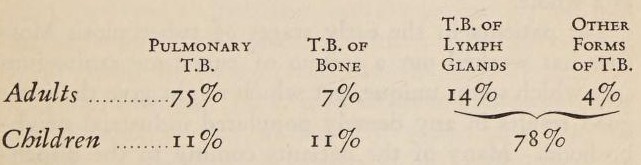
The tuberculosis dispensary has been the most important type of institution in the campaign. It is primarily devoted to the clinical diagnosis and treatment of the disease among out-patients, but growing out of its findings and recommendations have come a host of other institutions—permanent sanitoria, the “night sanitoria”, day camps, diet dining rooms, laboratories, forest schools, visiting nurse service, traveling exhibits. All the important cities now have anti-tuberculosis dispensaries as part of their health work, and their activities outlined and standardized by the central bureau in Moscow. In the R.S.F.S.R. there were on January 1, 1926, twenty-two cities with a population of over 100,000, and in each of these the law requires at least one tuberculosis dispensary. There are forty-seven cities with a population of from 50,000 to 100,000, and of these forty-two have such dispensaries; of the one hundred and four cities with a population between 20,000 and 50,000 seventy-two have opened dispensaries; and of the five hundred and sixty-five cities with a population from 5,000 to 20,000 fifty-four have dispensaries. Altogether in the R.S.F.S.R. there are 223 of these institutions, a progressive growth since 1919 when four were started as an experiment. (From the “The Tuberculosis Campaign in the U.S.S.R.,” by E. G. Munblitt, in the Russian-German Medical Journal for April, 1926.) To these dispensaries the factory doctor and the school doctor and the general clinic doctor and also now the private doctor may send their patients to be examined by specialists, with laboratories, facilities for surgery and Roentgen Ray cabinets to aid in diagnosis. The same source says the types of disease found by these dispensary examinations during 1925 were as follows:
From the dispensary the patient is sent to the type of institution indicated by his condition, at least that is the ultimate aim, but up to the present time there have not been sufficient funds to provide for all the institutional care really required.
The figures for January, 1926, again according to E.G. Munblitt’s article, show that there were then in the R.S.F.S.R. 206 institutions with a total of 14,758 beds offering permanent or long continued care to the tuberculous. Local funds are responsible for 155 of these institutions with 9,567 beds; 39 institutions with 3,991 beds are tuberculosis sanitoria in the health resorts, many of them supported by the health insurance funds; 3 with 220 beds are supported by the Russian Red Cross; 9 with 980 beds are maintained in various parts of the country as model institutions by the central Commissariat of Health. It is interesting to note that among these permanent institutions there are two lupusoria with 180 beds caring for that type of tuberculosis only. This total of about 15,000 beds for totally disabled tuberculosis cases is too low for a population of approximately 140,000,000. It is hoped that within a few years two factors will have brought the demand and supply of these beds into better ratio—the increasing amount of funds available for opening sanitoria, and the decrease of seriously ill patients due to earlier diagnosis, more effective prophylactic measures and generally better living conditions for the population as a whole.
For patients in the early stages of tuberculosis Moscow has worked out a system of part-time sanitorium care which seems unique, yet which might give the same good results in any densely populated industrial neighborhood. Many of the patients coming to the dispensaries must be diagnosed as definitely tubercular, but are nevertheless still able to work and to regain their health if surrounded with proper living conditions. These conditions are very difficult to obtain in Moscow, which is probably the most overcrowded city in the world, recent statistics showing an average of six and a fraction individuals per room for the entire city. To meet this situation the tuberculosis section of the City Health Department has taken over a number of former mansions and converted them into small model sanitoria to which the dispensaries may send 35 to 45 patients at a time for a two to three months’ period. At the end of their working day these patients go directly from the factories or offices to the sanitorium, where they bathe and dress in clean fresh clothing, then lie in long chairs in the garden or on the verandas for a rest of an hour before dinner. This meal is especially nourishing, more so than the average worker’s dinner at home would be, and after it comes another rest period. Then for an hour or two there are games, music and reading, sometimes a party at which the patients entertain their families, sometimes an illustrated lecture by the doctor in charge of the institution, and then bed-time. The windows of the bedrooms are nailed open even in the coldest weather and in Moscow this often means 30 degrees below zero Fahrenheit. The next morning a warm breakfast is provided before the patients start to their day’s work. Needless to say, the records show almost all the cases improved on discharge, but the authorities feel that the educational value of the treatment to the patient and to his family is of even greater benefit than his immediate gain in health. There is little opposition to entering the sanitoria as they are usually within easy walking distance of the patient’s home and his family may visit him often; the other great advantage of this type of part-time care is that the salary of the wage-earner is not cut off from his family. So successful and popular are these night sanitoria among the workers that many other industrial centers have copied Moscow in opening them. Last year there were over 5,000 beds offering—this temporary service to patients still able to carry on their ordinary working duties if their leisure time could be a period of recuperation.
These part-time sanitoria are also provided for school children. The following report was sent to the American Friends Service Committee after my visit to one of these children’s sanitoria in 1926:
This sanitorium is situated in the Basmannaya Ward of the city of Moscow and was visited in company with the Russian woman doctor who is in charge of all health work in that ward.
The institution is run as a day sanitorium between the hours of 8 a.m. and 5 p.m. for both boys and girls from 4 to 14 years, and as a night sanitorium between the hours of 5 p.m. and 8 a.m. for girls only from 9 to 14 years. The children are recommended for the institution by the school and tuberculosis dispensary doctors throughout the ward because of their incipient tuberculosis or state of especial malnutrition. As many more children need this care than there are institutions to receive them, two or three visiting nurses take the lists recommended by the doctors and visit the homes of the children, selecting those whose home surroundings are such as would preclude the possibility of their improvement in health at home. The children received in the day-time are those considered too ill for regular school attendance. Both night and day children receive a full daily ration of food from the sanitorium, but this is often further supplemented by food obtained at home. The night children are allowed to visit their homes at the noon school recess and for a short time after school; the day children live at home from 5 p.m. until 8 a.m.
The house is a three-story dwelling formerly belonging to a wealthy family. It is in very good repair, the rooms being large, well lighted and well ventilated, with good parquet floors. The first floor is occupied by three large bedrooms, bathrooms and dressing-rooms. The beds are metal with fairly good mattresses, two sheets and sufficient blankets. Between the beds are white wooden tables, no other furniture being in the rooms The walls, floors and beds (we examined several) were very clean. On the first floor there is also a dispensary where the children are given a physical examination monthly by the doctor and where they report twice daily for the taking of their temperatures and once every ten days to be weighed. The second floor has a large playroom, two rooms used as restrooms by the day sanitorium which are very crowded with beds made out of old army cots and stretchers, the dining room—used by both day and night children—and a small office for the doctor. The third floor has the kitchens, storerooms and the servants’ rooms. They were very clean when we saw them, and without odors. The milk, butter, meat, bread, etc. are kept in boxes covered with mosquito netting. Back of the house is an extensive garden, shaded in part by old trees and in part open to the sun. Several tables have been built into the ground allowing for outdoor occupations and meals when the weather permitted. Unfortunately on an adjoining lot there was a deep quarry-like depression filled with water which in past years had been a source of malaria. The city sanitary engineers were expected to come the day after our visit to arrange for the draining of the pool. The day sanitorium children spend most of their time in the garden both winter and summer.
From 8 a.m. to 10 a.m. the day children, 48 in number, both boys and girls from 4 to 14 years, arrive, remove their home clothes (which are hung in individual muslin bags in the first dressing-room), take a tub or shower bath and dress in the institution clothes, much of which were given several years ago by the American Relief Administration. Each child has his own numbered toothbrush; mug, towels and washcloth, the shelves of these toilet articles being protected by netting. From 10 to 10:30 a.m. breakfast is served, consisting of tea, milk and bread. From 10.30 a.m. to 1 p.m. the children play and rest in the garden, small groups being called to the house occasionally for the doctor’s examinations. From 1 to 2 p.m. dinner is served of soup, meat, potatoes or macaroni, bread and butter and dried fruit compote. From 2 to 3.30 they sleep on beds in the house. From 3:30 to 4:30 there is active and supervised instruction in singing, drawing, painting, etc. From 4:30 to 5.00 p.m. a light supper is served, after which the day children go home, having first changed to their own clothes.
The 48 children received in the evening are all girls ranging from nine to fourteen years who attend school during the day. They arrive at the institution about 5 p.m., bathe, clean their teeth and change into the dispensary clothes. From 6 to 7 dinner is served; from 7 to 8 all rest on their beds; from 8 until 9 p.m. there is active play (these girls edit a magazine and make most of the decorations about the house) or study their lessons for the next day. At 9:30 a light tea is served, and by 10:30 all are in bed. At 7 a.m. they are wakened, take shower baths, and dress in their own clothes. At 8 o’clock breakfast is served, after which they start to school, taking some white bread with them for the midday lunch. Some schools serve a hot lunch for the children, some do not.
The daily food ration received alike by day and night children consists of the following amounts:
Black bread 770 grams
Butter 48 grams
White flour (made into various kinds of cakes, buns) 200 grams
Sugar 56 grams
Meat 200 grams
Dried fruit 24 grams
Macaroni 150 grams (sometimes potatoes)
Milk 1 glass a day
Butter 48 grams
This ration is reckoned to amount to from 2,500 to 3,000 calories a day per child, but no attempt has been made to weigh or measure accurately the amounts which each child receives. The doctor said that the greatest lack was fresh fruits and vegetables, eggs and milk, but that the present budget did not allow a better diet. As it was, it was much better than she could afford for her own children.
Over the period of the two and a half months preceding our visit the children had shown the following results in weight:
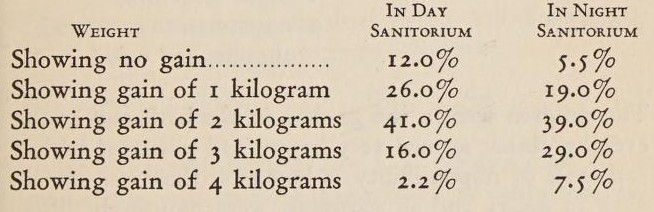
In connection with these figures it was pointed out to us that the children were at the night sanitorium for a period of sixteen hours out of the twenty-four as contrasted with the eight hours spent there by the day children, and that also the day children were usually in the poorer physical condition at the start, as they were the ones judged by the examiners to be unfit for school attendance.
That the children coming to this sanitorium needed special institutional care was proved by the reports of the nurses who visited in their homes. Only 33 percent of the children now in the institution had had separate beds at home; 56 percent had shared beds with one or more other people; 13 percent had had no beds at all. Six percent of the children came from homes where the rooms had no window or other direct ventilation, and only twelve percent lived in rooms which were not distinctly overcrowded.
The institution was considered both by the doctor in charge and by the ward doctor to be understaffed, but the premises, food and bed-linen all seemed clean and well-cared for. The personnel was as follows:
1 doctor in charge
2 cooks
1 doctor on part time
1 stove-man
2 teachers
1 yard-man
2 nurses
1 night watchman
5 maids
1 coachman to cart food supplies and wood
The children seen in the garden, in the bath and at the evening dinner seemed very happy and possessed with a real sense of responsibility as hostesses; their magazines, both in essays and in cartoons, were amusingly illustrative of the health teaching they had received. The spirit of the staff was enthusiastic and their relations with the children were very cordial.
There are also the forest schools, described in the chapter on the protection of children’s health, to which many tubercular as well as pre-tubercular children are admitted. Then there are many day camps for both adults and children where rest in quiet and sanitary surroundings and a nourishing supplementary diet are provided. The patients attending these also show improvement on their subsequent visits to the dispensaries.
It is too early to offer any definite proof of what has been accomplished throughout Russia by the anti-tuberculosis campaign. Only since 1925 has a registration of the cause of death been compulsory, even in the larger cities; the incidence of disease was previously checked up but not the mortality rate. For Moscow, however, there are figures, and while it is probable that the decrease in mortality there is more rapid than elsewhere owing to the more strenuous campaign against the disease, this decrease may be taken as indicative of what will happen throughout the country as increasing funds are assigned to the rural work. According to “The Anti-Tuberculosis Campaign in the U.S.S.R.,” by E.G. Munblitt in the Russian-German Medical Journal for April, 1926, these figures are:
DEATHS PER 10,000 PERSONS FROM ALL FORMS OF TUBERCULOSIS IN MOSCOW
1910 28.5
1911 27.9
1919 29.9
1920 39.7
1921 28.1
1922 26.1
1923 17.5
1924 16.1
Both the climate and the food products of Russia are natural aids in an anti-tuberculosis campaign, and now that there is a scientifically directed propaganda against certain unhygienic habits of the people as well as a nucleus of curative institutions, we may expect to see the disease ultimately routed.
PDF of original book: https://archive.org/download/healthworkinsovi0000anna/healthworkinsovi0000anna.pdf

