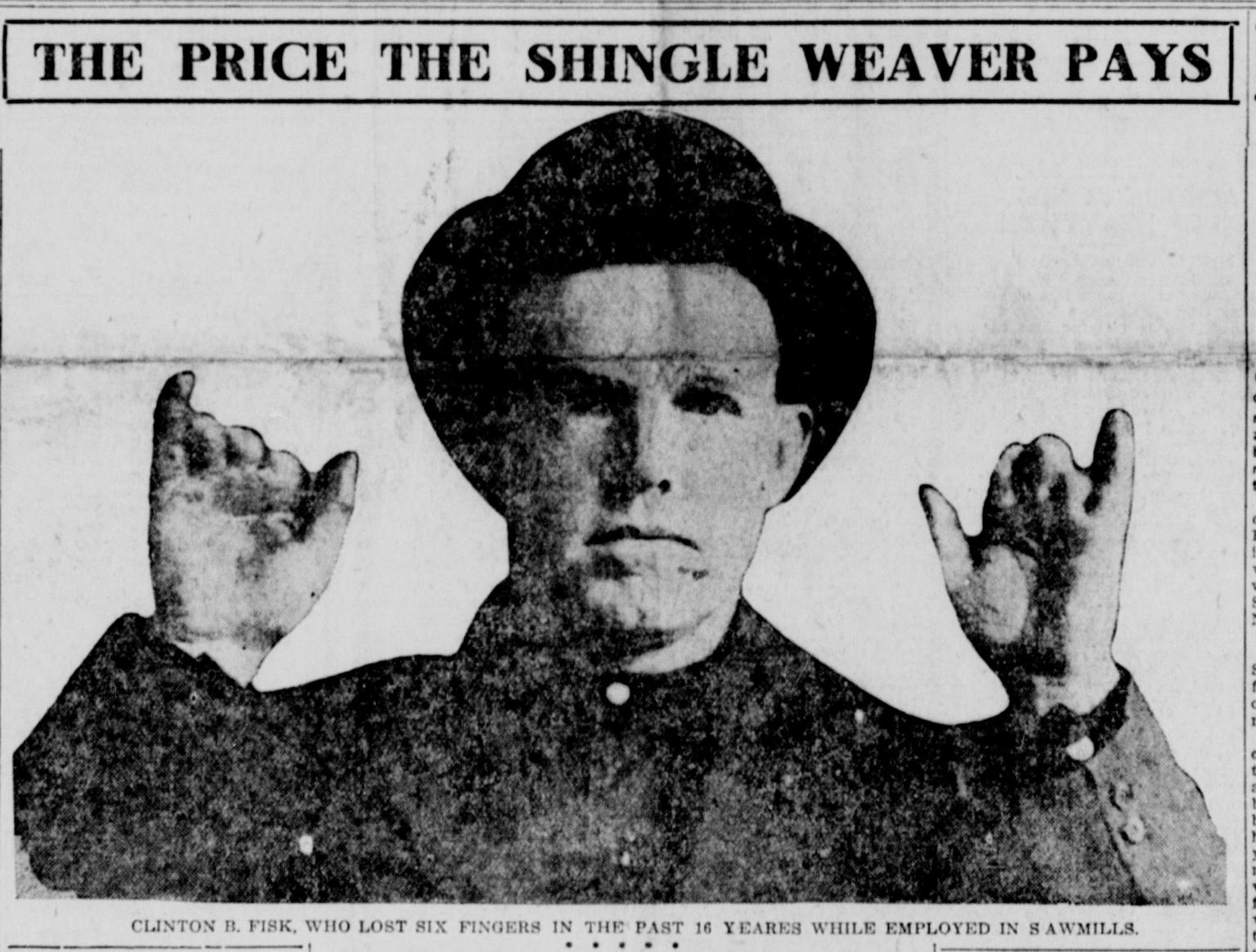
A rank-and-file push to have the A.F.L.-aligned International Shingle Weavers’ Union (one of the largest in the Northwest) become an industrial union, taking in all forest and lumber workers was defeated at its 1910 convention. Here, the I.W.W. answers craft union criticism of itself made by the leadership of the Shingle Weavers.
‘Shingle Weavers, Attention!’ from The Industrial Worker. Vol. 2 No. 36. November 24, 1910.
One of the important questions to come before the convention of the Shingle Weavers (in fact, the MOST important one) is whether the Shingle Weavers shall, affiliate with the Industrial Workers of the World or stay in the old, ancient, antiquated, moss-covered, fossilized A.F. of L.
As the time when the convention shall convene is getting short, it is natural that all the pros and cons shall be entered into before the membership will be prepared to vote.
Those who favor the I.W.W. in the Shingle Weavers’ organization and who have solved the question so far as they are concerned, are using argument to show why such an affiliation should take place, while we fail to see where our critics have advanced any, argument worth mentioning, why they should stay with the A. F. of L.
J.G. Brown, who is a prominent member of the Shingle Weavers and who is past president, uses up a large portion of the “Weaver” for November in answering those who favor the I.W.W.
Fellow Worker Brown objects to the move if it is based on only sentiment and wants to know where they are to gain anything in leaving the A. F. of L. Had this idea entered into the minds of those who started the I.W.W. and have still maintained it, there certainly would not have been any I.W.W. The question is not sentiment, but cold-blooded facts that are needed. The question is whether the I.W.W. is correct in its position, and whether such an organization is necessary. Our critic says that several internationals have in the past withdrawn to their lasting regret. The Brewery Workers left the A. F. of L. about three years ago after the question had been submitted to a referendum vote of the membership of that organization. The vote resulted in almost 37,000 to leave the A. F. of L. and less than 2,000 to stay in. At this time a strike was on in a brewery at New Orleans, and the A. F. of L. organized the scabs. The officers of the Brewery Workers seeing that the policy of the A. F. of L. would be to scab on them, applied for their charter back again. No referendum was taken to go back. The trouble which led up to this move of seceding on the part of the Brewery Workers was one of jurisdiction: whether the Brewery Workers would have the right to organize all the workers around the brewery into their organization. The international Teamsters’ Union wanted the teamsters and drivers that peddled beer, and the Firemen’s International wanted the firemen, and so on, and for years it has been a bitter fight with the Brewery Workers to try and keep the A. F. of L. from disorganizing them into separate crafts, any member of the A. F. of L. can see hope for a labor movement that employs such tactics as was practiced against the Brewery Workers, he certainly has a very optimistic view of the labor movement. Notice the following reason advanced by our critic for staying in the A. F. of L.:
“So in the face of the experiences of the two organizations mentioned it ought to be a more weighty reason than mere sentiment that would cause us to withdraw from an organization that even though powerless to do us much good can still do us infinite harm.”
If this statement of cowardice had been only uttered in one place in the article by J.G. Brown, we might have overlooked it; but note the following extract from his article where he again shows that he is afraid that the A. F. of L. will scab on his organization:
“It may be said that the A. F. of L. would be powerless to do any harm to the shingle weavers in case we were to withdraw from that institution. To those who think this I would call attention to the city of Goldfield, Nevada, which was solidly organized by the I.W.W. The A. F. of L. sent in organizers there and with the help of the employers succeeded in putting the industrialists entirely out of business. Nothing to be very proud of, perhaps, on the part of the Gompers organization, but the thing that is important to us is that it was done. When unions are at war, as with individuals, ethics cut no very important figure. The I.W.W. would return the compliment if they had the opportunity.”
The first part of the extract needs no comment from any industrial unionist, as Brown admits that the A. F. of L. sent organizers into Goldfield to scab on the I.W.W. and to disrupt them. It is the latter part of the extract that we take exception to, as it is not a fact and we challenge Mr. Brown or any other officer or member to show where the I.W.W. as an organization has ever scabbed on the A. F. of L. We have had thousands of chances to build up the I.W.W. if we had been desirous of assisting the master class. There are one or two cases on record where individual I.W.W. members have worked in shops where there was an A. F. of L. strike on, but no matter what reasons have been advanced by the individual member to defend his actions, he has always been turned down when the case has been brought before the executive board. In this we may say also that individual members have advanced some very strong reasons why they should be allowed to work in shops as above mentioned. An instance which happened in Great Falls, Mont., only recently ought to convince Mr. Brown and any one else holding such ideas that the I.W.W. would retaliate by scabbing is as false as the theory of hell. The charter was taken away from over 300 members of the I.W.W. in the town of Great Falls because they had been induced by local officials of the W.F.M. at that place, to enter into a contract with the Manufacturers’ Association, which would expire at the same time as the contract of the W.F.M., which is for five years. This move was a slippery one on the part of politicians holding office in the W.F.M. to keep the members of the I.W.W. at work when locals of the A. F. of L. would go on strike. The secretary of the I.W.W. local told the writer of this article that if the A. F. of L. locals were to strike and raise their wages, that the price of living would advance also, and that their brothers in the smelter who were tied up in a five-year contract at a certain wage, could not stand to have prices advance in the cost of living. In this matter, to prove our statement to be true. I will refer you to any officer or any member of the A. F. of L. in the city of Great Falls, Mont. The I.W.W. executive board went to an expense of over $200 in sending organizers to Great Falls to try and induce the members of the I.W.W. to repudiate the contract, and when they refused to do so, the CHARTER WAS TAKEN AWAY FROM THEM, and they are now an independent organization.
Here was a case in question and the only time where the I.W.W. has had to take the charter from the wall, where if the I.W.W. had wished to stick to the W.F.M. (which is the largest organization in Great Falls) and the Business Men’s Association, we could actually have wiped the A. F. of L. out of Great Falls, but as much as we would wish to wipe out the craft unions and put fighting Industrial Unions in their place, it will never be done on shame and dishonor.
The I.W.W. in Goldfield had raised wages higher (considering the price of commodities) than had ever been paid before or since in America. The wages of section hands and railroad construction men were raised from $1.75 a day to $4.50 a day. All others wages in proportion. The only way the master class could whip the I.W.W. was to divide the workers into crafts. How well the boss knew what to do when he sent for that King of SCABS, Grant Hamilton, official organizer of the A. F. of L. and who draws a $4,000 a year salary. As a result of this treachery, young officers of the I.W.W. are serving sentences ranging from 10 to 25 years in the penitentiary at Carson City, Nev., and they are as innocent of the charge against them as a newborn infant.
Note the following extract from Brown’s article in regard to the Preambles:
“Another correspondent quotes the preamble of the I.W.W. and asks us to contrast that statement of principles with the declaration of the A. F. of L. that the interest of labor and capital are identical. There can be no difference of opinion as to the correctness of the position taken in the preamble of the I.W.W., but I should like to inquire where the correspondent gets his authority for stating that the A. F. of L. is organized on the assumption that the interest of labor and capital are identical. I quote the following from the preamble of the A. F. of L.:
“Whereas, a struggle is going on in all the nations of the civilized world between the oppressors and the oppressed of all countries, a struggle between the capitalist and the laborer, which grows in intensity from year to year, and will work disastrous results to the toiling millions if they are not combined for mutual protection and benefit.”
True, the A. F. of L. has faint mutterings of a class struggle in many of their preambles, but in this matter, like the Goldfield incident, ACTIONS SPEAK LOUDER THAN WORDS. The CIVIC FEDERATION is the place to determine what the A. F. of L. stands for. When practically all the officers of the A. F. of L. are linked up with such capitalists as Andrew Carnegie, Belmont and others, talking PEACE UNDER CAPITALISM, and with Mitchell getting $6,000 a year from this HARMONY CLUB, to advocate trade union contracts, which will divide the workers on the industrial field, how in the name of common sense can we take cognizance of some faint whisper about a class struggle in a preamble? “Then we are told that the loggers and the miners are going to flock into the camp of the I.W.W. as soon as the shingle weavers have broken the ice. There are some ten thousand organized miners in the state, possibly more. Why not let them lead the procession? The fact is all this talk about the loggers and the miners and all the rest is the idlest of speculation. The hope is father to the thought.” Brown wishes for some one else to lead the procession. If the shingle weavers are going to wait until some others flock in before they move, it is quite natural to suppose that they would follow another procession that might leave the I.W.W. This argument won’t go very far with hundreds of shingle weavers that we know, and who are now members of the A. F. of L. If it is a procession that even Brown wants to follow, we may say that a small procession started a week ago among members of the U.M.W.A. in this State of Washington when 32 members of it sent for a charter to the I.W.W. Of course they were ITALIANS, and they have more to fear from being scabbed to death by the U.M.W.A. than have the shingle weavers who are not sewed up in a contract with the boss as the miners are. Probably there are aristocratic shingle weavers who work like hell all day packing shingles by the thousand for a miserable wage, that would not care about Italians leading the procession.
“With the certainty that we should have all delegates unseated in state and central bodies, and the probabilities that we should have dual unions formed from those who would be dissatisfied with the plan of going over to the industrialists, would it not be better to try the industrial plan on a less sweeping scale than that proposed by the advocates of the I.W.W.? What is to prevent us from organizing industrially and still retain our affiliation with the A. F. of L.? This is done by no small number of international bodies with the present A. F. of L.”
Brown is afraid that the delegates would be unseated from the state and central bodies. When the shingle weaver stops to consider what a lot of benefit he derives from paying delegates a salary and expenses to these conventions, they will not hesitate in solving this knotty problem. We have never heard of a carpenter refusing to place shingles on house when the weavers were on strike, and neither have we ever known the switchmen or brakemen to refuse to pull a carload of scab shingles from a scab mill and take it to its destination. The weavers would be money ahead if they kept their delegates at home, working in some shingle mill where the boss can pay him instead of travelling all over America to hear Gompers tell his tale of woe about going to jail. The jails are full of I.W.W. men who have more principle in one hair of their head, and more fight in one minute against the system than all the Civic Federationized officers of the A. F. of L. that ever existed.
Before discussing the departments of the A. F. of L. which are organized on less sweeping lines, let us read the following ex- tract from the press committee of the shingle weavers in Everett, Wash., and appearing also in the November “Weaver”:
“Local No. 2 will hold a good old-time smoker at the next regular meeting. Tuesday evening, Oct. 18th. A lively time is looked for, as the striking machinists have been invited to attend and indulge in boxing bouts with the weavers.
“The machinists have been out on strike to gain the eight-hour day for the past five months and in spite of summer scabs, who were also appointed police officers, the machinists have not had one single desertion from their ranks. They are prepared to fight Summer’s Iron Works to the last ditch. It’s up to every union man to lend these striking machinists a helping hand whenever possible to do so.”
These machinists, who are on strike in Everett and all along the coast, are members of THE METAL DEPARTMENT of the A. F. of L. Since going on strike in Everett, the very men who are on strike at present sent for a charter from the: I.W.W. True only a few of them, but also true that those who did send for the charter for Everett local of the I.W.W. were men who had been. members of the Machinists’ International for many years. If this thing of an A. F. of L metal department is such a good thing, why are the pattern makers, boiler makers, blacksmiths, moulders, etc., all working steady for the boss? The men referred to as scabs in the Sumner plant are not these A. F of L. craftsmen, but the men who have taken the places of the striking machinists. Which is the biggest scab? The man who helps the boss to defeat his BROTHER in the METAL DEPARTMENT with a paid-up card in his pocket, or the scab who is sick and disgusted with unionism as laid down by the A. F. of L. and who is taking a chance to get even with the A. F. of L. for some UNION SCABBERY in the past, where he has been the fall-guy. On strike five months. That’s nothing. The machinists were on strike four years and a half on the Santa Fe railroad and never stopped a railway train. Wonder if there were any UNION SCABS? There is much more that might be said in answering all the points made by J.G. Brown and our other critics, but what is the use? Those who are afraid to leave an organization for fear it will scab on them, would make poor material in the I.W.W. Those who have studied the question and who wish to see the working class united on the economic field, are not going to be deterred from coming in by any fear of mugs like Grant Hamilton or any other official of the A. F. of L. who talks PEACE under CAPITALISM. The coward we do not want, as he would be in the way, and the man could not be kept out under any pretext. The labor problem has got to be settled and settled right, and it is never going to be settled by men who can’t see past their own craft and their own petty job that they think they have a life lease on. If the boss could find a machine that could saw and pack the shingles without the aid of slaves, he would show the shingle weaver how much job he has. One union for all and all for one, scientifically arranged whereby we can act together when necessary, should be the battle cry of every working man and woman in America. Such an organization is the I.W.W.
The Industrial Union Bulletin, and the Industrial Worker were newspapers published by the Industrial Workers of the World (IWW) from 1907 until 1913. First printed in Joliet, Illinois, IUB incorporated The Voice of Labor, the newspaper of the American Labor Union which had joined the IWW, and another IWW affiliate, International Metal Worker.The Trautmann-DeLeon faction issued its weekly from March 1907. Soon after, De Leon would be expelled and Trautmann would continue IUB until March 1909. It was edited by A. S. Edwards. 1909, production moved to Spokane, Washington and became The Industrial Worker, “the voice of revolutionary industrial unionism.”
PDF of full issue: https://www.marxists.org/history/usa/pubs/industrialworker/iw/v2n36-w88-nov-24-1910-IW.pdf

