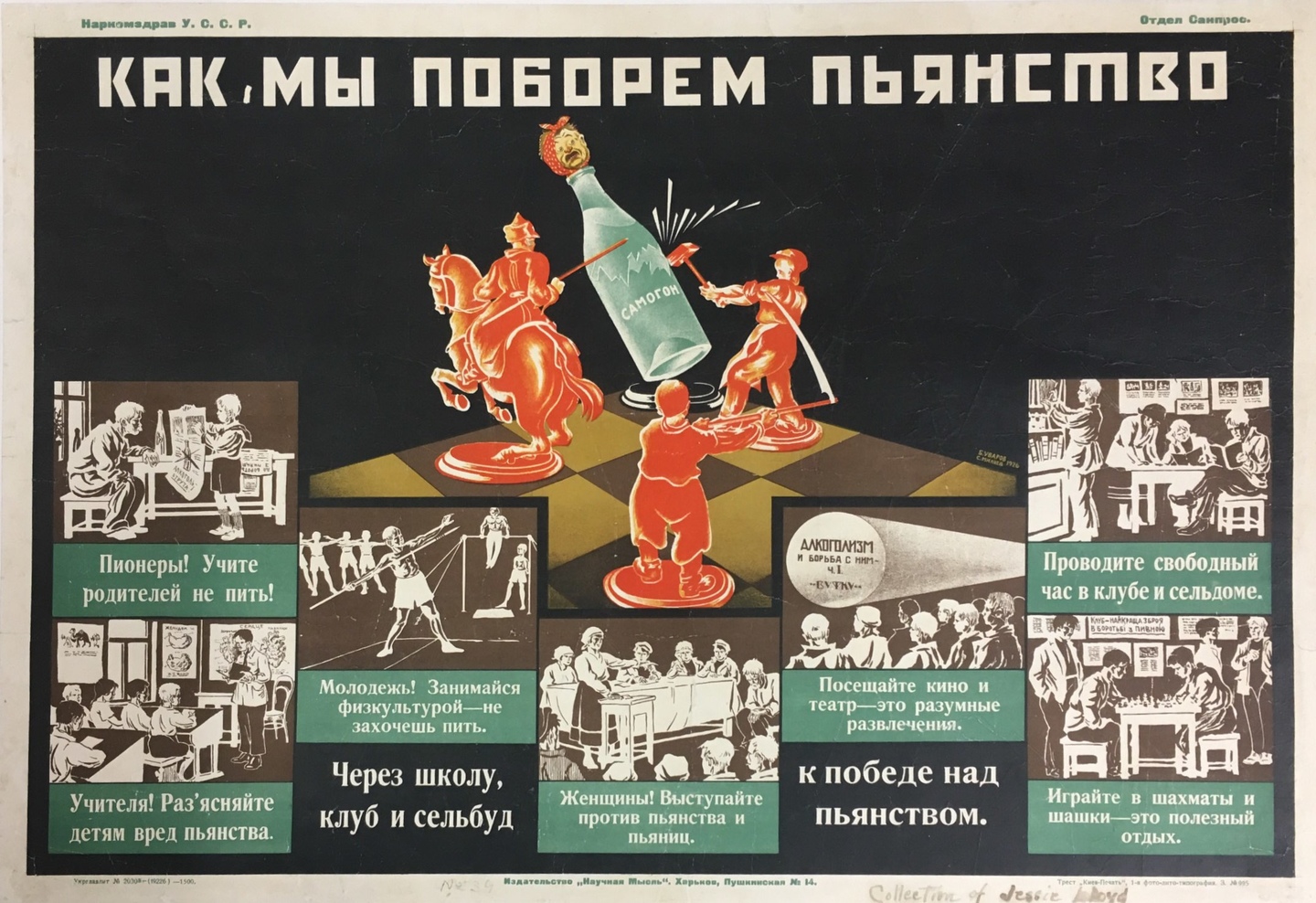
Below are XIII. The Campaign Against Venereal Disease, XIV. The Campaign Against Alcohol and Narcotics, XV. Health Work Among Soldiers and Transport Workers.
‘Chapters XII, XIV, & XV’ by Anna J. Haines from Health Work in Soviet Russia; Vanguard Studies of Soviet Russia. Vanguard Press, New York, 1928.
XIII. The Campaign Against Venereal Disease.
Up to the time of the Revolution the treatment of venereal disease was entirely in the hands of private physicians and of those country and city medical institutions which handled a general practice. According to the Report of the People’s Commissariat for the Protection of Health to the 12th All-Russian Congress, 1925, (p. 19), “the concerted campaign against venereal disease on a nation-wide scale began only after the October Revolution, at the time of the creation of the Commissariat for the Protection of Health, under which was organized the Section (today the Bureau) for the Campaign Against Venereal Disease.” Diagrams and a discussion of the organization of the Bureau were included in the chapter on the organization of the Commissariat for the Protection of Health, on pages 55 and 56. The aim of this Bureau is to create throughout Russia institutions for the cure and prevention of venereal disease, and to draw the working people into active participation in the campaign.
Special venereal dispensaries were from the beginning thought to be the best agencies for the fulfilling of these aims. Two great obstacles to the widespread establishment of such dispensaries immediately presented themselves: first, the lack of physicians trained to treat venereal diseases; and second, the lack of the necessary medicines, since salvarsan and bismuth preparations which had formerly been imported from Germany were then excluded by the blockade.
To meet the first need special courses were established in connection with the dispensaries of the large central cities and in 1921 the State Venereal Institute was opened in Moscow. From the first this institute has played a most important role in the training of doctors for practical work in the city and country dispensaries, not only because of its sound scientific work, but because it has also emphasized the non-medical aspects of venereal disease, so that the graduates of its courses are social workers as well as medical specialists. At the present time it has sixty doctors taking a three years’ post-graduate course, and sixty taking a year’s course, all of whom on the completion of their studies are to be stationed in the provincial districts.
The Institute has met the second great handicap to the campaign; i.e., the lack of medicines, by making original preparations of arsenic and of bismuth which are now widely and successfully used throughout Russia.
A German specialist in venereal diseases, Dr. Jadassohn of Breslau, who visited the Institute in 1925 wrote of it (in “An Account of My Trip to the Second All-Russian Congress in the Campaign against Venereal Disease at Harkov, May, 1925,” in the Deutsche Medizinische Wochenschrift, Nos. 32-34): “Its diagnostic, therapeutic, experimental and bacteriological equipment are unquestionably of the first rank, the equipment being simple, but very practical…Especially great care is taken with statistics. In this connection two things particularly impressed me—one, the detailed questions asked of the patient, whose answers are later assembled on large statistical sheets (the compilation of which must be a time-consuming piece of work); and the other, the great value of the statistical findings, which are presented in very intelligently arranged tables. The walls of the director’s office in one of the dispensaries were covered with these tables, which were especially well arranged for the purpose of understanding and were also admirable from an esthetic standpoint.”
To a German specialist the medical technique and the statistical information of the four Moscow dispensaries under the direction of the State Venereal Institute seemed especially noteworthy, but to an American public health worker the approach to the patient and the social service offered by the dispensaries are even more interesting.
The oldest of these dispensaries is situated in a large two-story building on a small side street in the central part of the city where many workers live. There is no sign over the door, but the house number is printed in large letters and electrically illumined at night, so that it is easily found without drawing attention to those who seek it. There are separate entrances for men and women leading into broad, well-lighted corridors which serve as waiting-rooms. Between these corridors are the record rooms (where the patient is known only by a serial number given to him by the doctor at the first interview) and a large cloak-room where all out-door wraps and bundles are checked without charge. In the waiting-rooms are tables with chess, checker-boards, dominoes, current newspapers and magazines. On the wall of a corridor hangs a letter-box where anonymous questions may be placed and on the following day the answers are written out on an adjoining blackboard where they remain for a couple of weeks. The walls also hold a few colored posters showing the extent, causes, prevention and methods of curing venereal dis- ease. These posters are frequently changed, new ones being brought out from a large room which serves as a special picture gallery and auditorium, where popular lectures are given weekly and where seminaries are held for students. A moving picture machine and a magic lantern are part of this room’s equipment. On the women’s side a room off from the general waiting-room is fitted up for child patients, with kindergarten tables, chairs and washable toys.
Two shifts of doctors, twenty-eight in all, work in the dispensary daily with an average attendance of 1,000 patients a day, the greatest numbers coming in the evening. Patients are received directly from the street, and are also sent from the general medical clinics, from factories and from private physicians. No charge is made for advice or treatment. On the first visit the doctor takes a full medical and social history of each patient and asks permission to call on the patient’s family in order to make the necessary tests to discover if other members are infected. Although this permission is sometimes refused at first, it is usually granted before the course of treatment is finished. During these visits to the home, instruction is given in general sanitation and in personal hygiene. As far as possible the same doctor continues with the treatment of one patient and with the home visits to that family. The technique and equipment in the treatment rooms compare favorably with those in American venereal dispensaries. Privacy and care in draping the patient are not so insisted upon, but in general in Russia the naked body is not so unfamiliar as with us. Courteous, respectful treatment of the patient is universal. For lumbar punctures there is a small ward with five beds where patients may be kept for one or two days at a time. In the office of the Medical Director there is a bewildering display of statistics declared to be the most complete in the world on this subject. They relate to the age, nationality, education, family life, occupation and social position of the patient as well as to many medical aspects of venereal disease.
Prostitution is still admitted to be one of the factors in spreading venereal disease, although it is no longer licensed, nor so openly practised as in the old days when the “yellow ticket” was one of the means by which ambitious and intelligent Jewish girls sometimes could be admitted to university towns otherwise closed to them. The great ease with which marriage can be made and unmade nowadays has undoubtedly lessened the value of prostitution as a trade, while the emphasis put on the teaching of social hygiene in the schools and among groups of young Communists leaves no one ignorant of the dangers of such a trade.
A certain proportion of the patients of every venereal dispensary, however, are still found to be prostitutes, and an interesting experiment in their reclamation is being worked out in Moscow. If they give as their reason for adopting such a profession the fact that they have no other means of livelihood, they are offered the opportunity of living in a dormitory and learning another trade while they are taking their course of medical treatment. For those who are illiterate lessons are given in reading and writing, and for those who are especially unskilled rough work at sewing and mending grain bags is supplied. Acceptance of this way of reform is entirely voluntary on the part of the girl, but once accepted it is supposed to be held to, and if she is absent from the dormitory at night or from the workshops during the day she is apt to find her place immediately taken by another applicant, as there is a long waiting list, and room for only about thirty in the dormitory. The girls are paid while in the workshops, and at the end of their course of medical treatment a self-supporting job is found for them in a factory or elsewhere. It is claimed that only a very small percentage go back to their old life. There is, of course, nothing new in these measures as a cure for prostitution; the novelty lies in their adoption by the health authorities as a part of the official medical program in a campaign against venereal disease. The success of this social experiment in Moscow is admitted, but its expense is too great for it to have been included as yet among the activities of other cities.
The backbone of the whole campaign is the venereal dispensary, modeled everywhere along the lines of the central dispensaries. In 1925 there were in the territory of the R.S.F.S.R. fifty-four such dispensaries, thirteen maintained by local budgets and forty-one dependent on the central Commissariat funds. The plans for 1926 include the placing of a dispensary in each gubernia, bringing the total up to sixty-seven. That the attendance at these dispensaries warrants operating them is shown by the following figures for attendance at the venereal clinics of six cities during 1924, which are taken from the Report of the People’s Commissariat for the Protection of Health to the 12th All-Russian Congress, 1925, pages 20, 21, and 22.
Tula 30,130; Voronej 12, 623; Saratov 12,888; Rostov 7,452; Ivanovo-Voznesensky 3,284; Irkutsk 1,164.
The total number of beds in the U.S.S.R. reserved for those requiring hospitalization because of venereal disease now equals 3,530 for a population of about 140,000,000, or one bed for about 40,000 people. The norm desired by the officials is one bed for every 1,000 city dwellers and one for every 10,000 country inhabitants.
It is felt that in the future more effort should be spent in the rural districts. This conclusion followed as a result of the reports of the twenty “flying squads” at the present time working in the country. “The squads have examined villages where the percent of those ill with syphilis amounted to 40 percent of all those examined. The work of the squads revealed that 94 percent of all those examined were entirely ignorant of the nature and cause of venereal disease.” In some villages, among non-Slavic tribes, where before the war syphilis was unknown, the infection was introduced by the demobilized soldiers and is especially virulent. The infant death-rate caused by this disease is so high in these places that the population is actually decreasing. The importance of these flying squads lies not only in their initial examination of the villages and their immediate follow-up work, but in their educational prophylactic work and in their linking up of the smaller villages with the nearest permanent medical station where treatment can be secured. It is proposed to increase the number of the traveling clinics as fast as financial means will admit.
The educational side of the problem is nowhere neglected by the directors of the campaign. Social hygiene lectures are given to the Pioneers (the organization which corresponds to our Boy Scouts, except that girls as well as boys belong to the Pioneers); factory doctors not only examine the workers for venereal disease but also include it in their program of lectures; the small health exhibits which exist in every provincial town and in many of the villages include posters and books on the subject; definite instruction is given in the army and navy. The attendance at the lectures given in the dispensaries in several cities is shown below.
ATTENDANCE AT LECTURES HELD IN VENEREAL DISPENSARIES IN 1924
Place–Number of Lectures–Number of Attenders
Astrakhan—127–22,568
Moscow–1,911–139,653
Tula—80—93,730
Veronej—147—11,660
(From the Report of the People’s Commissariat for the Protection of Health to the 12th All-Russian Congress, 1925, p. 20.)
A bi-monthly journal is now issued by the Institute to stimulate interest in this branch of medicine among provincial doctors and to inform them of the most recent scientific discoveries in treatment and prophylaxis.
As Dr. Jadassohn says in the report mentioned above: “It is astonishing with what energy the study and campaign against venereal disease is moving forward in Russia…That the goal has only been seen, but not yet gained is clear to the leaders of the campaign; but the organization is there, enthusiasm and energy for the work at hand—the venerealogists of the entire world will follow the campaign with the greatest interest.”
XIV. The Campaign Against Alcohol and Narcotics
SOME of the most interesting social phenomena of the last few years have been the various reactions of different countries to the almost universal prohibition laws that were put into effect during the war. Everywhere the high resolve to self-sacrifice which prompted the initial obedience to these laws has waned, yet everywhere governments and officials have feared to lose face by a direct repeal of them. In most countries, therefore, there has been a gradual relaxation in enforcement of these laws, then an equally gradual rewording to permit of some of the old social freedom. In Russia, however, changes involving social forces have a tradition of violence, and in the history of the modern anti-alcoholic campaign there is no exception to this rule.
“For centuries alcohol has been a curse to Russia. Vodka drinking is almost universal among the adult Russian males. Russian women drink very little. The drunken muzhik is the comic character of the Russian stage. The emphasis on drink in Russian plays and novels is an accurate reflection of Russian life. The ravages of alcohol have been greater than elsewhere. Not that Russians drink more than Frenchmen, but what they drink is more potent and more harmful.” So writes Hans V. Kaltenborn in the Century for June, 1927.
Dr. Sholomovich, head of the anti-alcoholic movement in Russia, states that before the Revolution 80 percent of the adult male population were pathologic drinkers. In those days the government itself made vodka of 40 percent to 60 percent alcoholic content; its product was strong, cheap and pure—and one of the greatest sources of income to the state. Home brew was inferior in quality and severely punished by the police. Therefore when the Czar’s ukase came in 1914 prohibiting the further sale of alcoholic beverages there existed for a couple of years as complete a condition of prohibition as any country has ever experienced. Seals closed the doors of the great government warehouses, there were no private distilling companies, and individuals were too afraid of police vigilance and too occupied with other affairs to make their own vodka. Prohibition had been decreed as a war measure, therefore when the Revolution came and with it the withdrawal of Russia from the World War, it was natural that the peasant soldiers returning to their villages should demand vodka as a peace-time necessity. Since the government stores and the cooperatives no longer supplied this need, stills were set up more or less openly. The old Imperial police were gone and law and order had become for the moment a matter of local concern.
But the Soviet officials could see only the evil effect of alcohol on the workers and they soon began to make every effort to continue the prohibition which seemed to them to promise such possibilities in improved health and mental attitude, as well as better social conditions for the masses. There was also the economic factor of the waste of the precious wheat, so badly needed if the Russian export trade was ever to be regained.
I quote again from Mr. Kaltenborn: “The peasant was not delivering his grain to the government. Moscow suspected that one reason was the peasant’s desire to keep himself supplied with grain-distilled vodka through the long winter. It was decided to teach him the uselessness of this procedure by confiscating every still in the land. The entire moral and material force of the Communist government was concentrated on the effort to make prohibition effective.
“Beginning in 1922 the Russian courts and jails were clogged with prohibition cases. There were only 94,000 in that year, but by 1923 the number increased to 191,000. In 1924 the government authority dealt with 275,000 separate cases in which the prohibition law was violated. There was a special effort to seize the illicit stills which supplied whole villages with the habitual quota of Russia’s national drink. In 1922, 22,000 such stills were confiscated; in 1923 the authorities seized 52,000, and in 1924, the last year in which there was a persistent effort to enforce the law, 73,000 stills fell into the hands of the government’s representatives.
“By the summer of 1925 it was clear that prohibition could not even be imperfectly enforced except at an enormous cost.
“There was a difference of opinion in the inner councils of the Kremlin as to what should be done. The prestige of the government was involved. To abandon prohibition was to confess failure. To retain it without enforcement would be worse. It was decided to abandon prohibition and substitute government control. The manufacture and sale of intoxicants was legalized as a government monopoly and of the many state enterprises this one soon became the most profitable.
“Comrade Semashko, Russia’s Commissar of Health, who was in the thick of the fight on the side of prohibition, confessed failure with a note of sadness. ‘We abandoned prohibition’, he said to the writer, ‘not because we do not believe in it, but because we found enforcement impossible. It was better to create a system of legal control than to permit the conditions developed by prohibition to continue. Now we have at least some measure of supervision. Vodka may not be sold to children. No store may sell more than one bottle at a time to any one person. Whenever we are assured that the majority of the population in any district objects to the sale of vodka we do not permit it to be sold there. Already we have dry districts around certain factories and in large areas near Archangel and in the Crimea. I have myself forbidden the sale of vodka in our southern health resorts. We are now seeking to do through education by tracts, lectures, films and posters what we failed to do by law. Our situation is different from yours. You are dealing with highly educated people who can be made to understand that drink is an evil. Ours is a people in a low state of culture. Drinking has been universal in Russia for generations, but our intensive educational campaigns in schools, clubs, youth organizations and moving picture houses is teaching our people the dangers of alcohol. We may come back to prohibition but it will take time. There is no agreement among Russians or among foreign observers in Russia as to whether conditions are better or worse since prohibition was abandoned. The majority says there is more drinking now than when the sale of vodka was prohibited. Commissar Semashko believes that city conditions are worse and country conditions better since prohibition was abandoned.”
It is undisputed that the return to state production of liquor has benefited the financial situation of the government in two important ways: first, by providing an enormous direct income from the sales; and second, by releasing large quantities of wheat for export since much of the government vodka is made out of corn (maize) and potatoes. But there is still a group of people in Moscow who feel that alcohol should be attacked as a social disease, exactly like tuberculosis and syphilis. Dr. Sholomovich, present director of the anti-alcoholic and anti-narcotic section of the Moscow City Health Department, tells of their work in his How We Wage War on Alcoholism. In all countries and ages, he says, people have resorted to the use of intoxicating stimulants, apparently seeking in them a relief from the hard and inharmonious conditions of life. Since these conditions exist more fully in cold climates it is only natural that, generally speaking, one finds the strongest drinks used in the coldest countries. However, as there are few people anywhere without either an internal or external conflict, it is natural that anything producing even a temporary harmony has been widely and eagerly sought. Narcotic drugs are therefore included in the same category as alcohol in Russia. The only hope for the complete elimination from life of these substitutes for happiness would seem to be the elimination of inner conflicts and of unpleasantly harsh exterior conditions—the goal at which Communist idealists aim.
Vodka, he says, is in Russia the most widespread of the narcoholic poisons, as they are called, more than three-fourths of the entire adult male population drinking to excess; the addiction to cocaine and morphine has increased since their use was made known to many during the war; cocaine has become an especial danger to the homeless children; women are smoking much more generally than was the case before the war.
While the government was fighting for prohibition by attempting to shut off the supply of home-brew, very little was done by any other department in the way of a positive temperance campaign. When the State opened its own liquor stores in 1925 there was but one organization in the country, the narcotic section of the Moscow City Health Department, which was offering prophylactic and therapeutic treatment for alcoholism and drug addiction. It had been organized in the autumn of 1923, but had been given such a small budget that for some time it depended on the generosity of the tuberculosis dispensaries for a home. Even when in the following year a special building was assigned for a “narcoholic” dispensary it was very poorly equipped and understaffed; but so zealous were some of its members that the social service workers washed the floors and cared for the stoves so that the dispensary might continue.
The first duty of the section was to define its scope and it decided to include in the term “‘narcotism” all addiction to alcohol, cocaine, morphine and tobacco. The next more radical step was the separation of narcotism from its traditional grouping with the psychiatric diseases and placing it beside tuberculosis and syphilis as one of the social diseases. This change was thought necessary because only about one-tenth of the psychiatric patients, that is not more than .002 of the total population, were mentally unbalanced because of the use of alcohol or drugs, and it was obvious that the institutions caring for them could not take on a problem involving 80 percent of the men of the country.
The first aim of the anti-narcotic propaganda was to establish a public opinion hostile to drunkenness—something which had never existed in Russia. The medical profession itself was the first to be approached as there never was a lecture given on alcoholism at which someone did not ask why, if alcohol were so harmful, do doctors prescribe it so often. A pamphlet was prepared and circulated to all the physicians of the country giving the latest scientific findings as to the small therapeutic value of alcohol. Temperance lectures were introduced into the curriculum of medical students and nurses. Then lecturers went out to factories and railroad centers, wherever groups of workers might be found. Up to the first part of 1926 about 70,000 people had been addressed in public lectures, but the more popular types of propaganda among the workers were mock trials, personal interviews, and illustrated articles in the wall newspapers posted weekly in factory corridors. As the police were the public officials having the most immediate contacts with drunkards, a special course of anti-alcoholic lectures was arranged and delivered in the city police stations, so that no blue-coat need be out-argued in a street-corner debate. Anti-alcoholic and anti-tobacco lectures became part of all hygienic courses in the schools; in the universities all the professors, no matter what their subject, were asked to give from ten to thirty minutes out of each term to a denunciation of alcohol and if certain professors were themselves unable to meet the situation, qualified speakers were sent to help them. Women’s clubs and recreational clubs were not forgotten; the Young Communists and the Pioneers, besides receiving special attention regarding the harmful effect of over-indulgence in tobacco, were allowed to help in the collection of social statistics relative to the use of alcohol. A permanent anti-narcotic (the word in Russia includes alcohol and tobacco) exhibition was set up in Moscow, and several smaller exhibitions were arranged for travelling in the provinces. Medical students are often sent out for a short period of service with these exhibitions as part of their training. Several pamphlets have been prepared for general distribution: The Alcohol and Narcotic Question, Cocaine and Its Victims, The Child Grows Up (a tract against tobacco), etc.
With the limited budget at command this educational work was considered more effective than the attempt to maintain sanitoria, but the therapeutic side has not been entirely neglected. There are now in Moscow one independent narcotic dispensary and five narcotic clinics in tuberculosis dispensaries. In 1924, the first year these institutions were open, there were, according to Dr. A.S. Sholomovich’s How We Wage War on Alcohol, published in Moscow in 1926, 2,899 first visits and 15,148 return visits made by patients, while in the first nine months of 1925 there were 5,461 first visits and 58,474 return visits. Of these patients 50 percent were alcoholics, 20 percent were users of morphine or cocaine, and the remaining 30 percent suffered from nervous diseases or from excessive smoking. Twenty percent of the patients were under twenty years of age; 82 percent were men; 18 percent were women. Among the alcoholics unskilled laborers; office workers and printers predominated; the excessive smokers were mostly students; the majority of morphine addicts were doctors, nurses, druggists and office workers; the users of cocaine were artists, street merchants and youthful workers.
Conclusive statistics as to results are difficult to state considering the short length of time the clinics have functioned. Half of all those treated have shown a definite cessation in the use of alcohol or drug for a period of three months or more. The other half would require colony treatment before any lasting benefit could be seen, and as yet there is no financial provision made for such a colony. The users of cocaine for the most part need institutional care as it is too easy for them to obtain the irresistible drug while they have their freedom. The morphinists have shown a great tendency to be benefited by the subcutaneous insufilation of oxygen. They cut down in their daily intake immediately without apparent suffering and this in spite of the fact that they are not confined in an institution but live in their usual surroundings. For the ultimate total abstinence from the drug, however, a residence of two to four weeks in some institution is almost essential.
Enough has been said to show that there still exists a definite interest in temperance in Russia. Indeed it is one of the few countries where an entrance fee can be demanded for an anti-alcoholic lecture and the hall be filled with people.
One of the most striking pieces of work carried on by the narcotic section, somewhat outside of its regular duties, is the reclamation from vagabondage of that group of homeless children whose habits bring them to the care of the narcotic dispensaries. As soon as the government recognized these bezprizorni children as a future if not an immediate menace to the state it encouraged their adoption into the already existing children’s homes. But almost immediately the cry was raised that many of these children were so abnormal, so anti-social in their habits, that no ordinary institution could cope with them. An amazingly large percent of them were found to be habitual drunkards or drug addicts. Especially were they users of cocaine, as the merchants of this drug often employed the children to distribute their wares. A medical examination given to 450 children in the colonies opened later for the bezprizorni only, showed that 15 percent were users of alcohol or drugs.
Since none of the institutions of the educational department was prepared to receive these children, the narcotic section assembled the funds to open a small observation station in Moscow for them, as well as a special pedagogic colony in the country to continue the treatment of those who responded hopefully. The early days of the observation station were exciting, as the work was of a pioneer type and none of the staff could have had much experience by which to guide the program. Dr. Sholomovich writes of having to deal with “the closely-knit coherence of the gang, the quick confluence of adolescence into a locked collectivity with inner iron-bound solderings, the behavior of this collectivity dictated by the will of the leader…Members of such a gang amazingly unite a-social conduct with strict discipline, pure childish behavior with the delinquency of the adult bandit, irresponsible psychopathic reactions with acute Sherlockian observation and alertness. In the beginning the children’s observation home received both narcotic and acute psychopathic cases, drunkards, twenty-year old bandits, epileptics, and once the degenerate young murderer of a prison warden. To serve this conglomerate group of apaches was most difficult, so much so that the terrified personnel, after more than one experience of being beaten up and spat upon, struck and refused to continue even for their six-hour day. Finally we refused to admit the inappropriate, purely bandit adult element, the definitely psychopathic were removed to hospitals, some of the more desperate characters ran away, and there remained a group of ill children who slowly, with great difficulty and very gradually began to yield to the regime of the institution; to the strict though quiet, patient and gracious treatment, to the pleasant measures of therapy (prolonged baths, showers, massages), to the clean surroundings, to a dining-table, to some garden work, books, stories of the teachers and a regular regime. They began to be accustomed and to value their place in an institution where cocaine was not used, nor vodka drunk, nor ‘girls bought for ten cents’ (the actual expression of a ten-year old patient), but where some sympathy might be shown in the matter of cigarettes. In the course of three or four weeks of such a regime, which could but be monotonous to the little street arabs, they were sent on, sometimes sorrowfully, to the suburban colony, where they found a much greater freedom, but the same authoritative medical care. Here, however, was a nature to be busied about, fishing, bathing, gardening and field work, mouth organ competitions, balalaikas to experiment with, horses, cows, calves needing care. Here gradually came a new gang spirit: “Take care of our stuff’, “Gather up those spades’, ‘Quit quarreling’—the idea of self-discipline had come. Within yesterday’s little bandit, tired out today with planting in the garden, there is a pathology—the thought kindles about the memory of cocaine, but the soil is unfavorable to the thought and it fades out in exhausted, healthy sleep.”
Both the observation ward in the city and the farm colony should be duplicated many times over—the individual homes should always be restricted in the number of patients in order to obtain the best results—but money can scarcely be found to maintain the present institutions. They have not been open long and in actual figures the results may not seem impressive, but to anyone familiar with this type of work any success seems rather worth while. Up to the first of the year 1926 there had been twenty-five children who had passed through the observation home in the city; of these, thirteen ran away and twelve were sent to the farm colony in the country, two of this last group had run away, but the remaining ten seemed to have completely changed their ways of life and their anti-social ideals.
Every country has need of institutions like these narcotic dispensaries, reclaiming the frontiers of social conduct from the inroads of the wilderness. The Russian experiments boast neither complete success nor perfect technique. But they do suggest a fresh approach and new responsibilities in some problems of Public Health.
XV. Health Work Among Soldiers and Transport Workers.
THERE are two departments in the Commissariat of Health which are organized along somewhat different lines from the others; these are the Department of Health Work in the Army and Navy, and the Department of Health Work Along Routes of Travel, each responsible to the central Commissariat, but having an internal organization and institutions quite independent of other civilian health work. They are maintained in cooperation with the Commissariat of War and of Transportation, by which commissariats they were organized and administered immediately after the Revolution, when the need for medical work in these spheres was so imperative that it was impossible to wait until the new and unprecedented Commissariat of Health could be put into operation. In the Czar’s time the Army and the Railroads had had their separate health bureaus so that it was natural to continue with this familiar plan of work.
The need, moreover, for flexibility, secrecy and quick change in geographic location makes it desirable that the Army have its own hospitals and sanitary work, independent of local civilian control. Eight thousand doctors are now employed by the Army and Navy, and their hospitals count 400,000 beds exclusive of the sanitoria and vacation homes maintained for the soldiers and sailors. Much money has been spent by the military authorities in improving sanitary conditions in the barracks, building bath-houses, laundries, etc.
An officer in the Red Army, who in the old days was a Czarist officer, witnesses to the improvement in living conditions. Formerly, he says, the officers’ quarters were very luxurious, but the barracks of the private soldiers were often long, barn-like buildings, with dirt floors and few windows. The walls were unpainted wood and the men slept in their clothes or rolled in a blanket on a low wooden platform built down the middle of the barrack. The officers used to dislike exceedingly the duty of sanitary inspection for the barracks always smelt very badly and could not be made really clean. Now, he says, conditions where he is on duty are quite different. The buildings have been floored with wood and the window space much increased; the whole interior is white-washed and the platforms have been removed; an iron cot with mattress and two sheets. and blankets and pajamas are supplied for each man; toilet fixtures and showerbaths have been installed and toothbrushes provided—it was necessary to make instruction in their use a part of the daily drill, owing to the unfamiliarity of most of the recruits with such evidences of civilization. One may well imagine what tales of wonder are carried back to remote villages by the young soldiers on their first visit home.
In addition to this practical teaching in personal hygiene the soldiers receive much theoretical instruction in village as well as camp sanitation, as they are continuously reminded that they are to take back to the “dark people” of Russia the enlightenment of modern life. In 1923 there were over 100,000 lectures on various phases of health work delivered to audiences numbering more than five and a half million soldiers.
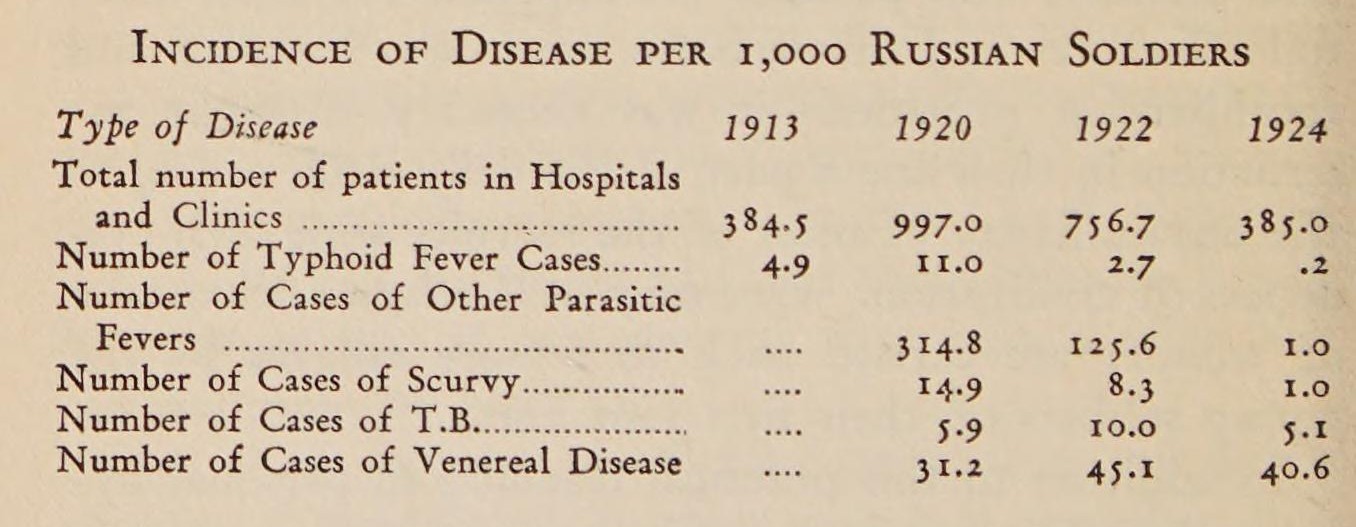
An improvement in the diet of the army since the war and famine days has greatly decreased the prevalence of scurvy. Dental clinics and advice regarding oral hygiene have been a recent innovation. The rate of illness among the soldiers at the present time is almost identical to that of pre-war days, but the men now are admitted to the hospitals and clinics sooner and for less serious complaints. The early stages of tuberculosis and venereal diseases receive treatment now. There are still many cases of malaria, but they have decreased yearly since 1922.
The following table, from the Report of the People’s Commissariat for the Protection of Health to the 12th All-Russian Congress, 1925, pages 103, 104, 105, 106, shows the incidence of disease per 1,000 soldiers for four different years,—the pre-war year 1913, the final civil war year of 1920, the famine year 1922, and the last year for which statistics are available, 1924:
The army doctors, coming in contact as they do with recruits from all parts of Russia, have the opportunity to carry out some very interesting research in comparative racial physical characteristics. The anthropometric studies which they are now making will be published later.
A special school, the Army Medical Academy in Leningrad, is devoted to the preparation of doctors for military service. A number of courses not included in the curriculum of the regular medical universities are given here in order to better equip the students for the special needs of the army and navy. A greater amount of laboratory and seminar work is required than in the courses preparing for civilian practice. All the clinical experience is gained in regiment hospitals and out-patient departments, so that by the time of graduation the young doctors are thoroughly versed in the traditions and ideals of military life.
The medical service for transportation workers has had much the same history as that of the army. It also is a legacy from pre-revolutionary days, as the railways and waterways have maintained their own hospitals for years. During the period of epidemics and famine the travel routes were inevitably foci for the spread of contagion, but conditions would doubtless have been worse than they were if the railroad and water transport departments had not set up a certain system of medical inspection and quarantine, inadequate as it was.
In 1924 this department (according to the above source, pp. 119 and 210) employed 3,214 doctors, 6,548 middle medical personnel and 10,861 servants. The railroads supported 207 hospitals with 10,667 beds, and the waterways 30 hospitals with 872 beds. These figures compare favorably with the totals for 1913 of 178 hospitals with 6,052 beds. It has been estimated that there are in Russia 700,000 transport workers, so that the proportion of one bed to every sixty workers exceeds the norm recommended by the law, of one bed for every one hundred workers in industry.
In addition to these permanent institutions there is a special need for emergency units which can be sent in case of epidemics to establish quarantine and disinfection service at railroad and steamboat terminals. About 400 of these units are maintained, some meeting the black plague as it tries to come up the Volga by boat from Astrakhan, some dealing with the cholera which appears each year in the southeast, many fighting a long war with malaria.
The railroads are able to carry health propaganda into remote places and are doing much in this matter. They have fifteen health exhibitions on wheels, which they reckon have been visited by over 60,000 people, the majority of whom were peasants. Wherever the railroad hospitals are located, the doctors, although not allowed to do active medical work among citizens other than the railroad workers and their families, give many lectures, inspect schools and workshops, conduct anti-malarial campaigns and make the railroad medical service as useful as possible to the general public.
PDF of original book: https://archive.org/download/healthworkinsovi0000anna/healthworkinsovi0000anna.pdf

